


Last updated: October 2026 Written by the LiftKitGuide Team, truck suspension installers and editors
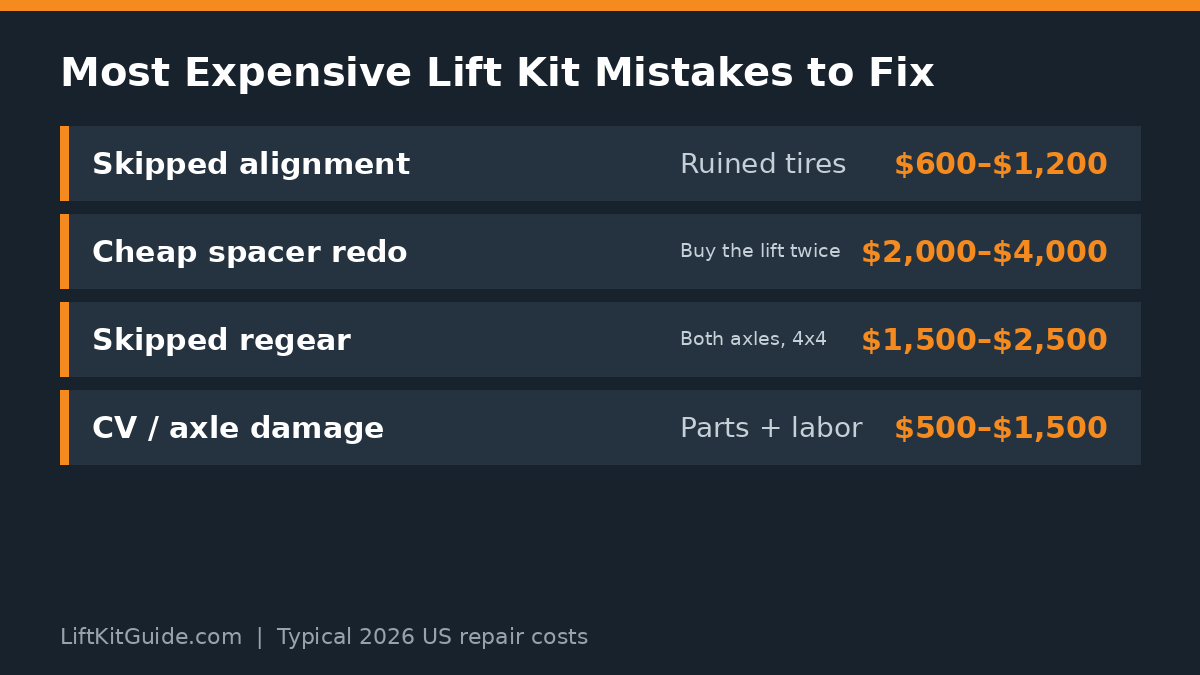
Lift kit mistakes cost truck owners thousands of dollars and months of frustration, and most are completely avoidable. The ones owners regret most are skipping the alignment ($600–$1,200 in ruined tires), buying a cheap spacer kit that rides terribly, skipping the regear on 35s ($1,500–$2,500 to fix later), ignoring CV and driveline angles, and forgetting about state lift laws. Every one of these lift kit mistakes traces back to budgeting the kit instead of the finished truck.
Key takeaways
- Skipping the $100–$150 alignment is the costliest of all lift kit mistakes — it can destroy $1,000+ tires in months.
- Cheap spacer lifts are the most regretted purchase; owners often pay for the lift twice when they replace them.
- Regearing for 35s costs $1,500–$2,500 on a 4×4 — skipping it leaves the truck sluggish and thirsty.
- Steep CV angles, wrong control arms, and short brake lines cause failures that a complete kit would have prevented.
- State lift laws and insurance disclosure are legal missteps that can void inspections and claims.
On this page
What are the most common lift kit mistakes?
Ask owners what they would do differently and the same lift kit mistakes come up again and again. Skipping the alignment after installation tops nearly every list — a lifted truck with wrong camber, caster, and toe will chew through an expensive set of tires in a few thousand miles while handling unpredictably. Next comes the cheap spacer kit: height without geometry correction rides harshly, stresses CV joints, and often gets ripped out and replaced within a year, meaning the owner paid for the lift twice.
The rest of the classic errors are quieter but just as costly. Skipping the regear when moving to 35-inch tires leaves the truck sluggish, hunting for gears, and thirstier than it needs to be. Ignoring CV angles, brake-line length, and worn steering parts turns the install into a cascade of failures. And the legal mistakes — an illegal lift height in your state, or mods your insurer never heard about — can surface at the worst possible moment: inspection day or claim day.
The meta-mistake behind most lift kit mistakes is buying before researching. Owners who spend two weeks reading build threads for their exact truck — same year, same cab, same engine — almost never regret the purchase, while owners who buy whatever kit the shop had in stock do. Forums like TacomaWorld, RamForum, and F-150 Forum hold thousands of reviews with mileage updates, and patterns emerge quickly: which kits still ride well at 50,000 miles, which shocks leak, which shops botch alignments. Two evenings of reading can save you from the classic lift kit mistakes that cost thousands to undo, making research the cheapest part of any lift project.
Why is skipping the alignment the costliest lift kit mistake?
Among all lift kit mistakes, skipping the alignment delivers the worst return on a small saving. Lifting changes ride height, which changes camber, caster, toe, and steering center — every angle the tires depend on. A truck driven even a few hundred miles with badly wrong toe can feather tires beyond saving. The alignment costs $100 to $150; the tire set it protects costs $1,000 to $2,400. There is no cheaper insurance in the entire project. Catch it early and the fix is a simple alignment; ignore it and you are buying tires.
The subtler damage is to handling and safety. Wrong caster makes the truck wander and feel vague at highway speed; wrong camber wears one tire edge; an off-center steering wheel masks the problem until the wear pattern appears. Get the alignment immediately after the install — not next month — from a shop that works on lifted trucks, and keep the printed spec sheet. If a shop says the alignment can wait, find a different shop. Many shops offer free alignment checks — take them up on it after any suspension work — it is the simplest way to catch small lift kit mistakes before they become tire bills.
| Alignment skipped for… | Likely damage | Approximate cost |
|---|---|---|
| A few hundred miles | Feathered tires, may be salvageable | $100–$150 alignment + rotation |
| A few thousand miles | Tires worn beyond saving | $600–$1,200+ new tires |
| Never aligned | Tires plus ball-joint and tie-rod wear | $1,500+ tires and parts |
How do cheap spacer lifts ruin a good truck?
Spacer lifts are the most regretted of all lift mistakes because they add height without fixing anything the height breaks. A strut spacer or tall top plate pushes the suspension down, steepening CV angles, reducing droop travel, and preloading the spring — which is why spacer-lifted trucks so often ride harshly and clunk over bumps. Forum threads are full of owners who stacked spacers chasing inches and ended up with alignment numbers no shop could correct. They promise an easy two inches and deliver a truck that rides like a wagon.
The economics are what sting. A $300 spacer kit plus install seems like a bargain until the truck needs upper control arms, longer shocks, and an alignment anyway — and then a proper suspension kit on top. Owners routinely spend $2,000 to $4,000 undoing a cheap lift and installing the complete system they should have bought first. If the budget only stretches to spacers, the smarter move is usually a smaller quality lift or a leveling kit, as our leveling kit guide explains.
Resale is the hidden tax on cheap lifts. A truck with a name-brand complete kit, documented alignment, and a folder of receipts sells quickly to enthusiasts; a truck with a mystery spacer stack and chewed tires sells at a discount to buyers who subtract the cost of redoing it. Dealers are even harsher — appraisers see spacers and worn suspension and price accordingly. Among common lift kit mistakes, buying cheap twice is the one that follows you to trade-in day. Spend once on the right kit and the truck holds its value; buy the cheap kit and you pay at purchase, at the redo, and at resale. That triple payment is why experienced owners warn newcomers off bargain kits.
What happens when you skip regearing for bigger tires?
Bigger tires act like taller gearing: each revolution covers more ground, so the engine works harder at every speed. On 35s with tall factory gears (3.21 or 3.42), trucks lug off the line, hunt between gears on grades, and downshift constantly on the highway. Owners describe it as the truck feeling tired — slower, busier, and thirstier. This is one of the mistakes that degrades every single drive, not just special occasions. Budget the gear swap with the tires and the truck stays enjoyable.
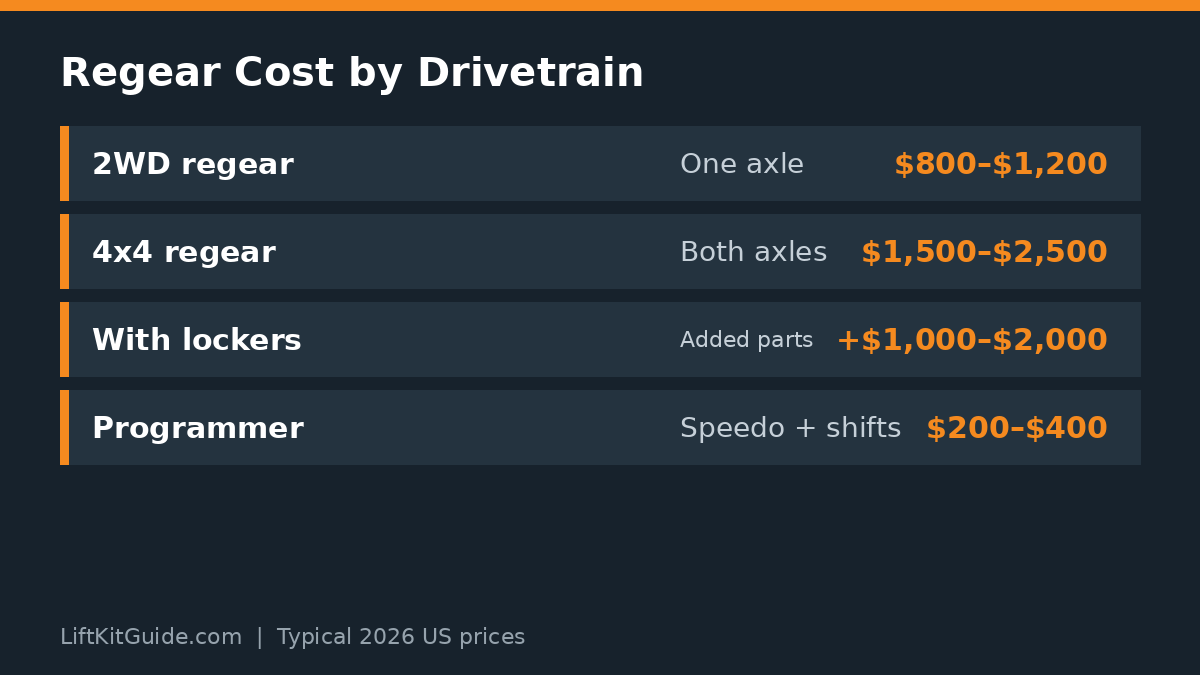
The fix is regearing the differentials — typically to 4.10s or 4.56s for 35s — which restores the engine to its happy rpm range. Expect $1,500 to $2,500 for both axles on a 4×4, including labor. Trucks that came with 3.73s or 4.10s from the factory often tolerate 35s acceptably, so check your glovebox codes before assuming the worst. At minimum, budget $200 to $400 for a programmer to correct the speedometer and shift points for the larger tires. Skipping that calibration is one of those small lift kit mistakes that quietly costs you every day.
| Tire size | Factory 3.21–3.42 gears | Recommended gears | Typical regear cost (4×4) |
|---|---|---|---|
| 33-inch | Usually acceptable | Stock gears fine | $0 — programmer only |
| 35-inch | Often sluggish | 4.10 or 4.56 | $1,500–$2,500 |
| 37-inch | Strongly recommended | 4.56 or 4.88 | $1,800–$3,000+ |
Why do CV angles and driveline issues catch owners off guard?
CV joints and driveshafts are designed to work through a specific range of angles, and lifting pushes them past it. On independent-front-suspension trucks, a tall spacer lift without a differential drop leaves the CV axles running at steep angles that wear boots and joints prematurely — owners report torn boots and clicking axles within tens of thousands of miles. Drop-bracket kits handle this better by lowering the differential, which is one reason complete 6-inch systems often have fewer angle problems than tall spacer setups, as covered in our suspension lift kit overview.
The driveline has its own traps. Lifting changes driveshaft angles and length requirements; on some trucks the rear shaft needs a spacer or a longer replacement, and carrier-bearing angles may need shims. Vibrations after a lift are the classic symptom — often dismissed as tire balance when the real cause is driveline geometry. A real-world example: one Tundra owner’s front-axle failure was traced to wrong control arms installed with the lift, a reminder to match every supporting part to the lift height and get it in writing, as documented in owner reports on TacomaWorld’s CV-angle discussions.
If you are buying a used truck that is lifted, the same lift kit mistakes become your inspection checklist. Drive it at highway speed and listen for driveline vibration, check the CV boots for tears and grease spray, study tire wear patterns for alignment neglect, and ask for the alignment spec sheet — a seller who has it maintained the truck, while one who shrugs did not. Crawl underneath and look for a differential drop on taller IFS lifts, brake lines long enough for the lift height, and shocks matched to the travel. A pre-purchase inspection at a 4×4 shop costs around $150 and routinely saves buyers from inheriting someone else’s errors. It is the best $150 in the deal.
How does ignoring state lift laws backfire?
Lift kit mistakes are not only mechanical — the legal ones bite just as hard. States regulate lifted trucks through suspension-height caps, bumper-height limits, and headlight rules, and they vary wildly. Connecticut caps suspension lifts at 4 inches and requires fenders; Delaware limits body height to 3 inches above the frame with a 30-inch bumper maximum; Florida enforces bumper-height limits by weight class. An illegal lift can mean tickets, a failed safety inspection, and a truck you cannot legally drive until it is fixed.
Georgia rewrote its law in 2024: Senate Bill 352, effective July 1, 2024, replaced the old two-inch rule with frame-height caps (27, 30, or 31 inches by weight class) plus a squat-truck rule, while largely exempting modern trucks with electronic stability control. The lesson is that lift law is a moving target — what was legal last year may not be this year. Check your current state statutes before buying, not after the install, and keep the truck’s headlights aimed and mud flaps fitted wherever required.
What hidden costs do first-time lift buyers forget?
The sticker shock usually comes from the costs nobody quoted. Beyond the kit and install, first-time buyers forget the alignment ($100–$150), the tire upgrade the lift was really for ($1,200–$2,400 for 35s), the programmer to fix the speedometer ($200–$400), and the possible regear ($1,500–$2,500). Then come the running costs: bigger tires wear faster and cost more to replace, fuel economy drops 1–2 mpg, and suspension parts wear quicker on any lifted truck.
Our lift kit installation cost guide and 6-inch lift cost breakdown price the full job so you can budget honestly. The pattern is consistent: owners who budget the finished truck love the result, while owners who budget the kit alone discover the real price in installments. Get quotes that include every line item — and if a quote seems too cheap, ask what was left out.
One cost almost nobody budgets is insurance. A disclosed lift with a custom-parts endorsement adds a modest amount to the premium — often around ten percent of the modifications’ value — but an undisclosed lift can void a claim entirely, turning a fender-bender into a five-figure loss. Among avoidable lift kit mistakes, skipping the five-minute call to your agent is cheapest to fix and costliest to ignore. Call before the install, describe the kit and tire size, ask about the endorsement, and get the confirmation in writing. It is the least exciting line item in the budget and the one most likely to save you. Five minutes on the phone beats five months fighting a denied claim.
| Forgotten cost | Typical price | When it hits |
|---|---|---|
| Alignment | $100–$150 | Immediately after install |
| 35-inch tires (set) | $1,200–$2,400 | With or right after the lift |
| Speedometer programmer | $200–$400 | At install time |
| Regear (4×4) | $1,500–$2,500 | When 35s feel sluggish |
| Replacement tires | $1,200–$2,400 | Every 40,000–50,000 miles |
How can you avoid lift kit mistakes before you buy?
Avoiding expensive errors starts before you spend a dollar. Define the tire size and the truck’s real job — daily commute, towing, trails — then choose the smallest lift that clears the tire. Compare complete kits from reputable brands using our best lift kit brands comparison, and be suspicious of any kit that costs half the competition: the missing parts become separate purchases. Read owner reviews for your exact truck, not generic praise.
Then protect the investment. Understand how modifications interact with your factory coverage in our lift kit warranty guide, disclose everything to your insurer, and have the work done — and aligned — by a shop that lifts trucks for a living. The owners with zero regrets are rarely the ones who spent the most. They are the ones who planned the most. A little homework now prevents the most common regrets later.
- Tires first, lift second: choose the tire size and use case, then buy the lift height that clears it.
- Complete kit over spacers: geometry correction, proper shocks, and real hardware beat stacked spacers every time.
- Budget the finish: kit, install, alignment, tires, programmer, and possible regear — all of it.
- Verify fitment: match the kit to your exact year, trim, engine, and drivetrain from the manufacturer’s chart.
- Check the law: confirm your state’s lift, bumper, and headlight rules before ordering.
- Tell your insurer: disclose the mods and ask about custom-parts coverage so the kit is protected.
Frequently asked questions
What is the most expensive lift kit mistake?
Skipping the alignment. A lifted truck with wrong camber, caster, and toe will destroy a $1,000+ set of tires in a few thousand miles and handle unpredictably. The alignment itself costs $100–$150 — the cheapest insurance in the entire lift project.
Are cheap lift kits a mistake?
Yes, very often. Cheap spacer lifts stack height without correcting geometry, which produces harsh ride, steep CV angles, alignment problems, and rapid tire wear. Many owners end up removing the spacer kit and buying a complete suspension system — paying for the lift twice.
Do I really need to regear for 35-inch tires?
Not always, but budget $1,500 to $2,500 for both axles on a 4×4 if your truck has tall factory gears (3.21, 3.42) and feels sluggish on 35s. Skipping the regear leaves the truck under-geared: poor acceleration, transmission hunting, and worse real-world economy. At minimum, recalibrate the speedometer.
Can a lift kit get me in legal trouble?
Yes. States like Connecticut cap suspension lifts at 4 inches, Delaware limits body height above the frame to 3 inches, and Florida enforces bumper-height limits by weight class. An illegal lift can mean tickets, failed inspections, and insurance claim problems. Check your state's rules before buying.
Do lift kit mistakes affect insurance claims?
It can complicate them. An insurer can deny a claim or cancel a policy if major modifications were not disclosed, and the other side's lawyers may argue the lift contributed to a crash. Disclose the lift to your insurer and consider a custom-parts endorsement so the kit itself is covered.
What fitment lift kit mistakes should I avoid?
The most common are buying a kit that does not match the truck's exact year, trim, and drivetrain; forgetting longer brake lines and shocks; ignoring worn ball joints and tie rods that the lift exposes; and stacking spacers to chase extra height. Verify fitment against the manufacturer's application chart before ordering.
The bottom line
Lift kit mistakes are almost always budget mistakes in disguise: the skipped alignment, the cheap spacer kit, the regear that got deferred. Each one converts a $200–$500 saving today into a $1,000–$2,500 repair tomorrow. The owners who love their lifted trucks are not the ones who spent the most — they are the ones who bought a complete kit, paid for the alignment, and budgeted the finished truck.
Before you order anything, price the whole job: kit, install, alignment, tires, and gearing if you are going to 35s or larger. Check your state’s lift laws, disclose the mods to your insurer, and get the install done by a shop that lifts trucks for a living. Do that, and your lift becomes an upgrade instead of a regret.





Leave a comment