


Last updated: October 2026 Written by the LiftKitGuide Team, truck suspension installers and editors
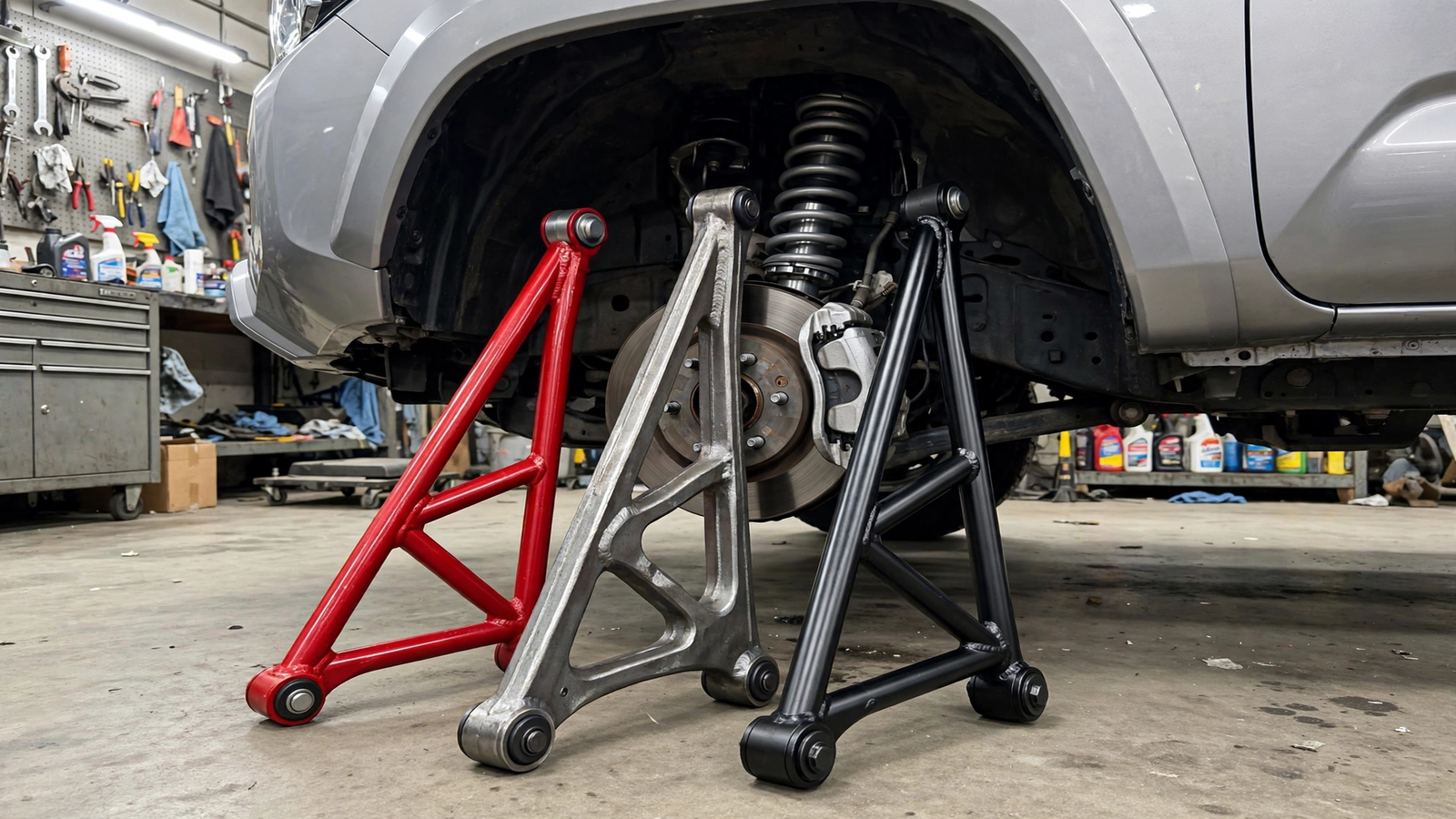
In the JBA vs SPC vs Camburg upper control arms debate, JBA wins on value at $550 to $650 with 90-degree articulation, SPC wins on adjustability at $695 to $800 with its patented xAxis joint, and Camburg wins on strength at around $1,100 in 4130 chromoly. For most 2 to 3-inch lifted Tacomas, JBA is the smart money; SPC suits tricky alignments and Camburg suits hard off-road use. All three restore proper alignment geometry at 2 to 3 inches of lift.
Key takeaways
- JBA STD High Caster arms cost $550-$650 with a greasable Max 90 ball joint offering 90 degrees of articulation.
- SPC 25470 arms cost $695-$800 with a sealed adjustable xAxis joint and the most alignment correction of the three.
- Camburg X-Joint arms cost ~$1,100 in 4130 chromoly for maximum strength in hard off-road use.
- All three correct geometry at 2-3 inches of lift; buy on adjustability needs and maintenance preference.
- Torque all UCA pivot bolts at ride height, not full droop, and align immediately after install.

On this page
How do JBA vs SPC vs Camburg upper control arms compare on price?
The JBA vs SPC vs Camburg upper control arms price ladder is steep and clear. JBA’s STD High Caster arms typically sell for $550 to $650, making them the value leader. SPC Performance 25470 arms run $695 to $800, reflecting their forged construction and adjustable design. Camburg’s X-Joint arms sit at the top around $1,100, built from 4130 chromoly for buyers who want race-grade hardware.
That $450 spread from JBA to Camburg buys real differences in materials and engineering, not just branding. JBA uses 1026 DOM steel tubing with its own Max 90 ball joint, a combination that delivers excellent strength per dollar. SPC steps up to forged steel with its patented adjustable xAxis ball joint. Camburg goes full chromoly with a massive X-Joint designed for hard off-road abuse.
For most daily-driven Tacomas with a 2 to 3-inch lift, the JBA vs SPC vs Camburg upper control arms decision rarely needs the most expensive option. All three correct alignment geometry and restore ball joint angles; the pricier arms add adjustability, articulation, and exotic materials that matter most to hardcore wheelers. Buy the capability you will actually use. Our lift kit installation cost guide can help you budget the full job.
One more pricing wrinkle: street prices move. JBA runs periodic sales that can drop the STD arms near $500, while SPC pricing is steadier. Camburg occasionally bundles arms with its coilover kits at a discount. If you are not in a hurry, watching prices for a month can save meaningful money, especially on the premium options.
Which of JBA vs SPC vs Camburg upper control arms is most adjustable?
SPC wins the adjustability contest by a wide margin, and it is not close. The JBA vs SPC vs Camburg upper control arms adjustability story centers on SPC’s patented xAxis sealed ball joint, which slides within its housing to provide generous camber and caster adjustment beyond what fixed arms offer. Alignment shops love SPC arms because they can dial in specs that fixed-geometry arms simply cannot reach.
JBA takes the opposite approach with built-in high caster geometry. The arms are engineered with approximately 3 degrees of additional caster baked into the design for a 2 to 4-inch lift, so most trucks align beautifully with zero fiddling. It is less flexible than SPC but simpler: bolt them on, align, and drive. Owners who want a set-and-forget solution appreciate this.
Camburg’s X-Joint arms offer fixed race-bred geometry with excellent strength but the least alignment fine-tuning of the three. They assume your lift is within their design window and deliver maximum durability there. If your alignment needs are unusual, perhaps from a taller lift or mixed components, SPC’s adjustability is the safer choice.
The JBA vs SPC vs Camburg upper control arms adjustability gap also shows up in tire wear patterns. Trucks with marginal caster chew the inside edges of expensive all-terrains, and the SPC’s extra adjustment can be the difference between even wear and a $1,200 tire replacement at 20,000 miles. Viewed that way, the SPC premium can pay for itself in rubber alone.
What ball joint does each arm use?
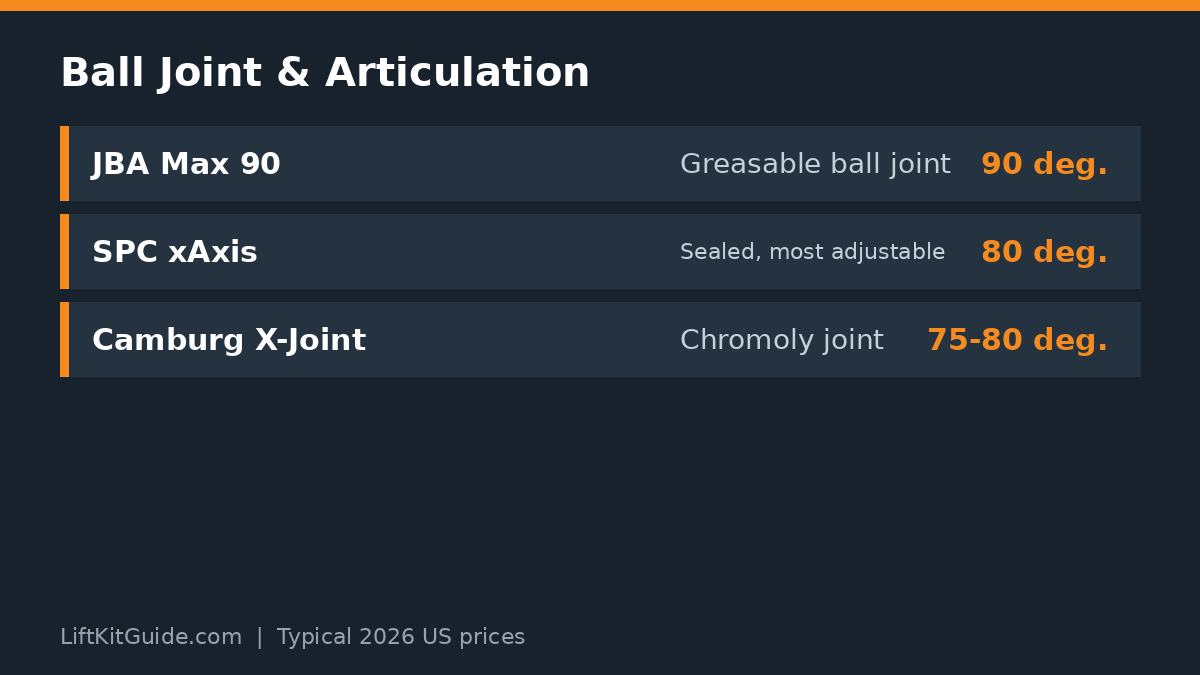
Ball joint design is where these three arms diverge most dramatically. JBA uses its proprietary Max 90 ball joint, a greasable unit based on a heavy-duty GM truck joint that is available at parts stores across the country. That parts availability is a genuine advantage: if you ever need a replacement on a road trip, any auto parts store can get you rolling again. For background on why arms matter, see suspension lift kits explained.
SPC uses its patented xAxis sealed ball joint, a maintenance-free unit that never needs greasing and adjusts within the arm for alignment. The sealed design keeps dirt and water out, which extends service life in harsh environments. Some owners prefer serviceable joints they can grease, while others love the fit-and-forget sealed approach.
Camburg’s X-Joint is a massive 4130 chromoly joint engineered for racing loads, with 75 to 80 degrees of articulation depending on version. It is overbuilt in the best way for trucks that see air time and hard hits. The trade-off is cost and the fact that replacement joints come from Camburg rather than any corner parts store.
Keep your factory arms after the swap. If you ever sell the truck, returning it to stock is straightforward, and having the original parts widens your buyer pool considerably.
| Arm | Ball joint | Articulation |
|---|---|---|
| JBA STD High Caster | Max 90 greasable | 90 degrees |
| SPC 25470 | xAxis sealed adjustable | 80 degrees |
| Camburg X-Joint | 4130 chromoly X-Joint | 75-80 degrees |
Which arm offers the most articulation?
JBA claims the articulation crown with its Max 90 joint delivering a full 90 degrees of angular travel, more than any ball joint or uniball in this comparison. In practical terms, that means the JBA arm binds last at full droop, which protects the joint and preserves ride quality over large whoops and articulation obstacles.
SPC’s xAxis joint manages 80 degrees, which is plenty for any 2 to 3-inch lifted Tacoma that is not jumping dunes. Camburg’s X-Joint delivers 75 to 80 degrees depending on the version, backed by chromoly strength that shrugs off impacts that would destroy lesser joints. For articulation alone, the ranking is JBA, then SPC, then Camburg, though all three exceed what a daily-driven truck will ever use.
Here is the honest context: on a street-driven Tacoma, you will never approach the articulation limits of any of these arms. The numbers matter for hardcore off-roaders running full droop regularly. If your truck’s hardest workout is a forest service road, buy on price, adjustability, and maintenance preference instead.
For rock crawlers who cycle suspension to full droop constantly, articulation numbers translate directly into traction and component life. The JBA’s 90-degree joint stays happy where lesser joints bind and wear. Weekend trail riders will never notice, but if your truck lives on difficult trails, the articulation ranking deserves real weight in your decision.
Do uniballs squeak in daily driving?
This question usually targets Camburg, famous for its uniball upper arms, though the X-Joint ball-joint versions are quiet. Traditional uniballs can develop squeaks after tens of thousands of miles as the PTFE liner wears and collects dust, particularly in dry, dusty climates. Regular cleaning and dry lubricant keep them quiet, but they demand more attention than sealed ball joints.
JBA’s greasable Max 90 and SPC’s sealed xAxis are both essentially silent in daily driving. The JBA needs a grease gun every oil change or so, a thirty-second job. The SPC needs nothing at all. For a daily driver that you never want to think about, sealed or greasable ball joints beat uniballs on noise and maintenance.
The JBA vs SPC vs Camburg upper control arms noise question has a simple answer for commuters: stick with ball-joint arms. Choose uniball-style arms only if your off-road use justifies the maintenance, because the performance gain on pavement is zero while the upkeep is real.
Salt-belt owners should know that uniball squeak is only half the winter story. Any exposed joint benefits from periodic cleaning, and the sealed SPC design has a genuine advantage in corrosive environments. JBA’s greasable joint lets you purge contaminants with fresh grease, which is the next best thing. Both approaches beat an unsealed, unserviceable joint.
Which arm is easiest to install yourself?
All three arms install the same way: unbolt the factory upper arm, transfer or replace the ball joint connection, bolt in the new arm, and align. A competent DIYer with basic tools can swap a pair of UCAs in two to three hours. None of the three brands requires special tools beyond what a leveling kit install already demands.
JBA gets a slight nod for DIY friendliness because its fixed high-caster geometry means less alignment guesswork afterward. The truck practically aligns itself within spec. SPC’s adjustability is wonderful in a good alignment shop but can confuse a mediocre one, so choose your shop carefully if you go the SPC route.
One tip that applies to the JBA vs SPC vs Camburg upper control arms install equally: torque all pivot bolts with the truck sitting at ride height, not hanging on the lift. Torquing at full droop preloads the bushings and causes creaks, premature wear, and mysterious noises. This single step prevents most post-install complaints.
The JBA vs SPC vs Camburg upper control arms install difficulty is genuinely equal, so do not let brand choice be driven by fear of the wrench work. The only specialty tool you might need is a ball joint separator, and even that can be rented free from most parts stores. Budget a Saturday morning and take your time with torque specs.
What does each brand's warranty cover?
JBA backs its arms with a strong warranty and is legendary for customer service, with owners routinely praising the company’s responsiveness. The Max 90 ball joints are warrantied, and replacement joints are inexpensive and widely available. For a value-priced arm, the ownership experience punches well above its weight.
SPC offers a solid warranty on its forged arms and xAxis joints, and the sealed design means fewer warranty claims in the first place. Camburg warranties its chromoly arms for the kind of abuse they are designed for, which is reassuring given the premium price. All three companies stand behind their products. Pair them with a quality setup from our best lift kit brands ranking.
The JBA vs SPC vs Camburg upper control arms warranty comparison has less daylight than the price comparison. Buy with confidence from any of the three; the differences that matter are adjustability, maintenance, and materials, not warranty fine print.
When comparing warranties in the JBA vs SPC vs Camburg upper control arms market, read what is actually covered. Ball joints and bushings are wear items everywhere, and no warranty covers normal wear. What matters is how the company treats gray-area claims, and all three brands have strong reputations for taking care of owners who installed the arms correctly.
| Factor | JBA | SPC | Camburg |
|---|---|---|---|
| Typical price | $550-$650 | $695-$800 | ~$1,100 |
| Material | 1026 DOM steel | Forged steel | 4130 chromoly |
| Adjustability | Fixed high caster | Highest (xAxis) | Fixed race geometry |
| Maintenance | Grease periodically | Sealed, none | Minimal |
| Best for | Value + travel | Alignment flexibility | Hard off-road use |
Which UCA wins for a 2-3 inch lifted Tacoma?
For most Tacoma owners, JBA wins the JBA vs SPC vs Camburg upper control arms value equation. At $550 to $650 with 90 degrees of articulation, a greasable serviceable joint, and excellent customer service, it corrects geometry and delivers more travel than anyone needs for hundreds less than the competition. The fixed high-caster design aligns easily and never needs adjustment.
SPC wins for owners with unusual alignment needs or mixed lift components. If your shop struggles to hit caster targets, the xAxis adjustability solves problems the other arms cannot. The sealed maintenance-free joint is a bonus for owners who never want to touch a grease gun. The $695 to $800 price is fair for what is arguably the most sophisticated arm here.
Camburg wins for hardcore off-roaders who will use the chromoly strength. For a daily driver, it is more arm than necessary, but for a truck that sees real abuse, the X-Joint’s durability justifies the $1,100. See our upper control arm guide, suspension lift kits guide, and Tacoma lift kits for more context. In the JBA vs SPC vs Camburg upper control arms finals, match the arm to your mission.
Finally, remember that UCAs are one piece of a system. Great arms cannot fix worn ball joints elsewhere, tired shocks, or a bad alignment. Install your chosen arms as part of a complete, well-maintained front end, and any of these three will deliver years of quiet, precise service.
- Choose JBA if: you want maximum value, 90-degree articulation, serviceable joints, and outstanding customer support.
- Choose SPC if: you need maximum alignment adjustability, want zero maintenance, or run mixed lift components.
- Choose Camburg if: your truck sees hard off-road use and you want chromoly race-grade durability.
Frequently asked questions
Do I need aftermarket UCAs with a 2-inch lift?
Usually not. Most Tacomas align fine at 2 inches on factory upper control arms. Aftermarket UCAs become valuable around 2.5 to 3 inches, where factory arms run out of caster adjustment and ball joint angle. If your alignment shop cannot hit spec, that is your signal.
Are SPC UCAs worth the extra money over JBA?
They are worth it if you need the adjustability. SPC's xAxis joint provides alignment correction that fixed arms cannot match, which matters with unusual lift setups. If a standard 2 to 3-inch lift aligns fine, the JBA delivers equal geometry correction for less money.
Do Camburg uniballs squeak?
Traditional uniballs can develop squeaks after extended use in dusty conditions as the liner wears. Camburg's X-Joint ball-joint arms are quiet like any ball joint arm. Regular cleaning and dry lubricant keep uniballs quiet, but ball-joint arms are the lower-maintenance choice for daily drivers.
How much caster can SPC UCAs add?
SPC's adjustable xAxis ball joint allows significantly more caster correction than fixed arms, typically enabling an additional 2 or more degrees of positive caster depending on the truck and lift height. This is why alignment shops prefer SPC for difficult alignments.
Can I install upper control arms myself?
Yes. UCA replacement requires basic hand tools and takes two to three hours for a competent DIYer. Support the lower control arm, unbolt the factory upper arm, install the new arm, and torque pivot bolts at ride height. A professional alignment is mandatory afterward.
How long do aftermarket UCAs last?
Quality aftermarket UCAs typically last 80,000 to 120,000 miles. Greasable joints like JBA's need periodic greasing, sealed joints like SPC's need nothing, and bushings are wear items on all brands. Salt and heavy off-road use shorten service intervals.
The bottom line
The JBA vs SPC vs Camburg upper control arms decision rewards honest self-assessment. Most Tacoma owners will never use the adjustability of the SPC or the strength of the Camburg, which makes the JBA’s $550 to $650 price and 90-degree articulation the rational choice. It is the rare product that is both the cheapest and extremely capable.
That said, the SPC’s adjustability has rescued countless difficult alignments, and the Camburg’s chromoly construction has survived abuse that destroyed lesser arms. There is no bad choice here, only a best choice for your truck. Pair your pick with a quality alignment and proper torque procedure.




Leave a comment