


Last updated: October 2026 Written by the LiftKitGuide Team, truck suspension installers and editors
Yes, you can move TPMS sensors to new wheels in most cases. If your OEM sensors are healthy and the aftermarket wheels accept the same valve stem and mounting style, a tire shop can transfer them during mounting for $0 to $50 per wheel in labor. When sensors are old or incompatible, new programmable aftermarket sensors cost $40 to $70 per wheel plus a $40 to $50 relearn. Most trucks need a relearn procedure afterward, which shops usually bundle with the mounting service.
Key takeaways
- Yes, OEM TPMS sensors can usually transfer to aftermarket wheels if the valve stem and mounting style are compatible.
- Transfer labor runs $0–$50 per wheel when done during a tire mounting service.
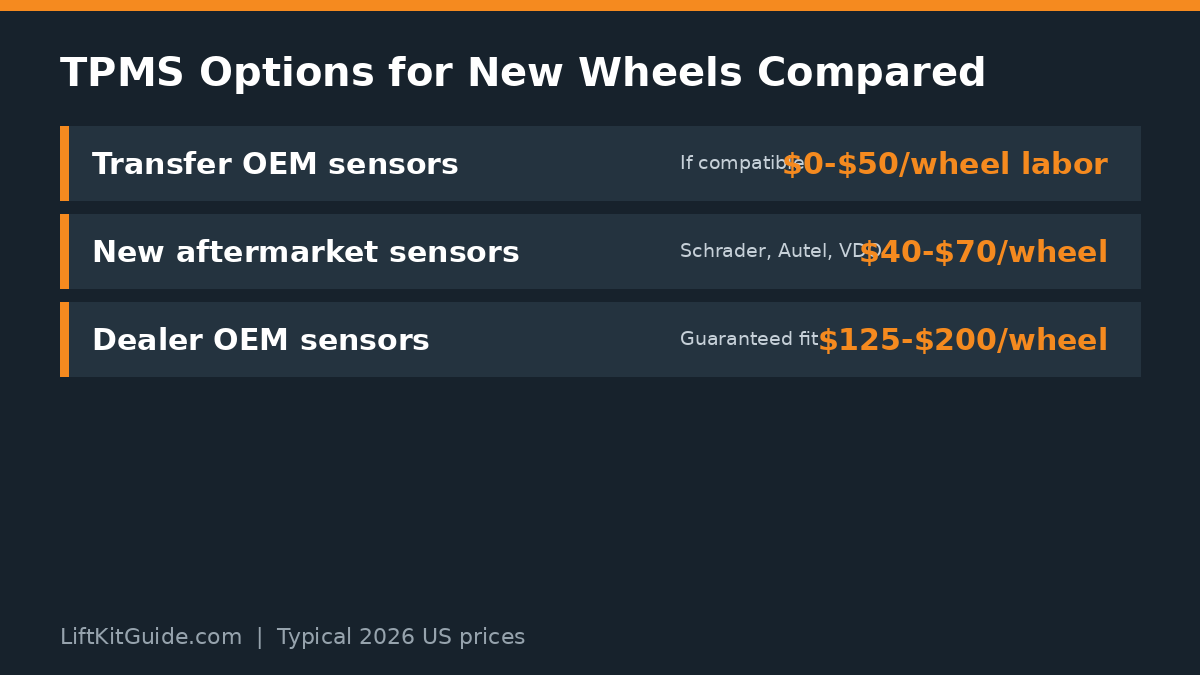
- New programmable aftermarket sensors (Schrader, Autel, VDO) cost $40–$70 per wheel; dealer OEM sensors run $125–$200.
- Match the radio frequency: most US trucks use 315 MHz, but some newer models use 433 MHz.
- Relearn procedures vary: many GM trucks auto-relearn by driving, Fords need a tool, Toyota/Ram vary by year.
On this page
Can you move TPMS sensors to new wheels?
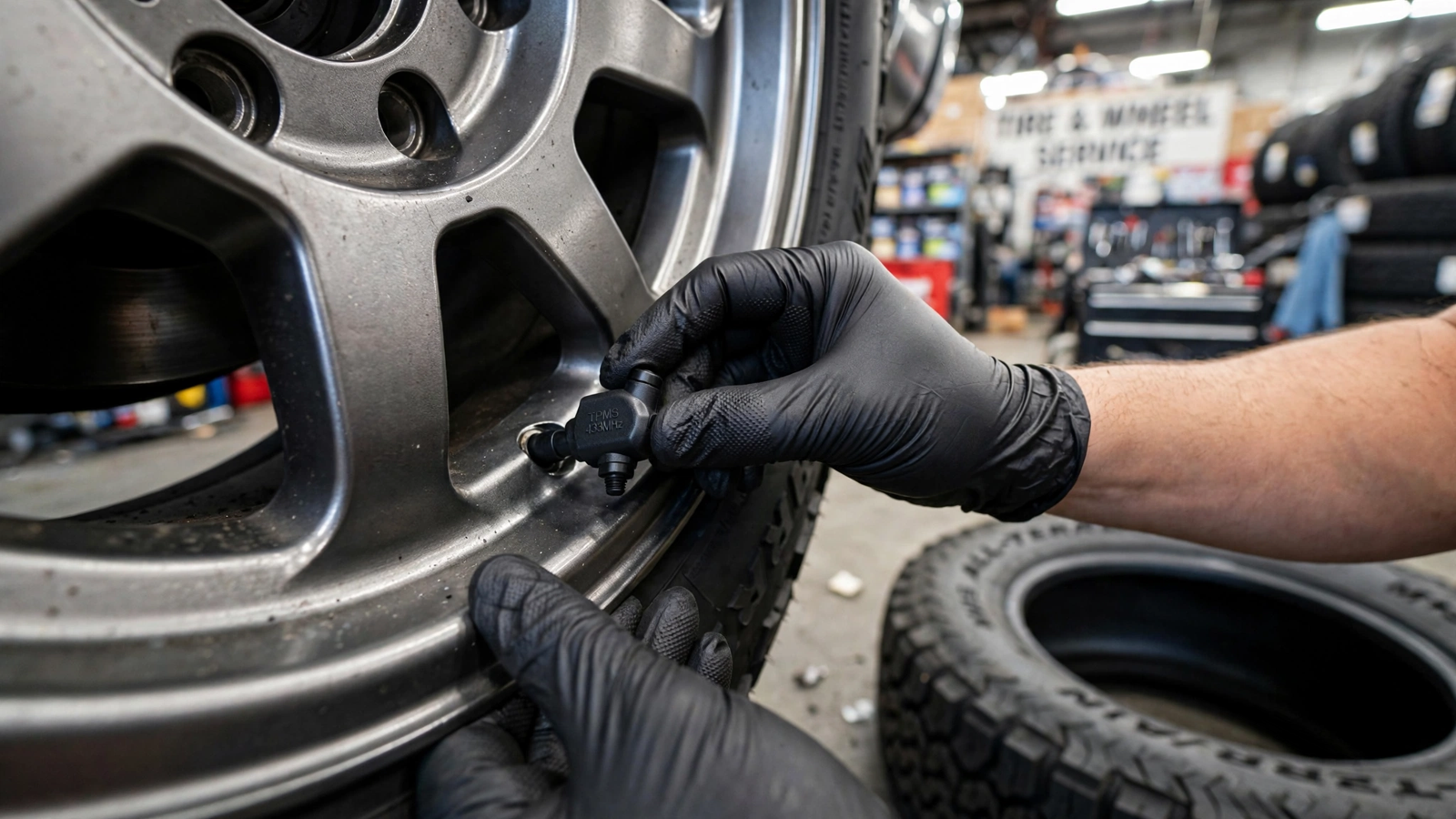
Yes, in most cases you can move TPMS sensors to new wheels without buying anything new. The sensors live inside the wheel, attached to the valve stem, and a tire shop can remove them from your old wheels and install them in the new ones during a normal mount-and-balance service. As long as the new wheels accept the same valve stem style and the sensor body clears the wheel’s barrel, the transfer is straightforward and adds little or no cost when the tires are already coming off.
The two things that can stop you when you try to move TPMS sensors to new wheels are compatibility and sensor health, so the question can you move TPMS sensors to new wheels always starts with those two checks. Some aftermarket wheels, especially deep-dish designs or wheels with unusual valve angles, will not accept certain sensor bodies. And sensors with dying batteries, cracked housings, or corrosion should be replaced rather than moved, since you will pay the labor twice when they fail months later. Check both before you commit, and the swap itself is painless.
Timing matters more than most owners expect. The cheapest moment to answer can you move TPMS sensors to new wheels with a yes is during a planned tire replacement, when the old tires are coming off anyway and the sensor swap adds almost no labor. Doing it as a standalone job means paying for a full mount and balance on top of the sensor work, which can double the cost. If your new wheels arrive before your new tires wear out, consider waiting for the tire swap to combine the labor, unless a dead sensor forces your hand sooner.
Will OEM TPMS sensors fit aftermarket wheels?
OEM sensors fit the vast majority of aftermarket wheels because most wheels are designed around standard valve stem holes and sensor clearances. The potential problems are specific: wheels with a very thick mounting pad can leave too little thread for the valve stem nut, and some multi-piece or deep-lip wheels position the sensor where it contacts the barrel. Reputable wheel makers publish TPMS compatibility notes, so check the product page or call before ordering.
If you are buying a wheel and tire package from a major retailer, they handle the question of can you move TPMS sensors to new wheels automatically and will either transfer your sensors or sell you new ones programmed for your truck. Problems mostly arise with boutique or custom wheels bought secondhand, where nobody verified fitment. A five-minute call to the wheel manufacturer with your truck’s year and sensor type eliminates the guesswork. When in doubt, choose wheels from brands that explicitly list TPMS compatibility, and read our best lift kit brands guide for companies that support truck builds properly.
Valve stem type is the detail that decides compatibility. Most OEM sensors use a clamp-in aluminum valve stem, while some aftermarket wheels are drilled for rubber snap-in stems only. When you ask can you move TPMS sensors to new wheels, the shop is really asking whether your sensor’s stem matches the wheel’s hole. Adapter stems exist for some combinations, but they add cost and complexity. The cleanest path is wheels drilled for standard clamp-in TPMS stems, which covers the vast majority of truck wheels on the market today.
What is the difference between 315 MHz and 433 MHz TPMS?
TPMS sensors talk to your truck by radio, and they must speak the right frequency. Most US-market trucks use 315 MHz sensors, while many newer models and most European vehicles use 433 MHz. A 433 MHz sensor will never be recognized by a truck expecting 315 MHz, no matter how perfectly it is installed, so matching the frequency is non-negotiable when buying new sensors.
Your truck’s original frequency is fixed, so whether can you move TPMS sensors to new wheels or must buy new, the job is simply to match it. The owner’s manual sometimes lists it, but the reliable method is to read the part number off an existing sensor or ask the dealer parts counter by VIN. Universal programmable sensors from Schrader, Autel, and VDO can be set to either frequency, which is why shops love them: one part number covers nearly every truck on the road. If you are transferring your OEM sensors, frequency is irrelevant because they already match; it only matters when buying new.
A common trap is buying sensors before confirming the frequency. Online marketplaces are full of 433 MHz sensors listed as universal, and buyers discover the mismatch only after paying for installation. If you are still deciding can you move TPMS sensors to new wheels versus buying new ones, read the frequency off your existing sensor first: it is printed on the sensor body and readable with a cheap TPMS scan tool. Write it down, photograph it, and match it exactly when ordering. This single check prevents the most common and most annoying TPMS mistake.
Do you need new TPMS sensors or can you reuse the old ones?
Reuse the old ones if they are healthy and less than about five years old. The transfer costs little during a tire swap, the sensors are already programmed to your truck, and many trucks will not even need a relearn. This is the cheapest and simplest path, and it is what most tire shops recommend when the sensors test good on their scan tool.
Buy new sensors when the old ones are aging, when you are keeping the old wheels as a second set, or when compatibility is uncertain, and the original question of can you move TPMS sensors to new wheels answers itself. New programmable sensors at $40 to $70 per wheel are cheap insurance against doing the labor twice, and a second set of sensors means each wheel set is permanently ready to bolt on. Dealer OEM sensors at $125 to $200 each buy guaranteed fitment but rarely outperform quality aftermarket units. For trucks that see seasonal wheel swaps, cloned sensors with copied IDs are the premium solution. Factor sensor costs into your cost to lift a truck budget if wheels are part of the build.
Ask the shop to scan every sensor before removal and show you the battery status on the tool’s display. A sensor reporting low battery should be replaced on the spot rather than transferred, because the labor to revisit the job exceeds the sensor’s cost. This five-minute diagnostic is the professional answer to can you move TPMS sensors to new wheels without regrets: move the healthy ones, replace the tired ones, and document which corners got new hardware. Keep the receipt with your service records for warranty purposes.
| Option | Best for | Typical cost per wheel |
|---|---|---|
| Transfer OEM sensors | Healthy sensors under 5 years old | $0–$50 labor |
| New programmable sensors | Aging sensors or second wheel set | $40–$70 plus relearn |
| Dealer OEM sensors | Guaranteed fitment, warranty work | $125–$200 plus labor |
| Cloned ID sensors | Seasonal swaps, no relearn wanted | $50–$90 plus programming |
How do you relearn TPMS sensors after a wheel swap?
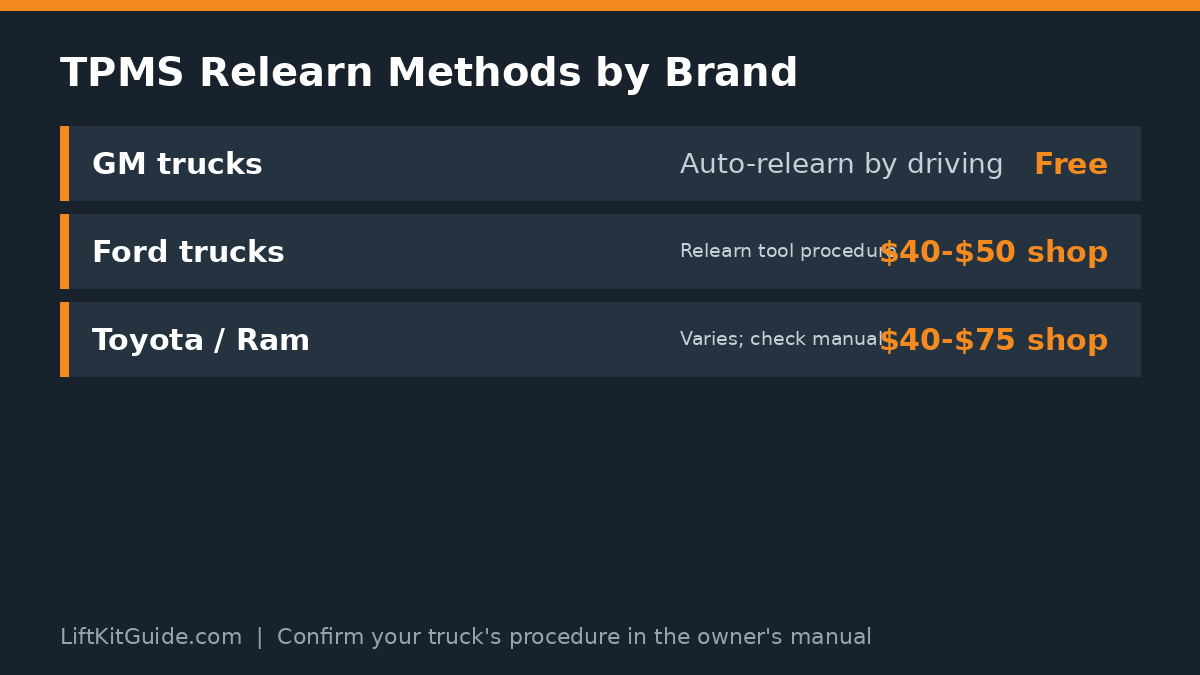
The relearn procedure teaches your truck the IDs of the sensors now on it, and the method depends entirely on the brand. Many GM trucks are the easiest: just drive for 10 to 20 minutes and the system picks up the sensors automatically. Ford trucks typically need a manual procedure involving ignition cycles and a cheap relearn tool held against each tire in sequence. Toyota and Ram vary by model year, with some auto-learning and others needing dealer or shop tools.
If you transferred your original sensors to the new wheels, some trucks skip the relearn entirely because the IDs never changed, which is the nicest payoff when can you move TPMS sensors to new wheels gets a yes. If you installed new sensors, a relearn is mandatory and skipping it leaves the warning light on permanently. Tire shops usually include a basic relearn in the mounting service, but confirm before you pay. A failed relearn is almost always a wrong-frequency or dead-battery sensor, not a procedure problem, so diagnose the hardware first.
- GM trucks: drive 10–20 minutes above 20 mph; most auto-relearn with no tools.
- Ford trucks: ignition-cycle procedure plus a $15–$30 relearn tool at each wheel.
- Toyota: reset button under the dash on many models; some need dealer Techstream.
- Ram: usually auto-relearns after driving; 2019+ models may need a shop tool.
- After any relearn: confirm the dash light is out and each corner shows a plausible pressure.
Can you move TPMS sensors to new wheels yourself or should you buy new ones?
Moving your existing sensors is almost always cheaper when the tires are already being mounted. The incremental labor is $0 to $50 per wheel, and there is no parts cost at all. Buying new programmable sensors adds $160 to $280 for a set of four plus a $40 to $50 relearn, bringing the real total to roughly $200 to $330. Dealer sensors push that past $600 with labor, which is hard to justify outside warranty situations.
The math flips when sensors are old. Transferring five-year-old sensors saves $200 today but risks a $50-per-wheel redo when batteries die next year, plus the annoyance of a second shop visit. It also flips when you keep both wheel sets: buying new sensors for the new wheels means each set is grab-and-go with no seasonal sensor surgery. Do the two-year math, not the today math, and the right answer is usually obvious. Include sensors in your lift kit installation cost estimate so the final invoice holds no surprises.
Winter wheel packages deserve a special mention. If you run dedicated winter wheels, cloning your summer sensor IDs onto the winter set means the truck never knows the difference and you skip the relearn dance twice a year. Shops charge a small programming fee for the cloning service, usually $10 to $20 per sensor on top of the hardware. For owners who asked can you move TPMS sensors to new wheels every season and got tired of the answer being a shop visit, cloned winter sensors are the set-and-forget upgrade. Pair them with a leveling kit if your winter setup changes ride height.
| Scenario | Cheapest option | Why |
|---|---|---|
| Tires being mounted anyway | Transfer OEM sensors | No parts cost, minimal added labor |
| Sensors over 5 years old | Buy new programmable | Avoid paying labor twice |
| Keeping old wheels too | New sensors for new wheels | Each set stays ready to bolt on |
| Dealer warranty work | Dealer OEM sensors | Guaranteed fitment and coverage |
What are cloneable and programmable TPMS sensors?
Programmable sensors are blank units a shop configures for your specific truck using a programming tool. Brands like Schrader EZ-sensor, Autel MX-Sensor, and VDO Redi-Sensor cover thousands of applications with a handful of part numbers, which is why tire shops stock them instead of hundreds of OEM variants. Once programmed, they behave exactly like the factory sensors, reporting pressure and temperature on the correct frequency.
Cloneable sensors go one step further for drivers who move TPMS sensors to new wheels every season: they copy the ID numbers of your existing sensors, neatly sidestepping the relearn question that can you move TPMS sensors to new wheels usually raises. Because the truck identifies sensors by ID, cloned sensors are invisible to the system and no relearn is ever needed, even when swapping between summer and winter wheel sets. This is the ideal setup for owners who change wheels seasonally. The cloning step requires a tool that can read your old sensor IDs, so it is a shop job, but the $50 to $90 per wheel cost pays for itself the first time you skip a relearn appointment.
What happens if you skip TPMS sensors on new wheels?
Skip the sensors and the truck will tell you immediately, which is why can you move TPMS sensors to new wheels is worth answering properly before you buy. Suspension lift kits get all the attention, but sensors are the detail that keeps the dash clean. Federal motor vehicle safety standards require the TPMS warning light to illuminate when the system cannot find its sensors, so you will get a constant dashboard warning from the first drive. The truck remains fully drivable, and nothing mechanical is harmed, but you lose all pressure monitoring, which rather defeats the purpose on a truck running expensive aftermarket tires.
Beyond the annoyance, there are practical consequences. Some states include TPMS function in safety inspections, and a perpetually lit warning can fail you. You also lose the early warning that catches slow leaks before they become blowouts, which matters more on heavy trucks towing trailers. Given that a basic set of programmable sensors costs less than a single tire, skipping them is false economy. Install sensors, complete the relearn, and enjoy the benefits of a properly set up lifted truck without a glowing warning light.
One more practical note: keep your old sensors when you upgrade. Even if you buy new sensors for the new wheels, the old ones have value as spares or for a future second set. Store them in a dry place away from extreme heat, and note their IDs if you have them. The next time someone asks you can you move TPMS sensors to new wheels, you will be able to answer from experience and even supply the hardware. Good sensors are too expensive to throw away, and a labeled spare set has saved many owners from a last-minute scramble before a road trip.
Frequently asked questions
Will the TPMS light stay on if you skip sensors?
Yes. Federal law requires the TPMS warning light to illuminate when sensors are missing or malfunctioning, and the light will stay on constantly. The truck remains drivable, but you lose pressure warnings and may fail inspection in states that check it.
How long do TPMS sensor batteries last?
Most sensor batteries last 5 to 10 years. If your truck is approaching that age, replace rather than transfer: paying labor to move a dying sensor, then paying again months later when it fails, costs more than new sensors now.
Can you clone TPMS sensor IDs to avoid relearning?
Yes. Clonable sensors can be programmed with your existing sensor IDs, so the truck cannot tell the wheels were swapped and no relearn is needed. This is the cleanest solution for seasonal wheel swaps.
Do TPMS sensors automatically relearn after a wheel swap?
It depends on the truck. Many GM trucks auto-relearn after 10 to 20 minutes of driving. Fords typically need a relearn tool procedure. Toyotas and Rams vary by model year, so check your owner's manual for the exact process.
Are aftermarket TPMS sensors as reliable as OEM?
Mostly yes for major brands like Schrader, Autel, and VDO, which make programmable sensors covering the vast majority of trucks. Quality matches OEM in most cases. Avoid no-name sensors with no published compatibility list.
Can aftermarket wheels reject TPMS sensors?
Sometimes. Deep-dish wheels, very thick centers, or unusual valve stem angles can prevent the sensor from seating correctly. Verify with the wheel maker before buying, especially for custom or boutique wheel brands.
The bottom line
Moving your TPMS sensors to new wheels is absolutely doable and usually the cheapest path, as long as the sensors are healthy and the new wheels accept them. A quick compatibility check before you buy wheels saves the most common headache in this whole process.
If your sensors are aging or you run two sets of wheels, new programmable sensors are cheap insurance at $40 to $70 per wheel. Either way, budget the relearn, verify the light goes out, and drive with the confidence that your pressure monitoring works as designed.







Leave a comment