


Last updated: October 2026 Written by the LiftKitGuide Team, truck suspension installers and editors
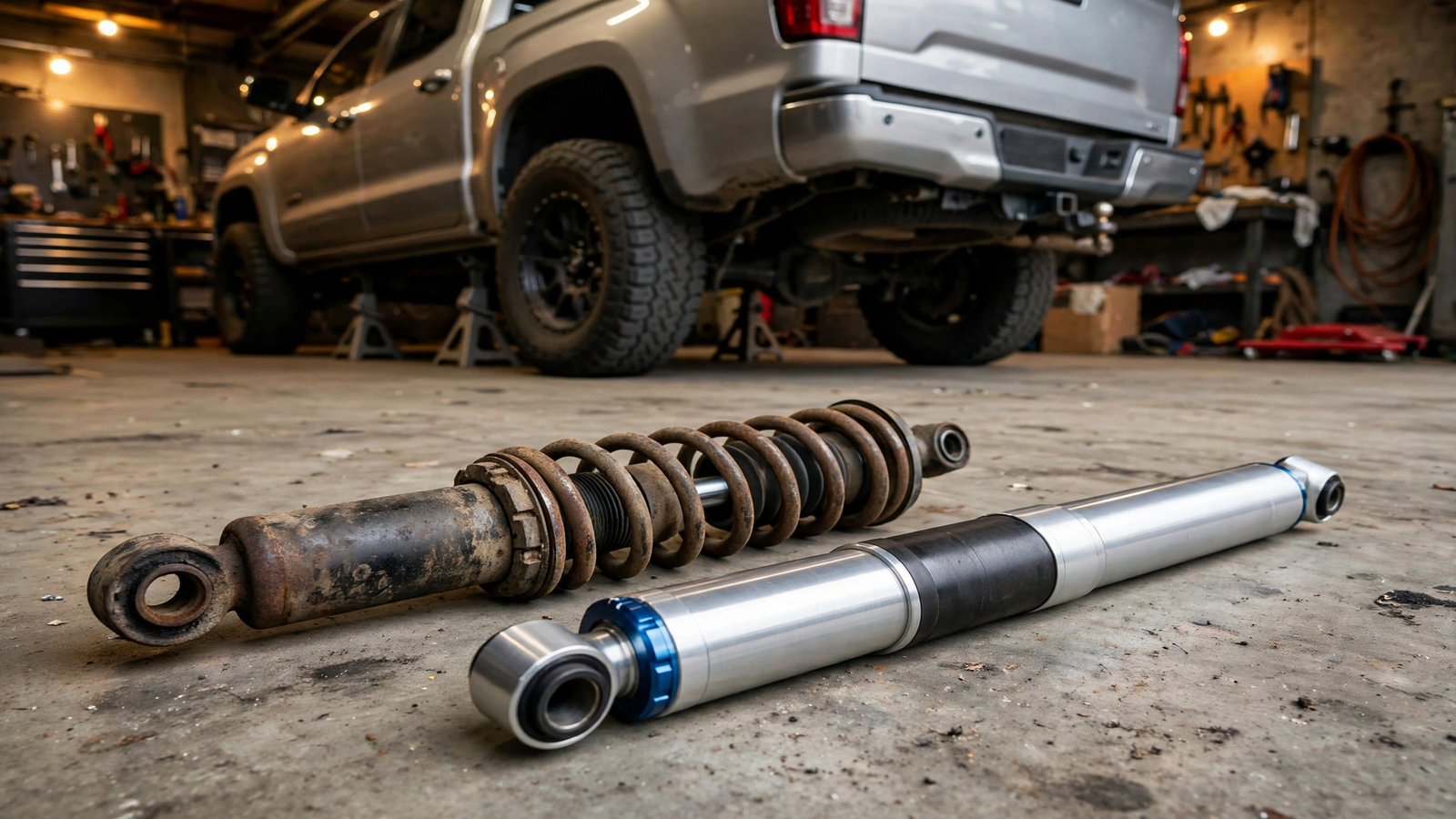
Should you replace shocks when installing a leveling kit? It depends on height and mileage: with a mild 1- to 2-inch level on a truck under 60,000 miles, the stock shocks usually work fine. But at 2.5 inches or more, or on any truck with worn dampers, you should replace them with extended-length shocks ($300–$800 for a set of four). Running shocks that are too short lets them top out constantly, which kills ride quality and destroys the shocks prematurely.
Key takeaways
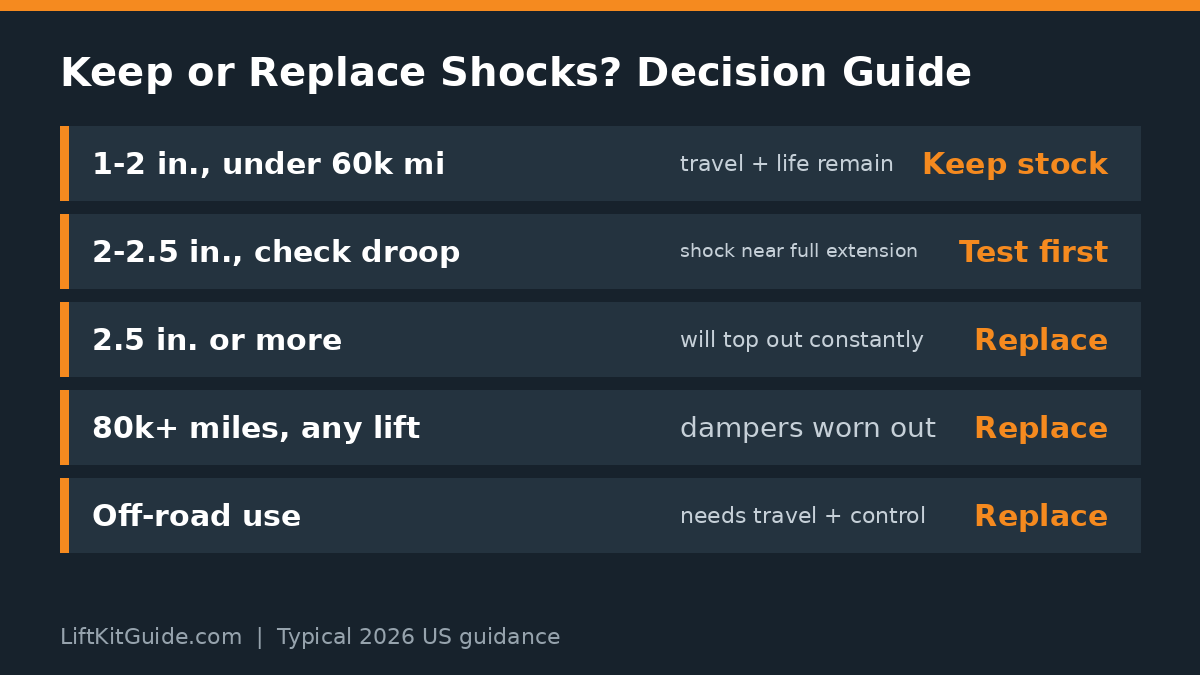
- 1–2 inch level + under 60k miles: stock shocks are usually fine.
- 2.5 inches or more: upgrade to extended-length shocks to avoid topping out.
- High-mileage trucks (80k+ miles) deserve fresh shocks with any leveling kit.
- Budget $300–$800 for four quality extended shocks (Bilstein 5100, Fox 2.0).
- Shock extenders ($40–$80) are a cheap stopgap, not a long-term solution.
On this page
Should you replace shocks when installing a leveling kit?
The real answer to should you replace shocks when installing a leveling kit comes down to two variables: how much lift the kit adds, and how many miles are on your current shocks. A leveling kit changes ride height but does not change the distance between the shock mounts at full droop — and that is where the trouble starts. If the new ride height pushes the shock near the end of its travel, every pothole tops it out with a harsh clunk.
For mild 1- to 2-inch levels on trucks with under 60,000 miles, the honest answer is usually no — the stock shocks have enough travel left to work acceptably. Owner consensus across truck forums lands in the same place: below about 2.5 inches of lift, factory shocks are sufficient for street driving, though the ride firms up slightly as the shock operates in a different part of its stroke.
Above 2.5 inches, or whenever the truck has 80,000-plus miles on original dampers, replacement is the smart move. Worn shocks were already done before the level; the new geometry just exposes it. Our leveling kit explainer covers the kit types, and this guide covers what to bolt on behind them. That height-and-mileage rule is the whole answer to should you replace shocks when installing a leveling kit.
Can you keep stock shocks with a leveling kit?
Yes, in the mild cases. A 2-inch front level on a 40,000-mile truck is the textbook scenario for keeping stock shocks: the height change is small, the dampers are healthy, and the shock still has travel to spare at the new ride height. Thousands of owners run exactly this setup with no complaints beyond a slightly firmer ride.
The key check is droop travel. With the truck on a lift or stands and the suspension at full droop, the shock should not be the thing stopping the axle — it should have some extension left. If the shock is fully extended and acting as the droop limiter, it will top out over every bump, and topping out is what kills shocks: the piston slams the end of its stroke repeatedly until the seals fail. Check droop travel before you decide should you replace shocks when installing a leveling kit — the shock will tell you.
Rear shocks deserve the same check even on front-only leveling kits, since many owners level the front and add a small rear block or leave the rear stock. If your truck has over 80,000 miles, consider that shocks are wear items with a typical service life of 50,000 to 100,000 miles — a leveling kit is the natural moment to refresh them. Price the full job in our leveling kit cost guide before you decide.
| Scenario | Keep stock shocks? | Why |
|---|---|---|
| 1–2 in. level, under 60k miles | Usually yes | Enough travel remains; dampers healthy |
| 2–2.5 in. level, any mileage | Maybe — check droop | Shock near end of travel; test required |
| 2.5 in.+ level | No — replace | Stock shocks top out constantly |
| Any level, 80k+ miles | No — replace | Dampers worn regardless of height |
| Off-road use, any level | Replace | Needs the extra travel and damping |
What happens when shocks are too short for the lift?
A too-short shock becomes the suspension’s droop limiter, and that is a job it was never designed for. Every time the wheel drops into a pothole or off a speed bump, the piston slams into the top of its stroke — owners describe it as a harsh metallic clunk over bumps that were previously silent. Beyond the noise, the repeated topping out hammers the internal valving and seals until the shock blows out, sometimes in just a few thousand miles.
Handling suffers too. A shock at full extension cannot control the wheel, so the tire bounces and loses contact over uneven pavement — exactly when you need grip most. Off-road, the penalty is severe: one owner testing mismatched shocks reported losing over 3 inches of flex, turning an expensive lift kit into a stiff, clunky disappointment. The shock is supposed to damp motion, not define its limits.
The insidious part is that the damage is gradual. The truck feels fine for the first few weeks, then the clunking starts, then the ride deteriorates as the seals give up. By the time most owners connect the symptoms to shock length, the new lift has already cost them a set of shocks. Measuring before the install — or simply buying the extended shocks with the kit — avoids the whole cycle. Ignore the warning and should you replace shocks when installing a leveling kit answers itself six months later. Our install cost guide breaks down bundled versus separate labor pricing.
How do you know if your shocks are worn out anyway?
Mileage is the first indicator: most twin-tube factory shocks are meaningfully worn by 60,000 to 80,000 miles, even if they have not failed outright. The classic bounce test still works — push down hard on a corner and release; the truck should settle in one motion, not bounce two or three times. Excessive bouncing, nose-diving under braking, and a floaty highway feel all point to tired dampers.
Visual inspection catches the rest. Oil misting or wetness on the shock body means the seal is going. Dented bodies, torn boots, and corroded mounts are replacement triggers. And if one corner sits lower than the others with the truck on level ground, a weak shock or sagging spring is the likely cause — a leveling kit will not fix worn components, it just changes the height around them.
Here is the practical rule: if your truck has 80,000-plus miles on original shocks, replace them with the leveling kit regardless of height. The labor overlaps completely — the shocks are already accessible during the install — so you pay only for parts. Doing shocks six months later means paying for the same labor twice. Our install cost guide shows how bundled labor saves real money.
There is one more wrinkle owners miss when asking should you replace shocks when installing a leveling kit: the rear. Even on front-only leveling kits, many trucks get a small rear block or spacer to keep some rake, and the stock rear shock ends up near full extension at the new ride height. Extended rear shocks — roughly 1 to 2 inches longer than stock — restore proper travel for about $200 to $400 a pair, and they install in minutes while the rear is already apart for the block. Measure before you order: with the truck on stands and the axle at full droop, measure eye-to-eye and compare against the manufacturer’s extended-length specs. The shock’s extended length must exceed your droop measurement with margin to spare.
What shocks work best with a leveling kit?
For leveled trucks, the sweet spot is a quality monotube shock valved for 0 to 2 inches of lift. The Bilstein 5100 series is the default recommendation across nearly every truck forum — around $100 to $130 per corner, with digressive valving that firms up handling without punishing ride quality, and lengths designed for leveled applications. The Fox 2.0 Performance series is the step up at roughly $150 to $180 per corner, with a slightly plusher feel and rebuildable construction. Owner consensus on extended rear shocks for leveled trucks is well documented in this TacomaWorld rear shock thread.
For the rear of a leveled truck, extended-length shocks add about 1 to 2 inches of travel over stock — the Bilstein 5160 remote-reservoir is a popular pick at roughly $200 to $250 per corner, running about 2 inches longer than stock with better heat management for towing. Match the shock to your use: daily drivers do great on 5100s, towers and off-roaders benefit from the reservoir models. That is why should you replace shocks when installing a leveling kit usually ends with buying a matched set of four.
Buy shocks as a matched set of four whenever the budget allows. Mixing a fresh monotube up front with worn twin-tubes out back creates odd handling balance. And always verify fitment for your exact year, cab, and drive configuration — shock lengths vary more than most owners expect. Our lift kit brands guide covers the major damper manufacturers in depth.
| Shock | Type | Rough cost (each) | Best for |
|---|---|---|---|
| Bilstein 5100 | Monotube, leveled length | $100–$130 | Daily drivers, best value |
| Fox 2.0 Performance | Monotube, rebuildable | $150–$180 | Comfort + longevity |
| Bilstein 5160 | Remote reservoir, +2 in. | $200–$250 | Towing, heat management |
| Rancho RS5000X | Twin-tube | $60–$90 | Budget replacement |
| Stock replacement | Twin-tube OE-style | $50–$80 | Low-mile trucks keeping stock height feel |
Are shock extenders a good alternative to new shocks?
Shock extenders — small brackets that relocate the shock mount to compensate for lift — cost $40 to $80 and install in minutes. They solve the topping-out problem by restoring the shock’s operating range, which makes them a legitimate stopgap when the budget is tight or the stock shocks are nearly new. For a 2-inch level on a 30,000-mile truck, extenders are a defensible choice.
But extenders do not fix worn dampers, and they add another joint to the load path — one more thing to loosen, clunk, or corrode. They also do nothing for damping performance; a tired shock on an extender is still a tired shock. Think of extenders as geometry correction, not a shock upgrade, and be honest about which problem you actually have. Do the math honestly and should you replace shocks when installing a leveling kit becomes a buy-once decision.
The long-term math usually favors real shocks. Extenders at $60 plus the eventual shock replacement costs more than buying the extended shocks once, and you do the labor twice. If the truck has over 60,000 miles, skip the extenders and put the money toward proper leveled-length shocks from the start.
How much do leveling-kit shocks cost in 2026?
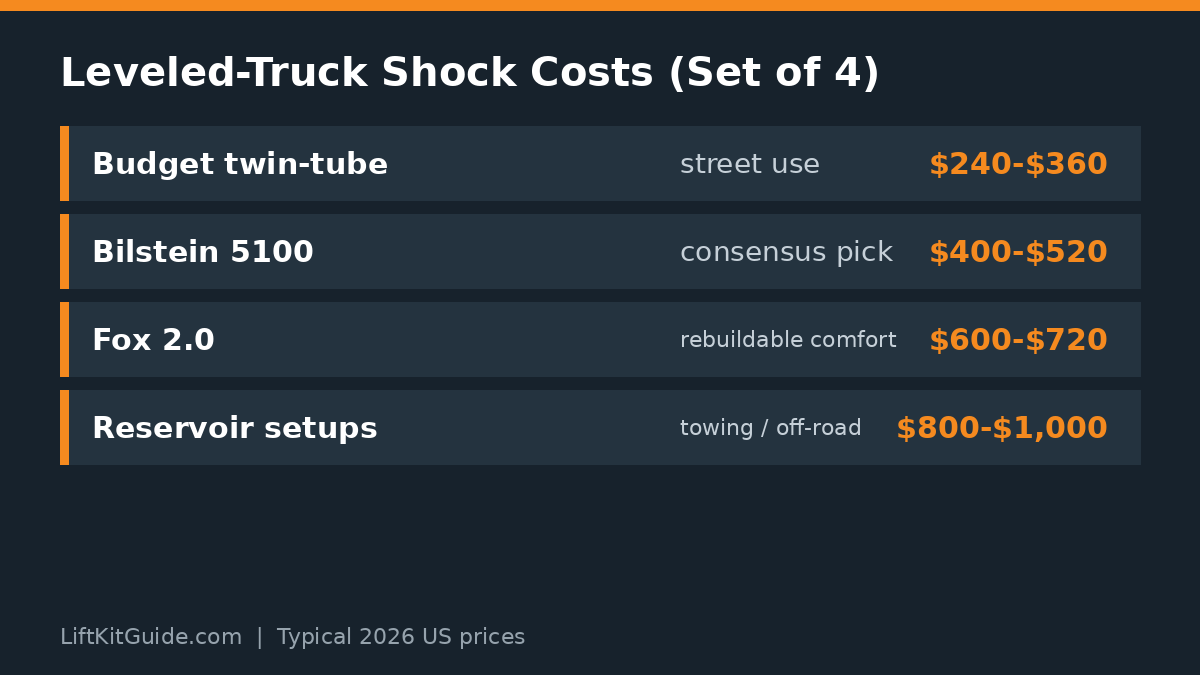
Budget $300 to $800 for a set of four quality shocks suited to a leveled truck in 2026. At the value end, Rancho RS5000X or similar twin-tubes run $240 to $360 for four — fine for street trucks on a budget. The mid-range sweet spot is Bilstein 5100s at $400 to $520 for four, which is what most forum builds run. Premium Fox 2.0 or reservoir setups reach $600 to $1,000 for four.
Labor is the variable. If you are already installing the leveling kit yourself, adding shocks costs nothing extra in labor — the corners are already apart. Paying a shop to do shocks separately later typically adds $200 to $400 in labor, which is the strongest argument for bundling. Some shops discount the shock install when it is combined with the leveling kit; ask before booking. Bundle it all and should you replace shocks when installing a leveling kit pays for itself in saved labor.
Do not forget the alignment ($100–$150) in the total — it is required after any ride-height change regardless of shocks. Add it all up with our cost to lift a truck calculator approach: kit, shocks, alignment, and any tools, compared against the shop quote for the bundle.
- Budget twin-tubes ($240–$360/set): acceptable for street trucks; replace again sooner.
- Bilstein 5100s ($400–$520/set): the consensus pick — monotube durability, leveled lengths.
- Fox 2.0 ($600–$720/set): plusher ride, rebuildable, longer service life.
- Reservoir rears ($400–$500/pair): worth it for towing and sustained rough roads.
- DIY labor ($0 extra): shocks go on while the kit is apart — bundling saves $200–$400.
- Alignment ($100–$150): mandatory after any height change, shocks or not.
Should you replace shocks when installing a leveling kit on a high-mileage truck?
On a high-mileage truck, the answer to should you replace shocks when installing a leveling kit is an easy yes. At 100,000-plus miles, factory twin-tube shocks are not just tired — they are typically operating at a fraction of their original damping force. Installing a leveling kit on worn shocks gives you the look of a fresh suspension with the handling of a worn one, which is the worst of both worlds.
The bundled economics are compelling. The leveling kit install already requires disassembling every corner you would touch for shocks, so the marginal labor is zero if you DIY and minimal at a shop. Four Bilstein 5100s at roughly $450 plus the kit puts a 120,000-mile truck’s suspension in genuinely better-than-new condition for less than a single shop visit would cost for either job alone. Fresh dampers plus the new height: that is the complete answer to should you replace shocks when installing a leveling kit.
There is also a safety dimension owners overlook: worn shocks increase braking distances and reduce stability in emergency maneuvers, and a leveling kit slightly raises the center of gravity. Pairing fresh, properly valved dampers with the new ride height keeps the truck’s emergency handling as good as — or better than — stock. For a high-mileage truck, fresh shocks are not an upsell; they are the other half of the job.
Frequently asked questions
Can I install a leveling kit and keep my factory shocks?
Yes — with a ≤2-inch level and under ~60k miles. Above 2.5 inches or past 80k miles, replace with extended-length shocks.
How do I know if my shocks are too short after leveling?
A harsh metallic clunk over bumps signals topping out. At full droop, the shock should not be fully extended.
Are shock extenders as good as longer shocks?
No — extenders fix geometry but not damping. Fine as a stopgap on low-mile trucks; extended shocks are the real fix.
What is the best shock for a leveled truck?
Bilstein 5100 (~$100–$130/corner) is the consensus value pick; Fox 2.0 (~$150–$180) is the comfort/rebuildable step up.
How much does it cost to replace shocks with a leveling kit?
$300–$800 for four shocks plus kit and $100–$150 alignment. DIY adds no labor since the corners are already apart.
Do I need longer shocks for a rear block with a leveling kit?
Usually yes for 2-inch+ rear blocks — extended rears ~1–2 inches longer than stock restore proper travel.
The bottom line
Should you replace shocks when installing a leveling kit? Let the numbers decide: 2 inches or less on a low-mileage truck, keep the stocks and spend the money elsewhere. More than 2.5 inches, or any truck past 80,000 miles, buy the extended shocks with the kit — the labor is free while everything is apart, and the alternative is topping out, clunking, and buying shocks anyway six months later.
A leveling kit changes where your suspension lives; the shocks need to be happy living there too. Match the damper to the height and the mileage, and the leveled truck will ride better than it did stock — not just look better.



Leave a comment