


Last updated: October 2026 Written by the LiftKitGuide Team, truck suspension installers and editors
Are lifted trucks good in snow? They can be, with the right setup. A lift helps in deep snow by adding ground clearance so the truck does not high-center, and 4WD plus tall tires handle unplowed roads well. But the lift alone does not improve grip: wide mud-terrain tires are actually worse on ice than narrower winter-rated tires, and the higher center of gravity demands more caution in corners. A lifted truck on proper winter tires is a confident snow rig.
Key takeaways
- Lifted trucks can be good in snow with the right tires; the lift helps in deep snow but not on ice.
- Wide mud-terrain tires are worse on ice; narrower winter-rated all-terrains grip far better.
- 4WD helps you go, not stop; braking and cornering need caution regardless of lift.
- 200 to 400 pounds of secured bed weight improves rear traction.
- The higher center of gravity demands slower speeds on snowy curves.
On this page
Are lifted trucks good in snow?
Are lifted trucks good in snow? The short answer is that they can be, but the lift itself is only a small part of winter performance. What makes a lifted truck work in snow is the combination of ground clearance for deep stuff, 4WD for traction, and, most importantly, the right tires. That conditional answer is why are lifted trucks good in snow is the wrong first question; ask about the tires first. Get the tires wrong and no amount of lift saves you on an icy highway.
In deep, unplowed snow, a lifted truck has a genuine advantage. The extra clearance keeps the frame and differentials from dragging and high-centering, which is exactly what strands stock-height vehicles when the snow gets deeper than 8 to 10 inches. Owners in snow-belt states consistently report driving through storms that stop lower vehicles, and that capability is real.
On plowed roads and ice, though, the picture flips. Clearance does not matter on a plowed highway, and the lifted truck’s higher center of gravity, heavier tires, and often wider footprint become mild disadvantages. So the complete answer to are lifted trucks good in snow is conditional: excellent in deep snow, average on winter highways, and entirely dependent on tires in both cases.
How does a lift change snow driving?
A lift changes snow driving in three ways: clearance, center of gravity, and tire fitment. The clearance gain is pure benefit in deep snow. A 4 inch lift with 35s gives roughly 5 extra inches of underbody clearance over stock, which is the difference between pushing through a drift and getting beached on it. For rural roads that do not see a plow until morning, that matters.
The center of gravity change is the tradeoff. A lifted truck leans more and feels less planted in snowy corners, and sudden maneuvers are riskier. Electronic stability control helps enormously here; make sure yours is active and functioning, since some owners disable it for off-roading and forget to re-enable it. Anyone evaluating are lifted trucks good in snow for their climate should weigh this tradeoff honestly: deep-snow clearance against reduced cornering confidence. Drive like the truck is taller than it looks, because it is.
The tire fitment change is the hidden variable. Lifts exist to fit bigger tires, and bigger usually means wider, which is worse on snow and ice. A 35×12.50 mud-terrain floats over the surface instead of biting in. The tire sizing guide is worth reviewing with winter in mind: for snow, a narrower tire in a winter-capable tread is the winning formula, even on a lifted truck. Lifted trucks also tend to run heavier wheels, which increases unsprung mass and makes the suspension slower to react on washboard ice. Quality shocks help, but the physics of heavy 35s on a frozen rutted road favor slower speeds regardless of setup.
Do bigger tires help or hurt in snow?
Bigger helps in deep snow and hurts on ice, which is why tire choice matters more than size. In deep powder, a taller tire’s larger contact patch and the lift’s clearance work together to keep the truck moving. This is where are lifted trucks good in snow gets its best yes: tall, narrow tires are the classic deep-snow setup for a reason: they cut through to find grip underneath instead of floating.
On packed snow and ice, wide tires are a liability. The physics are simple: the same vehicle weight spread over a wider patch means less pressure per square inch, so the tire cannot bite through the slick surface. This is why rally cars run narrow tires in winter. A lifted truck on 13.50-wide mud-terrains will skate where the same truck on 11.50-wide winter-rated all-terrains tracks confidently.
Tread compound matters as much as width. Mud-terrain compounds are formulated for warm-weather toughness and turn hard and slick below freezing. Winter-rated all-terrains use softer compounds with siping that stays pliable in the cold. Look for the 3-peak mountain snowflake symbol, which certifies the tire passed actual snow traction tests. Studded tires are legal in many snow states and offer the ultimate ice grip, though they are noisy and restricted in some areas; check local laws before committing to studs on a daily driver. The 35s fitment guide can help you find a winter-capable 35 that actually fits your lift.
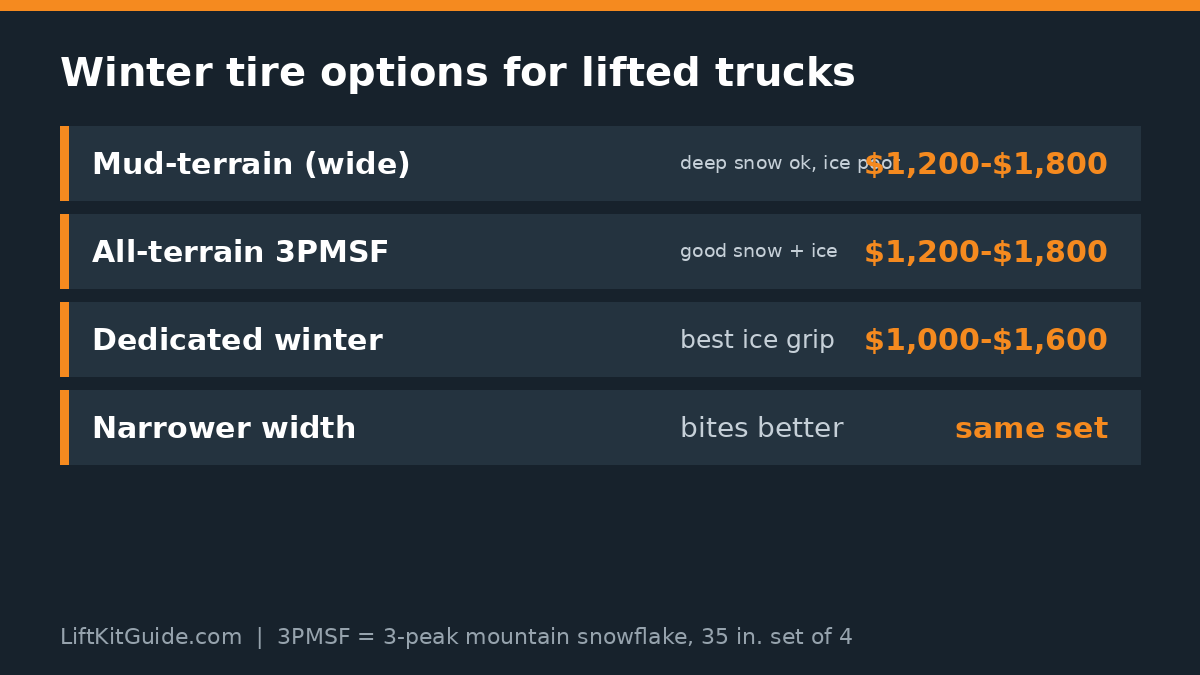
| Tire type | Deep snow | Ice / packed snow | Cold compound |
|---|---|---|---|
| Mud-terrain (wide) | Good flotation | Poor grip | Hardens in cold |
| All-terrain (3PMSF) | Good | Good | Stays pliable |
| Dedicated winter | Very good | Excellent | Designed for cold |
| Highway all-season | Poor | Fair | Marginal below freezing |
Are lifted trucks good in snow on icy roads?
Are lifted trucks good in snow when the road is sheer ice? Honestly, no better than any other truck, and slightly worse in one respect. Ice driving is entirely about the tire’s contact patch and compound, plus the driver’s restraint. A lift adds nothing on ice, while the higher center of gravity and heavier tires make emergency maneuvers sketchier.
That does not mean a lifted truck is dangerous on ice; it means the driver must respect the physics. Increase following distances well beyond what feels necessary, brake early and gently, and avoid cruise control, which can cause sudden wheel spin on icy patches. Four-wheel drive does not help you stop, a fact that surprises new truck owners every winter.
For ice-dominated winters, are lifted trucks good in snow enough to skip winter tires? No. If your winters are more ice than deep snow, consider a dedicated winter tire set on stock-size or narrower wheels. Swapping to a narrower winter setup for December through March transforms a lifted truck’s icy-road manners. It is an investment of $1,000 to $1,600, but it is the single biggest safety upgrade a winter-driven lifted truck can get. Tell your insurer about your setup too, since winter accident rates make coverage details matter.
What is the best winter tire setup for a lifted truck?
When owners ask are lifted trucks good in snow on all-terrains, the answer depends on the symbol. The best winter setup for a lifted truck is a 3-peak mountain snowflake rated all-terrain in the narrowest width your wheels support, or a dedicated winter tire if ice dominates your winter. Popular choices among lifted truck owners include the BFGoodrich KO2, Goodyear Wrangler Duratrac, and Falken Wildpeak AT3W, all of which carry the snowflake symbol and come in 35 inch sizes that fit common lifts.
Sizing strategy matters. If your lift clears 35×12.50s, consider a 35×11.50 or a 295-width equivalent for winter; the narrower footprint bites better. Some owners run a second set of wheels with 33 inch winter tires, accepting slightly less clearance for much better grip. The cost of a second set pays for itself if it prevents one accident or one set of prematurely worn mud-terrains.
Do not forget the spare. A winter tire setup is incomplete if the spare is a summer mud-terrain; a flat in a snowstorm with a mismatched spare is a miserable experience. Match all five, keep the spare properly inflated, and rotate it into the pattern so it wears evenly. Store the off-season set properly: clean, dry, out of sunlight, and stacked flat to prevent flat-spotting during the months they sit. Five-tire rotations also extend the life of expensive 35s by 20 percent.
Should you add weight to the bed in winter?
Yes, adding weight over the rear axle is one of the oldest and most effective winter tricks for pickup trucks, lifted or not. Pickups are light in the rear, which is why the back end steps out on slick roads. Two hundred to 400 pounds of tube sand directly over the axle settles the rear, improves traction, and makes the truck’s handling more predictable.
Placement and security matter. Center the weight over or slightly ahead of the rear axle, never behind it, and secure it so it cannot slide or become a projectile in a sudden stop. Purpose-made tube sandbags are ideal because they conform to the bed and do not shift. Avoid loose items like firewood or unsecured toolboxes, which turn dangerous in a crash.
Weight helps, but the full answer to are lifted trucks good in snow still starts with tires: bed weight is not a substitute for them. A lifted truck with sandbags and summer mud-terrains is still a lifted truck with summer mud-terrains. Think of bed weight as the finishing touch on a proper winter setup, not the foundation. And remove the weight in spring; hauling 300 pounds of sand year-round just burns fuel. The benefits of a lifted truck are year-round, but winter demands its own preparation.
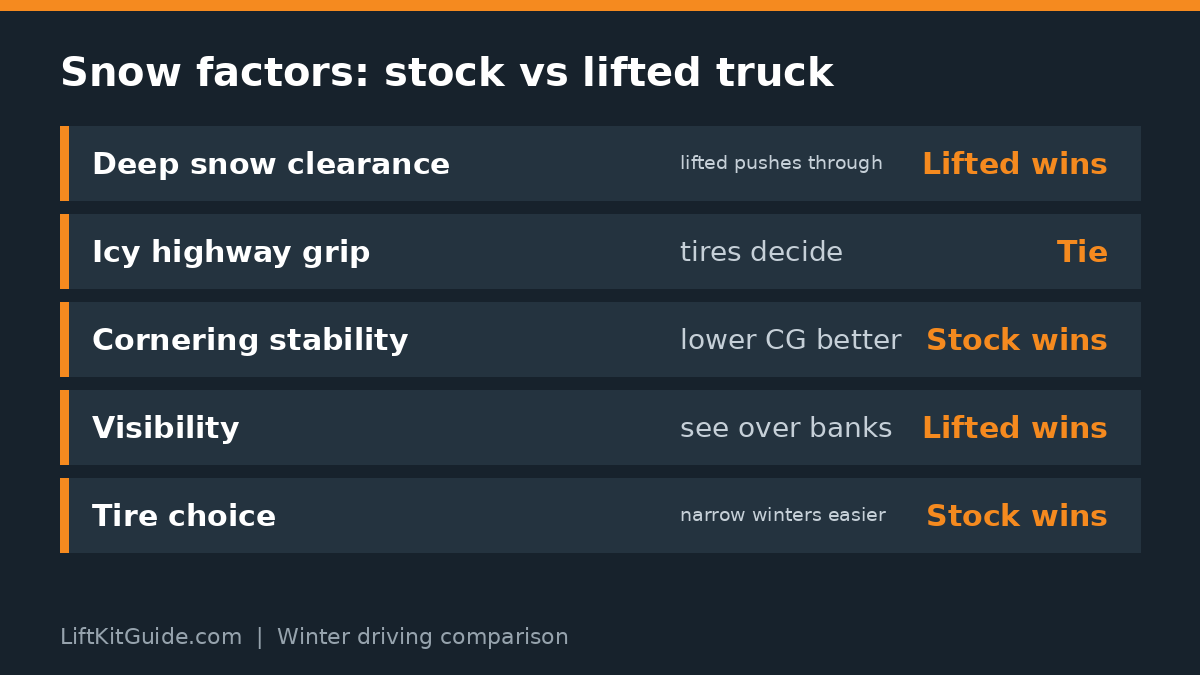
| Factor | Stock truck in snow | Lifted truck in snow | Edge |
|---|---|---|---|
| Deep snow clearance | High-centers easily | Pushes through drifts | Lifted |
| Icy highway grip | Depends on tires | Depends on tires | Tie |
| Cornering stability | Lower CG, planted | Taller, more lean | Stock |
| Tire options | Narrow winters easy | Wide tires common | Stock |
| Visibility | Lower seating | See over snowbanks | Lifted |
How do you drive a lifted truck safely in snow?
Drive a lifted truck in snow like it is taller, heavier, and less forgiving than it feels, because it is. The core techniques are universal: slow down before curves, not in them; brake early and progressively; and make one input at a time, steering or braking or accelerating, never two at once. Smoothness is the entire game on slick surfaces, and it matters more the taller the truck. Are lifted trucks good in snow in the hands of an aggressive driver? Never.
Use 4WD correctly. Engage 4-Hi before you need it, on snowy or icy roads, not after you are stuck. Shift back to 2WD on dry pavement to avoid binding the transfer case. Four-wheel drive helps you accelerate and climb, but remember it does nothing for braking; the number of 4WD trucks in ditches every winter proves that overconfidence is the real hazard. If your truck has selectable drive modes, use snow or slippery mode if equipped; it softens throttle response and starts in a higher gear to reduce wheel spin.
Leave bigger margins everywhere. Double your normal following distance, start braking twice as early, and assume intersections are icier than the road between them. If the truck starts to slide, look where you want to go, ease off the pedals, and let stability control work. Practice in an empty parking lot after the first snow so the truck’s reactions are familiar before traffic is involved. Ten minutes of practice beats ten years of assumptions. A leveled truck behaves similarly, so these habits transfer across setups.
- Slow down early: brake before the curve, never in it; lifted trucks lean more.
- One input at a time: steer, brake, or accelerate, never two at once on slick roads.
- Engage 4-Hi proactively: before the hill or the storm, not after you are stuck.
- Double following distances: heavier tires and taller gearing lengthen stops.
- Skip cruise control: it can spin wheels on icy patches before you react.
- Keep stability control on: re-enable it if you disabled it for off-roading.
What winter upgrades matter most for a lifted truck?
Ranked by impact per dollar, winter upgrades for a lifted truck go: tires, bed weight, emergency gear, undercarriage protection, and then everything else. Tires are the runaway winner; nothing else comes close. Bed weight is nearly free. Emergency gear, blanket, shovel, traction boards, jumper cables, costs under $200 and matters exactly when everything goes wrong.
Undercarriage protection earns its place because road salt is brutal on lift components. Unpainted brackets, heim joints, and hardware corrode fast in salt states. Fluid-film or similar undercoating each fall, applied to the lift brackets and fasteners, adds years to the kit’s life. Regular winter washes, including the undercarriage, are the companion habit. Pay special attention to brake lines and ABS sensors, which live close to big tires and take a beating from packed snow and ice chunks.
Finally, mind the details that winter exposes. Death wobble, which our death wobble guide covers, gets worse when bushings stiffen in the cold, so inspect track bar and steering components before winter. Battery health matters more when cold starts strain the system. And keep the fuel tank above half; it reduces condensation and ensures you can idle for heat if stranded. Winter does not disqualify a lifted truck, but it does audit your maintenance.
Frequently asked questions
Is 4WD enough for snow on a lifted truck?
Yes, 4WD helps enormously for getting moving, but it does not help you stop or turn. Winter tires and caution still matter.
Are mud tires good in snow?
Often worse. Wide mud-terrains float on snow and ice. A narrower winter-rated all-terrain performs far better.
Should I put weight in the bed of my truck for winter?
Yes, 200 to 400 pounds over the rear axle improves rear traction. Secure it so it cannot slide.
Does ground clearance help in snow?
It helps in deep snow by preventing high-centering. On plowed or icy roads, clearance does not matter.
What tire pressure should I run in winter?
Keep pressures at the upper end of the recommended range, measured cold. Check monthly through winter.
Can I run all-terrains year-round including winter?
Yes, if they carry the 3-peak mountain snowflake symbol. Dedicated winters are better on ice, but winter-rated ATs work well.
The bottom line
Lifted trucks can be good in snow, but the lift is the least important part of the equation. Tires, 4WD, weight distribution, and driving technique decide winter performance far more than ride height. A lifted truck on proper winter tires with weight in the bed is a confident snow vehicle.
If you run a lifted truck through winter, budget for the right rubber. All-terrains with the 3-peak mountain snowflake symbol or a dedicated winter set will do more for safety than any suspension part. The lift gets you through deep snow; the tires keep you on the road.



Leave a comment