


Last updated: October 2026 Written by the LiftKitGuide Team, truck suspension installers and editors
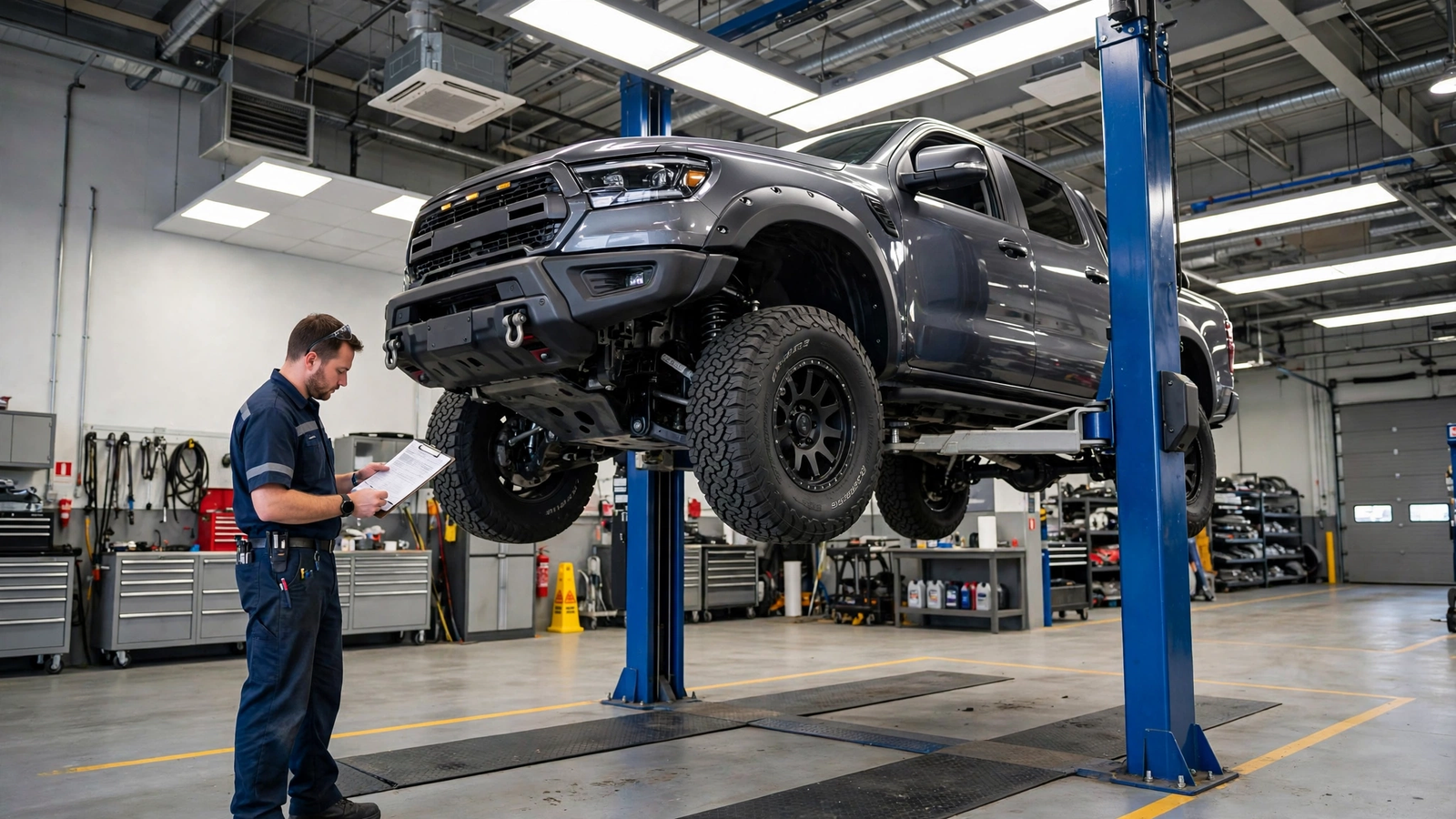
Does a lift kit void your factory warranty? No — under the federal Magnuson-Moss Warranty Act of 1975, a dealer cannot void your entire factory warranty simply because you installed a lift kit. The law places the burden of proof on the dealer: to deny a claim, they must prove the lift kit caused that specific failure. A lift can only jeopardize coverage for parts it plausibly affects, such as ball joints or CV axles, while unrelated systems like the engine electronics or air conditioning must still be honored.
Key takeaways
- The Magnuson-Moss Warranty Act (15 U.S.C. §2302(c)) bars dealers from voiding your factory warranty over an aftermarket lift kit alone.
- The dealer must prove the lift kit caused the specific failure — the burden of proof is on them, not you.
- Only claims on parts the lift plausibly affects (ball joints, CV axles, steering) can be denied; unrelated systems must still be honored.
- Extended service contracts are separate agreements with their own modification exclusions — federal warranty protections do not transfer to them.
- In 2022 the FTC forced Harley-Davidson to rewrite warranties that threatened coverage over aftermarket parts — the same rules protect truck owners.
On this page
Does a lift kit void your factory warranty under federal law?
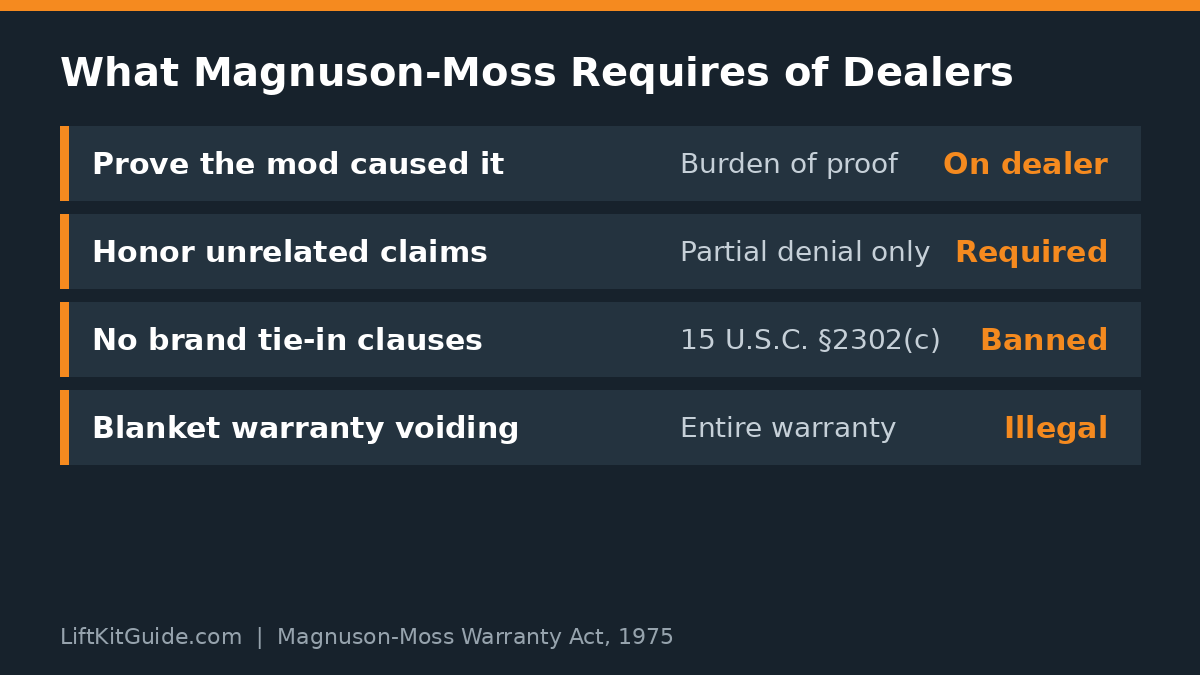
Does a lift kit void your factory warranty the moment it is installed? Under the federal Magnuson-Moss Warranty Act of 1975, the answer is no. The Act — codified at 15 U.S.C. section 2302(c) — prohibits a warrantor from conditioning warranty coverage on the use of branded parts or dealer service. The Federal Trade Commission, which enforces the Act, states plainly that simply using an aftermarket or recycled part does not void your warranty. A lift kit is an aftermarket part, so its mere presence on your truck cannot legally erase your factory coverage.
That protection has real teeth. In 2022, the FTC took enforcement action against Harley-Davidson for warranty language that threatened to void coverage when owners used independent shops or aftermarket parts. The company had to rewrite its warranties and notify customers of their rights. The same federal rules protect truck owners: a dealer cannot write “lift kit equals no warranty” into your service visit. They must evaluate each claim on its own facts, which is where the burden-of-proof rule becomes your strongest tool.
The same statute also protects where you have the work done and which brand of parts you use. A dealer cannot require you to buy an OEM-branded lift or have it installed at the dealership as a condition of keeping your warranty, unless those parts or services are provided free of charge. That is why the question “does a lift kit void your factory warranty” has the same answer whether you chose a budget spacer kit or a premium coilover system, and whether a shop or your driveway did the install: the law looks at causation, not branding. Our general lift kit warranty basics guide covers how this plays out for everyday claims.
What does “void” actually mean when a dealer says your warranty is void?
When truck owners ask whether a lift kit voids a factory warranty, they usually picture the entire warranty disappearing. That almost never happens. There is no single switch a dealer flips to void a factory warranty. What actually happens is claim denial: the dealer refuses to pay for one specific repair, arguing the modification caused that failure. Your remaining coverage — on every unrelated system — stays intact. This distinction matters because it changes your response from panic to a focused dispute over one repair.
Owner forums are full of service advisors using the word “void” loosely to end a conversation, but the single most important rule when asking “does a lift kit void your factory warranty” is that vague language is not a valid denial. Ask for the denial in writing, with the specific causal link stated: which part failed, and exactly how did the lift kit cause it? A vague “it is modified” is not a valid denial under federal law. If the advisor cannot articulate the connection, escalate to the service manager or the manufacturer’s customer care line before you pay a dollar out of pocket.
Who has to prove the lift kit caused the failure?
The dealer does — not you. If a dealer wants to deny your warranty claim because of a lift kit, the burden of proof rests entirely with the manufacturer or dealer. They must demonstrate direct causation between the modification and the failure, not simply point at the lift kit and shrug. You never have to prove that your lift kit did not cause the problem, and no dealer can legally shift that burden onto you by demanding you prove a negative.
In practice, the quality of the dealer’s evidence decides the outcome. A failed ball joint on a truck with a 6-inch lift and 37-inch tires is a plausible causal story, and dealers win those. But a failed infotainment screen, a power window motor, or an air conditioning compressor has no mechanical connection to ride height, and any denial there collapses under scrutiny. Once you understand this standard, you can predict how the “does a lift kit void your factory warranty” debate will play out for your specific repair before you ever walk into the service lane.
There is one honest gray area worth knowing. Courts have noted that the Act was written mainly to stop manufacturers from forcing brand-specific parts, and some dealers argue it fits less neatly when a part changes the vehicle’s operation or configuration — which a lift kit plainly does. In practice, though, the causation standard still controls: the dealer must connect the lift to the failure with evidence, not theory. When owners ask “does a lift kit void your factory warranty” in this gray zone, the practical answer is that tall lifts with big tires lose the close calls, while modest lifts usually win them.
Which warranty claims can a dealer still deny after a lift?
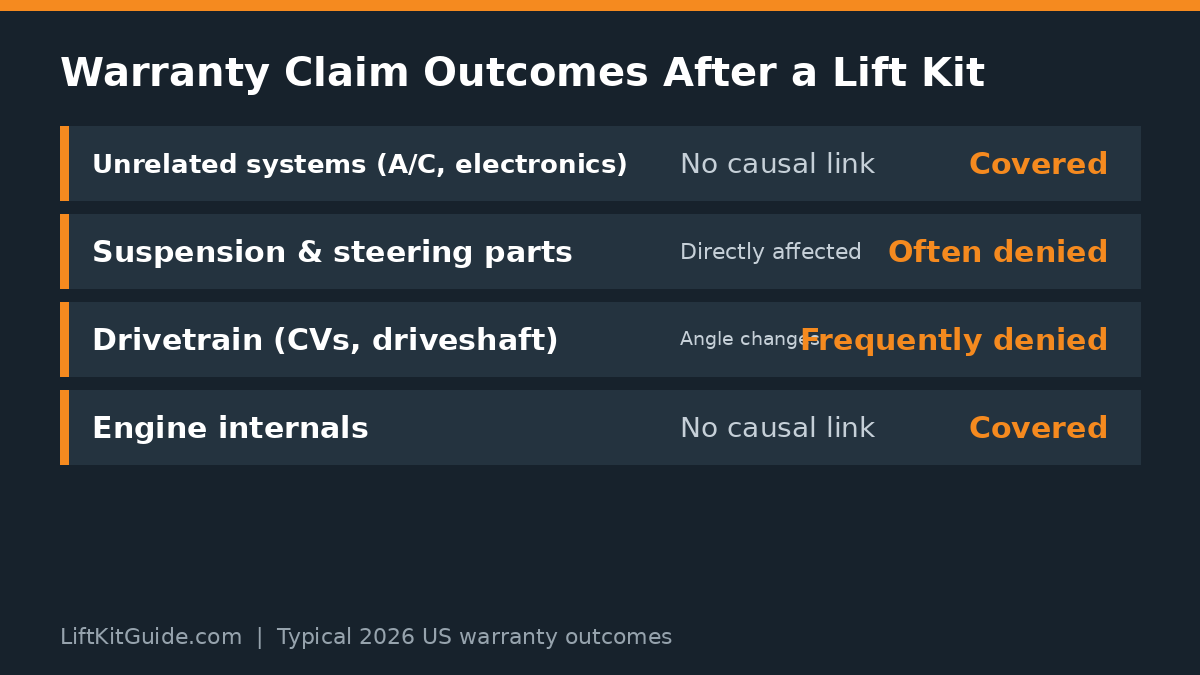
A dealer can legitimately deny claims on parts the lift plausibly stresses: ball joints, tie-rod ends, CV axles and boots, wheel bearings, driveshafts and U-joints, and steering components. Raising ride height changes the operating angles of all of these, accelerating wear in ways engineers can document. If you bring in a truck with a tall lift complaining of a torn CV boot or a howling wheel bearing, expect pushback — and understand the dealer is on reasonably solid ground, especially if you skipped the supporting mods like upper control arms that correct geometry.
But the line stops at unrelated systems. Your engine internals, transmission electronics, air conditioning, infotainment, power accessories, and emissions equipment have no causal relationship with a suspension lift. If a dealer tries to deny an engine repair by leaning on the “does a lift kit void your factory warranty” myth, that is exactly the overreach the Magnuson-Moss Act was written to stop. One Ram owner put it well: a dealer will not refuse to fix your windshield wiper motor because you installed bigger tires. Keep a mental map of which systems your lift touches, and challenge anything beyond it.
| System | Connection to lift kit | Likely claim outcome |
|---|---|---|
| Suspension and steering parts | Direct — angles and loads change | Often denied |
| Drivetrain (CV axles, driveshaft) | Direct — operating angles change | Frequently denied |
| Engine internals | None | Must be honored |
| Electronics and infotainment | None | Must be honored |
| Air conditioning | None | Must be honored |
| Transmission | Indirect — mainly via larger tires | Disputed, case by case |
Does a lift kit void your factory warranty if the dealer installs it?
Having the selling dealer install your lift kit does not change the federal law, but it changes the politics of every future claim — so does a lift kit void your factory warranty any less when the dealer did the work? Legally the standard is identical, yet a dealer that installed and profited from your lift will have a much harder time arguing it was an improper modification. Many dealers sell and install lifts themselves, and some will put their installation in writing as warranty-friendly, which becomes powerful evidence if a claim is ever disputed.
That said, a dealer install is not a magic shield. The manufacturer’s warranty administrator, not the installing dealer, often makes the final call on expensive claims. Get any warranty assurances in writing on the repair order, keep your alignment printout, and keep the stock parts. If you ever sell the truck or move to a different dealer, that paper trail is what protects you. And remember: even a dealer-installed lift does not extend your factory warranty, nor does the vehicle warranty cover the lift components themselves — the kit carries its own separate parts warranty.
One more scenario: buying a used truck that is already lifted. The remaining transferable factory warranty carries the same Magnuson-Moss protections — the Act protects the warranty, not the original buyer. But you inherit the previous owner’s paper trail, or lack of it. Before buying, ask for installation receipts and alignment records, and have your own mechanic inspect the suspension. A clean, documented lift is a warranty asset; a hacked-together one is a denial waiting to happen, no matter what the “does a lift kit void your factory warranty” forums tell you.
Do extended service contracts follow the same warranty rules?
No — and this is the nuance that surprises most owners. So does a lift kit void your factory warranty when you also hold an extended service contract? The two are separate: the Magnuson-Moss Warranty Act protects manufacturer warranties, while an extended service contract — often called an extended warranty — is a private agreement between you and a contract provider with its own exclusions. Most vehicle service contracts exclude failures caused by modifications or non-OEM parts, and many exclude lifted vehicles entirely. Your factory warranty rights do not transfer to the contract.
Before you lift a truck covered by a service contract, read the exclusions section line by line. Look for terms like “altered,” “modified,” “lifted,” or “oversized tires.” Some contracts allow modifications disclosed at purchase; almost none cover the modified parts themselves. If you bought the contract from the selling dealer, ask the finance manager — in writing — how a lift affects it. A contract that excludes modified vehicles can leave you paying for a plan that will never pay a claim, which is worse than having no contract at all. For the full cost picture of lifting, see our complete lift cost guide before you commit.
| Factory warranty | Extended service contract | |
|---|---|---|
| Governed by | Magnuson-Moss Act (federal law) | Private contract terms |
| Lift kit effect | Cannot void; each claim judged on causation | Often excluded explicitly |
| Burden of proof | On the dealer to prove causation | On you, per contract language |
| Covers the lift parts | No | No |
| Modifications allowed | Yes, with causation standard | Only if contract permits |
What should you do if a dealer denies your warranty claim?
Start by getting the denial in writing with the stated reason. A verbal “we cannot cover that because it is lifted” is not a denial you can appeal — and “does a lift kit void your factory warranty” is not a valid written reason either. Ask the service advisor to document the exact causal link on the repair order: which part failed and precisely how the lift caused it. Then escalate calmly: service manager first, then the manufacturer’s customer assistance center. Manufacturers overturn dealer denials more often than owners expect, especially when the dealer’s causation story is thin.
If the manufacturer sides with the dealer, you still have options. File a complaint with the FTC and your state attorney general’s consumer protection division — regulators track these patterns, and the 2022 Harley-Davidson action proves they act on them. For large claims, a consumer attorney experienced with warranty law can often resolve the dispute with a single letter, since many states allow recovery of attorney’s fees in warranty cases. Throughout the process, keep every receipt, photo, and alignment record: documentation wins disputes, and a second opinion from another dealer costs nothing.
Keep one more principle in mind: never authorize the repair before the coverage decision is final. Once you say “go ahead,” you have accepted the bill, and the dealer has little incentive to revisit the denial. Get the estimate, get the denial reason in writing, and take a day to escalate if needed. And if the truck is still within the factory warranty’s time and mileage limits, remember that asking “does a lift kit void your factory warranty” at the service desk is the wrong moment — the time to build your case was when the lift went on, with the receipts and photos described above.
- Get the denial in writing: insist the repair order states the exact part failure and the claimed causal link to the lift kit.
- Escalate to the manufacturer: call customer assistance — factory reps overturn weak dealer denials regularly.
- File regulatory complaints: the FTC and your state attorney general track warranty abuse patterns.
- Consult a warranty attorney: many states award attorney’s fees, so a single demand letter can end the fight.
- Try another dealer: claim decisions vary by service manager, and a mod-friendly shop may approve what another denied.
How can you protect your factory warranty before lifting?
The best warranty defense is built before the lift goes on. Keep your stock suspension parts — storing the factory springs, shocks, and control arms costs nothing and gives you the option to return the truck to stock for a contentious claim. Choose a reputable kit from our best lift kit brands guide, have it installed professionally, and get a full alignment immediately with a printed spec sheet. Take dated photos of the installation and keep every receipt in one folder.
Finally, talk to your service advisor before you need warranty work, not after a failure. Ask how the dealership handles modified trucks and whether they have installed lifts for other customers. A mod-friendly dealer is worth more than any legal argument, because most claims are decided by a service manager’s judgment call long before lawyers get involved. Lift the truck, enjoy it — and keep the paper trail that turns “does a lift kit void your factory warranty” from a fear into a question you can answer with confidence. If you are still deciding on height, our suspension lift kits guide and lift kit mistakes owners regret roundup will help you choose wisely.
Frequently asked questions
Can a dealer void my entire factory warranty because of a lift kit?
No. Under the Magnuson-Moss Warranty Act, a dealer cannot void your entire factory warranty because of a lift kit. They can only deny individual claims where they prove the lift kit caused that specific failure. Coverage on all unrelated systems remains intact.
What is the Magnuson-Moss Warranty Act in simple terms?
It is a 1975 federal law (15 U.S.C. §2302(c)) that stops warrantors from conditioning warranty coverage on using branded parts or dealer service. A manufacturer cannot deny your claim just because an aftermarket part is installed — they must prove that part caused the failure.
Does a leveling kit affect the factory warranty the same way as a lift kit?
Yes, the same legal rules apply, but leveling kits change geometry less than tall lifts, so dealers have a weaker causation argument for most failures. A small level with stock-size tires rarely triggers a legitimate denial.
Will the dealer know my truck was lifted if I return it to stock?
Possibly. Witness marks on bolts, stretched brake lines, trimmed sheet metal, and recalibrated speedometers can all reveal a previous lift. Returning to stock helps for unrelated claims, but dishonesty about the truck’s history can backfire if discovered.
Does the Magnuson-Moss Act cover used trucks with a remaining factory warranty?
Yes. The Act protects the warranty itself, so a used truck still covered by the transferable portion of the factory warranty carries the same protections against improper claim denials.
Should I tell the dealer about my lift kit before warranty work?
Be honest but strategic. Do not volunteer a legal lecture, but do not hide the modification either — it is usually obvious on the lift. Focus the conversation on the failed part and ask the advisor to explain the causal link in writing.
The bottom line
A lift kit does not void your factory warranty — federal law is explicit on this point. The Magnuson-Moss Warranty Act forces dealers to prove your modification caused each specific failure they refuse to cover, and it preserves your coverage on every system the lift does not touch. The word “void” is a scare tactic; what actually exists is claim-by-claim denial, and only for parts with a genuine causal link.
Go in prepared: keep stock parts, document the installation, get everything in writing, and know that a second dealer or a call to the manufacturer can reverse a weak denial. The one real exception is the extended service contract, which plays by its own rules — read it before you lift. For the broader warranty picture, our general lift kit warranty guide covers the basics this article builds on.



Leave a comment