


Last updated: October 2026 Written by the LiftKitGuide Team, truck suspension installers and editors
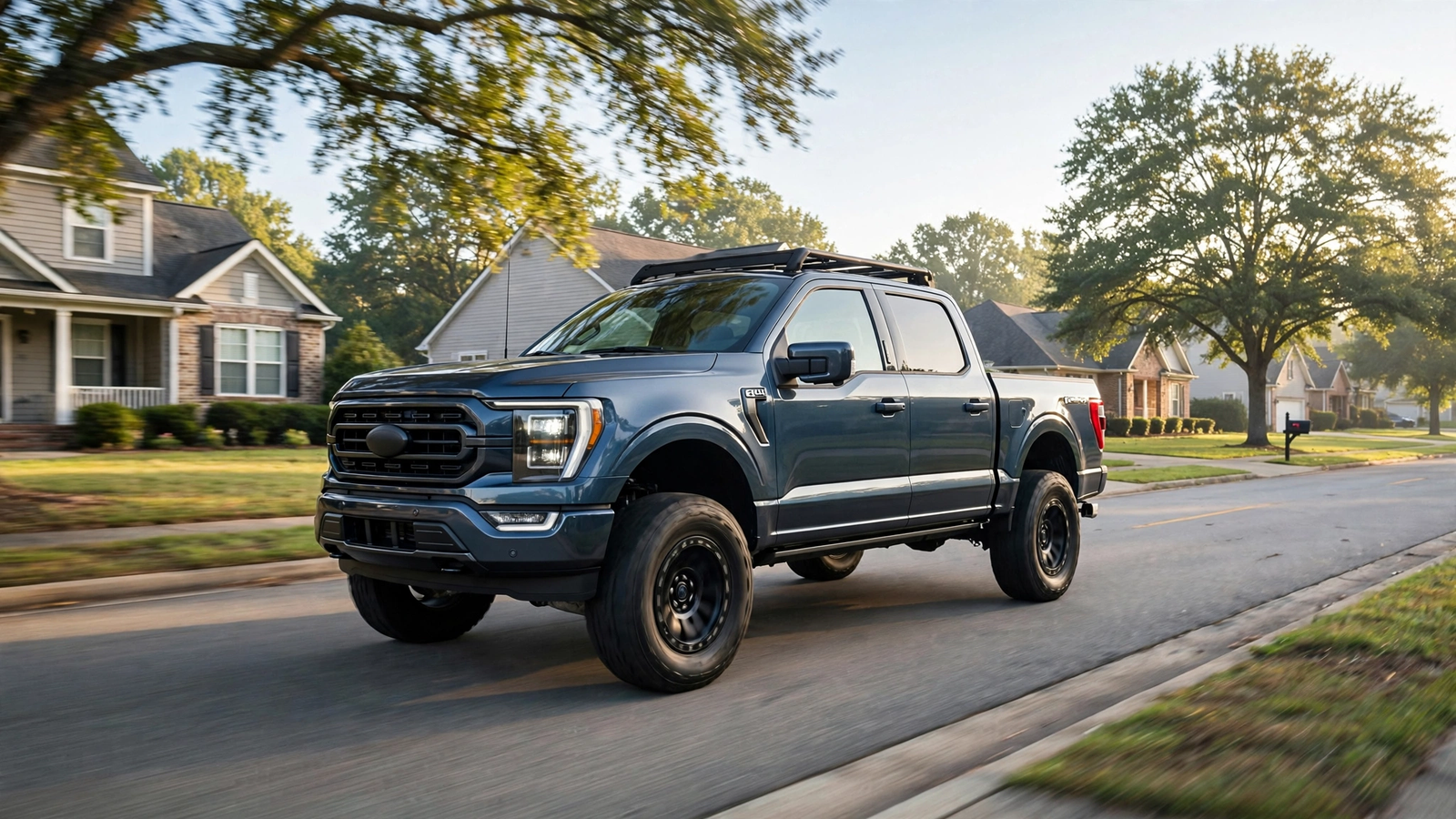
Can you daily drive a truck with a 4 inch lift? Yes, a 4 inch lift is one of the most daily-friendly lift heights. It clears 33 to 35 inch tires, still fits most parking garages and drive-throughs, and rides well with a quality kit. Expect to lose 2 to 4 MPG versus stock, pay more for tires, and climb a little higher getting in. Parking takes more care and tight garages need measuring, but most owners adapt within two weeks.
Key takeaways
- Yes, a 4 inch lift is one of the most daily-drivable lift heights.
- Expect 2 to 4 MPG less than stock and higher tire and maintenance costs.
- Most 4 inch lifted half-tons still fit 7 foot garages; measure to be sure.
- Parking and entry take two weeks to adapt to; steps and cameras help enormously.
- A quality suspension kit rides near stock; cheap spacer lifts ride worse.
On this page
Can you daily drive a truck with a 4 inch lift?
Can you daily drive a truck with a 4 inch lift? Yes, and it is one of the most popular choices for owners who want a lifted look without giving up everyday usability. A 4 inch lift sits in the sweet spot: tall enough to clear 33 to 35 inch tires and look properly aggressive, but short enough that the truck still fits in most garages, drive-throughs, and parking structures. It is the height where the compromises stay small.
Thousands of owners daily drive 4 inch lifted trucks as their only vehicle, commuting, hauling kids, and running errands without drama. The adjustment period is real but short. For the first week or two you will park farther out, duck slightly less under low branches, and think about height clearances you never noticed before. That two-week curve is the standard answer when owners ask can you daily drive a truck with a 4 inch lift long-term. Then it becomes normal, and getting back into a stock truck feels strangely low.
The key qualifier is kit quality. A complete 4 inch suspension lift with proper shocks, geometry correction, and an alignment drives almost like stock, just taller. A cheap spacer-and-block setup at the same height rides harsher, wears parts faster, and wanders more on the highway. If you are asking can you daily drive a truck with a 4 inch lift, the answer depends as much on which kit as on the height.
What is daily driving actually like on a 4 inch lift?
Day to day, the biggest differences are entry height, visibility, and maneuvering. Climbing in takes a deliberate step rather than a slide, which is why side steps are nearly universal on daily-driven lifted trucks. Visibility is actually better: you see over traffic and spot hazards sooner. So can you daily drive a truck with a 4 inch lift through tight parking structures? Yes, with technique. Maneuvering in tight lots takes more care because the truck feels bigger than it is, though the actual footprint barely changes.
Highway driving is where a 4 inch lift shows its mild side. Wind noise increases a notch, crosswinds push a bit more, and the truck leans slightly more in fast corners. None of it is dramatic at 4 inches. Most owners report that after the first month they stop noticing the differences except when parking or fueling up. The truck just feels like their truck.
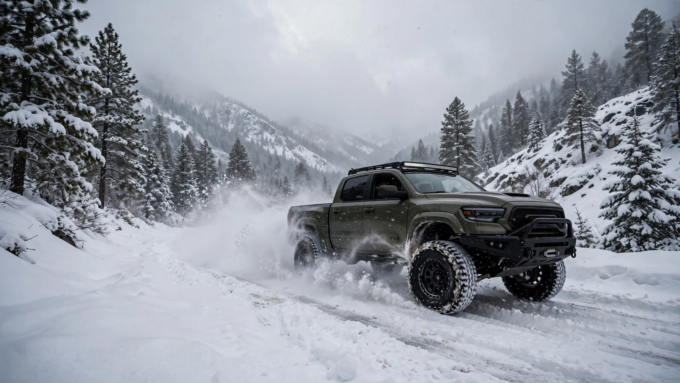
Weather and seasons add small wrinkles. Rain is a non-issue. Snow performance depends on tires more than lift height, which we cover in our winter driving guide. The one genuine annoyance is car washes: many automatic washes have height or width limits, so plan on hand washing or finding a truck-friendly wash. It is a lifestyle detail, not a dealbreaker.
How much MPG do you lose with a 4 inch lift?
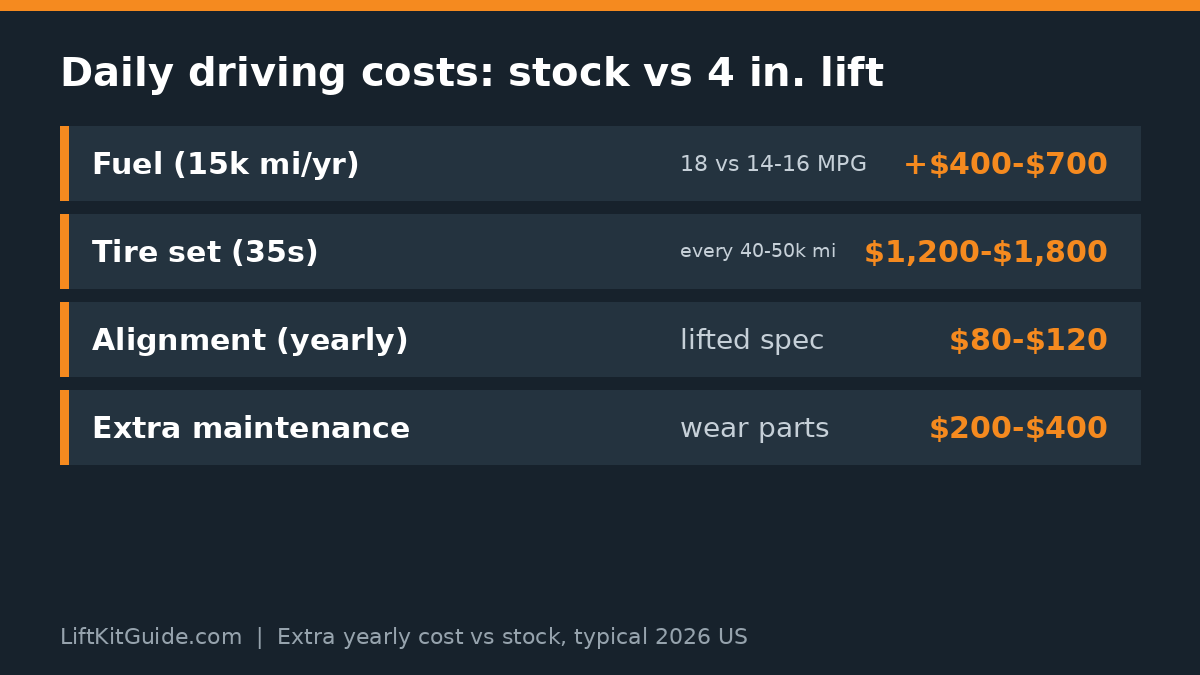
Expect to lose 2 to 4 MPG in mixed driving with a 4 inch lift and 35 inch tires. A half-ton rated at 18 MPG combined will typically deliver 14 to 16 MPG in the real world. Two things cause the loss: aerodynamic drag from the taller profile and the extra rolling resistance and rotating mass of bigger, heavier tires. Highway cruising takes the biggest hit because drag rises with the square of speed.
Anyone asking can you daily drive a truck with a 4 inch lift on a budget should run these numbers first. In dollars, the penalty is easy to calculate. At 15,000 miles per year and $3.50 per gallon, dropping from 18 to 15 MPG costs about $580 extra per year in fuel. Our MPG loss guide breaks down the numbers by lift height and tire size. Regearing helps recover some drivability with big tires, but it does not restore the lost MPG; the drag and mass are still there.
You can claw back some economy with driving habits and maintenance. Keep tires at proper street pressure, since underinflated big tires are MPG killers. Go easy on the throttle from stops, because accelerating heavy 35s is where fuel goes. And keep the truck aligned: a lifted truck with bad toe settings scrubs tires and burns fuel. None of this gets you back to stock numbers, but it keeps the penalty at the low end of the range.
| Setup | Combined MPG | Annual fuel cost (15k mi, $3.50/gal) | Tire set cost |
|---|---|---|---|
| Stock half-ton | 18 MPG | $2,917 | $800-$1,200 |
| 4 in. lift, 33s | 15-16 MPG | $3,281-$3,500 | $1,000-$1,400 |
| 4 in. lift, 35s | 14-15 MPG | $3,500-$3,750 | $1,200-$1,800 |
| 6 in. lift, 37s | 12-13 MPG | $4,038-$4,375 | $1,600-$2,400 |
Can you daily drive a truck with a 4 inch lift in the city?
Can you daily drive a truck with a 4 inch lift in the city? Yes, with modest adjustments. City driving is about parking, turning, and visibility, and a 4 inch lift changes all three slightly. Parking garages are the main concern: most have 6 foot 8 inch to 7 foot clearances, and a 4 inch lifted half-ton usually measures 6 feet 8 inches to 6 feet 10 inches. That is close enough that you must know your exact height and watch for hanging pipes and sprinkler heads that sit below the posted clearance.
Street parking and tight lots are more about technique than height. Back into spaces where possible; the backup camera makes it easy and departure is simpler. Avoid compact-only spots, which were tight for a stock truck anyway. In our experience surveying owners, the city learning curve is about two weeks, after which most say they think about the lift no more than they thought about the truck’s size before.
One city-specific tip: know your drive-through limits. Most fast-food drive-throughs clear 9 feet or more, so a 4 inch lift is fine, but bank and pharmacy windows with lower canopies deserve a glance. Parking sensors and a 360-degree camera system, standard on many newer trucks, erase most of the guesswork. If your truck lacks them, aftermarket sensors run $100 to $300 and are worth every penny for a daily driver.
Is parking harder with a 4 inch lift?
Parking is harder, but the difficulty is overstated. The truck’s length and width barely change with a 4 inch lift; what changes is your perception and the height clearances. The actual skills that matter, judging space and using mirrors, transfer directly from stock. Owners consistently report that the fear exceeds the reality, and the adjustment is faster than expected.
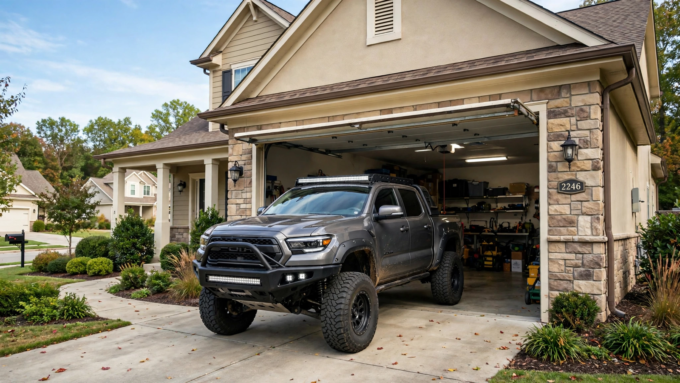
Garage parking at home deserves a real measurement, not a guess. Measure from the ground to the highest point of the truck, usually the antenna fin or roof, then measure the garage door opening and the lowest obstruction inside, often the door opener rail or the door itself when open. You want at least 2 inches of margin. For drivers wondering can you daily drive a truck with a 4 inch lift and still use their home garage every day, small tricks help: many owners gain clearance by switching to a stubby antenna, which can save 3 to 4 inches at the highest point.
For public parking, the strategy is simple: park farther out, back in, and skip structures with clearances under 7 feet when possible. Roof-mounted accessories like light bars and racks are what push a 4 inch truck over the edge, so if garage fit is tight, keep the roof clean. A truck that fits today will not fit after you add a roof basket, so plan accessories with the tape measure in hand.
- Back into spaces: the backup camera makes it easy, and leaving is simpler.
- Park farther out: a short walk beats door dings and tight squeezes every time.
- Know your exact height: measure to the antenna fin and memorize the number.
- Watch for low pipes: the posted clearance is not always the lowest obstruction.
- Skip compact spots: they were tight stock; they are impossible lifted.
Does a 4 inch lift hurt ride comfort?
This is the part of can you daily drive a truck with a 4 inch lift that surprises people: with a quality kit, ride comfort is close to stock, and some owners say it improves. Good aftermarket shocks absorb sharp bumps more progressively than factory twin-tubes, so potholes and expansion joints feel softer even though the truck is taller. The tradeoff is more body roll in corners and a slightly floatier feel on winding roads, because the center of gravity moved up and the suspension has more travel to work through.
Cheap lifts are where ride complaints come from. Spacer lifts keep the factory shocks working outside their designed range, which makes the ride harsh over sharp bumps and bouncy over dips. If ride quality matters for your commute, this is the strongest argument for spending the extra $500 to $1,000 on a complete kit with proper shocks. The cost difference between lift tiers is mostly the shocks and geometry parts that determine ride.
Tire choice affects ride as much as the lift. Load Range E tires at high pressure ride stiff; dropping to the correct pressure for the truck’s actual weight transforms comfort. Many shops overinflate big tires out of habit. Check the tire manufacturer’s load-inflation table and run the minimum pressure that supports your axle weights. Your back will notice the difference on a daily commute.
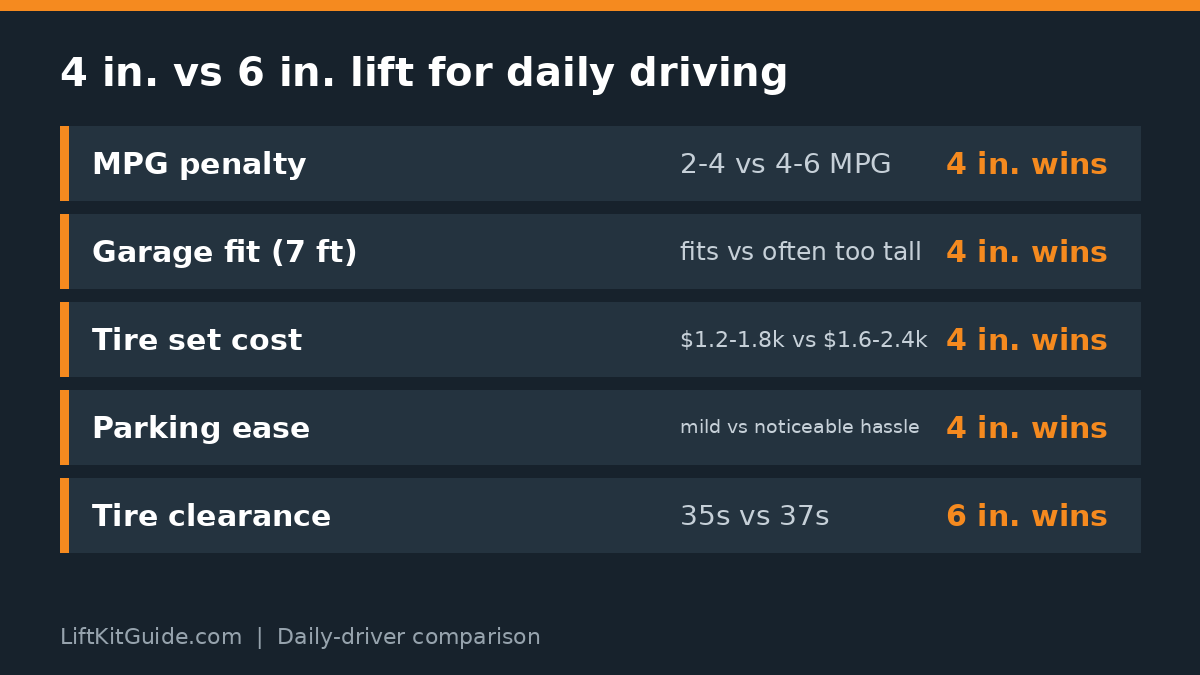
| Daily factor | 4 in. lift | 6 in. lift | Winner for commuting |
|---|---|---|---|
| Garage fit (7 ft door) | Usually fits | Often too tall | 4 in. |
| MPG penalty | 2-4 MPG loss | 4-6 MPG loss | 4 in. |
| Parking ease | Mild adjustment | Noticeable hassle | 4 in. |
| Tire cost per set | $1,200-$1,800 | $1,600-$2,400 | 4 in. |
| Entry height | One big step | Climb | 4 in. |
| Highway stability | Near stock | More wander | 4 in. |
What does it cost to daily drive a lifted truck?
Beyond the lift itself, daily driving a 4 inch lifted truck costs more in three recurring areas: fuel, tires, and maintenance. Fuel we covered: roughly $400 to $700 extra per year. Tires are the big one. A set of 35 inch all-terrains runs $1,200 to $1,800 and lasts 40,000 to 50,000 miles with religious rotation, versus $800 to $1,200 for stock-size tires. That is an extra $200 to $400 per year amortized.
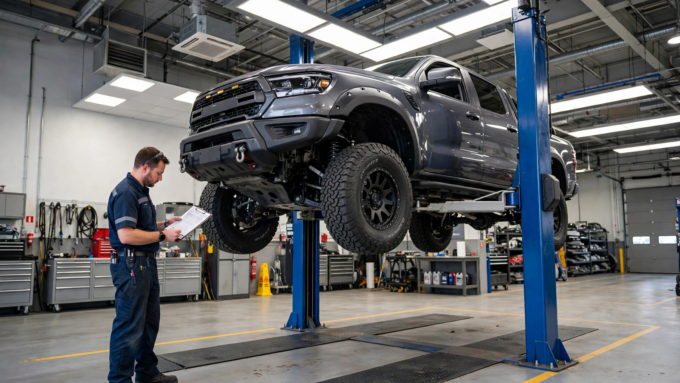
Maintenance increases modestly. Alignment checks should happen yearly instead of every few years, at $80 to $120 a pop, because lifted geometry is less forgiving. Ball joints, tie rods, and wheel bearings wear faster with heavy tires; budget an extra few hundred per year averaged over the truck’s life. None of this is ruinous, but it is real, and it is why the total cost of lifting a truck should include ownership, not just parts.
Insurance is the cost people forget. Tell your insurance company about the lift; premiums may rise slightly, but undeclared modifications can complicate claims far more. Some insurers ask about lift height specifically, and a 4 inch lift is generally easier to insure than 6 inches plus. The last piece of can you daily drive a truck with a 4 inch lift is paperwork. Finally, check lift kit legality in your state, since bumper height and headlight aim rules vary and tickets are an avoidable cost.
Who should and should not daily drive a 4 inch lift?
You are a good candidate if you have secure parking that fits, a commute that is mostly highway or suburban, and a budget that absorbs the fuel and tire premium without stress. Families do it happily with side steps for the kids. Contractors do it with the truck still working for a living. The 4 inch height is the reason it works: it asks for the smallest lifestyle changes of any real lift.
Think twice if you park in a low garage every day with inches to spare, drive mostly in a dense downtown with tight structures, or are stretching the budget to afford the lift itself. In those cases the daily friction, or the financial friction, outweighs the fun. A leveling kit that clears 33s gives most of the look with almost none of the compromise, and it is worth an honest look before committing.
The bottom line on can you daily drive a truck with a 4 inch lift is that thousands of people do, happily, as their only vehicle. It is not a sacrifice or a stunt; it is a slightly more expensive, slightly less convenient, noticeably more fun way to commute. Buy a quality kit, measure your garage, budget the running costs, and enjoy the view from up there. For the full picture on taller setups, see our guide to whether a 6 inch lift is too much for a daily driver.
Frequently asked questions
Will a 4 inch lifted truck fit in my garage?
Yes. A 4 inch lift typically puts a half-ton at 6 feet 8 inches to 6 feet 10 inches tall, which clears standard 7 foot garage doors.
How much MPG do you lose with a 4 inch lift?
Expect 2 to 4 MPG less than stock. A truck rated 18 MPG combined will typically see 14 to 16 MPG with a 4 inch lift and 35s.
Is it hard to park a lifted truck every day?
It is harder but manageable. Backup cameras and parking farther out solve most of the frustration within two weeks.
Does a 4 inch lift make the ride rough?
With a quality suspension kit, ride comfort is close to stock. Cheap spacer lifts ride worse.
Is it hard to get in and out of a lifted truck daily?
Side steps or power running boards fix entry and exit completely. Test the climb before committing.
Is a 4 inch lift better than a 6 inch for daily driving?
A 4 inch lift is easier to live with than a 6 inch in almost every daily metric: MPG, parking, height, and costs.
The bottom line
A 4 inch lift is one of the most daily-drivable lift heights you can choose. It is tall enough to look right and clear 33 to 35 inch tires, but short enough to keep the truck manageable in parking lots, garages, and traffic. Most owners adapt within two weeks.
Go in with eyes open on costs: fuel, tires, and maintenance all run higher than stock. If you can accept 2 to 4 fewer MPG and $1,000-plus tire sets, a 4 inch lifted truck makes a genuinely enjoyable daily driver.



Leave a comment