


Last updated: October 2026 Written by the LiftKitGuide Team, truck suspension installers and editors
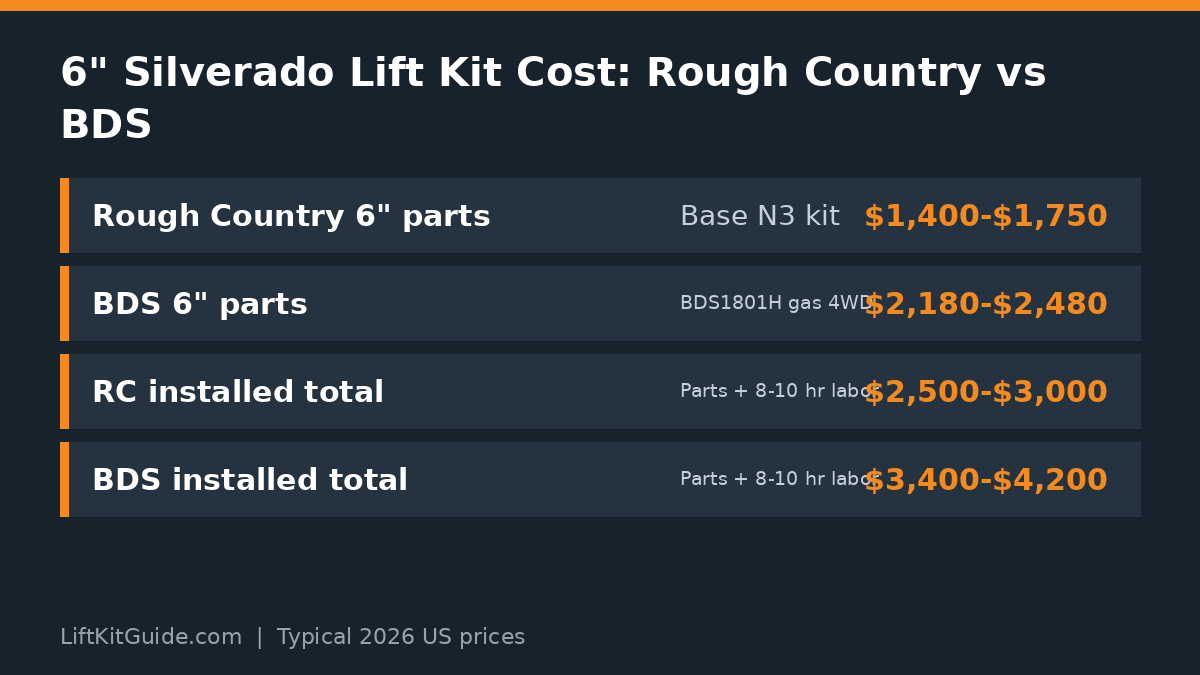
In the rough country 6 vs bds 6 lift silverado matchup, Rough Country’s 6-inch kit for a 2019-2024 Silverado 1500 4WD typically runs $1,400 to $1,750 in parts, while the BDS 6-inch kit lists around $2,180 to $2,480 for the same truck. That $700 to $1,000 gap buys BDS’s Factory Protection Plus warranty with a 5-year/100,000-mile drivetrain warranty, CNC-machined ductile iron steering knuckles, and heavier 1/4-inch steel crossmembers. For budget street trucks, Rough Country is fine; for towing, off-road use, or long ownership, the BDS premium is justified.
Key takeaways
- Rough Country’s 6-inch Silverado 1500 kit costs roughly $1,400 to $1,750 in parts; the comparable BDS 6-inch kit costs $2,180 to $2,480 — a gap of $700 to $1,000 before install labor.
- Both kits are drop-bracket (crossmember) designs that clear 35- to 37-inch tires and keep factory track width, but BDS includes ductile iron steering knuckles and a full skid plate system.
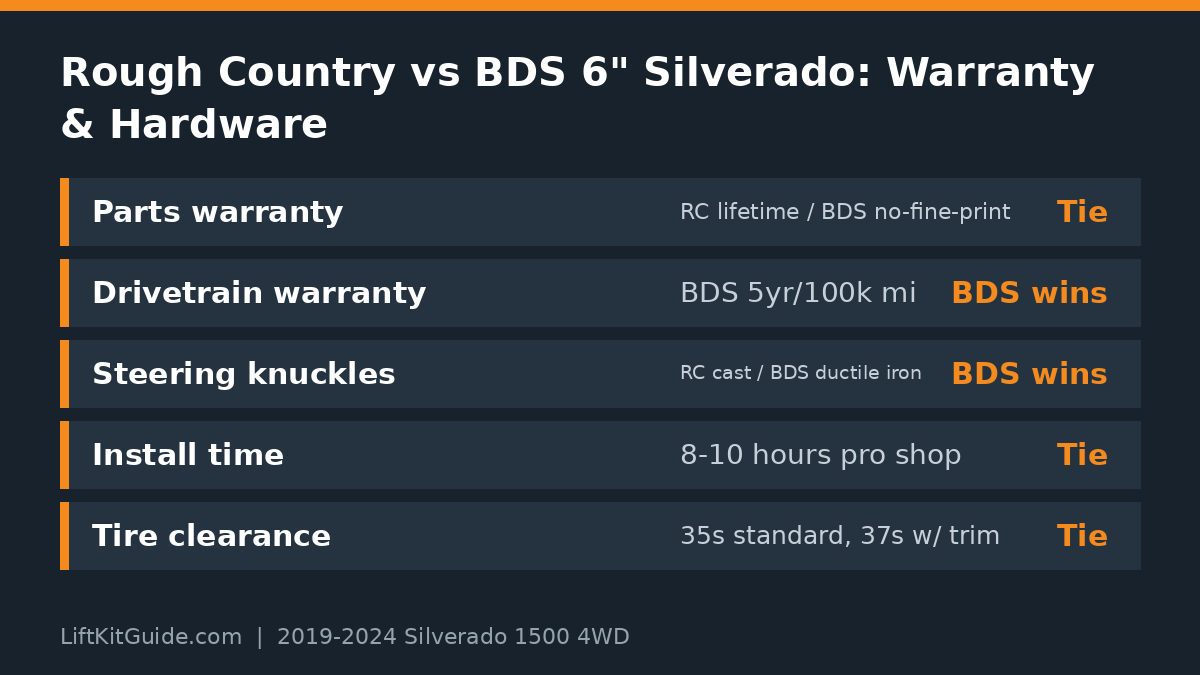
- BDS backs every kit with its Factory Protection Plus warranty: no-fine-print parts coverage plus a 5-year/100,000-mile drivetrain warranty that Rough Country does not match.
- Professional installation runs 8 to 10 hours for either kit and typically adds $1,000 to $1,600 in labor, so installed totals land near $2,500 to $3,000 (RC) versus $3,400 to $4,200 (BDS).
- Choose Rough Country for a street-driven show truck on a budget; choose BDS if you tow heavy, wheel hard, or plan to keep the Silverado past 100,000 miles.
On this page
What do you actually get in each 6-inch Silverado kit?
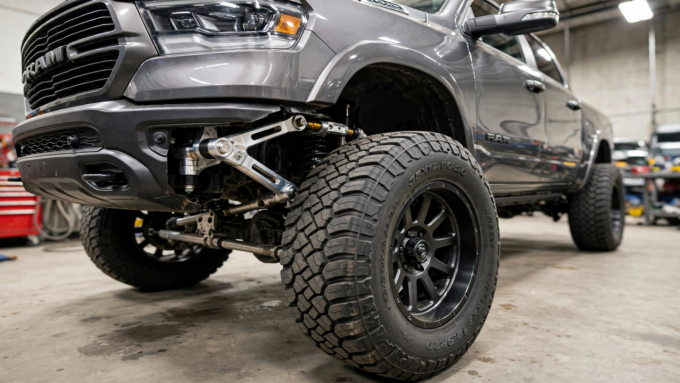
Both kits follow the proven drop-bracket playbook for the 2019-2024 Silverado 1500: tall front crossmembers lower the differential and control arm mounts so the suspension keeps near-factory angles at 6 inches of lift. Rough Country ships high-clearance crossmembers, lifted steering knuckles, differential drop brackets, a rear block kit with longer U-bolts, sway bar relocation brackets, and a set of its N3 or V2 shocks depending on the sub-kit you choose. It is a complete system in one box with no mystery add-ons required for a stock truck. shoppers weighing the rough country 6 vs bds 6 lift silverado decision
The BDS 6-inch kit for the same generation covers the same ground but upgrades several hard parts. You get 1/4-inch steel crossmembers, precision CNC-machined ductile cast iron steering knuckles, heavy-duty replacement tie rod ends, multipoint differential relocation brackets, a front and differential HD skid plate system, performance-series upper control arms, top-mounted strut spacers, sway bar and brake line relocation, a rear block kit, and your choice of gas shocks. BDS also engineers the kit to stay compatible with the factory electronic stability control system, which matters if you ever need warranty-style documentation of safe installation.
The philosophical difference shows up in the details most buyers never see. Rough Country uses cast knuckles and lighter bracketry that is perfectly adequate for street and light trail use. BDS overbuilds the steering and bracketry for people who will actually punish the truck. If your Silverado will see a ranch, a jobsite, or a heavy trailer, those differences are where your money goes. Shoppers comparing the best lift kit brands will notice BDS consistently ranks in the premium tier for exactly this reason. In the rough country 6 vs bds 6 lift silverado comparison, that distinction matters for hard-use trucks.
| Component | Rough Country 6-inch | BDS 6-inch |
|---|---|---|
| Steering knuckles | Cast lifted knuckles | CNC-machined ductile cast iron knuckles |
| Crossmembers | High-clearance steel crossmembers | 1/4-inch steel crossmembers |
| Upper control arms | Optional upgrade | Performance-series UCAs included |
| Skid plates | Basic front skid plate | Front + differential HD skid plate system |
| Shocks | N3 twin-tube (V2/Vertex optional) | Gas shocks (Fox 2.0 optional) |
| Rear lift | Block kit with U-bolts | Block kit with U-bolts |
How wide is the rough country 6 vs bds 6 lift silverado price gap?
The street-price gap is real and consistent. Rough Country’s 6-inch kit for a 2019-2023 Silverado 1500 4WD lists around $1,399 to $1,750 depending on the shock upgrade you pick, with the N3 base kit at the bottom and V2 or Vertex-equipped versions climbing higher. BDS’s 6-inch kit (BDS1801H for gas 2019-2024 4WD) is commonly listed at $2,179 to $2,480. So the parts-only gap is roughly $700 to $1,000, which is about 40 to 60 percent more for the BDS box. Anyone shopping the rough country 6 vs bds 6 lift silverado market should price both at the same shock tier. Current street pricing for the BDS kit can be checked on this BDS 6-inch Silverado kit listing, which also details the full parts breakdown.
Installation does not discriminate much between the brands. Both are 8- to 10-hour jobs at a competent shop because the crossmember install requires cutting the factory frame brackets and welding in some cases, relocating the differential, and re-routing brake lines. At $125 to $160 per hour of shop labor, plan on $1,000 to $1,600 in labor either way. That puts realistic installed totals at $2,500 to $3,000 for Rough Country and $3,400 to $4,200 for BDS. Shoppers should also budget $150 to $250 for tires-and-wheels-era extras like an alignment ($100 to $150) and possibly longer shocks if they deviate from the kit.
The gap narrows slightly if you compare top-trim versions of both kits, since Rough Country’s Vertex coilover 6-inch setup can push past $3,000 in parts. But at the base-kit level where most buyers shop, the BDS premium is a clean $700 to $1,000. The question the rough country 6 vs bds 6 lift silverado debate always comes back to is whether the warranty and hardware upgrades are worth that money — which the next sections answer. For a broader sense of what a 6-inch lift costs across brands, the installed range above is typical for all premium drop-bracket kits.
| Cost item | Rough Country | BDS |
|---|---|---|
| Parts (base kit) | $1,400 – $1,750 | $2,180 – $2,480 |
| Professional labor (8-10 hr) | $1,000 – $1,600 | $1,000 – $1,600 |
| Alignment | $100 – $150 | $100 – $150 |
| Installed total | $2,500 – $3,000 | $3,400 – $4,200 |
Which kit rides better on a daily-driven Silverado?
On pavement with the base shock packages, the ride difference is smaller than the price difference. Both kits keep the factory struts or replace them with similarly-valved twin-tube or monotube shocks, and both retain factory-like spring rates up front. Daily drivers on either kit report a firm but controlled ride with slightly more body roll than stock thanks to the higher center of gravity. Neither kit is a magic carpet, and neither ruins the truck.
The difference appears when you option up. BDS lets you spec Fox 2.0 Performance Series shocks (the FSR versions), and the BDS1803FSR diesel variant runs about $3,174 with Fox 2.0s — a meaningful damping upgrade that owners consistently praise for washboard roads and towing stability. Rough Country’s answer is its V2 monotube and Vertex adjustable coilover upgrades, which are genuinely good but add cost that erodes the value advantage. A base RC kit on N3 shocks rides noticeably stiffer and less controlled than a BDS kit on Fox 2.0s, though the gap is mostly the shocks, not the brackets. That is why the rough country 6 vs bds 6 lift silverado ride debate usually comes down to shocks, not brackets.
For a truck that spends 90 percent of its life commuting, either base kit is livable, and spending the price difference on better shocks narrows the ride gap more than any brand badge does. The ride verdict: BDS wins on refinement out of the box, Rough Country wins on ride-per-dollar. If ride quality is your top priority, also read whether a 6-inch lift is too much for a daily driver before committing to the height at all.
Does the BDS warranty justify the premium in the rough country 6 vs bds 6 lift silverado debate?
This is where the rough country 6 vs bds 6 lift silverado comparison tilts hardest toward BDS. BDS includes Factory Protection Plus with every lift kit: a no-fine-print warranty on the kit parts themselves plus a 5-year/100,000-mile drivetrain warranty that covers the components the lift touches. No other mainstream lift brand offers a drivetrain warranty like it, and for a truck you plan to keep long-term, that coverage is worth real money — a single differential or CV failure can cost more than the price gap.
Rough Country counters with its Lifetime Replacement Warranty, which covers the kit’s hard parts for as long as you own the truck. That is genuinely good coverage for brackets, knuckles, and blocks, and Rough Country honors it without much hassle according to owner reports. What it does not cover is the drivetrain: if a CV axle, differential, or transfer case issue gets blamed on the lift, you are on your own. For a street truck that never tows, that distinction rarely matters. For a work truck, it matters a lot.
The warranty math is simple: if there is any chance you will need drivetrain coverage during your ownership, the BDS premium pays for itself the first time it saves a $1,500 repair. If the truck is a weekend toy with a short ownership horizon, Rough Country’s parts warranty is plenty. Owners worried about factory coverage should also check whether a lift kit voids the factory warranty for the full legal picture.
How do installation difficulty and time compare?
Both kits are rated difficult by their manufacturers, and both list 8 hours as the book time for a professional shop with a lift, air tools, and a welder on hand. The crossmember install is the crux: the factory front crossmember brackets get cut out, the new tall crossmembers bolt in, and the differential drops into its new mounts. BDS’s instructions are widely regarded as the best in the business — clear torque specs, good diagrams, and a logical sequence — which is one reason shops quote BDS installs confidently. For the rough country 6 vs bds 6 lift silverado install question, plan on a full weekend if you DIY.
Rough Country’s instructions are serviceable but less polished, and a few owner threads mention head-scratching moments around the differential drop and sway bar relocation steps. An experienced shop will not care; a first-time DIYer in a driveway absolutely should. Neither kit is a realistic driveway job for most people — you need a welder for some steps, a transmission jack helps enormously, and the alignment afterward is mandatory. Budget a full weekend if you attempt it yourself, and have a backup vehicle.
One practical note: because the BDS kit’s brackets are thicker and its skid plates add steps, some shops quote an extra hour for BDS versus RC. At typical labor rates that is $125 to $160, which is noise compared to the parts gap. Either way, get the alignment done immediately after — lift kit installation costs almost always exclude the alignment, and driving a fresh 6-inch lift to the alignment shop is the one trip you are allowed.
Which kit clears bigger tires and wheels?
Tire clearance is a tie. Both kits are engineered around 35×12.50 tires on 20×9 wheels with roughly 0 to +18mm offset, and both can squeeze 37×12.50s with the right wheel specs and minor trimming of the front valance and inner liner. BDS’s product pages explicitly list 35- to 37-inch compatibility, and Rough Country’s 6-inch Silverado kits carry the same ratings. Neither kit changes track width, so your wheel offset math is identical for both.
Where they differ slightly is in the details that make big tires livable. BDS includes more complete brake line and sway bar relocation hardware, which matters when 37s cycle the suspension to full droop. Rough Country covers the essentials but a few owners running 37s report needing extended brake lines as a follow-up purchase — a $100 to $200 add-on that slightly trims the savings. If 37s are the goal, confirm brake line length with either brand before you order. Either way, the rough country 6 vs bds 6 lift silverado tire math is identical since track width is unchanged.
Gearing is the hidden cost of big tires regardless of brand. Moving from stock 33s to 37s on a Silverado 1500 with 3.23 or 3.42 gears will make the truck feel sluggish and cost 2 to 4 MPG; a regear to 4.10s runs $1,500 to $2,500 installed. Read whether you need to regear for 35s for the full breakdown — it applies even more strongly at 37 inches.
What do owners say after 20,000 miles on each kit?
Long-term owner feedback is where the two brands’ reputations were earned. BDS owners at 20,000 to 50,000 miles overwhelmingly report tight, rattle-free brackets, no unusual tire wear after the initial alignment, and good experiences with warranty claims — including the drivetrain warranty, which several owners have used successfully for CV and differential issues. The most common BDS complaint is the price, followed by the kit’s weight (shipping is freight, and the install is a workout). Long-term, the rough country 6 vs bds 6 lift silverado ownership story favors BDS past the 5-year mark.
Rough Country owners are a split camp. The satisfied majority — mostly street-driven trucks — report no issues at similar mileages and consider the kit a bargain. The vocal minority reports premature ball joint and bushing wear, powder-coat chipping on brackets in salt states, and a rougher ride as the N3 shocks age past 30,000 miles. Some of that is the shock tier rather than the brand, but the pattern is consistent enough to mention: budget for replacement shocks or upgraded UCAs around year three if you go RC.
The honest synthesis from forums and shops: Rough Country is a 3- to 5-year kit for most owners, BDS is a 10-year kit. That lines up almost exactly with the price gap, which is why the Rough Country vs BDS vs Zone comparison keeps reaching the same conclusion across truck platforms.
- BDS at 50k miles: owners report tight, rattle-free brackets and successful drivetrain warranty claims for CV and differential issues.
- RC at 30k miles: satisfied street-truck owners report no issues; the vocal minority notes bushing wear and aging N3 shocks.
- Common to both: re-torque all hardware at 500 miles and align immediately — skipping either causes the tire wear owners complain about.
- Salt states: BDS powder-coat and thicker brackets hold up better; budget RC owners should rinse the undercarriage regularly.
So which 6-inch lift should your Silverado get?
Buy the Rough Country 6-inch if your Silverado is a street truck, your budget is firm, and you will own it fewer than five years. At $1,400 to $1,750 in parts, nothing else delivers the 6-inch look for the money, the Lifetime Replacement Warranty covers the parts that matter, and the ride is perfectly acceptable for commuting and light towing. Put the $800 you saved toward 35s or the alignment and gearing the truck will eventually want.
Buy the BDS 6-inch if you tow heavy, go off-road, live where salt eats cheap powder-coat, or plan to keep the truck past 100,000 miles. The $2,180 to $2,480 buy-in gets you ductile iron knuckles, thicker crossmembers, a real skid plate system, Fox shock options, the best instructions in the industry, and the only drivetrain warranty in the business. Over a long ownership, the premium is cheap insurance. That is the core of the rough country 6 vs bds 6 lift silverado verdict: match the kit to your ownership plan.
Either way, do not skip the supporting math: 8 to 10 hours of labor, an alignment, and honest tire-and-gearing costs. A 6-inch lift is a $4,000 to $7,000 project all-in with wheels and tires no matter whose brackets you buy — the Silverado lift kit guide has the full platform breakdown if you want to compare heights before you commit.
Frequently asked questions
How much does a 6-inch lift cost for a Silverado 1500 installed?
A Rough Country 6-inch kit installed typically totals $2,500 to $3,000 including labor and alignment. A BDS 6-inch kit installed runs $3,400 to $4,200. Wheels, tires, and regearing are extra and can add $3,000 to $6,000 more.
Is BDS better than Rough Country?
BDS uses heavier brackets, ductile iron knuckles, and includes a 5-year/100,000-mile drivetrain warranty, so it is the better-engineered kit. Rough Country is the better value — its kits work fine for street trucks at 40 to 60 percent lower cost.
What size tires fit a 6-inch lifted Silverado 1500?
Both Rough Country and BDS 6-inch kits clear 35×12.50 tires on 20×9 wheels with 0 to +18mm offset. 37×12.50s fit with minor trimming and the right wheel specs, but expect to regear and lose 2 to 4 MPG.
Does BDS really cover the drivetrain?
Yes. BDS Factory Protection Plus includes a 5-year/100,000-mile drivetrain warranty on top of the no-fine-print parts warranty. It is the only mainstream lift brand offering drivetrain coverage, and owners have successfully used it for CV and differential claims.
Can I install a 6-inch Silverado lift kit myself?
It is possible but difficult. Both kits book at 8 hours for professionals and require cutting, possible welding, differential relocation, and a mandatory alignment afterward. Most owners are better off paying $1,000 to $1,600 for professional installation.
Do I need to regear a Silverado 1500 with a 6-inch lift?
With 35-inch tires, most 3.23-geared Silverados feel sluggish and should consider 4.10 gears ($1,500 to $2,500 installed). With 37s, regearing is strongly recommended. Stock 3.42 gears tolerate 35s acceptably for light use.
The bottom line
For a budget street build, Rough Country’s 6-inch Silverado kit is the rational buy — it delivers the stance, clears 35s, and carries a lifetime parts warranty for roughly $1,000 less than BDS installed.
If you tow, wheel, or keep trucks long-term, the BDS premium buys measurably better hardware and the industry’s only drivetrain warranty — over 100,000 miles, it is the cheaper kit to own.



Leave a comment