


Last updated: October 2026 Written by the LiftKitGuide Team, truck suspension installers and editors
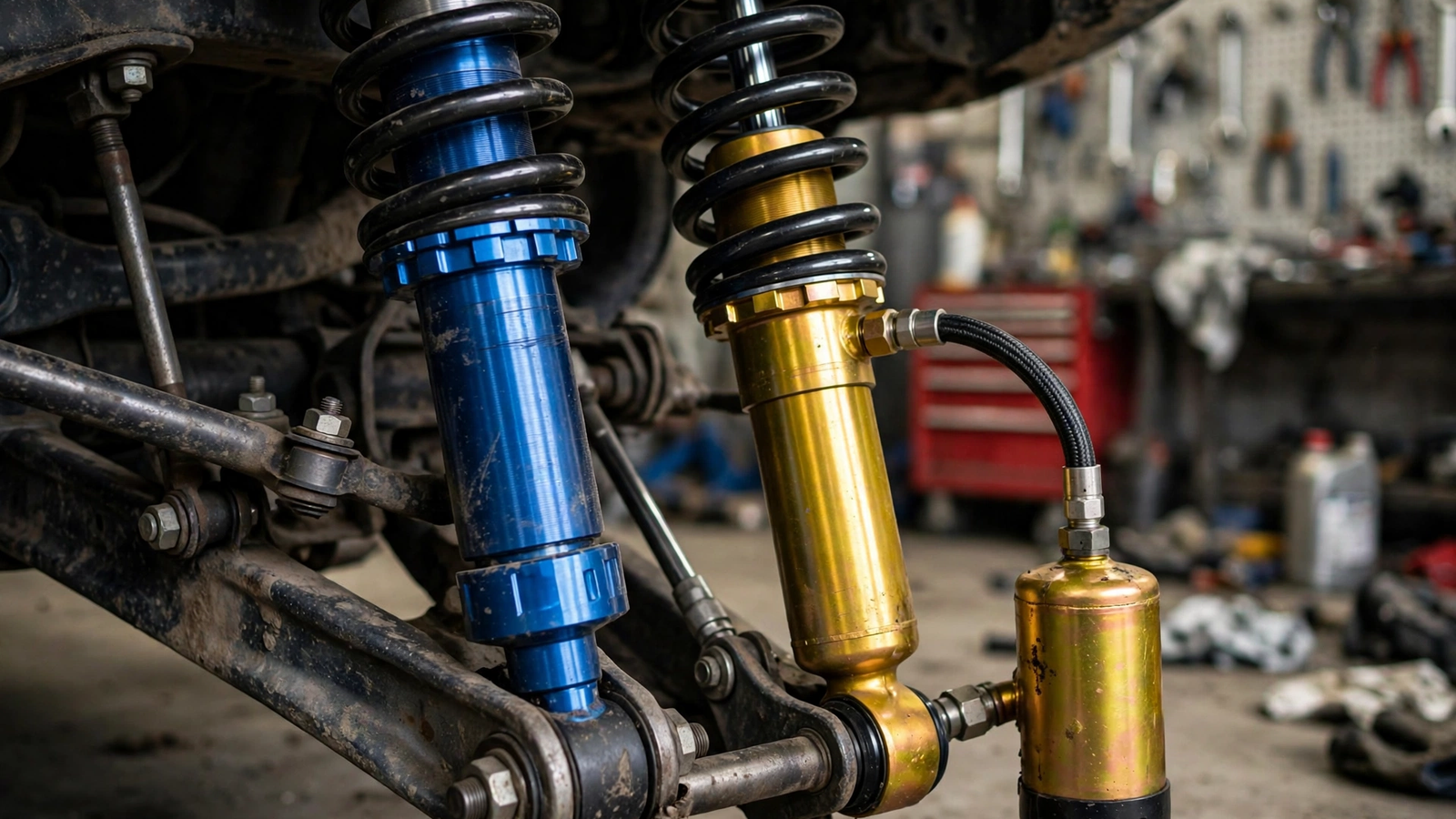
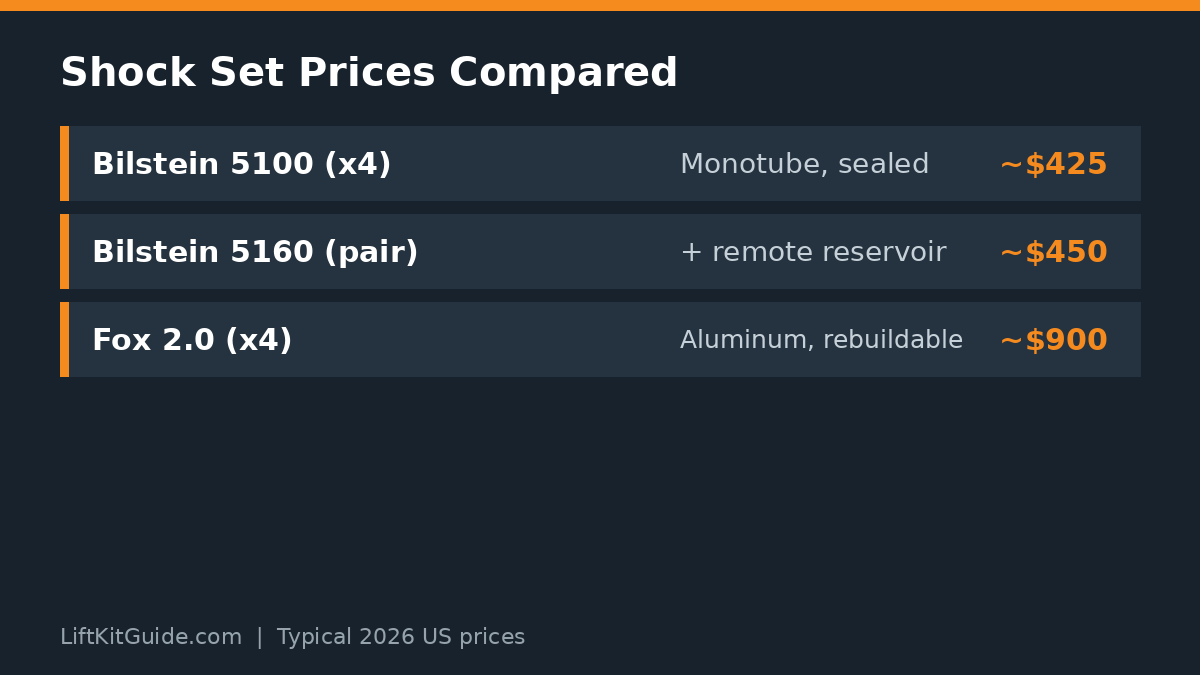
The fox 2.0 vs bilstein 5100 vs bilstein 5160 question comes down to budget versus heat management versus rebuildability. Bilstein 5100s cost roughly $425 for a set of four, use monotube digressive valving, and are the undisputed value pick for daily-driven lifted trucks. Bilstein 5160s are essentially 5100s with a remote reservoir, running about $450 per pair for the rear, and the extra fluid capacity keeps them cooler under sustained load. Fox 2.0 Performance shocks cost around $900 per set, ride slightly plusher, and are rebuildable, but one long-term owner reported a leak at 8,000 miles and increased body roll by 15,000.
Key takeaways
- Bilstein 5100: ~$425/set, monotube digressive valving, best value for daily drivers.
- Bilstein 5160: 5100 + remote reservoir (~$450/rear pair), runs cooler under sustained load.
- Fox 2.0: ~$900/set, plusher small-bump ride, rebuildable aluminum body.
- One owner running all three reported a Fox 2.0 leak at 8k miles and more body roll by 15k.
- 5100s are sealed throwaway units; Fox 2.0s can be rebuilt instead of replaced.
On this page
What is the fox 2.0 vs bilstein 5100 vs bilstein 5160 debate?
The fox 2.0 vs bilstein 5100 vs bilstein 5160 debate is the shock absorber argument that never dies in truck forums. All three are monotube gas shocks aimed at lifted and leveled trucks, all three have devoted followings, and one JL Wrangler owner famously bought all three sets and ran them back to back on the same truck to settle it. His verdict, like most honest comparisons, was that the differences are real but smaller than the internet suggests.
The short version: Bilstein 5100s are the value king at roughly $425 for a set of four, the 5160 adds a remote reservoir to the 5100 formula for heat management, and the Fox 2.0 Performance series costs about $900 a set while adding rebuildability and a slightly plusher ride. If you are choosing dampers for a suspension lift kit, this trio covers 90 percent of real-world builds.
The three-shock test that defines the fox 2.0 vs bilstein 5100 vs bilstein 5160 debate is remarkable for its honesty. The owner bought all three sets with his own money, ran them on the same Jeep over the same Colorado trails, and reported the unflattering details about each. That kind of back-to-back testing is vanishingly rare in the aftermarket world, where most reviews are unboxing videos. When someone spends $2,000 of their own money to answer a question, pay attention to the answer.
How much do Fox 2.0 vs Bilstein 5100 vs 5160 cost?
Price is the starkest difference in the fox 2.0 vs bilstein 5100 vs bilstein 5160 lineup. Bilstein 5100s run about $425 for all four corners, making them the default recommendation for budget builds; TacomaWorld’s famous $570 mixed-lift recipe prices front and rear 5100s at $300 alone. Bilstein 5160s, sold mostly as rear pairs with remote reservoirs, cost around $450 per pair, so a mixed 5100-front/5160-rear setup lands near $650 to $750.
Fox 2.0 Performance shocks sit near $900 for a set of four, roughly double the 5100s. That premium buys an aluminum body that resists corrosion better than plated steel, rebuildable internals, and Fox’s linear-feeling valving. Whether it is worth it depends on how long you keep trucks: a $900 rebuildable set serviced once can outlast two $425 throwaway sets. Our cost to lift a truck guide shows where shocks sit in the total budget.
Pricing dynamics in the fox 2.0 vs bilstein 5100 vs bilstein 5160 market shift with sales and seasons. Bilstein 5100s routinely drop to $380 to $400 for a set during holiday sales, while Fox 2.0s occasionally dip toward $800. The 5160 rear-pair pricing stays relatively stable around $450. If you are patient, buying during Black Friday or Memorial Day sales can fund your alignment with the savings. Set price alerts and pounce; shocks are a commodity purchase where timing matters.
| Shock | Approx. set price | Body | Rebuildable |
|---|---|---|---|
| Bilstein 5100 (x4) | ~$425 | Zinc-plated steel monotube | No (sealed) |
| Bilstein 5160 (rear pair) | ~$450 | Steel monotube + reservoir | No (sealed) |
| Fox 2.0 Performance (x4) | ~$900 | Aluminum monotube | Yes |
| Mixed 5100/5160 | ~$650-$750 | Steel monotube | No (sealed) |

How do the valving and ride compare?
Valving philosophy separates these shocks more than marketing does. The Bilstein 5100 uses digressive valving: firm control over big, fast hits with a relatively compliant feel on small chatter. Owners describe it as controlled and confidence-inspiring, if occasionally stiff on sharp-edged potholes. The 5160 shares the 5100’s valving with the reservoir’s oil volume added; several owners note the 5160 feels slightly more comfortable because the valving can live partly in the reservoir.
The Fox 2.0 uses a more linear valving curve that feels plusher over small bumps and washboard, which is why daily drivers often prefer it. The tradeoff appeared in the famous three-shock comparison: after 15,000 miles the owner noticed increased body roll and a tendency for the truck to rock side to side for several cycles over uneven bumps, suggesting less low-speed damping authority than the Bilsteins. Neither is objectively better; they are tuned for different priorities. If your truck rides rough after lifting, the shock is only one variable among springs, tires, and pressure.
Digressive versus linear valving is the engineering heart of the fox 2.0 vs bilstein 5100 vs bilstein 5160 ride debate. Digressive valving, used by Bilstein, provides high damping force at low shaft speeds for control, then levels off to avoid harshness on big hits. Linear valving, used by Fox, increases damping proportionally with shaft speed, feeling plusher initially but working harder on big impacts. Digressive suits heavy trucks that need control; linear suits lighter trucks where comfort rules.
Shaft diameter is a quiet differentiator. The Fox 2.0 uses a 5/8-inch hard-chromed shaft, while Bilstein uses a 14mm shaft on the 5100 series. Larger shafts displace more oil, which changes damping characteristics subtly. In practice, both are durable; shaft size matters less than valving for ride quality, but it contributes to the premium feel.
Which wins the fox 2.0 vs bilstein 5100 vs bilstein 5160 heat-management test?
Heat is the enemy of shock performance, and this is the 5160’s reason to exist. A remote reservoir adds fluid capacity and surface area, so the shock oil stays cooler during sustained cycling, towing a trailer over mountain passes, or running washboard roads loaded. The RamForum consensus is blunt: the 5160 is pretty much a 5100 with a reservoir, and the only benefit is that it runs cooler when worked hard.
The Fox 2.0’s aluminum body dissipates heat better than steel, which helps, but it has no reservoir in the base Performance series; Fox sells a separate 2.0 reservoir version at a higher price. For a street truck that occasionally tows, the 5100 is plenty. For a truck that tows heavy regularly or runs desert roads, the 5160 rear upgrade is the rational middle ground between 5100 value and Fox money. Read the owner’s three-shock comparison for the full back-to-back impressions that inform this guide.
Temperature testing reveals what spec sheets do not. In controlled comparisons, monotube shocks with larger oil volumes maintain consistent damping longer than smaller twin-tubes. The 5160’s reservoir effectively increases oil volume and cooling surface, which is why it punches above its price in sustained-use scenarios. For short trips the difference is academic; for desert running it is decisive.
Are Fox 2.0 shocks worth double the price of 5100s?
Whether Fox 2.0 shocks are worth double the 5100 price depends on your time horizon and your eyes. The rebuildability argument is real: a Fox 2.0 can be serviced with fresh seals and oil indefinitely, while 5100s are sealed throwaway units. Over 120,000 miles, one $900 Fox set plus one $200 rebuild can beat two $425 Bilstein sets on cost, and you keep the aluminum bodies that will not rust like plated steel.
But the honest counterpoint is that most owners never rebuild anything. If you trade trucks every five years, the 5100’s lower buy-in wins outright, and the lifetime warranty against defects, though not wear, covers the ownership period. The fox 2.0 vs bilstein 5100 vs bilstein 5160 value crown for the average owner stays with Bilstein; Fox wins for the keeper truck and the owner who appreciates serviceable hardware. Check lift kit brands for how the parent companies compare beyond shocks.
Corrosion is the silent killer in the fox 2.0 vs bilstein 5100 vs bilstein 5160 longevity equation, especially in salt-belt states. The Fox 2.0’s aluminum body simply does not rust, a meaningful advantage for trucks that see winter road salt. Bilstein’s zinc plating protects well initially but eventually shows surface rust; annual fluid-film application keeps it cosmetic rather than structural. If you keep trucks a decade in the Rust Belt, the Fox corrosion resistance alone may justify the premium.
Rebuildability changes the long-term math. A Fox 2.0 can be rebuilt for roughly $100 per corner in parts, effectively resetting its lifespan. Bilsteins are sealed throwaways by comparison, though their lower purchase price softens that reality.
What do owners report after 30,000-plus miles?
Long-term reports are consistent across forums. Bilstein 5100 owners routinely get 50,000 to 70,000 miles of good damping, with the rears fading first on trucks that tow. The zinc plating eventually shows surface rust in salt states, which is cosmetic but real; Fluid Film or similar undercoating helps. Nobody reports catastrophic 5100 failures at normal mileage, which is why shops recommend them without hesitation.
Fox 2.0 long-term reports are mostly positive with one caution from the three-shock test: a leak at 8,000 miles, fixed under warranty with the owner paying shipping, and increased body roll by 15,000 miles. Other owners report years of trouble-free service, so treat that data point as a reminder that any shock can fail rather than a pattern. The 5160 has the thinnest long-term record simply because fewer owners buy it, but its sealed construction suggests 5100-like longevity with better heat behavior. All three beat stock dampers by a wide margin.
Warranty realities temper the fox 2.0 vs bilstein 5100 vs bilstein 5160 marketing claims. Bilstein’s limited lifetime warranty covers defects, not wear, which means a shock that simply wears out at 60,000 miles is not covered. Fox’s warranty terms are typically shorter. Neither warranty replaces the value of buying from an authorized dealer who will advocate for you. Keep your receipt and document installation dates; warranty claims without paperwork go nowhere regardless of brand.
- 5100 longevity: 50,000-70,000 miles typical; rears fade first when towing.
- 5160 longevity: similar to 5100, with better sustained-heat behavior.
- Fox 2.0 longevity: similar miles, plus rebuild option; watch for early leaks.
- Corrosion: Fox aluminum resists rust; Bilstein zinc plating needs undercoating in salt states.
- Warranty: Bilstein limited lifetime (defects, not wear); Fox 1-year typical.
Which shock should you buy for a 2.5-inch lift?
For a 2.5-inch lift on a daily driver, the fox 2.0 vs bilstein 5100 vs bilstein 5160 answer is the 5100 for most buyers. Set the front 5100 snap rings to the middle or top groove for your desired height, pair with extended-length rears, and spend the $475 you saved over Fox on an alignment and a diff drop. The truck will ride better than stock and the shocks will last years.
Step up to the 5160 rears if you tow a camper or run loaded on rough roads regularly; the reservoir’s cooling is cheap insurance at about $150 more than 5100 rears. Choose the Fox 2.0 if you keep trucks a decade, value rebuildability, or simply prefer the plusher small-bump feel and corrosion-proof body. Our 6-inch lift cost breakdown and installation pricing help finalize the full budget once dampers are decided.
| Use case | Recommended shock | Why |
|---|---|---|
| Daily driver on a budget | Bilstein 5100 | Unbeatable value with great control |
| Towing and heavy loads | Bilstein 5160 rear | Reservoir cooling under sustained load |
| Long-term keeper truck | Fox 2.0 | Rebuildable and corrosion-proof |
| Maximum performance | Fox 2.0 reservoir | Best heat management and tuning |
Can you mix and match these shocks on one truck?
Mixing is common and sensible. The most popular hybrid is Bilstein 5100 adjustable fronts for height control with 5160 reservoir rears for heat management under load, a setup many tow-oriented owners run. What you should not do is mix worn and new dampers, or mix wildly different valving philosophies front to rear, which can make handling unpredictable.
Length matching matters more than brand matching. Rear 5160s are application-specific in a way 5100s are not, so verify the part number against your exact lift height before ordering. And whatever you choose, replace all four corners together; a lifted truck on two new and two tired shocks rides worse than a truck on four matched mid-tier dampers. Torque everything at ride height and recheck after 500 miles.
The mixed setup deserves emphasis in any fox 2.0 vs bilstein 5100 vs bilstein 5160 buying guide. Running 5100s up front for their height adjustability with 5160s in the rear for reservoir cooling gives you 90 percent of the premium experience at 70 percent of the Fox price. This hybrid approach is popular among tow-oriented owners who need front lift flexibility and rear heat management. It is the thinking person’s answer to the shock debate.
Frequently asked questions
What is the difference between Bilstein 5100 and 5160?
The 5160 is a 5100 with a remote reservoir: same monotube digressive valving, but the reservoir adds fluid capacity so the shock runs cooler during sustained cycling. The main benefit is fade resistance when towing, hauling, or running washboard roads, not a different ride feel.
Are Fox 2.0 shocks rebuildable?
Yes. Fox 2.0 Performance series shocks are designed to be rebuildable and revalvable, which is a major long-term advantage. Bilstein 5100s and 5160s are sealed units; when they wear out, you replace them.
How long do Bilstein 5100s last?
For a street-driven truck, 50,000 to 70,000 miles is a reasonable expectation for 5100s before damping noticeably fades. Fox 2.0s can go similar distances but benefit from a rebuild around the same interval if you want peak performance.
Can you mix 5100 fronts with 5160 rears?
You can, and many owners do exactly that: 5100s up front for the adjustable height and 5160s in the rear for the reservoir cooling under load. Just make sure the 5160 length matches your rear lift height, since they are less universal than 5100s.
Do Fox 2.0 ride better than Bilstein 5100?
Both are quality monotube shocks, and the differences are smaller than brand loyalists claim. Fox 2.0s tend to feel slightly plusher on small bumps and offer rebuildability; 5100s cost roughly half as much and their digressive valving controls big hits well. Most daily drivers are happy with either.
Do I need longer shocks with a leveling kit?
Yes for the fronts if you want height adjustment; the 5100 front struts have snap-ring grooves for 0 to 2.75 inches of lift. For the rears, choose extended-length 5100s or 5160s matched to your lift height, since stock-length shocks will top out.
The bottom line
The fox 2.0 vs bilstein 5100 vs bilstein 5160 decision is simpler than the forums make it look. Daily driver on a budget: Bilstein 5100s, no contest, the value is overwhelming. Towing heavy or running hard in heat: step up to the 5160s for the reservoir’s cooling. Want rebuildability and the most compliant ride, and you will actually service them: Fox 2.0.
All three are proven, quality dampers that outperform stock and no-name shocks by a wide margin. Match the shock to your use case, buy all four corners at once, install them correctly, and align the truck. The wrong choice is not among these three; it is leaving worn factory shocks on a lifted truck.





Leave a comment