


Last updated: October 2026 Written by the LiftKitGuide Team, truck suspension installers and editors
The benefits of lifted trucks start with real capability: more ground clearance, room for bigger tires with better traction, stronger off-road angles and a higher view of the road. The downsides are just as real: fuel economy drops 1 to 4 mpg, suspension and steering parts wear faster, and a tall build may not fit a standard garage. Whether the benefits of lifted trucks outweigh the costs depends on how you actually use your truck every week.
Key takeaways
- Ground clearance is the headline benefit: a suspension lift raises the frame 2 to 6+ inches, and bigger tires add another 1 to 2 inches under the axles.
- The lift itself mostly makes room; the 35- and 37-inch tires it allows deliver the traction and flotation gains on sand, mud and snow.
- Expect fuel economy to fall 1 to 4 mpg, and budget for faster wear on ball joints, CV axles and wheel bearings.
- A 6-inch lift on 37s often stands 7 ft 1 in to 7 ft 4 in tall, which is more than a standard 7-foot garage door. Measure before you build.
- Towing and payload ratings do not change with a lift, and the benefits of lifted trucks include stronger resale only when the build is quality and documented.

On this page
What are the real off-road benefits of lifted trucks?
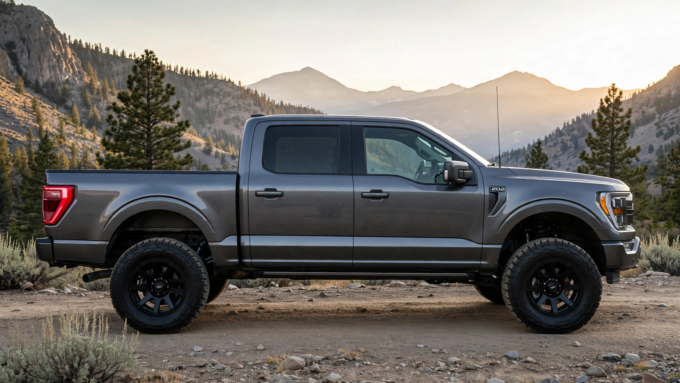
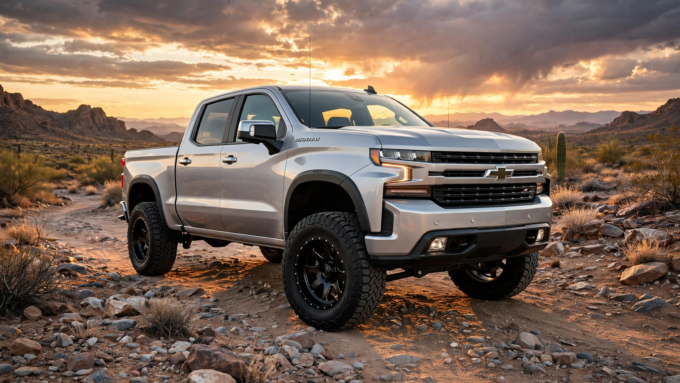
The core benefits of lifted trucks show up the moment the pavement ends. A suspension lift raises the frame and body 2 to 6 or more inches, which directly improves approach, departure and breakover angles. That means the front bumper clears ledges instead of plowing into them, the tail does not drag climbing out of a creek bed, and the middle of the truck is far less likely to high-center on a ridge. On rutted trails, rock gardens and washed-out ranch roads, that clearance is the difference between driving through and turning around.
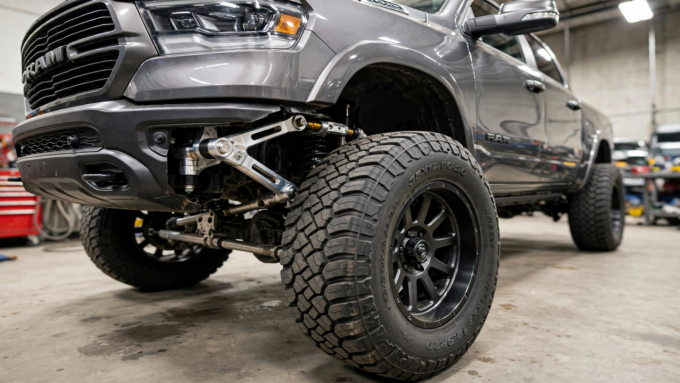
The second half of the equation is tire room. A lift lets you fit 33- to 37-inch tires, and those tires do much of the actual work: a taller sidewall wraps over rocks, a wider footprint floats better on sand and mud, and aggressive tread grips where highway tires spin. Note that axle clearance only rises with tire diameter, about 1 to 2 inches going from stock 33s to 37s. This is also where a suspension lift parts company with a spacer or body lift: only the suspension lift adds both clearance and wheel travel.
| Measurement | Stock half-ton | Lifted on 35s or 37s |
|---|---|---|
| Frame ground clearance | About 8-10 in. | About 12-16 in. |
| Axle (differential) clearance | About 8-9 in. | About 10-11 in. |
| Tire diameter | 31-33 in. | 35-37 in. |
| Approach angle | About 28-32 degrees | About 35-42 degrees |
Does a lifted truck give you a better view of the road?
Yes, and for many daily drivers this is one of the most noticeable benefits of lifted trucks. Sitting several inches higher lets you see over the cars ahead instead of staring at the trunk of the sedan in front of you, spot stopped traffic and hazards earlier, and read a trail or job site before you commit to a line. Owners who tow also find it easier to judge the trailer in the mirrors and place the truck precisely when backing into tight spots.
The honest flip side is the blind zone that grows at both ends. A tall hood hides more of the ground directly in front of the truck, and a lifted tailgate blocks the view of anything low behind you. In driveways and parking lots that means extra care around kids, carts and low cars, and it is why a front camera or parking sensors earn their keep on a tall build. The visibility trade is real: better far vision, worse near vision.
Does lifting a truck increase its towing or payload capacity?
No. This is the most oversold claim in the truck world, so let us be direct: a lift kit does not raise your tow rating or payload by a single pound. Those numbers are set by the manufacturer based on the frame, brakes, cooling and axles, and none of them change when the body sits higher. Any shop that promises extra towing capacity from a lift is selling you something. What a lift can change is how the truck feels under load, not what it is rated to carry.
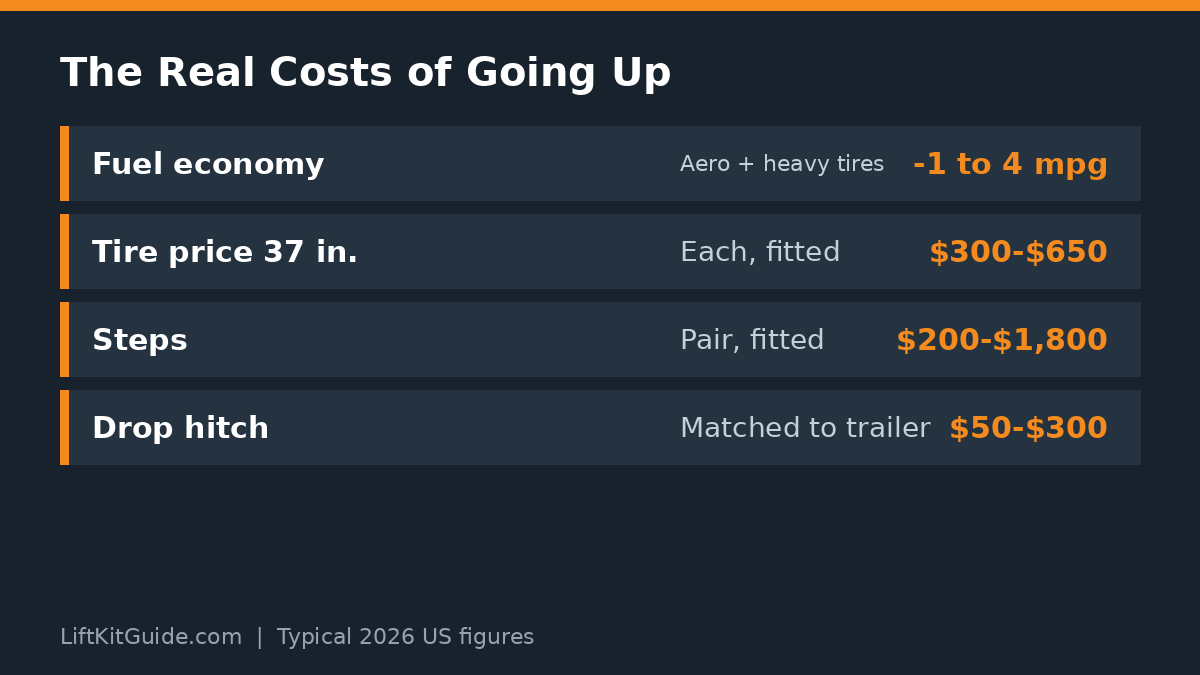
There are two practical effects worth knowing. First, a leveled or mildly lifted stance under a trailer keeps the nose from pointing skyward, which helps headlight aim and steering feel. Second, the hitch ball rises with the truck, so you will need a drop hitch matched to your trailer, typically $50 to $300, to tow level. Big tires also effectively lengthen your gearing, which can make heavy towing feel lazier. If you tow near your limit often, a leveling kit or a mild lift is usually the smarter setup.
What are the downsides of lifted trucks on the highway?
Physics is the main one. Raising a truck raises its center of gravity, so you get more body roll in corners, more lean in evasive maneuvers and a truck that asks you to drive like you are aware of its size. Bigger, heavier tires also lengthen braking distances a little and can dull steering precision. None of this makes a well-built lifted truck unsafe, and modern stability control handles a lot of it, but the relaxed, car-like feel of a stock half-ton is gone. That trade-off is covered fairly in Jalopnik’s pros-and-cons take on lifting a truck, and it matches what we see from owners.
Fuel economy is the other guaranteed downside. A lift pushes more air under the truck where the aerodynamics are ugly, and taller, wider, heavier tires add rolling resistance and rotational weight. Together they typically cost 1 to 4 mpg, with the big losses on 6-inch builds running 37s at highway speed. On a truck that covers 15,000 miles a year, that is real money every single year you own it, and it never comes back.
Do lifted trucks wear out parts faster?
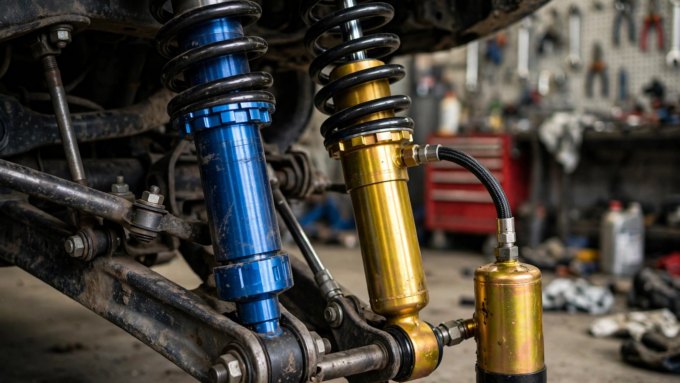
They do, and pretending otherwise is how owners get surprised by repair bills. Steeper CV axle angles, ball joints working at the edge of their travel, wheel bearings carrying heavier tires on wider offsets, and steering parts fighting more tire all day: each wears faster than it would at stock height. A quality kit with corrected geometry, proper control arms and a good alignment slows this down a lot, but it does not erase it. Expect to inspect front-end parts more often and replace wear items sooner than the owner’s manual assumes.
Tires are the recurring expense owners underestimate most. A 37-inch all-terrain costs roughly $300 to $650 per tire, you need a matching full-size spare for the numbers to work off-road, and heavy tires that are not rotated on schedule wear unevenly and get loud. When you run the full math in our breakdown of how much it costs to lift a truck, the purchase price of the kit is often less than half of what the build costs you over the following three years.
Will a lifted truck still fit in your garage?
Measure before you build, because this is where a lot of proud new owners get a nasty surprise on day one. A standard residential garage door opening is 7 feet tall. A stock half-ton usually clears it with several inches to spare, but add a 6-inch lift and 37-inch tires and the same truck commonly measures 7 ft 1 in to 7 ft 4 in at the cab or antenna. Downtown parking garages are often tighter still, with posted clearances of 6 ft 8 in to 7 ft in older structures.
The daily-living side matters too. A tall truck means a tall step up, and kids, older passengers and anyone in work boots on a wet running board will have opinions about it. Fixed or power steps solve the problem for $200 to $1,800, and they are close to mandatory on a 6-inch build used as a family vehicle. Add step costs to the build budget from the start rather than discovering them the first time your passenger has to climb in.
- Measure the door, not the brochure: your garage door’s actual clear opening, which is often an inch or two less than its nominal size.
- Know your truck’s finished height: lift height plus half the tire diameter gain, plus any roof rack, light bar or tall antenna.
- Check your regular parking: work garages, airport parking and downtown decks all post clearances that a tall truck can exceed.
- Plan the step-up: if family members ride daily, price fixed or power steps into the build from day one.
- Re-aim the headlights: after any lift, adjust the beams so you are not blinding oncoming traffic.
Are there legal or insurance issues with a lifted truck?
In some states, yes. Lift laws vary widely across the US: a number of states cap bumper height, headlight height or frame height, and a few limit total lift outright. The rules in your state decide how tall you can legally build, so check them before you choose a height, not after a ticket. Related and simpler: after any lift, your headlights point higher than they did. Re-aiming them is a ten-minute job that keeps you legal, keeps other drivers from being blinded and keeps your own night vision useful.
Insurance deserves a phone call too. Call your insurer before the build and ask how the lift and wheels should be declared; some companies want the modifications listed, some offer a rider that covers the value of the kit itself, and an undisclosed modification can complicate a claim at the worst possible moment. Owners also worry about warranty coverage, which is a separate question: a lift does not automatically void a factory warranty, and we explain the rules in our guide to whether a lift kit voids your warranty.
Do lifted trucks hold their value at resale time?
A quality build can. In truck-heavy markets, a well-known brand lift, installed by a reputable shop, with receipts and a fresh alignment printout, often holds its value or even adds some at private resale, because the next owner is buying a finished truck instead of a project. Dealers vary: some truck-focused stores price good builds up, while others wholesale anything modified. Documentation is what separates the two outcomes, so keep every receipt from the day the kit goes on.
A cheap build can do the opposite. Spacer-only lifts on worn shocks, extreme heights, chopped-up fenders and tired front-end parts narrow your buyer pool to almost nobody and can genuinely hurt a trade-in offer. And let us end on the honest note: beyond clearance and capability, the number one reason owners lift trucks is the way they look. That is a perfectly good reason. Just count it as a benefit you are buying with the downsides above, eyes open.
| Benefits | Downsides |
|---|---|
| 2-6+ in. more frame clearance | 1-4 mpg fuel economy loss |
| Fits 35-37 in. tires for real traction | Faster ball joint, CV and bearing wear |
| Better approach and departure angles | Higher center of gravity, more body roll |
| Higher seating position and road view | May not fit a 7 ft garage door |
| Strong resale when the build is quality | Tires run $300-$650 each at 37 in. |
Frequently asked questions
What is the biggest benefit of a lifted truck?
Ground clearance, and the bigger tires it makes room for. The lift raises the frame 2 to 6+ inches for better approach and breakover angles, while 35- or 37-inch tires add traction and another 1 to 2 inches of axle clearance. Together they are the core of the benefits of lifted trucks off-road.
How much fuel economy do you lose with a lift kit?
Plan on losing 1 to 4 mpg. The lift itself hurts aerodynamics, and taller, wider, heavier tires add rolling resistance. Mild 2- to 3-inch builds on 33s sit at the small end of that range; 6-inch builds on 37s at highway speed sit at the painful end. It is the one downside of lifted trucks you pay for every single week.
Will a lifted truck fit in a standard garage?
Often not, once you go tall. A standard garage door opening is 7 feet, and a 6-inch lift on 37-inch tires commonly measures 7 ft 1 in to 7 ft 4 in. A 2- to 3-inch lift on 33s or 35s usually still fits. Measure your actual door opening and add up your finished height before ordering anything.
Does lifting a truck increase its towing capacity?
No. Tow and payload ratings are set by the manufacturer and do not change with a lift. A level stance under a trailer can help headlight aim and steering feel, and you will need a drop hitch ($50 to $300) to tow level, but the rated numbers stay exactly where the factory put them.
Are the benefits of lifted trucks worth it for a daily driver?
For most daily drivers, a mild setup captures most of the benefits of lifted trucks with the fewest downsides: a leveling kit or 2- to 3-inch lift on 33s keeps the stance, the tire upgrade and reasonable fuel economy, and usually still fits the garage. Save the 6-inch build for trucks that genuinely work or play off-road every week.
The bottom line
So, are the benefits of lifted trucks worth the downsides? Match the build to the life the truck actually lives. If you run trails, work a farm or ranch, or regularly drive unplowed, rutted or flooded roads, the clearance and tire gains pay you back every week and the trade-offs are simply the cost of a more capable truck. For a highway commuter or a truck that tows near its limit, a leveling kit or a mild 2- to 3-inch lift is the sweet spot: here is what a 3-inch lift costs if you want the numbers before deciding.
Two last pieces of honest-friend advice. First, measure your garage before you order a single part; discovering a fit problem in your own driveway is an expensive way to learn. Second, budget the whole build, not just the kit: as our full cost breakdown for lifting a truck shows, tires, alignment, steps and calibration routinely double the headline price. Do those two things and the benefits of lifted trucks come with no surprises attached.



Leave a comment