



Walk into any truck forum and you’ll see the same question every week: should I level it or lift it? The two terms get used as if they mean the same thing, and shops don’t always help. They’re different products that solve different problems, cost very different amounts, and change how your truck drives in different ways.
This leveling kit vs lift kit guide explains what each one does, what’s actually in the box, and how to decide which one fits your truck and your plans.
On this page
Why trucks sit nose-down from the factory
Most pickups leave the factory with the rear sitting higher than the front. That slope is called rake. Manufacturers build it in on purpose: when you load the bed or hitch a trailer, the rear squats and the truck ends up roughly level. Unloaded, though, the truck looks nose-down, and the front wheel wells limit how big a tire you can run.
A leveling kit exists to fix exactly that. A lift kit goes further and raises everything. That one difference drives the whole leveling kit vs lift kit decision.

What is a leveling kit?
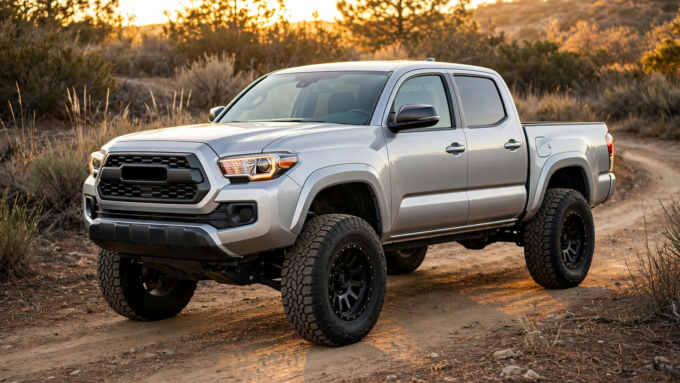
A leveling kit raises the front of the truck so it sits level with (or close to) the rear. Typical front lift is 1 to 3 inches. The rear is left alone.
Leveling kits come in a few common forms, depending on how your front suspension is built:
- Strut spacers: A spacer sits on top of the front coil-over strut. This is the most common type on modern half-ton trucks and the cheapest.
- Torsion keys: Trucks with torsion-bar front suspension (many older GM and some other 4WD trucks) can be leveled by swapping to adjustable keys that preload the torsion bar.
- Coil spacers: Trucks with a solid front axle and coil springs (such as heavy-duty Ram models) can use spacers that sit on the coil spring.
- Leveling coil-overs: A complete replacement strut assembly set taller than stock. More expensive, but it usually rides better than a spacer because the shock is valved for the new height.
What a leveling kit is good for
- Removing the nose-down look
- Making room for a modestly larger tire (often one size up, depending on the truck, wheel offset and backspacing)
- Keeping the job cheap and simple
What to watch out for
- Spacer-style kits don’t add suspension travel. They preload the existing parts, so the front can lose some down-travel and may ride a little firmer – the main trade-off in any leveling kit vs lift kit comparison.
- If you tow or haul heavy loads often, the rear will squat further with no rake to absorb it. Headlight aim may need adjusting.
- You still need a front-end alignment afterward.
What is a lift kit?
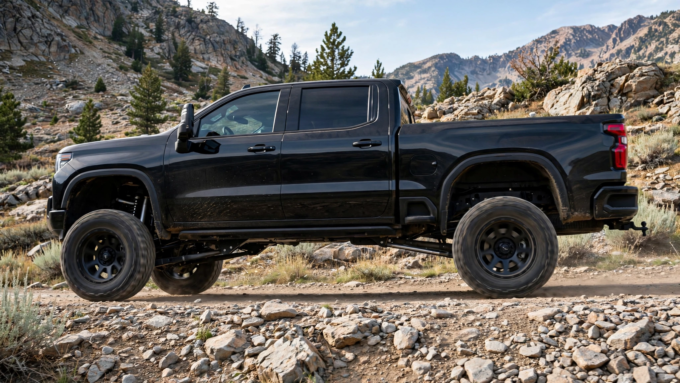
In leveling kit vs lift kit terms, a lift kit raises the whole truck, front and rear. Mild kits start around 2 to 3 inches. Popular “big lift” kits are 4 to 6 inches, and some go well beyond that.
There are two broad families of lift kit:
Suspension lifts
A suspension lift raises the frame away from the axles. That increases real ground clearance under the frame and body. Depending on height, a suspension lift may include:
- Taller coil springs, strut spacers or complete coil-overs up front
- Rear lift blocks, add-a-leafs or new leaf springs (or taller coils on coil-sprung rears)
- Longer shocks
- On taller kits for independent front suspension: new steering knuckles or spindles, crossmembers, differential drop brackets, and sometimes new upper control arms to keep the geometry within range
- Extended brake lines and sway bar end links
Body lifts
A body lift uses spacers (pucks) between the frame and the body. It raises the body to make room for bigger tires but doesn’t raise the frame, axles or differentials, so ground clearance under the frame doesn’t change. Body lifts are usually limited to a few inches and are less common on modern trucks.
Leveling kit vs lift kit: side by side
| Leveling kit | Lift kit | |
|---|---|---|
| What it raises | Front only | Front and rear |
| Typical height | 1 to 3 in (front) | 2 to 6+ in (whole truck) |
| Main purpose | Remove factory rake, modest tire upgrade | Ground clearance, much bigger tires, off-road use |
| Parts involved | Spacers, torsion keys or leveling struts | Springs, shocks, blocks; on taller kits knuckles, crossmembers, diff drops |
| Ride quality | Usually close to stock | Depends heavily on kit design and quality |
| Parts cost | Roughly $100 to $1,000 | Roughly $200 to $4,000+ |
| DIY difficulty | Moderate for most home mechanics | Moderate to hard; taller kits are a shop job for most people |
| Alignment needed | Yes | Yes |

That table is the whole leveling kit vs lift kit debate on one screen. Parts pricing varies a lot by truck and brand. See our full breakdown in How Much Does It Cost to Lift a Truck?
How each one affects the way your truck drives
Ride and handling
Ride and handling is where leveling kit vs lift kit differences show up first. A good leveling kit changes very little day to day. A lift kit raises the center of gravity for the whole truck, so expect more body roll in corners and more sensitivity to crosswinds. Kits that replace the shocks and use properly designed springs tend to ride better than kits that simply space the factory parts up.
CV axles and front-end angles
On 4WD trucks with independent front suspension, raising the front increases the angle of the CV axles. Small leveling kits usually stay within a safe range. Taller lifts use drop brackets or new knuckles to bring those angles back down. If a kit skips this on a big lift, CV boots and joints tend to wear out faster.
Fuel economy
Leveling on its own has a small effect. Most of the drop in mileage people notice comes from what goes on afterward: bigger, heavier, more aggressive tires, plus the extra wind drag of a taller truck.
Speedometer
If you go up in tire size, your speedometer and odometer will read low until the truck is recalibrated. That’s a tire-size issue, not a lift issue, but it comes with almost every lift or level project.
Which one should you choose?
The right leveling kit vs lift kit answer depends on how you actually use the truck:
Choose a leveling kit if:
- Your truck is mostly a daily driver
- You mainly want a better stance and one tire size up
- You want to keep cost and complexity low
- You don’t want to change how the truck rides very much
Choose a lift kit if:
- You go off-road and need real clearance under the frame and differentials
- You want to run significantly larger tires (for example 35s or bigger on a half-ton)
- You’re willing to spend more on parts, labor and the extras that come with it
If you tow heavy loads often, think carefully about either option. Removing the rake means the truck sits nose-up under load, and a tall lift changes how the truck handles with a trailer. Many owners who tow a lot stick with a small level and rear helper springs or airbags.
Warranty and insurance
In the US, a manufacturer can’t void your entire warranty just because you installed aftermarket parts. They can deny a specific claim if they can show the aftermarket part caused the failure. A lifted truck with a failed CV axle, for example, is an easy denial. Tell your insurer about any modification too, so a claim doesn’t turn into a dispute later. Warranty rules are one area where leveling kit vs lift kit barely matters – the same law covers both. That law is the federal Magnuson-Moss Warranty Act, explained in plain language in the FTC’s guide to federal warranty law.
Leveling kit vs lift kit on popular trucks
On a Silverado or Sierra, the first question is which truck you have. A Trail Boss or AT4 already sits 2 inches higher from the factory, so a standard leveling kit does not fit the way it does on an LT or RST. Our Silverado lift kit guide walks through every trim, including the Adaptive Ride Control trucks that need ARC-specific kits.
Ram 1500 owners have a different trap: air suspension. Trucks with the 4-corner air system cannot use most standard spacers or struts, and the Rebel and Off-Road Package trucks already sit an inch higher, which changes the tire math. The Ram 1500 lift kit guide covers which kits fit air-ride trucks and which to avoid.
On an F-150 or Tacoma, the choice is more straightforward: a 2-inch level and 33-inch tires covers most daily drivers, while a 3-inch suspension lift is the step up for owners who actually leave the pavement. If you are still deciding, our guide to what a leveling kit is explains the hardware in plain terms before you spend anything.
Leveling kit vs lift kit: daily driving, fuel economy and resale
Day to day, the leveling kit vs lift kit difference is smaller than most people expect at the mild end. A 2-inch level leaves the ride almost stock, with a slightly firmer front end on spacer kits and no real change to steering feel. A taller lift kit moves the truck’s center of gravity up, adds a small amount of body roll in corners, and raises the step-in height enough that most owners add side steps.
Neither ruins a daily driver, but the taller the truck, the more every one of those small compromises adds up, which is why so many owners start with a level and only go taller when they need the tire clearance. The full cost guide shows what each step up in height does to the budget as well.
Fuel economy follows the tires more than the kit. A leveling kit vs lift kit comparison on identical 33-inch tires usually lands within half a mile per gallon of each other, because both trucks punch the same hole in the air at almost the same height.
Jumping to 35-inch tires on a 6-inch lift is where the real cost shows up: expect 2 to 3 miles per gallon less, plus heavier steering and longer braking distances. Regearing the axles brings some of that back and restores the stock driving feel, which is why it appears in the bigger budgets in our installation cost breakdown.
Resale cuts the other way from what most owners assume. A mild leveling kit is roughly neutral at resale time and can even help in truck-heavy markets, because the next buyer sees a level stance on a truck that is otherwise stock. A tall lift kit narrows your buyer pool: private buyers worry about how the truck was used, and dealers routinely discount modified suspension trucks or ask for the stock parts.
The practical move is to keep every factory part you remove, whichever route you take, so the truck can go back to stock in an afternoon. Factor that into the leveling kit vs lift kit decision now and the choice stays reversible later.
Frequently asked questions
Can I install a leveling kit myself?
Many owners do. A strut-spacer or torsion-key kit is a common driveway job with basic hand tools, a jack and stands, and a spring compressor if needed. Budget for a professional alignment afterward either way.
Is a leveling kit bad for your truck?
A quality kit installed correctly and followed by an alignment is generally fine. Problems usually come from very cheap spacers, going too high on a torsion-key setup, or skipping the alignment.
Can I add a leveling kit and a lift kit together?
Usually not. Most lift kits already account for front rake and raise the front more than the rear. Stacking a spacer on top of a lift kit tends to push the front suspension past its intended angles.
How big a tire can I run?
It depends on the truck, the kit, and the wheel offset and backspacing. Check the kit manufacturer’s published tire size for your exact model and year before you buy.
How much does a leveling kit cost compared to a lift kit?
A leveling kit is far cheaper: $300 to $1,000 installed for most trucks, against $1,000 to $4,000 for a mild suspension lift and $3,000 or more for a 6-inch lift. See the full numbers in how much a leveling kit costs and our complete lift cost guide. That price gap is the biggest practical difference in leveling kit vs lift kit.
Is a leveling kit or a lift kit better for towing?
Neither one increases your tow rating. A leveling kit removes the factory rake, so a heavy trailer can make the truck squat nose-up; a lift kit raises the hitch point and needs a drop hitch to keep the trailer level. If you tow often, weigh both options against the honest pros and cons of a lifted truck before you decide.
Whichever way you land on leveling kit vs lift kit, match the kit to your exact truck with the model guides below.
We’re building model-by-model guides for Ram, Ford, Chevy & GMC, Toyota, Jeep and Nissan trucks. Browse the categories in the menu to find yours.




Leave a comment