


Last updated: October 2026 Written by the LiftKitGuide Team, truck suspension installers and editors
Track bar relocation bracket vs adjustable track bar: which should you buy? A relocation bracket ($50 to $120) raises the track bar mounting point to restore factory geometry and improve the roll center, with axle centering as a bonus. An adjustable track bar ($150 to $300) only recenters the axle without fixing geometry. For lifts under 3 inches, an adjustable bar alone is usually enough; for taller lifts, the bracket matters more, and running both is the best setup.
Key takeaways
- A 2.5-inch lift makes the stock track bar too short, pulling the axle roughly 1/2 inch to 1 inch off-center.
- A relocation bracket ($50 to $120) corrects track bar angle and roll center; centering is a bonus.
- An adjustable track bar ($150 to $300) recenters the axle precisely but does not fix geometry.
- For lifts over 3 inches, the bracket matters more than the bar; running both is the ideal setup.
- On the front of a Jeep, keep the track bar parallel with the drag link to avoid bump steer.

On this page
Track Bar Relocation Bracket vs Adjustable Track Bar: What Is the Difference?
The debate over track bar relocation bracket vs adjustable track bar confuses a lot of owners because both parts claim to fix the same problem. When you lift a Jeep, Bronco, or solid-axle truck, the fixed-length stock track bar becomes too short for the new ride height. At 2.5 inches of lift it pulls the axle roughly 1/2 inch to 1 inch to one side, which you can see by standing in front of the truck: one tire sticks out further than the other. Both parts address this, but they do it in fundamentally different ways.
An adjustable track bar is a direct replacement for the stock bar with a threaded or multi-hole design that lets you set its length. Lengthen it to match the new ride height and the axle slides back to center. That is all it does: recenter the axle. A relocation bracket, by contrast, bolts to the axle or frame and moves the track bar’s mounting point, usually raising it. That changes the bar’s angle back toward level, which restores the factory roll center and reduces lateral axle movement through suspension travel. Centering happens as a side effect.
That distinction is the whole answer to track bar relocation bracket vs adjustable track bar in one paragraph: the bar centers, the bracket corrects geometry. A well-known Jeep builder put it this way after testing both: an adjustable track bar can only recenter your axle, while a relocation bracket makes the track bar level again like factory and improves the roll center. For a daily driver that rarely flexes, centering alone may satisfy you. For a rig that works its suspension, geometry matters more.
How Does a Lift Affect Track Bar Geometry?
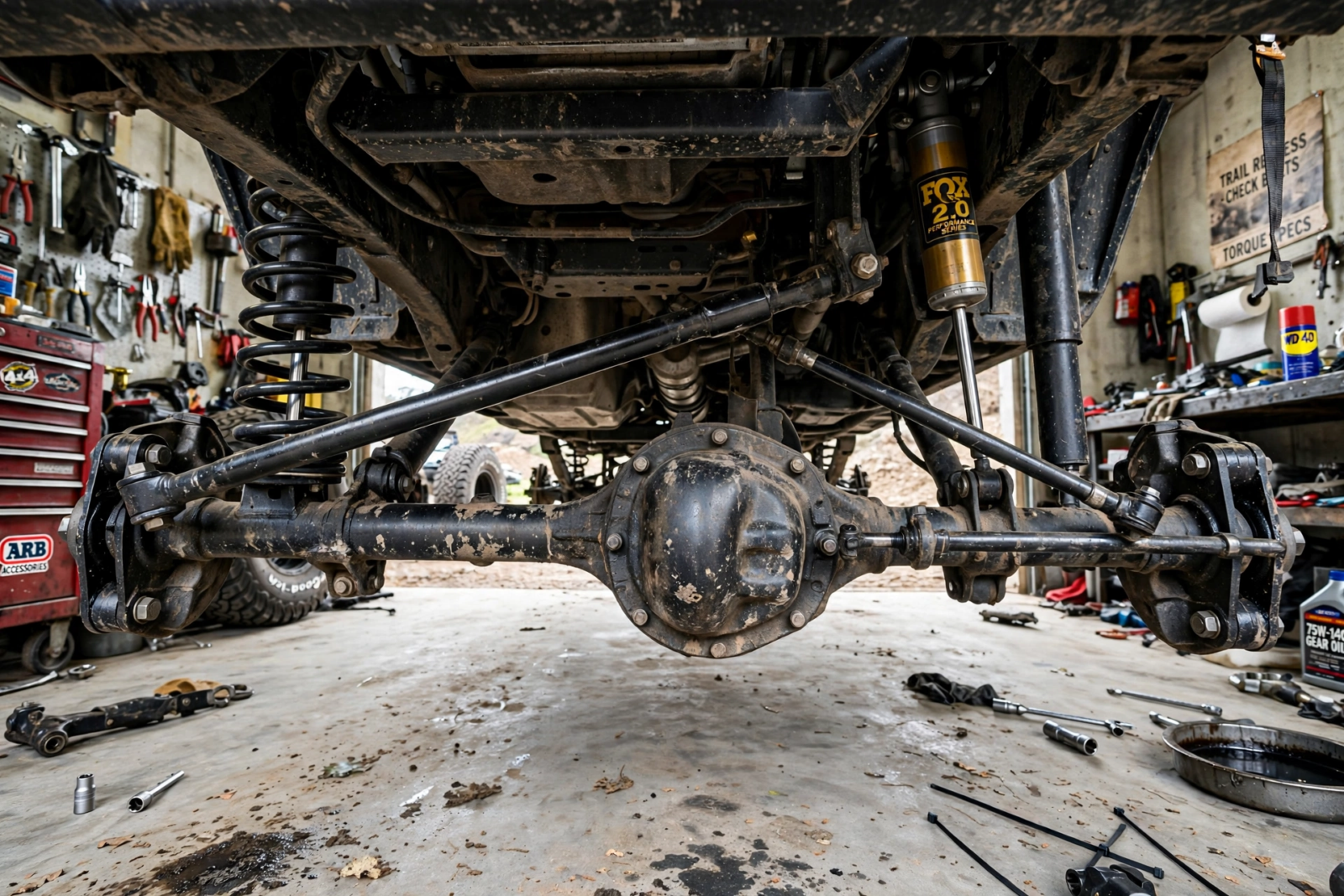
The track bar, also called a Panhard rod, is the lateral locator for a solid axle. One end bolts to the frame, the other to the axle, and as the axle moves up and down it swings in an arc dictated by the bar’s length and angle. From the factory the bar sits nearly level, so that arc is mostly vertical and the axle barely shifts sideways through travel. Lift the truck and the frame end rises with the chassis while the axle end stays put, so the bar angles downward steeply.
A steeply angled track bar causes two problems. First, the static one: at ride height the short bar holds the axle off-center, typically toward the driver’s side on Jeeps. Second, the dynamic one: through suspension travel the axle now swings in a pronounced sideways arc, so the rear end feels like it shifts laterally over bumps and in corners. Owners describe it as the back end stepping sideways on uneven pavement. (See Off-Road Express’s guide to track bar geometry on lifted Jeeps for owner-reported results.)
This is why geometry correction matters beyond cosmetics. An off-center axle looks wrong, but a bad roll center drives wrong. The roll center is the imaginary point the body rolls around in corners, and a steep track bar drops it, increasing body roll. Understanding this is key to the track bar relocation bracket vs adjustable track bar decision, because only one of the two parts fixes it. Our suspension lift kits explained guide covers how the track bar fits into the whole system. Understanding this roll center effect is the key insight in the track bar relocation bracket vs adjustable track bar debate, and it is covered alongside the rest of the system in our 6-inch lift cost breakdown.
What Does a Track Bar Relocation Bracket Do?
A relocation bracket raises the track bar’s axle-side mounting point, usually by 2 to 3 inches, which brings the bar back toward level at the new ride height. Leveling the bar does three things at once: it recenters the axle approximately, it restores the roll center close to factory, and it reduces the sideways arc of axle travel. That is why experienced builders call it a geometry correction rather than a centering device.
Brackets are the economical choice at $50 to $120, and they are simple: a bolt-on or weld-on bracket with no moving parts to wear out. On the rear of a Jeep JL or JT, an axle-side bracket is the most common recommendation, and many complete lift kits include one in the box. Installation is straightforward, though some brackets require drilling the axle bracket, so check whether yours is bolt-on before ordering.
The limitation is precision. A bracket moves the mount a fixed amount, so it gets the axle close to center but rarely perfect, and if your lift is taller than the bracket was designed for, the axle can still sit slightly off. That imperfection is invisible to most drivers, but perfectionists pair the bracket with an adjustable bar. In the track bar relocation bracket vs adjustable track bar tradeoff, the bracket wins on geometry per dollar for moderate lifts.
| Feature | Relocation bracket | Adjustable track bar |
|---|---|---|
| Typical cost | $50 to $120 | $150 to $300 |
| Axle centering | Approximate | Precise |
| Geometry correction | Yes, restores roll center | No |
| Moving parts to wear | None | Jam nuts, threads, joints |
| Best for | Lifts over 3 inches, off-road use | Mild lifts, exact centering |
What Does an Adjustable Track Bar Do?
An adjustable track bar replaces the fixed-length stock bar with one you can lengthen to match your lift height. Threaded ends or multiple mounting holes let you dial in the exact length that centers the axle at ride height, and you verify with a tape measure from fixed frame points to each tire. For lifts in the 2 to 3-inch range, this alone gets the axle visually and measurably centered.
The advantage is precision and simplicity of concept: one part, one adjustment, done. Quality adjustable bars from JKS, Rancho, MetalCloak, or Synergy also upgrade strength over the wimpy factory bar, which matters because bigger tires put more lateral force through it. On the front of a Jeep, that strength upgrade alone is worthwhile even before considering centering. Pair that strength with the correct length setting and the front end gains both precise centering and a meaningful durability upgrade over the thin factory bar.
The disadvantage is what it does not do. Lengthening the bar does not change its angle, so the roll center stays low and the axle still swings sideways through travel. One Jeep forum member summarized it well: the adjustable bar gets you centered, but only the bracket gets the bar parallel with the axle again. When weighing track bar relocation bracket vs adjustable track bar, be honest about whether you need geometry or just centering. And if your truck is a daily driver that never leaves pavement, centering alone is a defensible choice.
Track Bar Relocation Bracket vs Adjustable Track Bar: Which Should You Buy?
Here is the decision framework for track bar relocation bracket vs adjustable track bar. If your lift is 2 to 3 inches and you mainly drive on road, buy the adjustable track bar. It centers the axle precisely, strengthens a known weak factory part, and installs without drilling. Your geometry error at this height is small enough that most drivers never feel it.
If your lift is over 3 inches or you off-road regularly, buy the relocation bracket first. The geometry error is large enough to affect handling, and the bracket’s roll center correction transforms how the truck tracks through corners and over uneven ground. Add the adjustable bar later if the axle is not centered to your satisfaction. Many builders consider running both the ideal setup: the bracket fixes geometry, the bar dials in perfect centering.
There is also a front-versus-rear distinction, especially on Jeeps. The common wisdom is an adjustable bar up front and a relocation bracket in the rear. The reason is the drag link: the front track bar should stay parallel with the drag link to avoid bump steer, and on the front the factory bar is worth replacing for strength anyway. In the rear there is no drag link to match, so the bracket’s geometry correction shines. Budget the pair at $200 to $400 total, which is modest next to the total cost to lift a truck.
| Lift height and use | Recommended fix | Why |
|---|---|---|
| 2 to 3 inches, street | Adjustable track bar | Centering is enough; geometry error is small |
| Over 3 inches | Relocation bracket | Roll center correction transforms handling |
| Tall off-road build | Bracket plus adjustable bar | Geometry fixed and centering dialed in |
| Front of Jeep JL/JT | Adjustable track bar | Keep parallel with drag link; upgrade weak stock bar |

Do You Need a Track Bar Correction on an IFS Truck?
This whole discussion applies to solid-axle vehicles: Jeeps, Broncos, Rams with solid front axles, and Super Dutys. If your truck has independent front suspension, like a Silverado, Sierra, F-150, Tacoma, or Tundra, there is no front track bar to correct, because IFS locates the wheels with control arms instead. Rear track bars appear on some trucks with coil-spring rear suspension, such as Rams with the five-link rear, and those follow the same rules as above.
IFS trucks have their own version of this problem in the form of differential drops and control arm angles, covered in our leveling kit versus lift kit comparison. Do not buy track bar parts for an IFS front end; they will not bolt to anything. This is a common beginner mistake when shopping by lift height alone instead of by suspension type.
If you are unsure what your truck has, look under the front: a solid axle is a single rigid tube spanning the full width with a differential in the middle, and you will see the track bar running diagonally from the frame to the axle. IFS shows two separate control arms per side and CV axles. Five seconds under the truck answers the question definitively.
- Solid front axle: track bar correction applies; check centering after any lift over 2 inches.
- IFS front end: no track bar exists; focus on control arms and differential drop instead.
- Coil-spring solid rear: rear track bar rules apply the same as the front.
- Leaf-spring rear: no track bar; the springs locate the axle laterally.
- When in doubt: look for the diagonal bar from frame to axle before ordering parts.
How Do You Install a Track Bar Bracket or Adjustable Bar?
Both install with basic hand tools in a driveway. For a relocation bracket: support the axle on jack stands, remove the track bar bolt at the axle end, bolt or weld the bracket in place per the instructions, reinstall the bar into the bracket’s new mounting hole, and torque to spec. Some brackets require drilling out the factory hole, so read the instructions before you start and have sharp drill bits ready.
For an adjustable bar: remove the stock bar entirely, set the new bar to approximately the needed length, install it, then adjust until the axle is centered. Centering is measured with a tape measure from a fixed frame point to the outer sidewall of each tire, or between the frame and tire on each side. Bounce the suspension a few times and remeasure, since bushings settle. Torque the jam nuts hard; a loose jam nut lets the bar change length on its own.
After either install, get an alignment check. As with any track bar relocation bracket vs adjustable track bar install, changing track bar geometry alters the steering wheel center and can affect toe slightly. While the truck is on the rack, it is also the right time to verify the rest of the lift kit installation work, since a shop alignment after any suspension change is cheap insurance. It is also smart to review which lift kit brands include track bar correction before buying a kit.
Can You Run Both a Bracket and an Adjustable Track Bar?
Yes, and for tall lifts it is the recommended setup. The bracket restores the bar angle and roll center, and the adjustable bar then fine-tunes the length for perfect centering. Several builders in the track bar relocation bracket vs adjustable track bar debate landed exactly here after trying each part alone: the bracket alone left the axle slightly off, the bar alone left the geometry steep, and the combination drove the best. If your budget allows one purchase now and one later, buy the bracket first for lifts over 3 inches.
There is one caveat: make sure the bracket and bar are compatible. Some brackets are designed around the stock bar’s mounting width, and an oversized aftermarket bar end may not fit the bracket’s hole. Buy both from the same manufacturer when possible, or verify dimensions before ordering. Mismatched parts are the most common cause of frustration with this combo. Measure twice before ordering, because a bracket designed for a 2.5-inch lift will not fully correct a 4.5-inch lift, and mixing incompatible brands is the most common source of installation headaches.
For the ultimate setup on a dedicated off-road rig, look at complete systems that integrate the bracket, an adjustable bar, and matching control arms as one engineered package. But for most owners, the staged approach works: bracket now for geometry, adjustable bar later for perfection. Either way, you have resolved the track bar relocation bracket vs adjustable track bar question with the best of both answers.
Frequently asked questions
How much does a track bar relocation bracket cost?
Relocation brackets typically cost $50 to $120. They are simple bolt-on or weld-on brackets with no moving parts, making them the most economical track bar correction.
How much does an adjustable track bar cost?
Adjustable track bars run $150 to $300 depending on brand and construction. Quality options from JKS, Rancho, MetalCloak, and Synergy also upgrade strength over the factory bar.
At what lift height do you need track bar correction?
Around 2 to 2.5 inches. At that height the stock bar is short enough to pull the axle roughly 1/2 inch to 1 inch off-center, which is visible when you stand in front of the truck.
Should the track bar be parallel with the drag link?
Yes, on the front of a Jeep or solid-axle truck. Keeping the track bar and drag link parallel prevents bump steer, where the steering wheel tugs over bumps. This is a key reason the front gets an adjustable bar while the rear gets a bracket.
Do IFS trucks need track bar correction?
No. Independent front suspension locates the wheels with control arms, so there is no front track bar. IFS trucks need differential drops and control arm correction instead. Some coil-spring solid-rear trucks do have a rear track bar.
Can I install a track bar bracket myself?
Yes, with basic hand tools in a driveway. Most are bolt-on and take 1 to 2 hours. Some require drilling the factory axle bracket, so check the instructions and have sharp drill bits ready before starting.
The bottom line
In the track bar relocation bracket vs adjustable track bar decision, buy the bracket when geometry matters and the bar when only centering matters. The bracket corrects the bar angle and roll center for $50 to $120, while the adjustable bar centers the axle precisely for $150 to $300 without fixing geometry.
For lifts over 3 inches or regular off-road use, run both: the bracket for geometry, the bar for perfect centering. For mild street lifts, the adjustable bar alone is a defensible, simpler choice.






Leave a comment