


Last updated: October 2026 Written by the LiftKitGuide Team, truck suspension installers and editors
The ironman 4×4 vs old man emu debate pits two Australian overland legends against each other. Ironman 4×4 Foam Cell Pro kits typically cost $1,300 to $1,900 and use oversized foam-cell twin-tube shocks that resist fade under heavy loads; they carry a 4-year unlimited-mile warranty and are fully rebuildable. Old Man Emu kits typically run $1,500 to $2,200, pairing tuned coil springs with Nitrocharger shocks backed by 30-plus years of engineering; OME’s BP-51 line adds adjustable bypass damping at the premium end. Choose Ironman for heavy, hard-used overland builds and OME for refined daily-driver manners.
Key takeaways
- Ironman Foam Cell Pro kits: ~$1,300-$1,900, 4-year unlimited-mile warranty, rebuildable.
- Old Man Emu kits: ~$1,500-$2,200, 30+ years of engineering, tuned spring rates.
- Foam cell twin-tubes resist fade best under sustained heavy loads and washboard.
- OME’s matched spring-and-shock tuning feels more refined on daily-driven trucks.
- Both lift ~2-3.5 inches; choose spring rates for your actual loaded weight.
On this page
What is the ironman 4×4 vs old man emu debate about?
The ironman 4×4 vs old man emu debate is the overland community’s favorite value argument. Both are Australian companies that built their names on trucks working hard in brutal conditions, and both sell complete lift kits, springs, shocks, and leaf packs, for Tacomas, 4Runners, Hiluxes, and a growing list of US trucks. The philosophical split: Ironman engineered the Foam Cell Pro around surviving sustained punishment, while OME engineered its kits around matched spring-and-damper tuning refined over three decades.
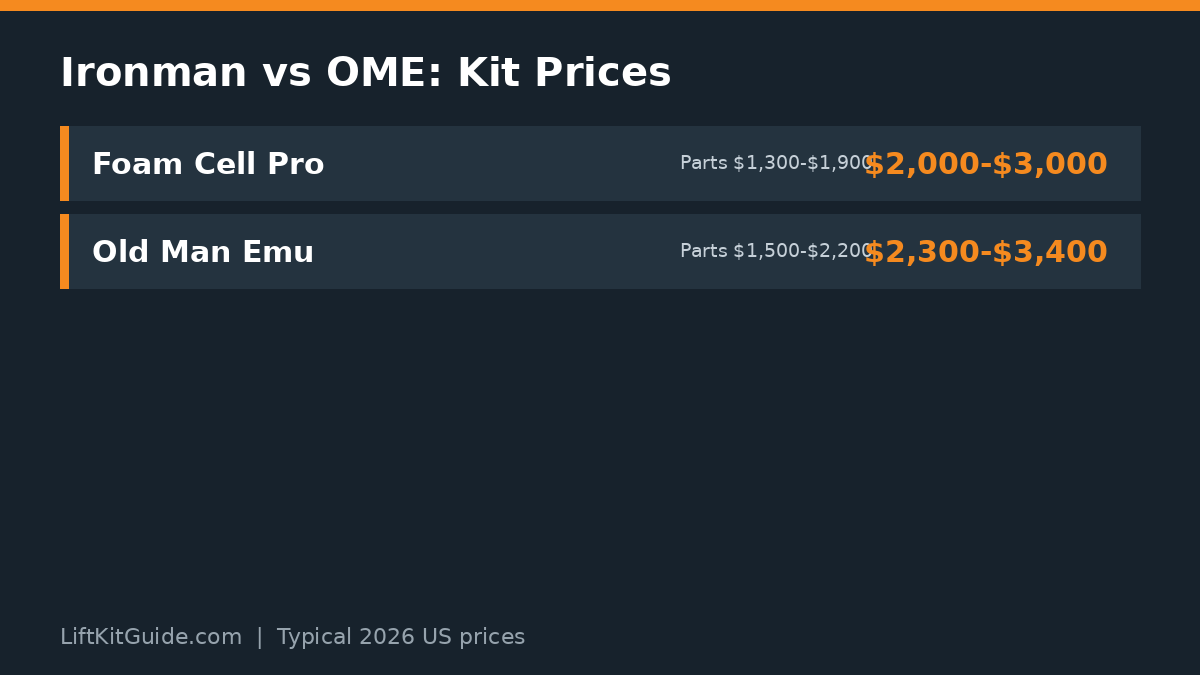
Price keeps the debate alive. Ironman Foam Cell Pro kits typically land between $1,300 and $1,900 depending on application, undercutting comparable OME kits by a few hundred dollars while including a 4-year unlimited-mile warranty. OME kits typically run $1,500 to $2,200, with the BP-51 adjustable line climbing far higher. If you are shopping lift kit brands for an overland build, these two define the value-versus-refinement axis.
The Australian heritage matters in the ironman 4×4 vs old man emu story because both brands developed their products for conditions that destroy lesser suspensions. Australia’s corrugated outback roads, extreme heat, and remote travel demands created a testing ground no laboratory can replicate. Ironman built its reputation on mining and expedition vehicles; OME built its on decades of overland travel. When you buy either kit, you are buying engineering validated by some of the harshest real-world testing on earth.
Weight is the variable most buyers underestimate. A Tacoma with steel bumpers, sliders, a roof tent, and full camping load can easily carry 800 pounds over stock. That transforms spring requirements completely. Honest weight assessment, ideally from a truck scale, is the foundation of every good suspension decision regardless of brand.
How does ironman 4×4 vs old man emu shock technology compare?
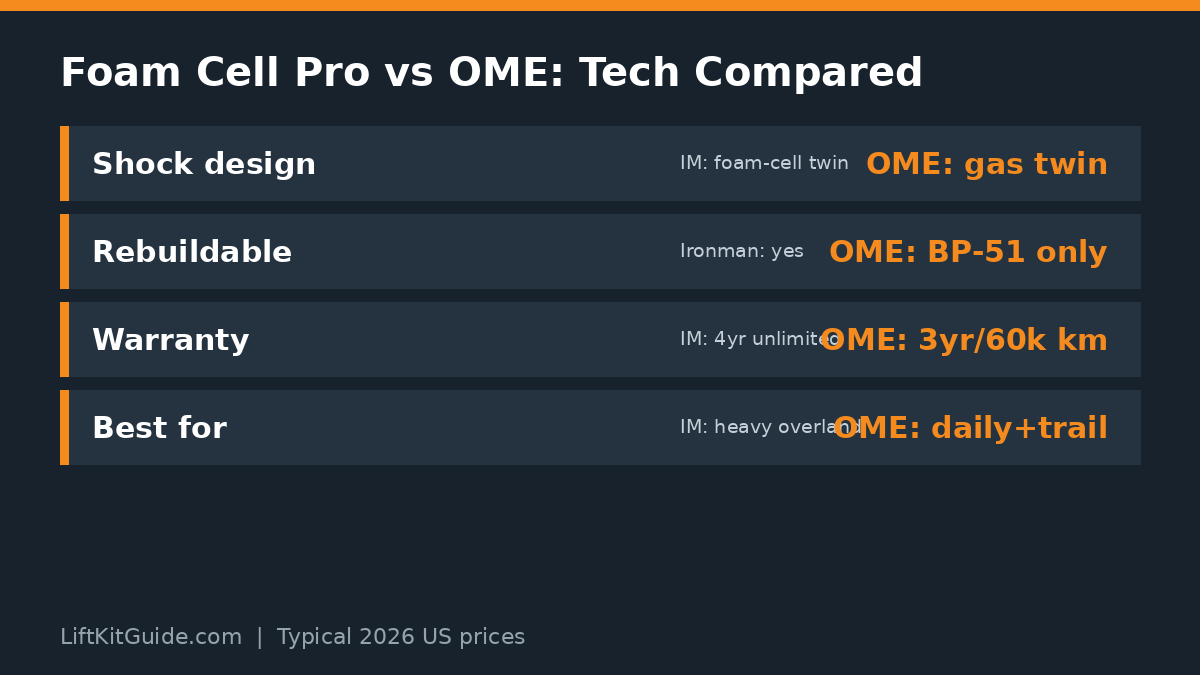
Shock technology is the core of the ironman 4×4 vs old man emu comparison. The Foam Cell Pro uses an oversized twin-tube body with a foam cell insert that separates shock oil from air, preventing aeration and fade when the shock cycles hard for hours on corrugated roads. It is a workhorse design: virtually indestructible according to long-term owners, and fully rebuildable by design, so a seal kit and fresh oil restore it indefinitely.
OME’s standard Nitrocharger Sport is also a twin-tube, but tuned as part of a matched system where ARB engineers specify spring rates and damping together for each vehicle weight. The result feels more composed on pavement and mild trails. At the top end, OME’s BP-51 line adds external bypass tubes with adjustable compression and rebound, a different league of tunability at roughly double the price. For most overlanders choosing between the standard lines, the question is fade resistance under load versus tuned street manners.
Twin-tube versus monotube is the technical backdrop to the ironman 4×4 vs old man emu shock debate. Twin-tubes like the Foam Cell Pro and Nitrocharger use an inner working cylinder and outer reserve, which allows a softer initial stroke and good ride comfort. The foam cell insert in the Ironman design prevents the oil aeration that causes fade in standard twin-tubes during sustained use. Neither brand chose monotubes for their standard lines, prioritizing comfort and control over maximum heat dissipation.
| Feature | Ironman Foam Cell Pro | OME Nitrocharger Sport |
|---|---|---|
| Shock architecture | Oversized twin-tube, foam cell | Twin-tube, gas charged |
| Fade resistance | Excellent (foam anti-cavitation) | Good |
| Rebuildable | Yes, by design | No (sealed); BP-51 is |
| Warranty | 4-year unlimited mile | ~3-year / 60,000 km |
| Typical kit price | $1,300-$1,900 | $1,500-$2,200 |
| Best for | Heavy loaded overlanding | Refined daily + trail use |
Which rides better loaded: Foam Cell Pro or OME?
Loaded ride is where the ironman 4×4 vs old man emu choice gets personal. With 400-plus pounds of bumpers, sliders, rack, and rooftop tent, the Foam Cell Pro’s big oil volume and fade resistance shine; owners describe the truck staying controlled on washboard at speed long after lesser shocks go soft. The foam cell insert earns its keep exactly in this scenario, hour three of corrugations with a loaded truck.
OME counters with spring-rate science. Because ARB publishes multiple spring rates per platform, you can match coils and leaf packs to your exact loaded weight, and the matched damping keeps the truck composed. An OME kit spec’d correctly for a heavy truck rides beautifully; an OME kit with stock-rate springs on a heavy truck sags and wallows. The lesson applies to both brands: weigh the truck loaded and buy springs for that number, a service both companies’ dealers provide. Our suspension lift kits guide explains how spring rate and damping interact.
Spring rate selection is where ironman 4×4 vs old man emu buyers most often go wrong. Both brands offer multiple rates, and choosing too stiff because you might add a bumper someday ruins the ride for years. Weigh the truck as it sits today, add only the accessories you actually own, and select accordingly. You can always upgrade springs later; you cannot un-buy a harsh ride. Reputable dealers will talk you out of the heavy rate if your truck is light, and that is the dealer you want.
When in doubt between two spring rates, most experienced overlanders recommend choosing the lighter one. You can add air bags or a leaf later; you cannot make an oversprung truck comfortable.
How do the warranties and company support compare?
Warranty terms favor Ironman on paper: 4 years with unlimited miles on lift kits, which is generous for parts that live under a truck. Ironman’s US distribution has grown substantially, with vehicle-specific valving and free shipping on kits from its American operation, plus a 4.7-star rating across thousands of verified reviews.
OME’s warranty is shorter in most markets, typically 3 years or 60,000 km, but the brand’s support reputation is arguably the industry’s best; ARB’s dealer network is vast and its technical documentation is exhaustive. In practice, both companies honor legitimate claims well. The tiebreaker is local: buy the brand your nearest reputable shop knows best, because correct spring-rate selection and install quality matter more than warranty fine print. Either way, keep receipts and register the kit.
Dealer networks differ significantly in the ironman 4×4 vs old man emu comparison. ARB’s OME network spans the globe with deep technical resources and decades of application data. Ironman’s US presence has grown rapidly, with American-based support and vehicle-specific valving developed for domestic trucks. For common platforms like the Tacoma, both offer excellent support. For less common vehicles, check parts availability before committing; waiting six weeks for a replacement shock is no joke.
What do long-term owners say about ironman 4×4 vs old man emu?
Owner testimony in the ironman 4×4 vs old man emu debate is passionate on both sides. Ironman converts often come from failed budget kits and describe the Foam Cell Pro as transformative; one widely quoted IH8MUD member called it ten times better than the OME setup he pulled off, praising its composure on rough tracks. The rebuildable design also wins long-term fans who like servicing rather than replacing.
OME loyalists point to decades of expedition-proven reliability and the refined on-road feel that matched spring rates deliver. Fleet and tour operators across Australia and Africa run OME for a reason: predictable, supported, and consistent. Criticisms of each are mild; Ironman gets occasional notes about firmer unladen ride with heavy-rate springs, OME about cost creep once you add every option. Both have earned their reputations over hundreds of thousands of trucks.
The used market for ironman 4×4 vs old man emu kits favors buyers who know what to inspect. Foam Cell Pro shocks can be rebuilt, so a used set with good bodies is a legitimate bargain; budget for a seal kit and fresh oil. OME Nitrochargers are sealed, so buy used only if the price reflects their remaining life. Check leaf packs for cracked leaves and flattened arch, and verify spring part numbers match your vehicle’s weight rating before handing over cash.
- Ironman strengths: fade resistance, rebuildable design, 4-year unlimited-mile warranty, value pricing.
- OME strengths: 30+ years of matched tuning, huge dealer network, BP-51 upgrade path.
- Ironman watch-outs: heavy-rate springs ride firm when unloaded; spec rates carefully.
- OME watch-outs: higher prices; sealed Nitrochargers are not rebuildable.
- Both: 2-3.5 in. lift; demand correct spring rates for your loaded weight.
Which kit is better for towing with an overland build?
Towing with a lifted overland truck stresses the rear suspension, and here the design philosophies show. The Foam Cell Pro’s big twin-tube body and foam insert handle sustained heat from a loaded truck plus trailer without fading, and Ironman explicitly targets towing and heavily loaded trucks in its marketing. Pair it with the correct heavy-duty leaf pack and the rear stays composed.
OME’s answer is spring-rate matching: choose the leaf pack rated for your tongue weight plus cargo, and the tuned Nitrochargers control it. Both approaches work when spec’d right and both fail when undersprung. Whichever you choose, add a weight-distributing hitch for bumper-pull trailers over 5,000 pounds and verify your towing setup after the lift, since ride height changes hitch geometry.
Air bags versus heavy springs is a common crossroads in the ironman 4×4 vs old man emu decision for towing. Heavy-duty leaf packs handle constant load beautifully but ride stiff when empty. Air helper springs let you run a medium pack daily and air up for towing, offering the best of both worlds at the cost of complexity. Ironman’s philosophy leans toward proper springs; many OME dealers recommend air bags for variable loads. Match the solution to how often you actually tow.
How much does an ironman 4×4 vs old man emu lift cost installed?
Parts prices set the baseline: $1,300 to $1,900 for Ironman Foam Cell Pro kits and $1,500 to $2,200 for comparable OME kits, before the BP-51 line. Installation adds $600 to $1,000 at a shop since these are strut-and-leaf-pack jobs without crossmember cutting, plus $80 to $120 for alignment. Realistic out-the-door totals land around $2,000 to $3,000 for Ironman and $2,300 to $3,400 for OME.
The value math extends past purchase. Ironman’s rebuildable shocks can be serviced for the cost of a seal kit instead of replaced, while OME’s sealed Nitrochargers get replaced at end of life; over 150,000 miles that narrows the price gap further. Budget the full project using our cost to lift a truck worksheet, and remember that correct spring rates cost nothing extra but determine everything about the result.
Installation nuances separate a good ironman 4×4 vs old man emu outcome from a great one. Torque all fasteners at ride height, not full droop, to avoid preloading bushings. Cycle the suspension by bouncing each corner before final torque to settle everything. Get an alignment after 500 miles of settling, not immediately; the springs need time to take a set. These details cost nothing but determine whether your $2,000 kit rides like $2,000 or like $500.
| Cost item | Ironman Foam Cell Pro | Old Man Emu |
|---|---|---|
| Kit (typical) | $1,300-$1,900 | $1,500-$2,200 |
| Professional install | $600-$1,000 | $600-$1,000 |
| Alignment | $80-$120 | $80-$120 |
| Out-the-door estimate | $2,000-$3,000 | $2,300-$3,400 |
| Long-term shock service | Rebuild (seal kit) | Replace (sealed) |
Which should you buy for your overland build?
Buy Ironman Foam Cell Pro if your truck works hard: heavy armor, constant load, long corrugated transits, and a desire to rebuild rather than replace. The foam-cell fade resistance and 4-year unlimited-mile warranty are purpose-built for that life, and the price leaves room in the build budget for tires and recovery gear. The ironman 4×4 vs old man emu value crown goes to Ironman for the working truck.
Buy Old Man Emu if refinement matters most: a daily driver that overlands on weekends will appreciate the matched spring-and-damper tuning and the vast ARB support network. And if budget truly is no object, the BP-51 line ends the debate with adjustability neither standard kit offers. Check lift costs by height and installation pricing to finalize your budget, then spec springs for your real loaded weight. An honest look at Ironman’s current lift kit lineup shows how the series stack up before you buy.
The break-in period matters more than most expect. New leaf packs and coils settle noticeably in the first 1,000 miles, sometimes dropping half an inch. Do not judge ride height or alignment on day one. Drive normally for two weeks, then measure and align. Patience here prevents the common mistake of cranking preload to compensate for unsettled springs.
Frequently asked questions
What is foam cell shock technology?
Foam cell technology replaces the gas charge in a twin-tube shock with a foam sleeve that separates the oil from air. This prevents aeration and fade during sustained rough-terrain use, which is why the design suits heavy overland trucks that work their suspension for hours.
What is the difference between OME Nitrocharger and BP-51?
OME's Nitrocharger Sport is the standard twin-tube shock in most OME kits; the BP-51 is a separate premium line with external bypass tubes and adjustable compression and rebound. BP-51 kits cost roughly twice as much and target drivers who want race-level adjustability.
Are Ironman Foam Cell Pro shocks rebuildable?
Yes. The Foam Cell Pro shocks are designed to be fully rebuildable, which extends their service life indefinitely with fresh seals and oil. OME Nitrochargers are sealed units; the BP-51 line is rebuildable and revalvable.
How do I choose the right spring rate?
Both brands publish multiple spring rates for common platforms like the Tacoma, 4Runner, and Hilux. Weigh your truck loaded for a trip, then choose the spring rate matching that weight; too stiff rides harsh empty, too soft sags loaded. Retailers can help spec this.
What warranty do Ironman and OME offer?
Ironman 4×4 backs its lift kits with a 4-year unlimited-mile warranty. Old Man Emu offers a 3-year/60,000 km warranty on most components in many markets, with the brand's reputation for honoring claims doing heavy lifting beyond the paperwork.
Which is better for washboard roads?
For washboard roads at speed with a loaded truck, the Foam Cell Pro's fade resistance gives it the edge; owners describe it as virtually indestructible on corrugated tracks. OME's tuned spring rates can feel more composed on milder terrain, so match the kit to your worst-case road.
The bottom line
The ironman 4×4 vs old man emu decision rewards honesty about your build. Heavy overland rig with bumpers, rack, and a rooftop tent? The Foam Cell Pro’s fade resistance and rebuildable twin-tube design were made for exactly that abuse, at a price that leaves budget for the rest of the build. Lighter daily driver that sees forest roads on weekends? OME’s matched spring-and-shock tuning delivers the more refined ride.
Both are legitimate lifetime-of-the-truck purchases from companies that have been doing this for decades. Pick your spring rates for your actual loaded weight, install it right, align it, and either kit will outlast the payment book. The wrong choice is not picking between these two; it is buying a no-name kit and replacing it in two years.




Leave a comment