


Last updated: October 2026 Written by the LiftKitGuide Team, truck suspension installers and editors
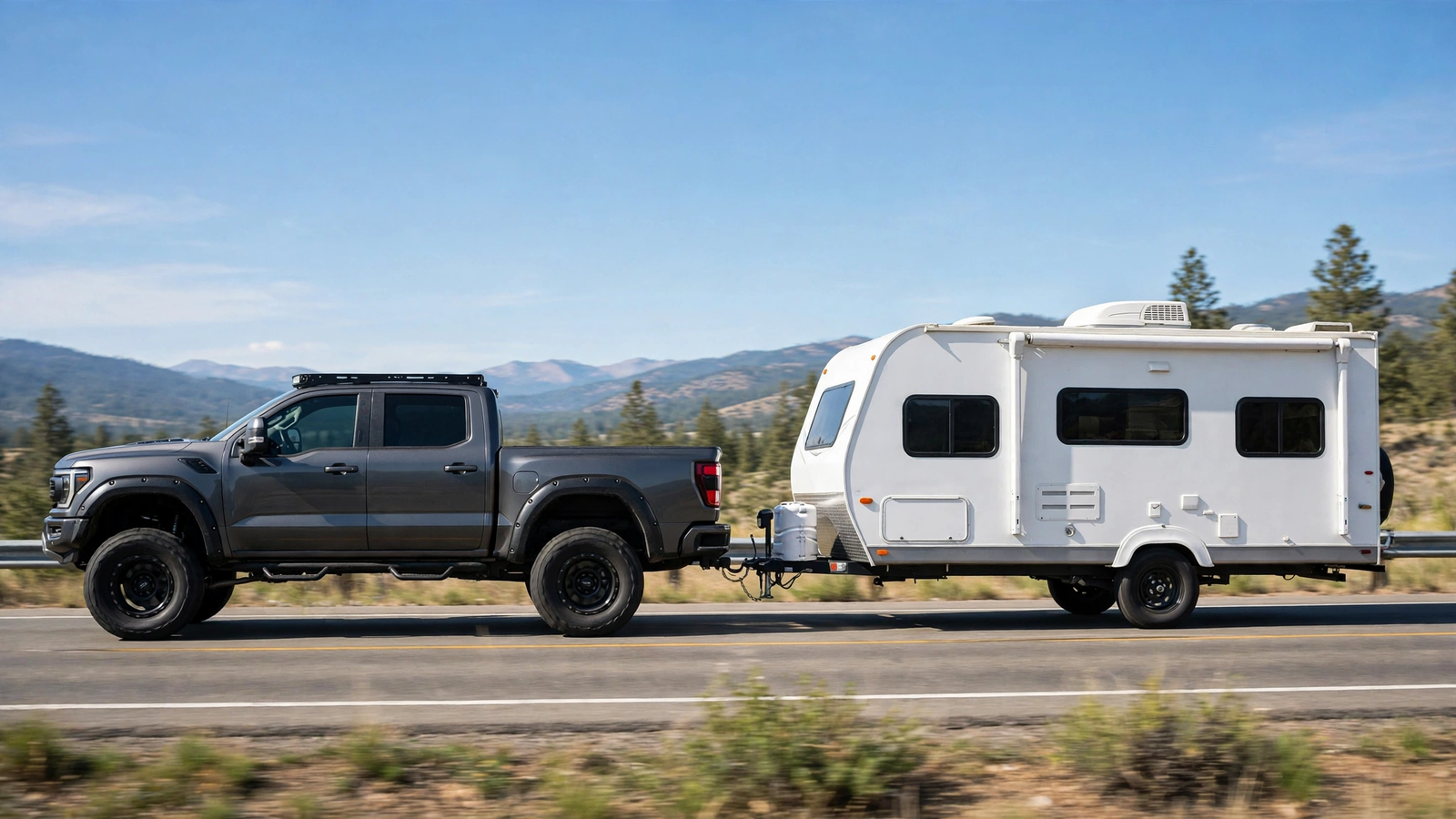
Can you tow with a lifted truck? Yes, but your factory tow rating does not change — GVWR, GCWR, and tongue-weight limits stay on paper while real-world stability, rear sag, and braking all get harder. Tongue weight of 500–1,000 pounds can drop the rear 1–3 inches, unload the steering, and invite sway, so a lifted truck needs a drop hitch, a weight-distribution hitch on heavy loads, and sometimes air bags or Timbren SES springs. Plan on $500–$1,500 in towing upgrades beyond the lift itself.
Key takeaways
- Factory tow ratings (GVWR, GCWR, and tongue weight) do not change after a lift — and no air bag, helper spring, or Timbren kit raises them.
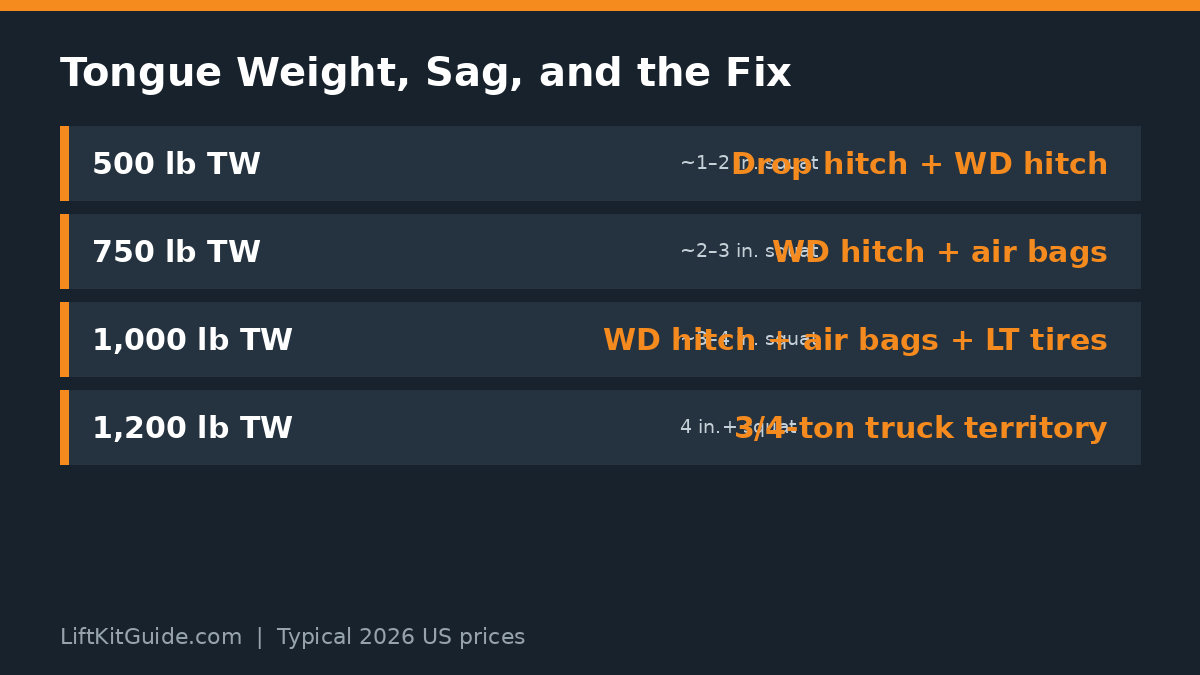
- About 800 pounds of tongue weight can drop a lifted truck’s rear 2–3 inches and lift weight off the front axle.
- Measure your drop, then add 2 inches: a 6-inch lift on 35–37 inch tires typically needs an 8–11 inch drop hitch.
- A deep-drop weight distribution hitch (up to 7 in. drop, 8,000–10,000 lb trailer capacity) is the single best upgrade for trailers over 5,000 lb.
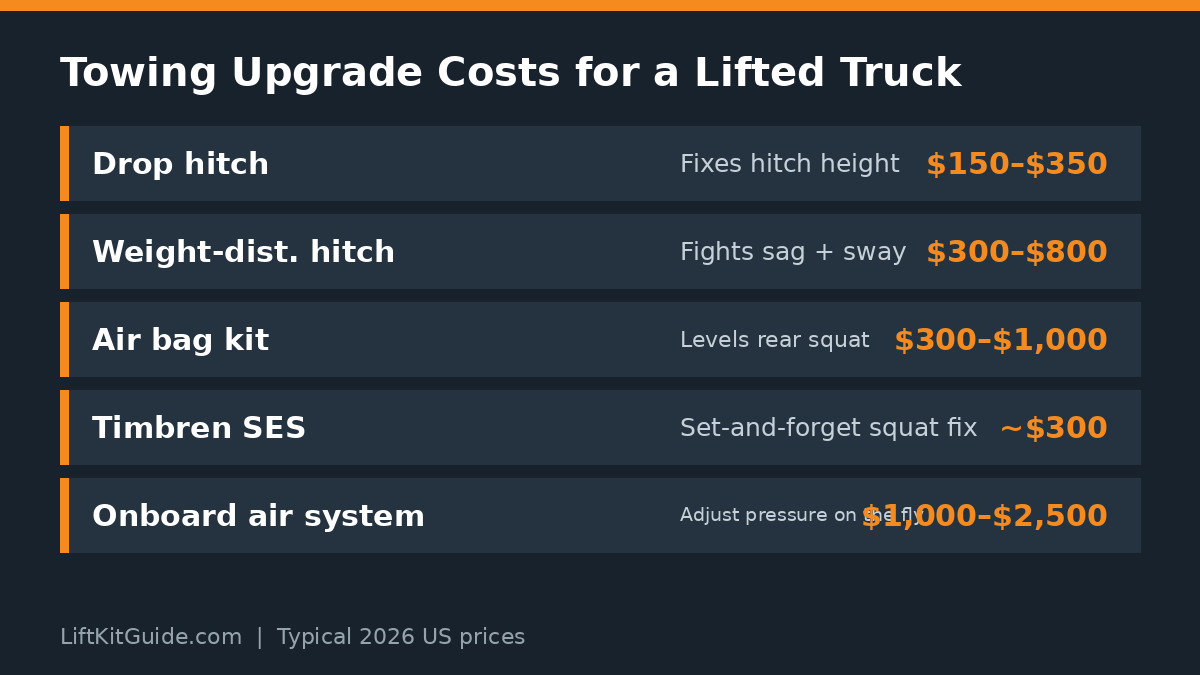
- Typical 2026 towing setup costs: $150–$350 for a drop hitch, $300–$800 for a WD hitch, $300–$1,000 for air bags or about $300 for Timbren SES.
On this page
Can you tow with a lifted truck without losing capacity?
So, can you tow with a lifted truck and still use its factory rating? Yes — but paper and pavement differ. A lift kit does not change the numbers on your door sticker: GVWR, GCWR, tongue weight, and the hitch rating stay where the manufacturer put them. No lift, air bag, or helper spring raises them, and towing past them is just as risky in a lifted truck as in a stock one. Stay inside the ratings and the truck stays rated to pull it. The catch is that everything around the rating gets more demanding — a higher center of gravity, softer springs, bigger tires, and a raised hitch point all change how the trailer behaves behind the truck.
That gap between the rating and reality is where lifted trucks earn their reputation for sketchy towing. On a stock truck, 800 pounds of tongue weight might settle the rear an inch or two; on a truck with a soft 6-inch lift and tall sidewalls, the same load can drop the tail several inches, point the headlights at the sky, and unload the front axle. Steering gets lighter, stopping distances grow, and the trailer gains leverage over the truck. None of that changes the sticker, but it shrinks the margin you tow with. Treat the factory rating as the ceiling, then rebuild the margin with the right hitch gear and load support before you hook up.
Does a lift kit change your truck's towing rating?
No. A lift kit never changes a truck’s official towing rating. Manufacturers set the maximum tow rating by testing the stock truck as a complete system, and the weakest link sets the number. Aftermarket parts fall outside that certification. Even good upgrades like air bags or helper springs only improve comfort and control — CURT and other hitch makers remind buyers that the lowest-rated component in the chain caps the setup. The common follow-up — can you tow with a lifted truck past the stock rating on air bags? — gets a firm no. They can also complicate warranty claims, so read our guide on whether a lift kit voids warranty first.
What a lift does change is payload and effective gearing, and both eat into real towing headroom. Heavier lift parts, wheels, and tires all weigh more than stock, and every extra pound on the truck subtracts directly from payload — which includes tongue weight. A 35-inch tire also raises the effective gear ratio, so the engine works harder on grades and acceleration fades. While suspension lift kits create real clearance and travel, these are practical reductions, not legal ones: the sticker still says what it says, but a trailer that felt easy behind the stock truck can feel like a chore behind the lifted one. Staying conservative on trailer weight buys back the margin the lift takes.
The honest planning number is therefore the stock rating minus everything the lift took. Weigh the truck as built — with the lift, wheels, bumpers, and gear — and subtract from GVWR to find your true remaining payload; the loaded tongue weight must fit inside it. Many half-ton owners discover that after a 6-inch lift, armor, and 35s, a travel trailer’s 900-pound tongue plus passengers leaves almost nothing for cargo. That math, not the brochure tow figure, is what decides which trailer a lifted truck can pull safely. Run it before you shop for the trailer, not after.
Why does a lifted truck sag when towing?
Rear sag happens because tongue weight acts as a lever on the rear axle. Load 600 to 1,000 pounds on the coupler and that weight presses down behind the rear axle while prying the front end upward. One half-ton owner measured 3 inches of squat with 800 pounds of tongue weight; another measured 2.5 inches of sag with a 600-pound tongue. Lifted trucks feel it more because many lift springs are tuned soft and tall sidewalls flex too. A raised hitch point gives the trailer more leverage — which is why the real question is not the rating but stability: can you tow with a lifted truck that has a soft, tall suspension and feel in control?
The consequences go well beyond looks. When the rear drops and the nose rises, weight leaves the front axle, so steering turns vague, headlights aim into oncoming traffic, and the front brakes lose the grip they need for emergency stops. A nose-high trailer also catches wind differently and sways more easily, especially on downhill grades or when a semi passes. An inch or two of squat is often considered acceptable, but several inches on a lifted truck is a warning sign that the rig is out of balance. That balance — not raw spring rate — is what keeps a tow stable, and it is the true test behind can you tow with a lifted truck safely.
What size drop hitch does a lifted truck need?
A lifted truck needs a drop hitch because the receiver sits several inches higher than stock, and a trailer that rides nose-high tows badly. The method is simple: park the truck and trailer on level ground, measure from the ground to the inside top of the receiver, measure from the ground to the trailer coupler with the trailer level, and subtract. The difference is your drop — then add about 2 inches for the squat that appears once tongue weight is loaded. Even a modest leveling kit changes the math, and after the common question of can you tow with a lifted truck, drop-hitch sizing is usually the next one owners ask.
Adjustable drop hitches are the practical answer because one hitch can cover several trailers and load conditions. Some designs adjust in 6-inch increments up to 12 inches, while others offer exact one-inch positioning for a precise match. Check the ratings as carefully as the drop: the ball mount must be rated for the trailer’s gross weight and tongue weight, and the receiver, ball, and shank each carry their own limits. Whatever you choose, the goal is a level trailer with the coupler at its design height — that single detail fixes more towing complaints than any spring upgrade ever will.
| Lift height | Receiver rise over stock | Typical drop needed | Notes |
|---|---|---|---|
| 2 in. leveling kit | 1–2 in. | 2–4 in. | Measure first, then add 2 in. for loaded squat |
| 4 in. lift | 3–5 in. | 4–8 in. | Most adjustable ball mounts cover this |
| 6 in. lift | 5–7 in. | 8–11 in. | Common with 35–37 in. tires |
| 8 in. lift and up | 7–10 in. | 10–12 in.+ | Verify ball, shank, and receiver ratings |
Can you tow with a lifted truck using a weight distribution hitch?
Yes — and for bumper-pull trailers above roughly 5,000 pounds, a weight distribution hitch is the single most important upgrade a lifted truck can get. The spring bars lever tongue weight forward onto the front axle, restoring the steering weight that sag steals and returning the trailer to level. Set up correctly, owners report rear sag dropping from 3 inches to half an inch or less: the truck stands level and the trailer tracks straight. Size it to the loaded tongue weight, not the dry brochure number — a 1,000-pound loaded tongue needs bars rated for at least 1,000 pounds. So can you tow with a lifted truck and a travel trailer? Absolutely — but plan on a WD hitch.
Lifted trucks need one extra consideration: the shank. A standard WD shank does not drop far enough for a raised receiver, so look for a deep-drop design. CURT’s deep-drop trunnion-bar system, for example, offers up to 7 inches of drop and 10.5 inches of rise with 8,000–10,000 pounds of trailer capacity and 800–1,000 pounds of tongue-weight capacity — check the specs on this deep drop weight distribution hitch to match a model to your lift height. Sway control is worth adding on the same hitch: friction bars or integrated cam systems damp the side-to-side motion that taller trucks are more prone to, especially in crosswinds.
Setup matters as much as the hardware. A WD hitch set up wrong can transfer too little weight — or too much — and on a lifted truck the geometry is already working against you. Set the ball height so the trailer sits level when loaded, tension the bars until front-axle weight is restored close to its unhitched value, and recheck everything after the first loaded drive, because springs settle and loads shift. Done right, a weight distribution hitch makes a lifted rig feel close to stock; done wrong, it just adds dead weight to the receiver.
Which sag fixes work best: air bags, Timbren SES, or helper springs?
Air bags are the adjustable option. Sleeve-style bags mount at the rear springs or frame, and adding 30–70 psi firms the rear only when you need it, then deflates back to a near-stock ride when you unhook. Basic manual-fill kits start around $300, while complete systems with an onboard compressor run about $1,000–$2,500. They erase squat and let you fine-tune the stance for different trailers, but they need air checks and can develop leaks over years of use. Can you tow with a lifted truck on air bags alone? Yes — but remember the universal caveat: air bags improve control and leveling without raising GVWR or the tow rating.
Timbren SES and steel helper springs are the set-and-forget alternatives. Timbren’s hollow rubber springs replace the factory bump stops, engage progressively under load, cost about $300 and install in under 30 minutes with no air lines. Traditional helper springs and add-a-leafs work similarly but stay engaged longer and can firm the empty ride. The answer to can you tow with a lifted truck and heavy tongue weight using only helpers is: often, yes — but pair them with a WD hitch on 5,000-pound trailers, since only a WD hitch restores front-axle weight. For weekly towers, air bags earn their price; for a few weekends a year, rubber springs deliver most of the benefit for a third of the cost.
- Air bags: adjustable 30–70 psi; level any trailer; $300–$1,000 basic, $1,000–$2,500 with onboard air.
- Timbren SES: hollow rubber bump-stop springs; no air or maintenance; about $300; under-30-minute install.
- Helper springs / add-a-leaf: steel, always working; firms the empty ride; budget-friendly but least refined.
- Weight distribution hitch: the only option that also restores front-axle weight and fights sway — use it with helpers on heavy trailers.
How do you prevent trailer sway with a lifted truck?
Start with the trailer, because most sway begins behind the hitch rather than under the truck. Keep tongue weight at 10–15% of the loaded trailer weight — an 8,000-pound trailer wants 800–1,200 pounds on the tongue — and load heavy cargo ahead of the trailer axles, never at the rear. A tail-heavy trailer will sway behind any truck, lifted or not, and no gadget fully fixes bad loading. Tire pressure matters too: run LT-rated tires at the pressure the load requires, because soft sidewalls on a tall tire let the trailer walk sideways. The straight answer to can you tow with a lifted truck and stay sway-free is that loading discipline matters more than lift height.
Then protect the truck side. A level trailer, restored front-axle weight, and a tight WD setup do most of the work; dedicated sway control handles the rest. Friction sway bars are cheap insurance at $50–$150, while integrated systems like the Equal-i-zer or dual-cam designs manage sway continuously. Slow down before descents, keep a generous following distance, and avoid sudden steering corrections — a lifted truck’s higher center of gravity makes every input bigger. If sway starts, ease off the throttle and apply the trailer brakes manually instead of stabbing the truck brakes.
What does it cost to set up a lifted truck for towing?
Budget the towing setup separately from the lift itself. A quality adjustable drop hitch runs roughly $150–$350, and a deep-drop weight distribution hitch with sway control typically lands between $300 and $800 depending on capacity. Squat control adds about $300 for a Timbren-style kit, $300–$1,000 for manual-fill air bags, or $1,000–$2,500 for a full onboard-air system. Most owners spend $500–$1,500 total on towing gear for a lifted half-ton — modest next to the cost to lift a truck, which commonly runs $1,200–$5,000 installed. So can you tow with a lifted truck on a budget? Yes — most of the fix is the hitch, not the springs.
Do not forget the supporting costs that towing exposes. Bigger tires may demand a regear — 4.56 gears are a common answer for 35s on a truck that tows — and a transmission cooler is cheap insurance when the truck works harder on grades. A brake controller is mandatory for trailers with electric brakes, and LT tires at the correct pressure are non-negotiable on a tow rig. For trucks that do double duty as daily drivers and weekend towers, the benefits of lifted trucks still apply — the towing setup simply protects them. Once everything is dialed in, can you tow with a lifted truck cross-country? Owners do it every day.
| Upgrade | What it fixes | Typical cost |
|---|---|---|
| Adjustable drop hitch | Hitch height mismatch | $150–$350 |
| Weight-distribution hitch | Sag plus sway | $300–$800 |
| Air bag kit (manual fill) | Rear squat | $300–$1,000 |
| Onboard air system | Adjustable leveling on the fly | $1,000–$2,500 |
| Timbren SES kit | Set-and-forget squat control | $250–$350 |
| Sway control device | Side-to-side motion | $50–$400 |
Frequently asked questions
Does a lift kit reduce towing capacity?
Not on paper. The factory tow rating, GVWR, and GCWR stay exactly as the manufacturer set them, because a lift is an aftermarket modification outside the certification. In the real world, heavier lift parts and bigger tires subtract from payload, and taller tires raise the effective gear ratio, so the same trailer feels harder to pull. Stay conservative on trailer weight and keep the loaded tongue weight inside your true remaining payload.
What size drop hitch do I need for a 6-inch lift?
Most 6-inch lifted trucks on 35–37 inch tires need a drop hitch in the 8–11 inch range, but measure your own setup instead of guessing. Park on level ground, measure from the ground to the inside top of the receiver and to the level trailer coupler, subtract, then add about 2 inches for the squat that appears under tongue weight. Adjustable drop hitches are the best value because they cover multiple trailers and loads.
Can I use a weight distribution hitch on a lifted truck?
Yes. A weight distribution hitch works on a lifted truck, but you need a deep-drop shank because a standard shank will not reach far enough below the raised receiver. Deep-drop models offer up to 7 inches of drop for trailers up to 10,000 pounds. Size the spring bars to your loaded tongue weight, add sway control, and set the hitch so the trailer rides level when loaded.
Do air bags increase towing capacity?
No. Air bags level the truck, erase rear squat, and improve control, but they do not raise GVWR, payload, or the maximum tow rating. Neither do Timbren SES kits or helper springs. They make towing within your existing limits safer and more comfortable — they never create new limits. The truck, hitch, ball, and every other component each keep their original ratings, and the lowest one caps the setup.
How much rear sag is normal when towing with a lifted truck?
About 1–2 inches of squat under a loaded trailer is generally acceptable. Around 3 inches or more — common with 800–1,000 pounds of tongue weight on soft lift springs — is a sign the rig is out of balance: steering gets light, headlights aim high, and braking suffers. A properly set weight distribution hitch can reduce that sag to half an inch or less, and air bags or Timbren SES kits can finish the job.
Is it legal to tow at the factory rating after installing a lift kit?
The factory rating still applies — the lift does not change the legal number, and towing past GVWR or GCWR can bring fines and insurance trouble after an accident. In practice, the heavier lifted truck has less real-world margin, so treat the rating as an absolute ceiling and leave extra room. Weigh the truck as built, confirm the tongue weight fits the remaining payload, and never exceed the lowest-rated component in the setup.
The bottom line
Yes, you can tow with a lifted truck — the factory rating never changed, but your job is to restore the stability the lift took away. A measured drop hitch keeps the trailer level, a weight distribution hitch with sway control puts weight back on the front axle, and air bags or a Timbren-style kit erases the remaining squat. Together they close most of the gap between a lifted rig and the stock truck the rating was written for.
Spend the $500–$1,500 on the towing setup before the first long haul, keep tongue weight at 10–15% of the loaded trailer, and stay honest about the payload math after the lift. Do that, and a lifted truck tows a travel trailer, boat, or car hauler with confidence instead of white knuckles.





1 Comment