


Last updated: October 2026 Written by the LiftKitGuide Team, truck suspension installers and editors
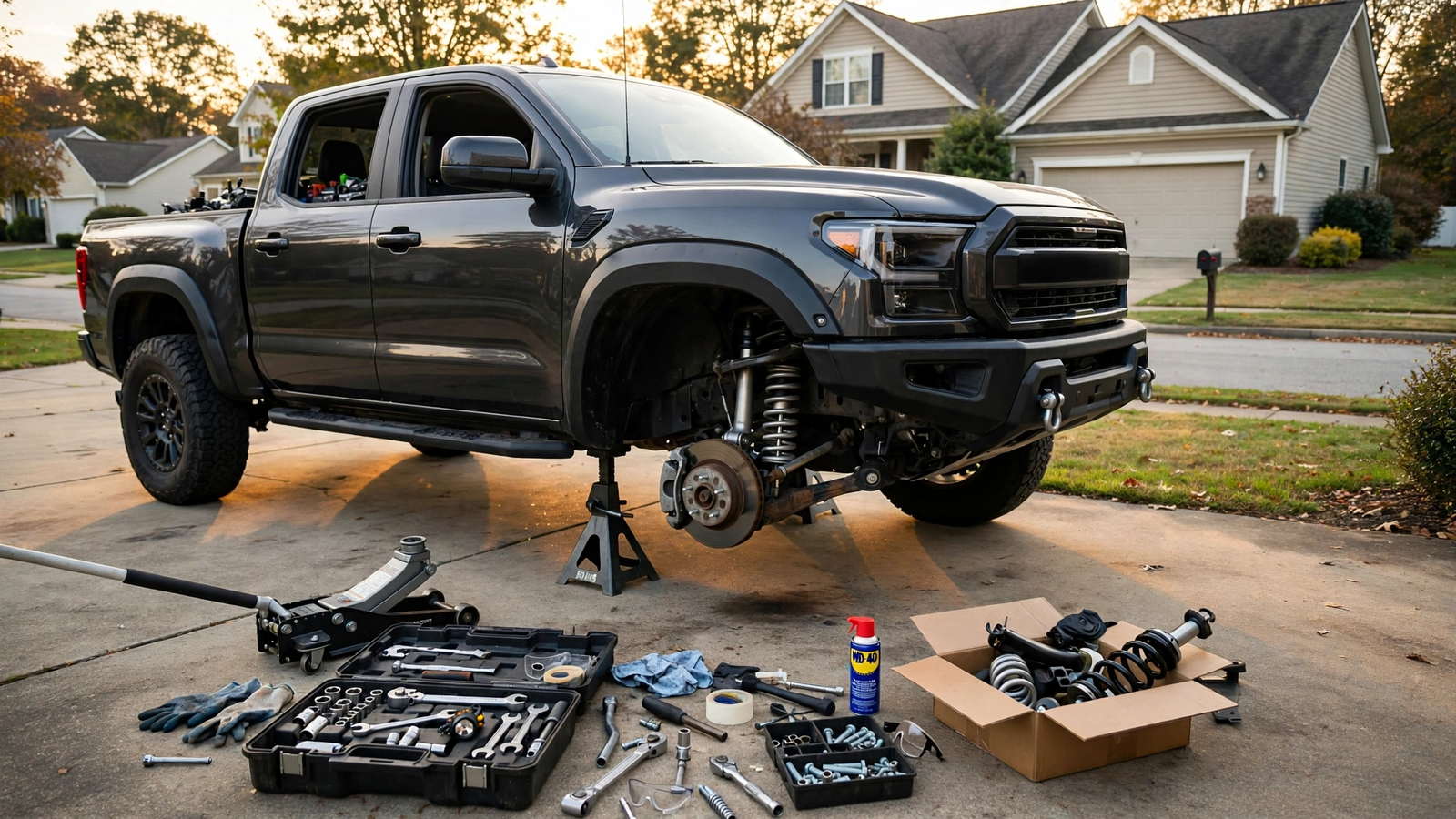
Can you install a lift kit in your driveway? Yes — if it is a basic spacer or strut kit, you have hand tools, jack stands, and a full weekend. Thousands of owners do this every year; one Tacoma owner reported finishing the front end of his first lift in 2.5 hours with basic tools. But 6-inch bracket kits with cutting, heavy diesels, and rust-belt trucks belong at a shop. The deciding factors are kit complexity, your experience, and whether you can afford to have the truck stuck on stands.
Key takeaways
- Yes, a basic 2- to 3-inch spacer or strut kit is a realistic driveway job with hand tools, jack stands, and a weekend.
- Budget 12 to 20 hours of wrenching for a first-timer — roughly triple the shop time.
- You need a torque wrench, a spring compressor for strut work, penetrating oil, and ideally a helper.
- Coil springs store lethal energy — never improvise spring compression, and never work under a truck on a jack alone.
- Quit and call a shop if you hit frame cutting, snapped brake lines, or a bolt you cannot remove safely.
On this page
Can you install a lift kit in your driveway? The honest answer
Can you install a lift kit in your driveway? For a basic 2- to 3-inch kit — strut spacers or replacement struts up front, blocks or an add-a-leaf in the rear — the honest answer is yes. This is one of the most documented DIY jobs in the truck world: forum threads are full of owners who did their first lift on jack stands with basic hand tools, and many report being surprised at how straightforward it was. One Tacoma owner finished the entire front end of his first lift in about 2.5 hours with a jack, two stands, and a dozen hand tools.
But ‘can you’ and ‘should you’ are different questions, and the answer depends on three things: the kit, the truck, and you. A spacer kit on a clean 3-year-old truck installed by someone who has done brakes before is a genuinely reasonable weekend project. A 6-inch bracket kit requiring frame cutting, on a 10-year-old rust-belt diesel, attempted by someone whose biggest job was an oil change, is a recipe for a tow bill. The rest of this guide helps you figure out which situation you are in — because the worst outcome is not a slow install, it is a truck stuck on stands Sunday night when you need it Monday morning.
The forum evidence for a yes is overwhelming when you search can you install a lift kit in your driveway: build threads with hundreds of photos, torque specs crowdsourced across dozens of trucks, and owners answering questions in real time. That community knowledge base is arguably better than some shop manuals, because it includes the mistakes — the bolt everyone strips, the step the instructions skip. Before you buy the kit, spend an evening reading two build threads for your exact truck. If owners with your skill level finished it, you can too; if every thread ends at a shop, believe them. Our best lift kit brands guide points to the kits with the best instructions, which matters more for DIY than brand prestige.
What tools do you absolutely need for a driveway lift install?
The non-negotiable list is shorter than people expect: a good floor jack, two (preferably four) rated jack stands, a complete socket and wrench set in metric and SAE, a torque wrench, and penetrating oil. That covers a basic spacer kit. The moment your kit involves strut disassembly, add a quality coil spring compressor — rented from the parts store if needed — because prying a compressed spring apart with improvised tools is how people get seriously hurt.
The tools that separate a smooth install from a miserable one are an electric impact wrench, a MAP-gas torch for stuck bolts, and a second pair of hands. The impact wrench alone can save hours on a rusty truck; the torch handles the bolts that penetrating oil cannot. As for the helper: maneuvering a strut assembly into place while threading bolts is dramatically easier with someone guiding it. Our lift kit installation cost guide prices out the tool investment versus shop labor, so you can see whether DIY actually saves you money once tools are counted.
- Floor jack + rated jack stands: never work under a truck supported only by a jack.
- Socket/wrench set (metric + SAE): suspension hardware mixes both standards.
- Torque wrench: every suspension fastener has a spec — guesswork is dangerous here.
- Coil spring compressor: mandatory for strut disassembly; rent a quality one.
- Penetrating oil + MAP-gas torch: the rust-belt survival kit for seized bolts.
- Impact wrench + a helper: the two biggest time-savers in a driveway install.
How long does a driveway lift install take versus a shop?
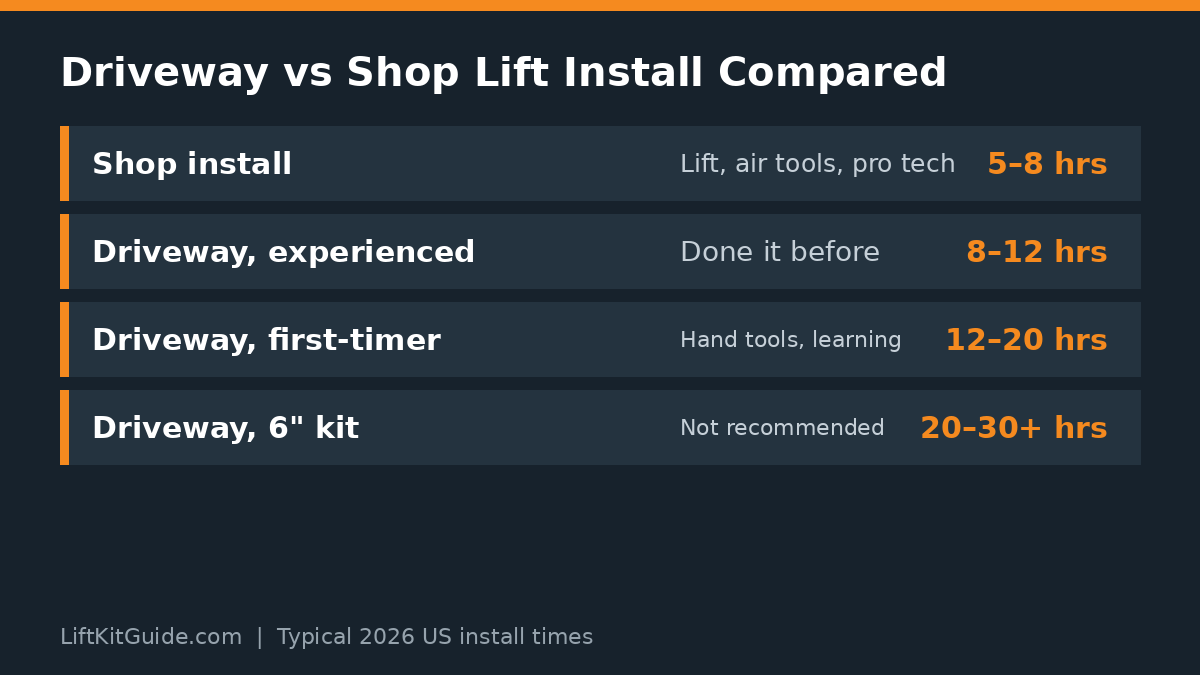
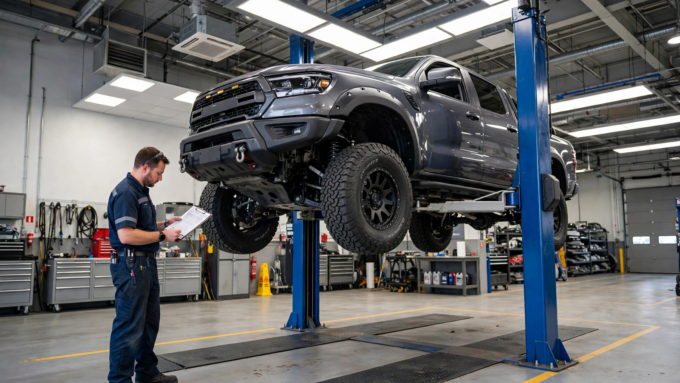
Expect the driveway to take two to three times the shop time. A shop does a 3-inch lift in 5 to 8 hours; a first-timer at home should budget 12 to 20 hours across a full weekend. The gap is not about skill — it is about equipment. A shop’s two-post lift puts every bolt at chest height with air tools; in a driveway you are on your back with a breaker bar, jacking and re-jacking to reach everything. Even experienced home mechanics report a full day for what a shop does before lunch.
That said, the driveway penalty shrinks with preparation and repetition. Owners doing their second lift routinely cut the time in half. The biggest controllable factor is the pre-game: soaking every bolt with penetrating oil for a week, inventorying the kit hardware before starting, and reading the instructions fully. An hour of preparation on Friday evening can save three hours of frustration on Saturday. And do not schedule the alignment until the truck is drivable — nothing derails a weekend like missing a Monday alignment appointment because the truck is not done. When you ask can you install a lift kit in your driveway on a schedule, the schedule needs a full weekend with margin, not a Saturday afternoon.
Weather and timing deserve a line in your plan, because they quietly determine whether can you install a lift kit in your driveway stays a yes all weekend. Rain turns a driveway into a miserable and unsafe workspace — check the forecast and have a canopy or a bail-out day ready. Cold matters too: metal contracts, your hands stop working, and penetrating oil works slower below freezing. Start Saturday at first light, not after lunch; the hours you save by sleeping in are the hours you will miss when a bolt fights you at dusk. Daylight is a tool, and it is free.
Which lift kits are realistic for a driveway install — and which are not?
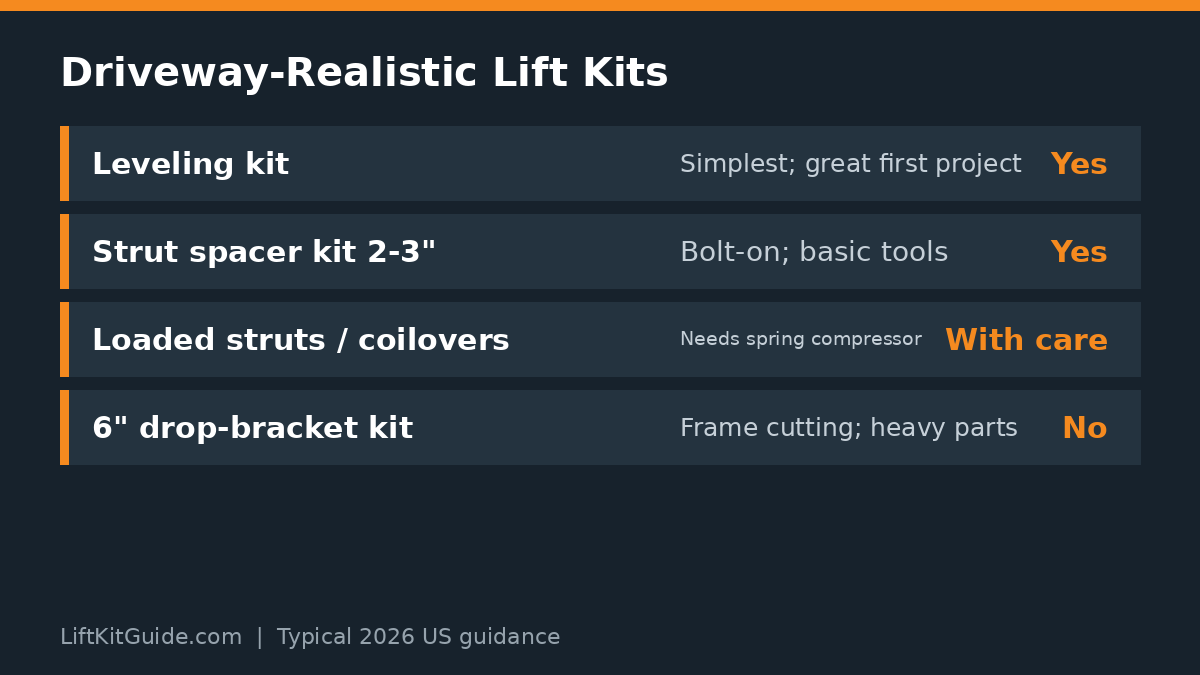
Realistic driveway kits: strut spacer kits (2 to 3 inches), leveling kits, and loaded-strut kits where the assembly comes pre-built. These are bolt-on jobs with no spring compression drama — or with compression handled by a rented tool on a bench, which is far safer than doing it under the truck. Rear blocks and add-a-leafs are similarly approachable. If the kit’s install manual shows only hand tools and no cutting, it is driveway territory.
Not realistic for most driveways: 6-inch drop-bracket kits (frame cutting, 50-pound crossmembers, differential work), coilover conversions requiring fabrication, and anything on a heavy-duty diesel where components weigh more than you can safely maneuver alone. The dividing line is simple: if the manual mentions cutting, welding, or a transmission jack, that is a shop job. Our suspension lift kits guide breaks down which kit designs are bolt-on and which demand fabrication, so you can match the kit to your garage before you buy.
| Kit type | Driveway realistic? | Why |
|---|---|---|
| Strut spacer kit (2–3″) | Yes | Bolt-on; no cutting; basic tools suffice |
| Leveling kit | Yes | Simplest job; 3–5 hours for beginners |
| Loaded struts / coilovers | Yes, with care | Spring compressor needed; bench work safer |
| Rear blocks / add-a-leaf | Yes | Straightforward with jack stands + helper |
| 6″ drop-bracket kit | No | Frame cutting; heavy parts; alignment-critical |
| Long-travel / fabrication | No | Welding and custom geometry; shop only |
What are the real dangers of a driveway lift install?
Coil springs are the number-one danger. A compressed coil spring stores enough energy to kill, and improvised compression methods — pry bars, ratchet straps, cheap no-name compressors — fail catastrophically. Use a proper rented compressor, keep your body out of the spring’s line of fire, and if anything looks sketchy, stop. This single step is where driveway installs go from ‘weekend project’ to ’emergency room,’ and it deserves more respect than any other part of the job.
The number-two danger is the truck falling. Never — ever — work under a vehicle supported only by a jack. Use rated jack stands on solid, level ground (not dirt, not a sloped driveway), chock the wheels, and shake the truck hard before getting under it. Beyond those two, the risks are financial rather than physical: snapping a brake line, stripping a critical bolt, or discovering you cannot complete the job with the truck immobile. Each of those turns a money-saving DIY into a tow-truck-and-shop-bill story. Respect the physics, and the project stays fun.
The financial risks deserve equal billing with the physical ones, because they are what actually end most troubled driveway installs. A snapped hard brake line means a tow to a shop — you cannot safely drive without brakes, and flaring a new line is beyond most DIYers. A stripped lower strut bolt can mean an extraction job or a new knuckle. None of these are likely on a well-prepared install, but each is a four-figure surprise if it happens. This is why the experienced answer to can you install a lift kit in your driveway always includes an emergency fund: keep $300 to $500 uncommitted, so a setback is an errand, not a crisis.
Can you install a lift kit in your driveway if you have never done suspension work?
Can you install a lift kit in your driveway as a complete beginner? It is possible, but pick the right first project. A leveling kit or 2-inch spacer kit is a genuinely good first suspension job — the steps are simple, the instructions are clear, and forum threads walk through every bolt. A full 3-inch kit with control arms is ambitious but doable for a careful beginner with a full weekend and a knowledgeable friend on call. What you should not attempt first is anything involving spring compression without supervision or any kit requiring cutting.
The beginner’s edge is patience. Experienced mechanics work fast because they have done it before; you will work slow because you are learning, and that is fine. Photograph every step of disassembly, label every bolt, and bag hardware by corner. Watch two different install videos for your exact truck before starting — when they agree, you understand the job; when they disagree, you have found the tricky part. And set a bail-out threshold in advance: decide before Saturday which problems mean calling a shop, so you are not making that decision tired and frustrated at 9 PM.
| Your experience | Good first lift project | Skip for now |
|---|---|---|
| Oil changes only | Leveling kit | Anything with spring compression |
| Done brakes before | 2–3″ spacer kit | 6″ bracket kits; control-arm kits alone |
| Done struts before | 3″ kit with UCAs | Frame cutting; diesel HD kits |
| Experienced DIYer | Most bolt-on kits | Fabrication; long-travel |
How do you set up a driveway for a safe lift install?
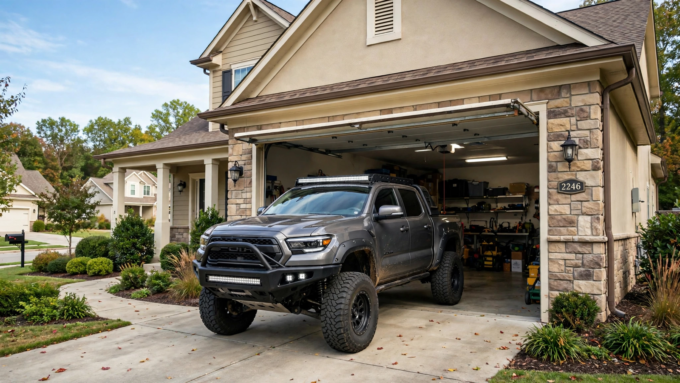
Start with the surface: flat, solid concrete or asphalt, never dirt or gravel, and never a slope. A truck on jack stands on soft ground can shift as you wrench, and that is how vehicles fall. You need enough room to walk completely around the truck with the doors open, plus space for tools, parts, and the removed wheels. Good lighting matters more than people expect — a pair of cheap LED work lights turns a frustrating evening into a productive one, and you will be working in wheel wells where daylight does not reach.
Organize like a shop. Lay out a tarp for hardware, sorted by corner and step; keep the install manual open and visible (a phone in a zip-lock bag works); and stage everything — jack, stands, torque wrench, compressor, penetrating oil, new hardware — before the first bolt comes off. Keep a fire extinguisher within reach when using a torch, and keep kids and pets far from the work area. The most overlooked setup item is a second vehicle: if you need an emergency parts run, you do not want your only transportation sitting on jack stands. Ask anyone who has lived the question can you install a lift kit in your driveway, and the second car is always in the top three lessons learned.
Think about neighbors and local rules too, since a truck on stands for a weekend is more visible than you think. Most residential areas tolerate a weekend project, but a truck immobile for a week can draw HOA complaints or even a citation in strict municipalities. If there is any chance the job runs long, warn the neighbors and keep the workspace tidy — parts scattered across the sidewalk invite trouble. And check whether your area restricts automotive work in driveways; a few cities do. The question can you install a lift kit in your driveway has a legal footnote in some zip codes, so a five-minute check beats a fine.
Is the money you save worth the weekend you will spend?
Run the numbers honestly. A shop charges roughly $600 to $1,200 in labor for a 3-inch lift install; DIY costs about $100 to $200 in tool rentals, supplies, and penetrating oil — plus 12 to 20 hours of your weekend. If you already own the tools, the savings are real: $500 to $1,000 stays in your pocket. If you need to buy a floor jack, stands, torque wrench, and impact gun, the first DIY barely breaks even, though the tools pay for themselves on future projects.
But money is only half the equation. DIY teaches you your truck — you will spot worn ball joints, understand your suspension, and know exactly what is holding your wheels on. That knowledge pays dividends every time something clunks. The counterweight is risk: a botched step costs a tow and a shop repair, wiping out the savings. The sweet spot is the owner who has the tools, the time, and the temperament — and who picks a kit that matches their garage. For that person, the answer to can you install a lift kit in your driveway is not just yes, it is ‘absolutely, and you’ll enjoy it.’ Our cost to lift a truck guide helps you run the full comparison before deciding.
One final consideration: resale and records. Keep every receipt, the alignment printout, and photos of the install — a documented DIY lift with proper torque specs and a professional alignment sells far better than a mystery lift with no paperwork. Buyers (and their mechanics) inspect lifted trucks skeptically, and your documentation answers their questions before they ask. For ongoing costs after the install, our 6-inch lift cost guide and warranty guide cover what comes next.
Frequently asked questions
Can you install a lift kit in your driveway without a lift?
Yes — a two-post lift is a luxury, not a requirement. Jack stands on flat concrete do the same job; it just takes longer because you are working at ground level. What you cannot substitute is stable support: never work under a truck held only by a jack, and never set stands on dirt, gravel, or a slope.
What is the hardest part of a driveway lift install?
Compressing coil springs safely — it is the only step with genuine injury risk if done wrong. After that, seized bolts on rusty trucks eat the most time. Everything else is straightforward unbolting and rebolting in sequence. Rent a quality spring compressor and soak bolts with penetrating oil for a week beforehand.
Can you install a 6-inch lift kit in your driveway?
Technically yes, realistically no for most owners. A 6-inch drop-bracket kit involves frame cutting or drilling, 50-plus-pound components, differential relocation, and alignment-critical geometry — plus 20 to 30 hours of work without a lift. This is the job that belongs at a professional shop with the right equipment.
Do you need air tools to install a lift kit at home?
No, but an electric impact wrench is the single best purchase for the job — it can save hours on stubborn fasteners. A breaker bar handles everything an impact wrench does, just slower. If you buy one tool for this project, make it the impact wrench; if you buy two, add a MAP-gas torch for rusty bolts.
When should you give up and take the truck to a shop mid-install?
Stop and call a shop if you snap a brake line, strip a critical frame bolt, cannot safely compress a spring, or discover frame damage or severe rust. Also stop if the truck must be drivable by a deadline you will miss — paying for a tow and a professional finish is cheaper than a rushed, unsafe assembly.
Is it cheaper to install a lift kit yourself?
Usually yes — DIY saves $600 to $1,200 in shop labor on a typical 3-inch install, costing only $100 to $200 in supplies and rentals if you own basic tools. The savings shrink if you must buy a jack, stands, and torque wrench for the job. Factor in your time and the risk of a tow if something goes wrong.
The bottom line
Can you install a lift kit in your driveway? Yes — for basic 2- to 3-inch bolt-on kits, with proper tools, jack stands on flat concrete, and a full weekend. Thousands of owners prove it every year, and the savings of $500 to $1,000 are real. But respect the two non-negotiables: coil spring safety and never working under an unsupported truck.
Match the kit to your garage and your experience, prepare for a week before you start, and decide your quit conditions in advance. Do that, and the driveway install becomes one of the most satisfying weekends in truck ownership — instead of the story you tell about the tow truck.



Leave a comment