


Last updated: October 2026 Written by the LiftKitGuide Team, truck suspension installers and editors
Will 35s rub? On most trucks, yes — somewhere — unless the lift, wheel offset, and trimming are all planned together. Thirty-fives typically rub the fender liner, front bumper valance, cab mount (on Toyotas), or pinch weld at full steering lock. A 3-inch lift helps at ride height but does not create clearance at full suspension compression, because the wheel still travels to the same bump stop. The reliable recipe is correct offset (+25 to +30 on an 8.5-inch wheel), minor plastic trimming, and a cab mount chop where needed.
Key takeaways
- Will 35s rub? Usually yes at first — plan on trimming plastic, the pinch weld, or the cab mount depending on the truck.
- A lift does not prevent rubbing at full compression; the wheel travels to the same bump stop regardless of lift height.
- Wheel offset around +25 to +30 on an 8.5-inch wheel minimizes rubbing for most applications.
- Narrower 35s (like 285/75R18) rub far less than wide 35×12.50s on the same truck.
- A cab mount chop costs roughly $150–$300 at a shop and is the standard fix for Toyota cab-mount contact.

On this page
Will 35s rub on a stock truck?
Will 35s rub on a stock truck? Almost certainly, and usually badly. A stock truck’s fender openings, bumper valance, and inner liners were designed around the factory tire size, and a 35-inch tire is typically 2 to 4 inches taller and an inch or more wider than stock. At full steering lock the tire will hit the liner, the valance, and often the cab mount or frame — and that is before the suspension compresses over a bump.
The rare exceptions prove the rule: some heavy-duty trucks with generous wheel wells can clear a narrow 35 with the right offset and no lift, but they are the exception. For everyone else, fitting 35s means committing to the full package — lift height, wheel specs, and trimming planned together. If you are still choosing the lift, our suspension lift kits guide shows which heights pair with 35s on common trucks.
Measure your actual clearance before ordering anything. With the truck on level ground, turn to full lock both ways and measure the tightest gaps between the tire and the liner, valance, and cab mount — then subtract half the diameter and width increase of the 35s you want. Owners who ask will 35s rub and get a shrug from the forum can get a real answer from a tape measure in ten minutes. Write the numbers down; they turn every later decision about offset and trimming from a guess into arithmetic.
Will 35s rub with a 3-inch lift?
Will 35s rub with a 3-inch lift? At ride height and in straight lines, often no — a 3-inch lift with sensible wheel specs clears 35s for daily driving on many half-tons and midsize trucks. But turn to full lock, hit a speed bump, or articulate off-road, and the answer frequently becomes yes. This surprises owners who assume the lift ‘made room,’ so it deserves a clear explanation.
A lift moves the wheel’s resting position lower in its travel range; it does not change where the travel ends. At full compression the tire still reaches the same bump stop it always did, and at full steering lock the tire sweeps the same arc through the wheel well. Clearance at the bump stop and at full lock is set by tire size, wheel offset, and trimming — not by lift height. That is why the question will 35s rub cannot be answered with a lift number alone.
Where do 35s rub first?
The usual suspects appear in a predictable order. First contact is almost always plastic: the front fender liner and the lower bumper valance at full steering lock. These are the easy wins — trimming or heat-molding the liner and cutting back the valance costs nothing and solves the majority of street-driving rub. Next come the mud flaps, which most owners simply remove.
After the plastic comes metal. The pinch weld along the back of the front wheel well is a common contact point that gets hammered flat and sealed. On Toyotas, the cab mount (body mount) intrudes into the rear of the front wheel well and is the classic 35s contact point — the standard fix is the cab mount chop. Get the order right and work cheapest-first: plastic, then pinch weld, then cab mount.
Heat-molding the fender liner deserves a try before cutting. A heat gun softens the plastic enough to push it back a half-inch or more, gaining clearance without removing material — and the reshaped liner still protects the wiring and components behind it. Work slowly and keep the heat moving to avoid warping or melting through; if the liner is old and brittle, it may crack instead of bending, which is your sign to trim instead. For owners wondering will 35s rub after only plastic work, this technique is often the difference between ‘almost clears’ and ‘clears.’
- Fender liner and bumper valance: first contact at full lock — trim or heat-mold the plastic.
- Mud flaps: remove them; they are the cheapest rub point to eliminate.
- Pinch weld: hammer flat and seal where the tire kisses the rear of the wheel well.
- Cab mount (Toyota): chop and plate it — the standard fix, roughly $150–$300 at a shop.
- Inner fender and skid plate: massage with a mallet or heat where liners still touch.
How does wheel offset change whether 35s rub?
Wheel offset is the hidden variable that decides where 35s rub. Offset measures how far the wheel’s mounting face sits from its centerline: positive offset tucks the wheel inward, negative offset pushes it outward. Push the tire outward with aggressive negative offset and it clears the upper control arm and sway bar — but now it swings a wider arc and rubs the fender flare and liner instead. Tuck it inward with high positive offset and the fender is happy while the tire kisses the control arm and frame.
The sweet spot most owners land on is around +25 to +30 on an 8.5-inch-wide wheel, which balances inner and outer clearance on many trucks. Wider wheels and more negative offset look aggressive but demand more trimming; it is a direct trade. When owners ask will 35s rub, the honest follow-up is always ‘on what wheels?’ — because the same 35 on a +30 wheel and a -12 wheel are two completely different fitment jobs.
Test-fit wheels before mounting tires if you can. A bare wheel bolted on at full lock shows exactly where the tire’s sidewall will sweep, and a straightedge across the wheel face approximates the tire’s outer edge. Shops that specialize in fitment will often let you test-fit, and the twenty minutes it takes has saved countless owners from buying the wrong offset twice. When the question is will 35s rub on your specific truck, nothing beats seeing the actual geometry instead of trusting a forum signature.
| Offset (8.5 in. wheel) | Tire position | Typical rub point |
|---|---|---|
| +25 to +30 | Tucked in, near stock | Least rubbing overall |
| 0 | Flush with fender | Fender liner at full lock |
| -12 to -25 | Pushed outward | Fender flare and valance |
| +40 or more | Tucked deep | Upper control arm, sway bar, frame |
What is a cab mount chop and do you need one?
The cab mount chop (CMC) is the signature 35s modification on Toyota Tacomas, 4Runners, and similar trucks. The front cab mount protrudes into the back of the front wheel well, and a 35-inch tire at full lock and compression will find it. The chop cuts back the offending portion of the mount and welds on a reinforcement plate — SDHQ and similar plates run about $50, with a shop typically charging $150 to $200 for the cut and weld.
Do you need one? If your tire contacts the mount, yes — there is no alignment trick that permanently substitutes for removing metal that occupies the tire’s space. Some owners gain enough room with extra caster (pushing the wheel forward in the well) to delay the chop, but that trades cab-mount rub for front bumper rub and is a bandage, not a fix. If you are committed to 35s on an affected Toyota, budget the chop from the start instead of discovering it with shredded sidewalls.
Vet the welder, not just the price, for a cab mount chop. The mount is structural, and a cold or porous weld on the reinforcement plate is worse than no plate at all. Ask to see previous chop work, confirm the shop plates both the cut edge and the backside, and make sure they repaint or undercoat the bare metal — a chop that rusts from the inside out will haunt you. The $150-to-$300 range is standard; a suspiciously cheap chop usually skips the plating or the paint, which is exactly what will 35s rub owners regret a year later.
Which 35-inch tire size rubs the least?
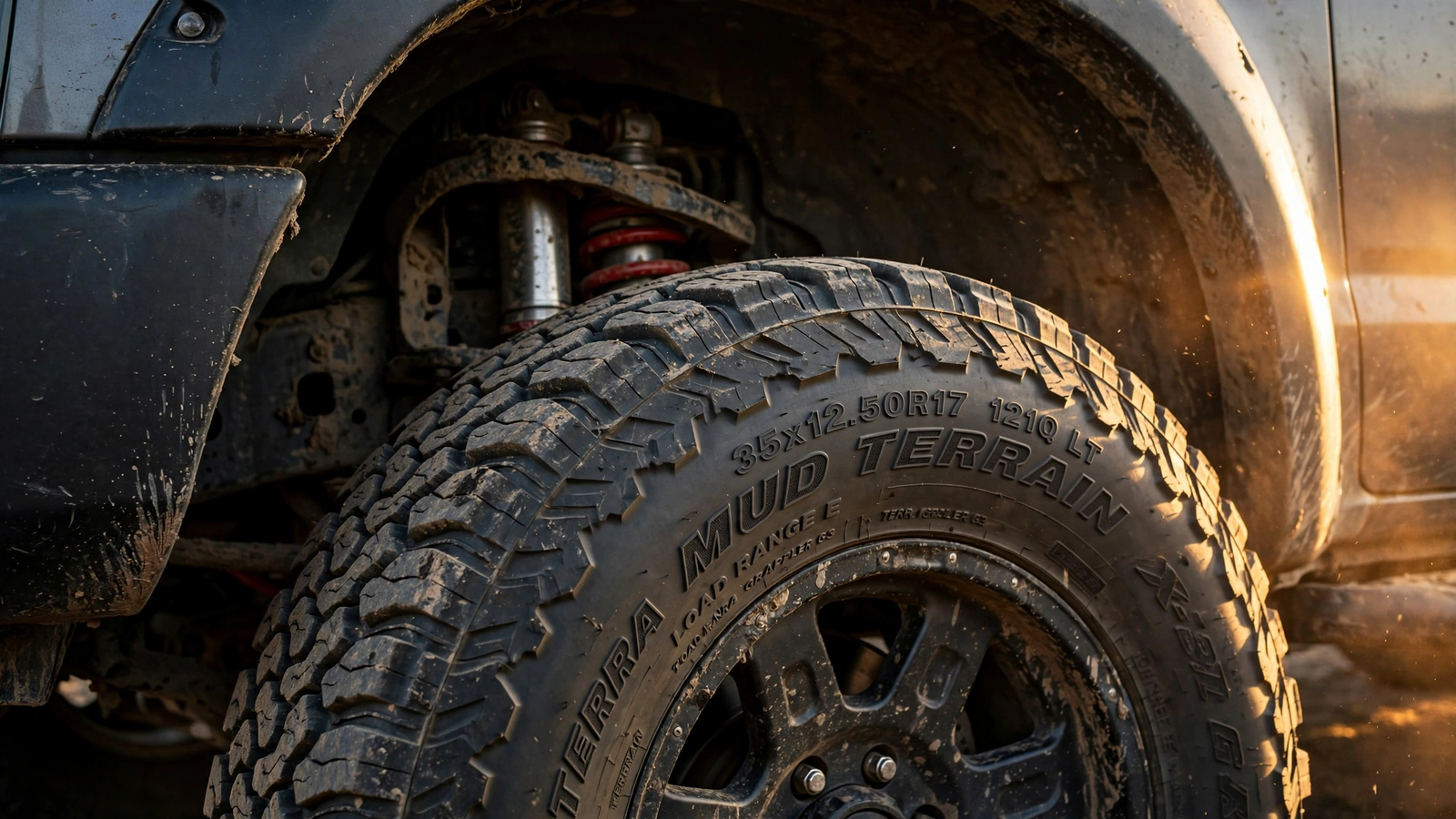
Not all 35s are equal. A 35×12.50R17 is a true 35 inches tall and a full 12.5 inches wide — the hardest fit. A 285/75R18 is also about 35 inches tall but roughly an inch narrower, and that missing inch of width is worth a surprising amount of clearance at the control arm, cab mount, and liner. Similarly, a 315/70R17 (about 34.5 inches) splits the difference. When fitment is tight, going narrower beats going shorter.
Measured height also varies by brand and load: two tires both labeled 35s can differ by half an inch or more in true mounted height, and the number shrinks as tread wears. If you are on the edge, choose the narrower metric size, verify the actual mounted diameter, and remember that width causes more distinct rub points than height does. A skinny 35 with correct offset is genuinely easier to live with than a wide one.
Match the tire’s load rating to the truck, not just the size. An E-rated 35 on a half-ton that never tows is overkill that rides harsh and costs more; a D-rated tire in the same size often fits identically while riding better. The rating does not change the rub points — a 35-inch diameter is a 35-inch diameter — but it changes the price and the daily comfort. Fitment guides focus on dimensions, so this is the detail buyers have to remember on their own.
| Tire size | True height | Width | Fitment difficulty |
|---|---|---|---|
| 35×12.50R17 | About 35.0 in. | 12.5 in. | Hardest — widest rub points |
| 315/70R17 | About 34.5 in. | 12.4 in. | Slightly easier |
| 285/75R18 | About 35.0 in. | 11.2 in. | Easiest 35 — narrow wins |
How much trimming do 35s need?
For street-driven trucks with correct offset, trimming is usually minor: fender liner edges, the lower bumper valance, and mud flap removal. That is an afternoon with a rotary tool and it resolves the vast majority of daily-driving contact. The work is all in areas that are invisible or easily cleaned up, which is why so many owners report fitting 35s ‘with just a little trim.’
Trucks that articulate off-road need the full treatment: pinch weld flattened, cab mount chopped where applicable, and liners fully clearanced through the whole steering and compression range. The professional method is to remove the coilover, cycle the suspension to full bump at full lock both ways, and cut whatever the tire touches. For real-world examples of this process, the TacomaWorld thread on 35s rubbing documents what owners actually had to trim. If you are paying a shop for the whole job, our lift kit installation cost guide helps you budget trimming alongside the lift, and the 6-inch lift cost guide covers the heights where 35s fit with the least drama.
Protect every cut edge the same day you make it. Bare plastic edges collect dirt and can crack over time; a quick pass with a file or sandpaper plus a wipe of trim dressing keeps them clean. Cut metal — pinch welds, cab mounts — needs paint or undercoating immediately, or surface rust starts within weeks. Owners who document will 35s rub fixes online always show the finished, sealed edges; the trimming is only half the job, and the sealing is what keeps it looking professional years later.

Will 35s rub at full flex even after trimming?
Will 35s rub at full flex even after trimming? Honestly, sometimes — and experienced builders accept a light kiss at full stuff as the price of running a big tire with full travel. The goal of trimming is to eliminate contact that damages tires or bodywork during normal use, not to guarantee zero contact in every theoretical position. A tire that lightly brushes a liner at full bump and full lock is a successful fit; one that grabs the cab mount is not.
If you demand zero contact everywhere, the remaining levers are limiting up-travel with taller bump stops (which sacrifices articulation), more lift, or a smaller tire. Most owners find the middle ground: trim thoroughly, set bump stops sensibly, and accept that the last half-inch of interference only exists in positions the truck rarely sees. For model-specific fitment notes, our Silverado, Ram 1500, and leveling kit guides cover the common combinations.
Document your final fitment for the next owner — or your future self. Photos of the trimmed areas, the wheel specs, and the alignment numbers turn a modified truck from a question mark into a known quantity at resale time. Buyers pay more for a truck with a documented, methodical 35s fit than one with a mystery trimming and unknown specs. Keep the receipts for the wheels, the chop, and the alignment in the glovebox; a folder of fitment documentation is worth real money when the truck changes hands.
Frequently asked questions
Will 35s rub with a leveling kit?
Often, yes. A leveling kit raises only the front about 2 inches and does not change the wheel well's shape, so 35s will still contact the liner, valance, and possibly the cab mount at full lock. Leveling kits pair best with 33s; 35s want a real lift plus trimming.
Do 35s rub worse than 33s?
Yes — roughly in proportion to the size difference. The extra inch of diameter and width puts the tire closer to every rub point simultaneously: liner, valance, cab mount, pinch weld, and control arm. A truck that clears 33s with zero trimming will very often need at least plastic work for 35s.
Will 35s rub if I get the right offset?
Correct offset minimizes rubbing but rarely eliminates it alone. Offset around +25 to +30 on an 8.5-inch wheel balances inner and outer clearance, yet the tire can still touch the liner at full lock or the cab mount at compression. Think of offset as the foundation — trimming finishes the job that offset starts.
How much does a cab mount chop cost?
Plates run about $50 and a shop typically charges $150 to $200 for the cut, weld, and paint, so budget $150 to $300 all-in. It is a permanent, well-understood modification on Toyotas, and a competent off-road or fabrication shop can complete it in a couple of hours.
Can wheel spacers stop 35s from rubbing?
Spacers move the tire outward, which cures inner rubbing on control arms and sway bars but worsens outer rubbing on fenders and liners — and the tire sweeps a wider arc. They are a targeted fix for a specific inner contact point, not a general solution, and cheap spacers bring their own safety concerns. Proper wheels with correct offset are the better answer.
Will 35s rub on a 6-inch lift?
At ride height, generally no — a 6-inch lift is designed around 35s to 37s. But the same rule applies: at full compression and full lock, the tire reaches the same bump stop regardless of lift height, so minor liner trimming is still common. The 6-inch lift makes 35s easy, not automatic.
The bottom line
Will 35s rub? Plan like the answer is yes, and you will never be disappointed. The winning formula is proven: correct wheel offset, a lift matched to the truck, minor plastic trimming for the street, and the cab mount chop and pinch weld work for trucks that see full flex.
Start with the wheels and the narrowest 35 that meets your needs, trim in cheapest-first order, and cycle the suspension to verify before calling it done. Done methodically, 35s fit cleanly and stay quiet — done by lift height alone, they rub exactly where this guide said they would.






3 Comments