


Last updated: October 2026 Written by the LiftKitGuide Team, truck suspension installers and editors
How much mpg do you lose with a lift kit? Most half-ton trucks lose 1–3 MPG after a lift and larger tires, roughly a 10–15% drop. A leveling kit with near-stock tires may cost you almost nothing, while a 6-inch lift on 37-inch tires can erase 5–6 MPG. The tires, not the lift itself, do most of the damage through added weight, rolling resistance, and taller effective gearing, with aerodynamic drag hitting hardest at highway speed.
Key takeaways
- Most half-ton trucks lose 1–3 MPG (roughly 10–15%) after a lift and larger tires, based on widespread owner reports.
- A leveling kit with stock-size tires may cost 0–1 MPG; a 6-inch lift on 37-inch tires can cost 4–6+ MPG.
- Tires drive most of the loss: a published Motor Trend test found aggressive all-terrains returned 2.2 MPG less than all-season tires, a 15% penalty.
- Bigger tires throw off the odometer by about 9% with 33-inch tires, so uncorrected hand calculations overstate the real loss.
- Lighter P-rated all-terrains, correct tire pressure (worth up to 5% economy), and a speedometer recalibration can claw back 1–3 MPG.
On this page
How much MPG do you lose with a lift kit on average?
How much mpg do you lose with a lift kit? Across owner reports, the honest average is 1–3 MPG on a half-ton truck that gets lifted and fitted with larger tires, which works out to roughly a 10–15% hit against stock fuel economy. A Ram owner went from 16–17 MPG stock to about 13 MPG after installing a lift with 35-inch tires, while Tacoma owners commonly report dropping from roughly 21 MPG to 15–18 MPG after a 2–3 inch lift with bigger rubber. Your exact number depends on the truck, the tire choice, and especially how fast you drive.
On bigger builds the loss gets more painful. A 6-inch lift on 37-inch mud-terrains can easily cost 4–6 MPG or more, and some owners report losing a quarter or more of their stock economy once heavy bumpers, roof racks, and armor join the build. A popular rule of thumb says to expect roughly a 10% penalty for heavier wheels and tires, another 10% for the lift itself, and another 10% for added accessories — but treat that as a ceiling, not a guarantee, because tire choice and driving habits move the real number more than any formula.
One more caveat before you judge your own truck: bigger tires throw off the odometer, so the loss you calculate at the pump is usually worse than the real loss. With 33-inch tires the speedometer and odometer can read about 9% low, meaning you drove farther than the trip meter says. Always correct your math for tire diameter — or recalibrate the speedometer — before concluding exactly how many MPG disappeared, because uncorrected numbers can easily turn a true 2-MPG loss into an apparent 4-MPG one.
Why does a lift kit reduce your gas mileage?
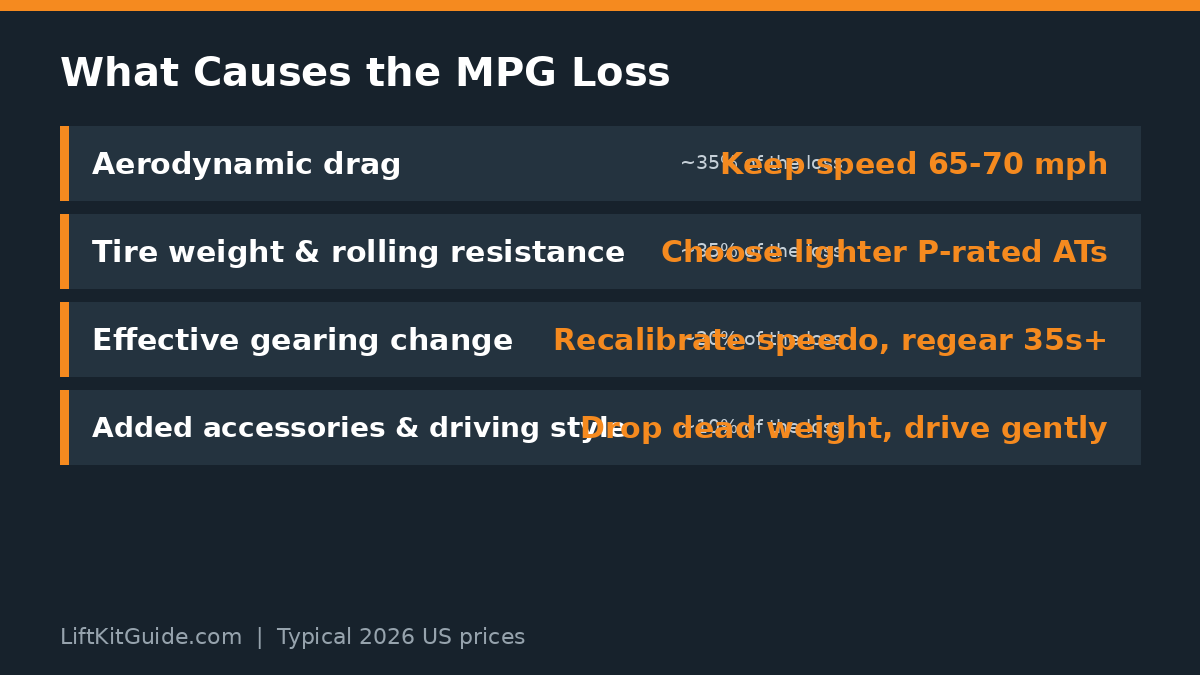
Aerodynamic drag is the first culprit, and it hurts most at highway speed. Lifting the truck increases its frontal area and exposes more of the tires and underbody to the wind, so the engine must burn more fuel to hold a steady speed. Research on ride height suggests that each inch of added height can degrade the drag coefficient by about 10 drag counts, and since pickups are already among the least aerodynamic vehicles on the road, every bit of extra wind resistance shows up at the pump. This is why taller trucks always suffer more on the interstate than around town.
The second culprit is the tires — and this is where most of the answer to how much mpg do you lose with a lift kit really lives. Larger, heavier tire-and-wheel packages cost more energy to accelerate, especially around town where stop-and-go driving dominates. Wider tread adds rolling resistance through a bigger contact patch, and aggressive all-terrain or mud-terrain patterns can cost 2–3 MPG versus a highway all-season. In one published comparison, aggressive all-terrains returned 2.2 MPG less than all-season tires — a 15% gap from tread design alone.
The third culprit is effective gearing, and it explains why the answer to how much mpg do you lose with a lift kit changes with tire diameter. Taller tires act like a taller final-drive ratio, moving the engine out of its efficient RPM range and forcing more throttle input to accelerate and climb grades. Owners often describe constant downshifting at 65–70 mph after fitting big tires, and each downshift is the transmission asking for fuel the engine did not need on stock rubber. Regearing the axles can restore the mechanical advantage, but factory gearing was never designed for 35-inch tires.
How much MPG do you lose with a lift kit and 35-inch tires?
The 3-inch lift with 35-inch tires is the most common build in America, so it is worth pinning down how much mpg do you lose with a lift kit in exactly this configuration: most half-tons lose 2–4 MPG. One Ram owner dropped from 16–17 MPG stock to 13 MPG, and a Tundra owner reported 17 MPG falling to 13 MPG after a 3-inch lift with 35-inch tires, with many owners landing around 14–15 MPG combined. The taller, heavier tire does most of this damage; the lift itself mainly adds highway drag, so check how much a 3-inch lift costs before budgeting the full build.
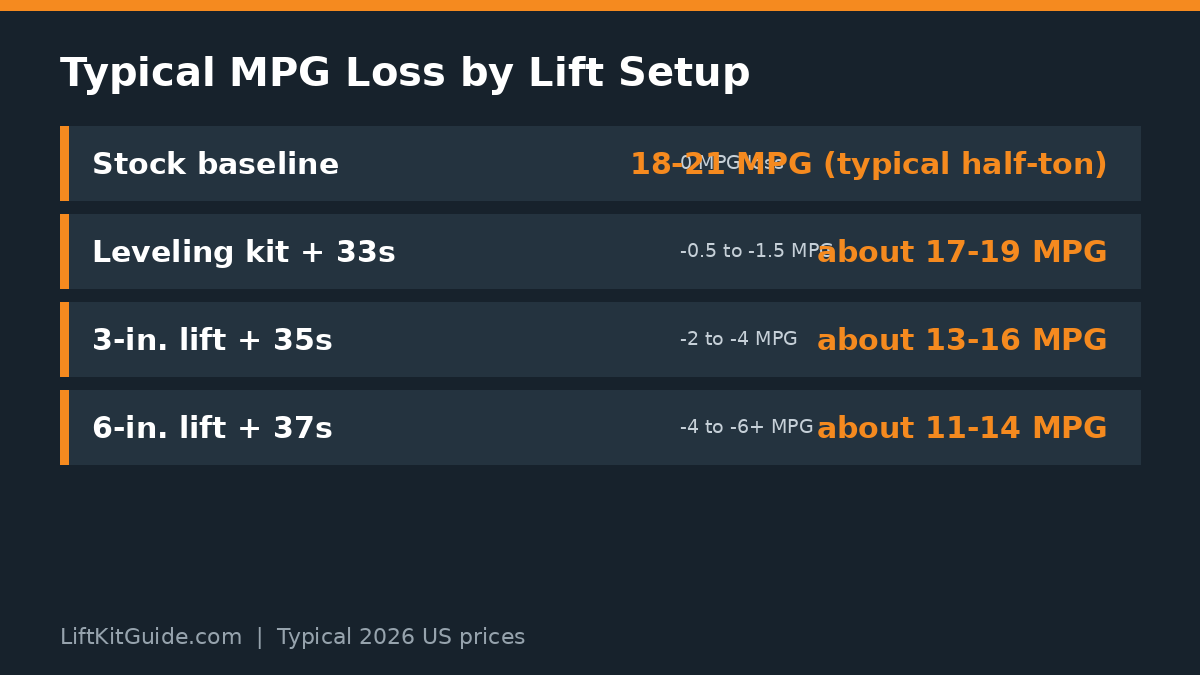
Compare that with the other popular setups to see how much mpg do you lose with a lift kit across the range: a leveling kit with 33-inch tires typically costs 0.5–2 MPG, mostly from the tires, while a 6-inch lift with 37-inch tires commonly costs 4–6 MPG or more. One Hummer H2 owner with a 6-inch lift and 38-inch tires reported just 8–11 MPG in mixed driving — a reminder that tire diameter and tread matter more than lift height alone.
| Lift setup | Typical loss vs stock | Typical result (half-ton) |
|---|---|---|
| Leveling kit + 33-inch tires | 0.5–2 MPG | About 17–19 MPG |
| 3-inch lift + 35-inch tires | 2–4 MPG | About 13–16 MPG |
| 6-inch lift + 37-inch tires | 4–6+ MPG | About 11–14 MPG |
Do leveling kits hurt fuel economy as much as full lift kits?
A leveling kit raises only the front of the truck, usually by about 2 inches, so how much mpg do you lose with a lift kit when it is just a level? Usually very little — and sometimes nothing at all. Owners who install a level while keeping near-stock tires frequently report zero change, because the small aerodynamic shift is barely measurable. Add larger tires to the level and the loss comes almost entirely from the tires: owners report 1–2 MPG with bigger rubber on a leveled truck, which matches what those tires would cost on their own. Either way, a level is far cheaper than a full kit — see how much a leveling kit costs in 2026.
Full lift kits are a different story, because they raise both ends of the truck, add brackets and exposed hardware under the body, and are almost always paired with much larger tires. A 3-inch system and up changes the aerodynamic profile enough to matter at highway speed and demands tires that add weight, rolling resistance, and effective gearing all at once — which is exactly how much mpg do you lose with a lift kit climbs into the 2–4 MPG range. If fuel economy matters but you still want the stance, a quality level with light P-rated tires is the cheapest way to keep MPG close to stock.
There is one exception worth knowing: some owners report no measurable loss with a 2-inch lift and stock-size P-rated all-terrains, especially after correcting the odometer for the small tire change. That tells you the lift alone is a minor player. The honest takeaway is that leveling kits and full lifts sit at opposite ends of the fuel-economy spectrum, with the tire package — not the number of inches — deciding where your truck lands. If you want the leveled stance with the smallest possible fuel penalty, keep the stock-size tires and treat larger rubber as a separate decision with its own MPG price tag.
Can regearing recover the MPG you lost?
Regearing — swapping the axle gears for a shorter ratio — restores the mechanical advantage the taller tires stole, and it genuinely improves drivability. One Ram owner who swapped from 3.92 to 4.56 gears gained almost 2 MPG around town because less throttle input was needed, though highway mileage fell about 1.5 MPG from the higher cruising RPMs. On 35-inch tires, experienced owners suggest regearing can recover 1–3 MPG in city and towing use, with one reporting a gain of more than 4 MPG after moving to 4.88 gears with 35s. Our suspension lift kit guide explains when taller builds truly demand gears.
The catch is the price tag: a professional regear typically costs $1,200–$4,000, with $2,500–$3,000 common for a shop to do both axles, and it will never return the truck to stock economy because the drag and tire weight remain. One owner calculated that gaining 3 MPG back over 12,000 miles per year saves about $450 annually — a four-to-six-year payback. Regearing is a drivability upgrade first and a fuel saver second, but for trucks that constantly hunt gears or tow, the driving improvement alone justifies it regardless of how much mpg do you lose with a lift kit.
| Fix | Typical cost | What it recovers |
|---|---|---|
| Recalibrate the speedometer | $300–$600 for a calibrator | Corrects the ~9% odometer error with 33s, so you measure true MPG |
| Lighter P-rated all-terrains | $0 extra at purchase time | 1–2 MPG versus heavy LT mud-terrains |
| Correct tire pressure | Free | Up to 5% better economy versus under-inflation |
| Regear the axles | $2,000–$4,000 installed | 0–3 MPG, mostly in city driving and towing |
| Slower highway cruising | Free | 1–2 MPG from cutting speed from 80 to 65 mph |
Does the MPG loss from a lift kit hit harder on the highway or in the city?
On the highway, aerodynamic drag dominates, so how much mpg do you lose with a lift kit depends heavily on cruising speed. The lifted truck’s taller frontal area and exposed tires force the engine to work harder the faster you go — drag rises with the square of speed, so 80 mph costs dramatically more fuel than 65 mph. Tacoma owners report struggling to hold 15–16 MPG at 65–70 mph after lifting, with constant downshifting on slight grades. Slowing down is the cheapest fuel saver a lifted-truck owner has, and keeping tires properly inflated helps too — Jalopnik’s guide to how tire tread affects gas mileage explains why tread design and pressure matter so much.
In the city, weight and rotational inertia take over, which is the other half of how much mpg do you lose with a lift kit breaks down. Every stoplight forces the engine to spin up heavier tire-and-wheel assemblies, and this is where P-rated versus LT tires make their biggest difference: one Tacoma owner saw no MPG change with P-rated all-terrains but reported heavy LT tires costing a couple of MPG. Short trips with lots of idling magnify the penalty, since the truck never reaches its efficient cruising state.
The practical takeaway is to match your expectations — and your tire choice — to your real driving. Highway commuters should prioritize aerodynamic cleanliness and moderate tire width, because drag is their tax. City drivers should prioritize light wheels and tires, because acceleration is theirs. Either way, the split of your driving changes which half of the loss you feel most, and both halves are smaller when the tire package is chosen with fuel economy in mind. A tonneau cover can also help highway drivers by smoothing bed airflow, and removing a roof rack costs nothing yet saves fuel on every single mile.
How can you minimize MPG loss after installing a lift kit?
Tire choice is the single biggest lever on how much mpg do you lose with a lift kit, so choose tires like fuel economy matters. Prefer lighter all-terrains over heavy mud-terrains, consider P-rated construction instead of LT if your truck’s load rating allows it, and keep width moderate — every extra inch of contact patch adds rolling resistance. Buying wheels and tires as a matched package also lets you pick lighter wheels, since a few pounds per corner of unsprung weight noticeably reduces the acceleration penalty. Stick with proven options from our best lift kit brands guide to avoid mismatched components that make economy worse.
Next, calibrate and maintain. Recalibrate the speedometer after any tire-size change so your mileage math is honest — with 33-inch tires the odometer can undercount by about 9%, which makes the loss look worse than it is. Keep tires at the correct pressure, rotate them on schedule, and consider regearing if you moved to 35-inch tires or taller. Finally, strip unnecessary weight: roof racks, heavy bumpers, and bed armor all cost fuel every single day, so run only the accessories your actual driving needs.
- Choose tires like it matters: lighter P-rated all-terrains can save 1–2 MPG versus heavy LT mud-terrains.
- Recalibrate the speedometer: bigger tires under-report miles by roughly 9% with 33-inch tires, skewing your math.
- Hold the right pressure: correct inflation is worth up to 5% fuel economy, free of charge.
- Regear for 35-inch tires and up: restores drivability and can add back 1–3 MPG around town and while towing.
- Slow down on the highway: drag rises with the square of speed, so 65 mph beats 80 mph every time.
- Shed dead weight: every accessory you bolt on costs fuel on every drive, not just off-road.
Is a lift kit worth the MPG loss?
Run the real numbers before deciding, because how much mpg do you lose with a lift kit only matters once you convert it to dollars. A half-ton that falls from 17 MPG to 14 MPG over 15,000 miles per year burns about 190 extra gallons — roughly $650–$700 per year at $3.50–$3.75 per gallon. That is the true annual price of the stance, worth budgeting alongside the installation itself. Owners who tow or commute long highway miles feel it most, while weekend trucks that barely leave the garage will hardly notice the pump difference.
For most owners, the answer is yes — with eyes open. A lift kit buys clearance, capability, tire fitment, and a look stock trucks cannot match, and the MPG penalty shrinks when you choose lighter tires, hold the right pressures, and cruise at sane highway speeds. But if you buy the tallest kit with the heaviest tires and then commute 60 miles a day, the fuel bill will remind you of the decision every single week. Match the build to your real driving, and the loss becomes a planned cost instead of a nasty surprise.
Frequently asked questions
How much mpg do you lose with a lift kit on average?
Most half-ton trucks lose 1–3 MPG, roughly 10–15% of stock fuel economy, after a lift and larger tires. A leveling kit with near-stock tires may cost almost nothing, while a 6-inch lift on 37-inch tires can cost 4–6 MPG or more. Tire size, tread, weight, and cruising speed move the number more than lift height alone.
Do leveling kits affect gas mileage?
Barely. A leveling kit raises only the front by about 2 inches, and owners who keep near-stock tires often report no measurable change. Most of the 0.5–2 MPG loss seen on leveled trucks comes from the larger tires installed at the same time, not the level itself.
Do bigger tires or the lift itself cause more MPG loss?
Bigger tires cause most of the loss. Added weight, wider rolling resistance, aggressive tread, and taller effective gearing typically outweigh the aerodynamic penalty of the lift itself — one published test showed aggressive all-terrains returning 2.2 MPG less than all-season tires, a 15% gap from tread alone.
Will regearing improve my fuel economy after a lift?
Regearing can recover roughly 0–3 MPG, mostly in city driving and towing, by restoring the engine's mechanical advantage with taller tires — one owner gained nearly 2 MPG around town after moving from 3.92 to 4.56 gears. But at $1,200–$4,000 for a professional job, it rarely pays for itself in fuel savings alone; think of it as a drivability upgrade.
Why does my odometer seem wrong after installing bigger tires?
Larger tires rotate fewer times per mile, so the speedometer and odometer under-report: with 33-inch tires the error is about 9%, roughly 4 mph at 65 mph. That makes hand-calculated MPG look worse than it really is. Recalibrate the speedometer with a handheld calibrator so your mileage math is honest.
Can I lift my truck without losing any MPG?
Close to it. A leveling kit with stock-size P-rated all-terrains, correct tire pressure, and a recalibrated speedometer can show essentially no measurable loss. You cannot fully escape physics with a tall lift and big tires, but choosing lighter tires and cruising at 65–70 mph keeps the penalty small.
The bottom line
Expect 1–3 MPG of loss for a typical lift-and-tire build, more for big setups, and remember the tires do most of the damage — choose lighter P-rated all-terrains, keep pressures correct, and recalibrate your speedometer before judging the true cost.
Regearing fixes the driving experience on 35-inch tires and bigger but rarely pays for itself in fuel savings alone. Budget the extra fuel as part of the build, drive at sane highway speeds, and a lifted truck can still fit a working budget.





Leave a comment