


Last updated: October 2026 Written by the LiftKitGuide Team, truck suspension installers and editors
Do you need to regear for 35s? For most half-ton trucks with stock 3.21, 3.42, or 3.73 gears, yes — a regear to 4.56 (or 4.88 for towing and off-road use) restores the acceleration, towing ability, and transmission behavior the bigger tires take away. In 2026, a professional regear of both axles typically costs $1,200 to $2,500. Trucks already running 4.10 gears, or modern trucks with 8- and 10-speed automatics, may run 35s on stock gears without complaint, especially for light daily driving.
Key takeaways
- A 35-inch tire makes stock 3.21–3.73 gears feel roughly 10–15 percent taller, hurting acceleration and causing constant transmission gear hunting.
- 4.56 is the best all-around gear ratio for 35s; choose 4.88 if you tow, crawl, or carry heavy bumpers, armor, and cargo.
- A professional regear costs $1,200 to $2,500 for both axles in 2026, including ring-and-pinion sets, master install kits, labor, and fluids.
- On 35s in a 1:1 transmission gear, 4.56 gears turn about 2,846 RPM at 65 mph; overdrive on modern automatics drops that to roughly 2,000 RPM.
- 4WD trucks must regear both axles to the same ratio; mismatched front and rear ratios can destroy the transfer case in 4WD.
On this page
Do You Need to Regear for 35s? When the Answer Is Yes
So do you need to regear for 35s on a typical half-ton pickup? In most cases, yes. Trucks that left the factory with 3.21, 3.42, or 3.73 gears and stock 31- or 32-inch tires were engineered around that exact combination of tire diameter and final drive ratio. Bolting on 35s changes the effective gearing enough that the truck can feel sluggish off the line, downshift constantly on grades, and lose meaningful towing confidence. Regearing restores the mechanical advantage the engine was designed to work with, putting the power band back where the engineers intended.
When owners start asking ‘do you need to regear for 35s,’ these are usually the symptoms that prompted the question. The transmission hunts between gears at highway speed, the engine lugs below its power band when you ask for passing power, and fuel economy often drops because the engine works harder outside its efficient RPM range. Drivers who tow report the biggest difference: a properly regeared truck holds gears on hills instead of kicking down, keeps transmission temperatures in check, and accelerates a loaded trailer without drama or delay.
The short test is simple. If your truck has 3.21 or 3.42 gears, regearing is close to mandatory with 35s. If it has 3.73s, it becomes a judgment call based on how you use the truck, and if it already has 4.10s, many drivers find 35s perfectly acceptable. Answering ‘do you need to regear for 35s’ honestly means budgeting for gears too, not just tires — the regear is part of the upgrade, not an optional extra. Price the whole project with our cost to lift a truck guide before committing, so no line item surprises you later.
How Do 35-Inch Tires Change Your Effective Gear Ratio?
Every discussion of do you need to regear for 35s starts with the same physics. Think of a bigger tire as a longer lever working against your engine: each rotation of a 35-inch tire covers more ground than a 32-inch tire, so the axle ratio that felt perfect from the factory now behaves like a numerically lower, taller ratio. That is why a truck with 3.73 gears and 35s can feel like it has 3.42 or even 3.21 gears — the engine must produce more torque at every road speed just to maintain the same performance.
There is a simple formula that gives ‘do you need to regear for 35s’ a mathematical answer before it becomes a matter of opinion: new tire diameter divided by old tire diameter, multiplied by your old axle ratio. For example, moving from 32-inch tires to 35s on a truck with 3.73 gears gives (35 / 32) × 3.73 = 4.08, so 4.10 gears restore factory behavior. The same math shows 3.21 gears become 3.51 on 35s, which explains why base-model trucks struggle most. Four Wheeler’s gear ratio guide explains this calculation and recommends going one step numerically higher than stock-equivalent for towing or performance use.
What Gear Ratio Is Best for 35-Inch Tires: 4.10, 4.56, or 4.88?
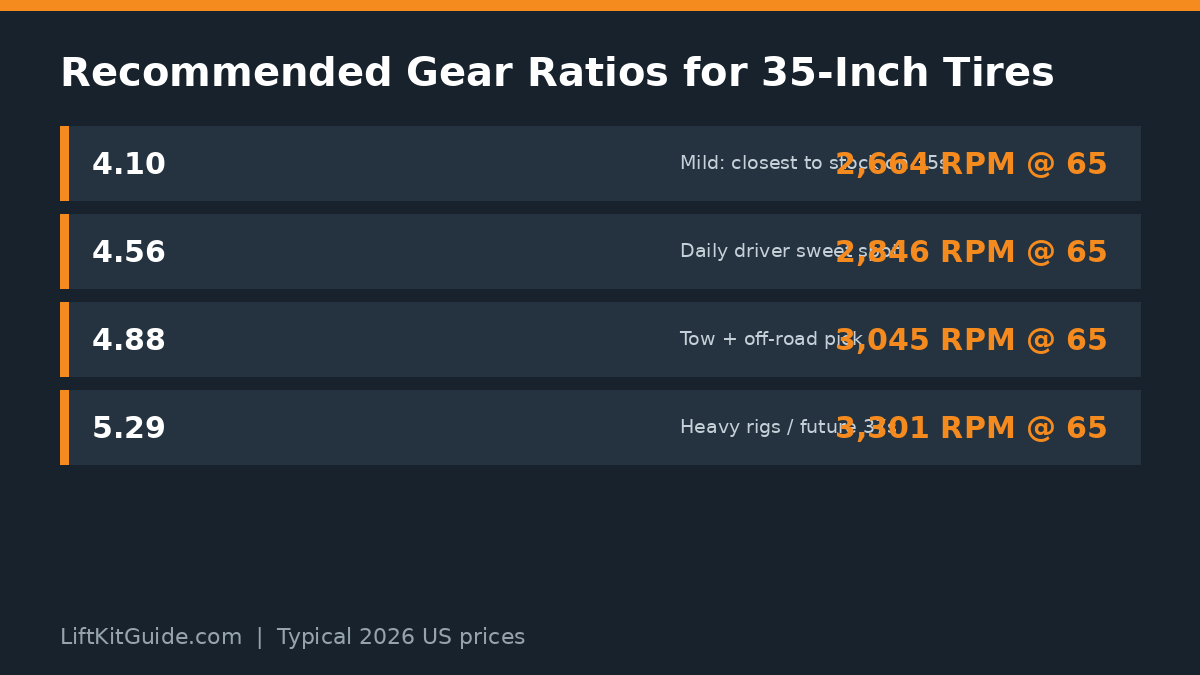
For the classic ‘do you need to regear for 35s’ daily-driver scenario, 4.56 is the sweet spot. It sits just above the stock-equivalent ratio for the most common factory setups, which restores factory-like acceleration while adding a useful margin for the extra weight of an all-terrain tire, heavier wheels, and typical accessories like bumpers and bed racks. Owners consistently report that 4.56 gears with 35s feel slightly quicker than stock around town, without turning the truck into a noisy highway screamer or punishing fuel economy.
Choose 4.88 if you tow regularly, climb steep grades, crawl off-road, or carry heavy bumpers, winches, and roof racks. The extra mechanical advantage keeps the engine in its power band under load and improves low-speed control on trails, where precise throttle response matters more than top speed. The trade-off is roughly 200 more RPM at highway speed compared with 4.56, which most owners consider a fair price for towing confidence. Either way, the answer to do you need to regear for 35s on only the rear axle is always no on a 4WD — both axles must be regeared to the same ratio.
The remaining choices are situational rather than mainstream. 4.10 gears can work for light-duty trucks that rarely tow and spend most of their lives on flat highways, but they are a half-measure on trucks that work hard or live in the hills. 5.13 and 5.29 gears suit heavy rigs, dedicated rock crawlers, or owners planning to move to 37-inch tires later, since they put the power band exactly where a loaded truck needs it. When deciding do you need to regear for 35s, pick the ratio for the truck you will own in two years, not just the tires you are buying today.
| Factory ratio | Feels like on 35s | Recommended ratio | Best for |
|---|---|---|---|
| 3.21 | About 3.51 | 4.56 | Daily driving and light towing |
| 3.42 | About 3.74 | 4.56 | Daily driving and moderate towing |
| 3.73 | About 4.08 | 4.56 or 4.88 | 4.56 for street; 4.88 for heavy towing |
| 4.10 | About 4.48 | 4.56 or skip | Skip if light use; 4.56 for best performance |
How Much Does It Cost to Regear a Truck for 35s?
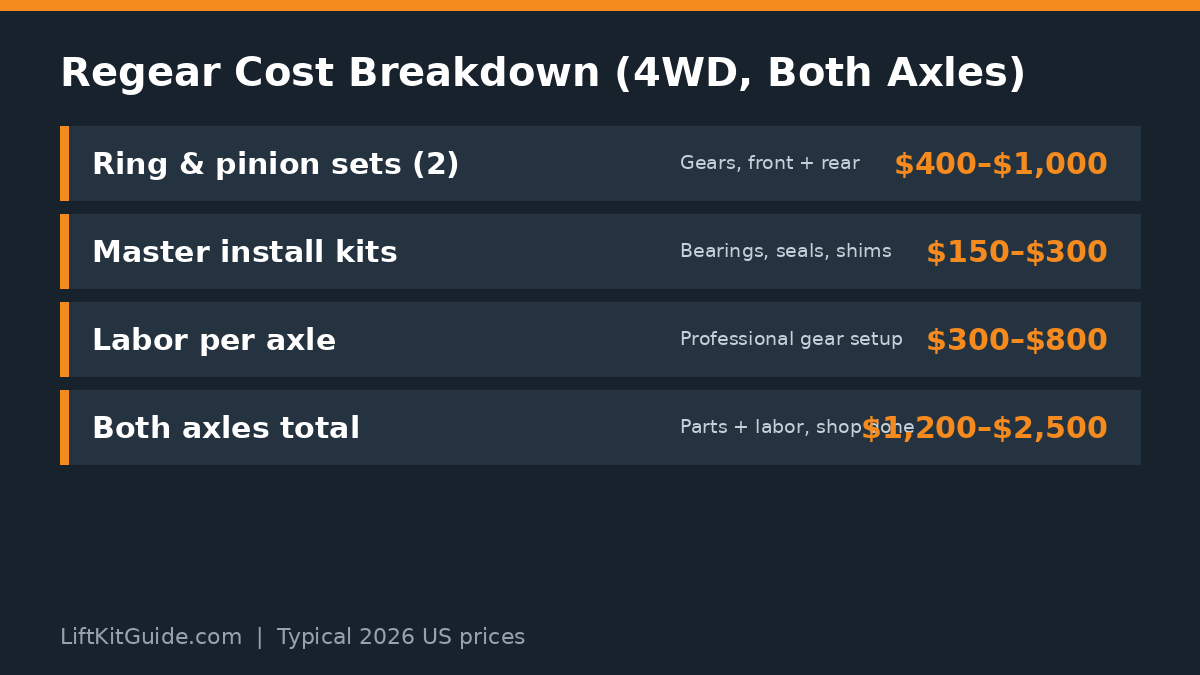
When owners price ‘do you need to regear for 35s,’ the professional answer lands between $1,200 and $2,500 for both axles on a 4WD truck in 2026, parts and labor included. The exact total depends on the axle type, the gear brand, local labor rates, and whether the shop finds worn bearings or seals during teardown that need replacing. Two-wheel-drive trucks cost roughly half, since only the rear axle needs work — but on a 4WD, both ends get done or the job is not done at all.
The parts stack has three main pieces. Ring-and-pinion sets from quality brands like Yukon or Nitro typically run $200 to $500 per axle, so $400 to $1,000 for a 4WD pair. Master install kits — new pinion and carrier bearings, seals, shims, and crush sleeves — add $150 to $300 for both axles. Fresh differential fluid and any speedometer recalibration module complete the parts bill, so ask every shop for an itemized quote rather than a single lump-sum number you cannot compare.
Labor is the biggest line item because setting up gears is precision work: backlash and tooth contact pattern must be measured to the thousandth of an inch, and rushing the setup produces gears that whine or wear prematurely. Expect $300 to $500 per axle for a standard solid rear axle, with independent-front-suspension differentials sometimes reaching $800 because the entire diff must be removed from the truck. Because gears and lift labor both show up in full build budgets, our lift kit installation cost guide helps you see how regearing fits beside the rest of a lifted-truck project.
| Item | Typical cost | Notes |
|---|---|---|
| Ring-and-pinion sets (front and rear) | $400–$1,000 | Quality brands like Yukon or Nitro; price varies by axle type |
| Master install kits (both axles) | $150–$300 | Bearings, seals, shims, and hardware for a complete setup |
| Labor per axle | $300–$800 | Rear axles cheaper; IFS front diffs cost more to remove |
| Professional total, both axles | $1,200–$2,500 | Includes gears, kits, labor, fluids, and setup |
What Will Your Highway RPM Be With 35s?
The RPM question is where owners talk themselves out of regearing, so run the numbers first. The formula is RPM = MPH × gear ratio × 336 ÷ tire diameter, measured in a 1:1 transmission gear. On 35s at 65 mph, 4.10 gears turn about 2,664 RPM, 4.56 gears turn about 2,846 RPM, and 4.88 gears turn about 3,045 RPM. Those figures look high only until you remember they assume direct drive with no overdrive — almost no modern truck cruises in 1:1 on the highway.
Modern automatics make these numbers far more livable. A typical 0.70:1 overdrive multiplies those figures by 0.70, so 4.56 gears on 35s cruise near 2,000 RPM at 65 mph — right in the efficient zone for most V8s and turbocharged V6s. That is why do you need to regear for 35s is rarely decided by highway RPM anymore; the engine’s happy place at cruise matters less than whether it can hold gears under load. For a concrete example, Ram 1500s with 3.21 gears are the trucks that suffer most on 35s, and our Ram 1500 lift kit guide covers how 35s fit those builds.
| Gear ratio | RPM at 65 mph (1:1) | RPM at 70 mph (1:1) |
|---|---|---|
| 3.73 | 2,328 | 2,507 |
| 4.10 | 2,664 | 2,755 |
| 4.56 | 2,846 | 3,064 |
| 4.88 | 3,045 | 3,279 |
| 5.13 | 3,201 | 3,447 |
Do You Need to Regear for 35s If You Mostly Drive on the Street?
Not everyone needs gears, and honest shops will tell you when do you need to regear for 35s has a ‘not yet’ answer. If your truck came with 4.10s from the factory — common on tow packages and off-road trims — 35s usually feel close enough to stock that most drivers never notice a problem. The same goes for modern trucks with 8- or 10-speed automatics, whose deep first gears and closely spaced ratios mask the taller effective gearing far better than the old 4- and 6-speed transmissions ever could.
Flat-terrain commuters who never tow get the most leeway. On level ground at steady speed, a truck with 3.73 gears and 35s can cruise acceptably, even if it feels lazier merging onto the highway or climbing an overpass. The key is honesty about use: the same truck that feels fine commuting can become frustrating the first time it tows a boat up a grade. Many owners use a stock-gear trial period to answer do you need to regear for 35s for themselves — if the gear hunting annoys you daily, that is your verdict.
One step is mandatory whether you regear or not: recalibrate the speedometer. Bigger tires make the speedometer and odometer read slower than actual speed, which also skews transmission shift points, ABS, and traction control behavior. A handheld tuner or speedometer calibration module fixes all of it in minutes, and it costs a fraction of a regear. New gears also need about 500 gentle break-in miles before hard use, so if you plan to regear eventually, drive gently on the stock gears until the appointment.
- You can likely skip regearing: factory 4.10 gears, modern 8- or 10-speed automatics, flat-terrain daily driving with no towing.
- You should strongly consider it: factory 3.21 or 3.42 gears, frequent towing, hilly terrain, heavy bumpers and armor, or off-road crawling.
- Recalibrate regardless: a tuner or calibration module corrects the speedometer, shift points, and odometer even if you keep stock gears.
What Happens If You Run 35s on Stock Gears?
Owners asking do you need to regear for 35s often fear instant damage, but the reality is slower and subtler. Running 35s on stock gears does not break anything immediately — it changes how the whole truck behaves. Acceleration dulls because the engine cannot reach its power band as quickly, and the transmission downshifts more often to compensate. That constant hunting generates heat, and heat is what shortens transmission and torque-converter life over tens of thousands of miles of hard use.
Fuel economy usually drops rather than improves. Many owners expect taller effective gearing to help mileage, but the engine lugs below its efficient RPM range and the computer compensates with more throttle and lower gears — the worst of both worlds. Larger tires also add rotating mass the stock brakes were not sized for, so stopping distances grow and brake components work harder. Upgrading pads and rotors is a smart companion to any 35-inch-tire build, regeared or not, especially on trucks that tow heavy trailers regularly.
There is also a paperwork angle worth checking before you modify the drivetrain. A regear itself is a mechanical change, but paired with a lift and 35s it can complicate warranty claims on related components if a failure looks modification-related, so document the work and keep the stock parts. Read our does a lift kit void warranty guide before you schedule the work. And remember that gearing is one chapter of a build — our suspension lift kits guide walks through how tires, lift height, and gearing should be planned together from the start.
Is Regearing Worth It for Your Truck?
Regearing is worth it when the truck works for a living — towing, hauling, climbing, or crawling — and when the factory gears sit at 3.73 or numerically lower. For those trucks, $1,200 to $2,500 restores the drivability the 35s removed, reduces transmission stress, and makes the truck feel engineered rather than compromised. If do you need to regear for 35s is a question you keep coming back to, use the work test: the harder the truck works, the stronger the case for gears.
Spend the money once and spend it on quality. Precision-cut gear sets from established manufacturers, complete master install kits with new bearings, and a shop that sets up differentials daily will outlast bargain gears installed by a general repair shop. Cheap gears can whine at highway speed or wear prematurely if the setup is rushed, and redoing a bad gear job costs more than doing it right once. The same buy-once logic applies to the rest of the build, which is why our best lift kit brands guide focuses on manufacturers with real engineering and warranty support.
The decision framework is straightforward. If you run 35s on 3.21 or 3.42 gears, budget the regear as part of the tire purchase — it is not optional for a truck that tows or climbs. If you have 3.73s, try the tires first and regear when the hunting and lugging annoy you on every drive. If you have 4.10s or a modern multi-speed automatic and drive gently on flat roads, you may never need gears at all. Match the ratio to your real use, regear both axles on a 4WD, and the truck will drive like the 35s were always meant to be there.
Frequently asked questions
Can you run 35s on stock gears without regearing?
Yes, you can physically run 35-inch tires on stock gears, and many owners do it for months or years. It works best with factory 4.10 gears or modern 8- and 10-speed automatics that mask the taller effective gearing. With 3.21 or 3.42 gears, expect sluggish acceleration, constant transmission downshifting, and reduced towing performance until you regear.
Should I choose 4.56 or 4.88 gears for 35-inch tires?
Choose 4.56 gears for 35s if the truck is mainly a daily driver with light to moderate towing — it is the best all-around balance of acceleration and highway RPM. Choose 4.88 if you tow heavy loads, climb steep grades, crawl off-road, or carry heavy bumpers and armor. The 4.88 setup costs roughly 200 more RPM at highway speed but keeps the engine in its power band under load.
How much does it cost to regear a truck for 35s in 2026?
A professional regear typically costs $1,200 to $2,500 for both axles on a 4WD truck in 2026, including ring-and-pinion sets, master install kits, labor, and fluids. A 2WD truck with a single rear axle costs roughly half. Labor runs $300 to $500 per axle for most rear axles, with independent-front-suspension differentials sometimes reaching $800.
Do I need to regear both axles on a 4WD truck?
Yes. On a 4WD truck, the front and rear differentials must be regeared to the same ratio. Running mismatched ratios forces the front and rear driveshafts to turn at different speeds, which causes severe driveline bind and can destroy the transfer case the first time you engage 4WD. This is one job where cutting corners is not an option.
Will regearing fix my speedometer after installing 35s?
Regearing alone only partially corrects the speedometer, and only if the new ratio happens to match the tire change closely. For an accurate speedometer and odometer — plus correct transmission shift points, ABS, and traction control — you need a separate recalibration with a handheld tuner or speedometer calibration module. Recalibrate even if you decide to keep your stock gears.
Can I drive on 35s for a while and regear later?
Yes. Many owners run 35s on stock gears for a season while they budget for the regear. Drive gently, avoid heavy towing, recalibrate the speedometer, and watch transmission temperatures on grades. Treat it as a trial period: if the gear hunting and sluggish acceleration bother you daily, that is your signal to schedule the regear.
The bottom line
Do you need to regear for 35s? For most trucks with stock 3.21 to 3.73 gears, the answer is yes if you want the truck to drive the way it did before the bigger tires. A move to 4.56 gears — or 4.88 for towing and off-road work — restores acceleration, stops transmission hunting, and protects the drivetrain from working outside its design range. At $1,200 to $2,500 for both axles, it is one of the most functional upgrades a 35-inch-tire build can include.
The exceptions are real but narrow: factory 4.10 gears, modern 8- and 10-speed automatics, and gentle flat-road driving can all make stock gears livable. Whatever you decide, recalibrate the speedometer, regear both axles to matching ratios on a 4WD, and plan the gears as part of the tire purchase rather than an afterthought. Done right, a regeared truck on 35s drives like the combination was factory equipment.



2 Comments