


Last updated: October 2026 Written by the LiftKitGuide Team, truck suspension installers and editors
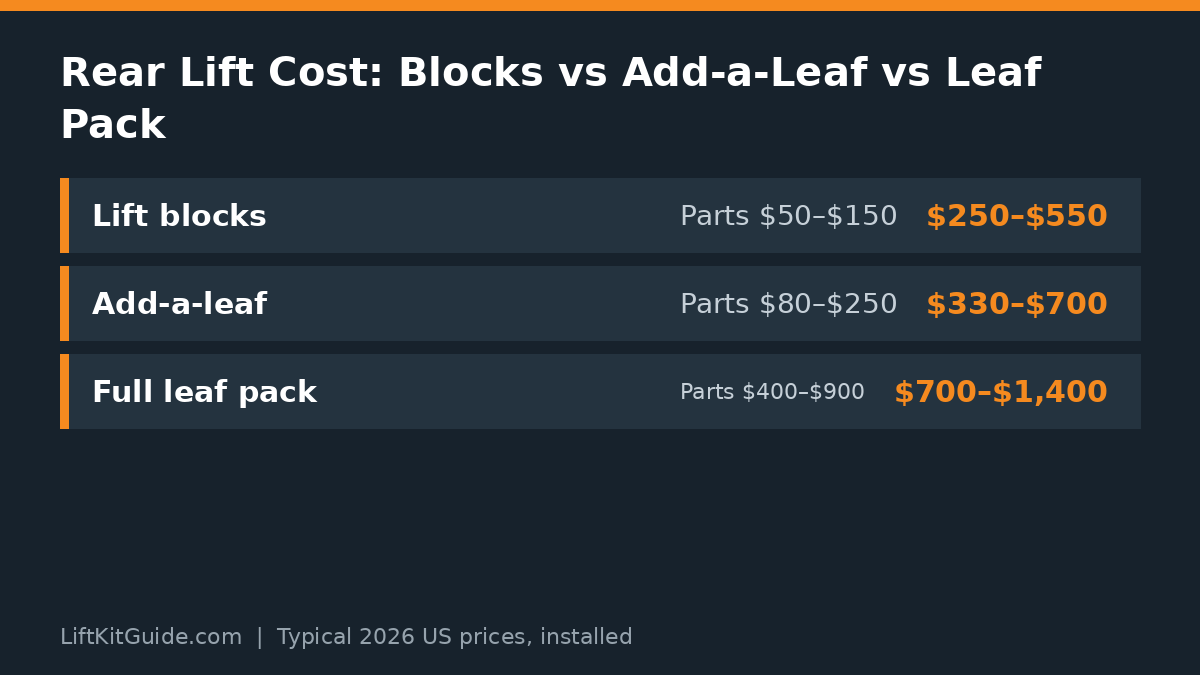
In the lift blocks vs add-a-leaf debate, lift blocks are the cheaper, simpler rear lift at $50 to $150 — a steel or aluminum block between the axle and leaf spring that preserves the factory ride but adds axle-wrap leverage. An add-a-leaf costs $80 to $250, stiffens the spring pack for better load handling and reduced axle wrap, but rides firmer. For towing and hauling, the add-a-leaf wins; for a street truck on a budget, blocks are fine at 2 inches or less.
Key takeaways
- Lift blocks cost $50–$150 and keep the stock ride; add-a-leafs cost $80–$250 and firm up the rear.
- Blocks add height only — zero performance gain and more axle-wrap leverage, especially above 2 inches.
- Add-a-leafs increase spring rate, improving towing stability and load capacity while reducing axle wrap.
- For regular towing or hauling, choose the add-a-leaf; for street looks on a budget, 1–2 inch blocks are fine.
- Full replacement leaf packs ($400–$900) beat both for serious use — the ultimate rear lift upgrade.
On this page
What are lift blocks and how do they raise the rear?
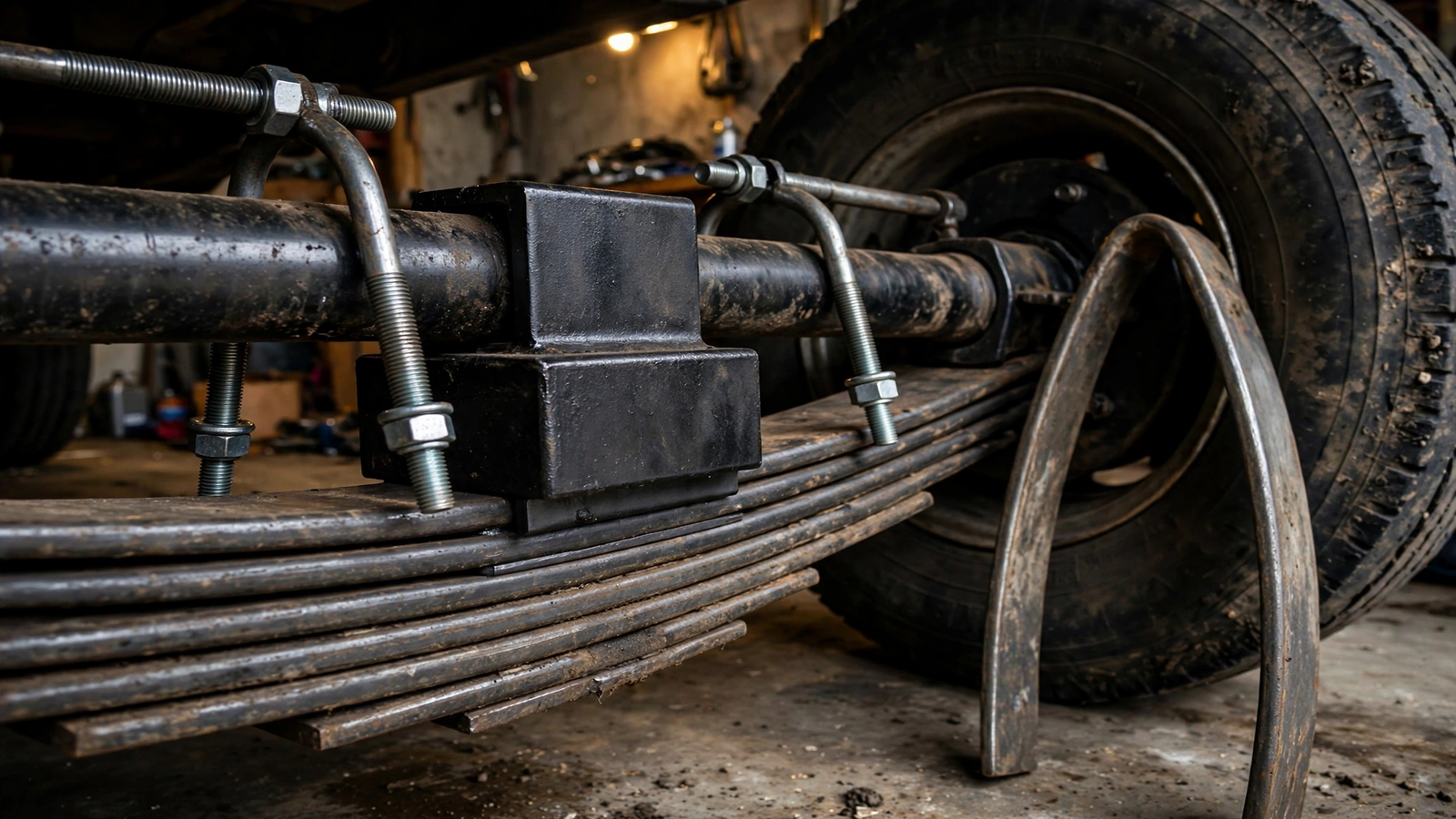
A lift block is exactly what it sounds like: a solid block of cast steel, billet aluminum, or iron, typically 1 to 4 inches tall, that sits between the rear axle housing and the leaf spring pack. Longer U-bolts clamp the whole stack together, pushing the axle down relative to the frame and raising the rear of the truck by the block’s thickness. Nothing about the spring itself changes — same leaves, same rate, same ride.
Installation is straightforward enough for a driveway mechanic with jack stands: support the axle, remove the U-bolts, drop the axle slightly, slide the blocks in with the locating pins seated, and torque the new U-bolts to spec. Most owners finish in 2 to 3 hours. Because the factory springs are untouched, the truck rides exactly as it did before — which is both the block’s greatest strength and, as we will see, the root of its criticism.
Tapered versus flat blocks is a detail worth knowing when shopping. Quality kits use tapered blocks — slightly wedge-shaped — to correct the pinion angle as the axle drops, preventing driveline vibration. Cheap flat blocks ignore this geometry, which is why the lift blocks vs add-a-leaf price debate should always compare reputable tapered kits rather than the cheapest flat blocks on the marketplace. Spend the extra $20 for the tapered design; your driveshaft will thank you.
Finally, check your state’s lift laws before choosing — some states cap bumper or frame height, which can rule out taller block setups regardless of the lift blocks vs add-a-leaf merits.
What is an add-a-leaf and how does it work?
An add-a-leaf (AAL) is an extra leaf spring inserted into the existing leaf pack, increasing the pack’s arch and therefore the truck’s ride height by 1 to 2.5 inches. Unlike a block, it changes how the suspension actually works: the added leaf increases spring rate, making the rear stiffer and more resistant to squat under load. Installation requires disassembling the leaf pack — removing the center pin, inserting the new leaf in the correct position, and re-clamping — a 3 to 5 hour job that demands more care than blocks.
Add-a-leafs come in short and long versions. Short AALs are cheaper and easier to install but create a harsh, choppy ride because they concentrate stress in a small area. Long AALs distribute the load across more of the pack and ride noticeably better, and they are what experienced owners recommend. Expect to pay $80 to $150 for a short single AAL or $150 to $250 for a long 3-leaf progressive set.
Break-in behavior differs between the two options as well. A new add-a-leaf typically settles 0.25 to 0.5 inches over the first few thousand miles as the pack seats, so experienced installers recommend measuring ride height after a month and adjusting if you were chasing an exact stance. Blocks do not settle at all — what you bolt in is what you get forever. In the lift blocks vs add-a-leaf planning process, factor this settling into your target measurements.
How does ride quality compare: lift blocks vs add-a-leaf?
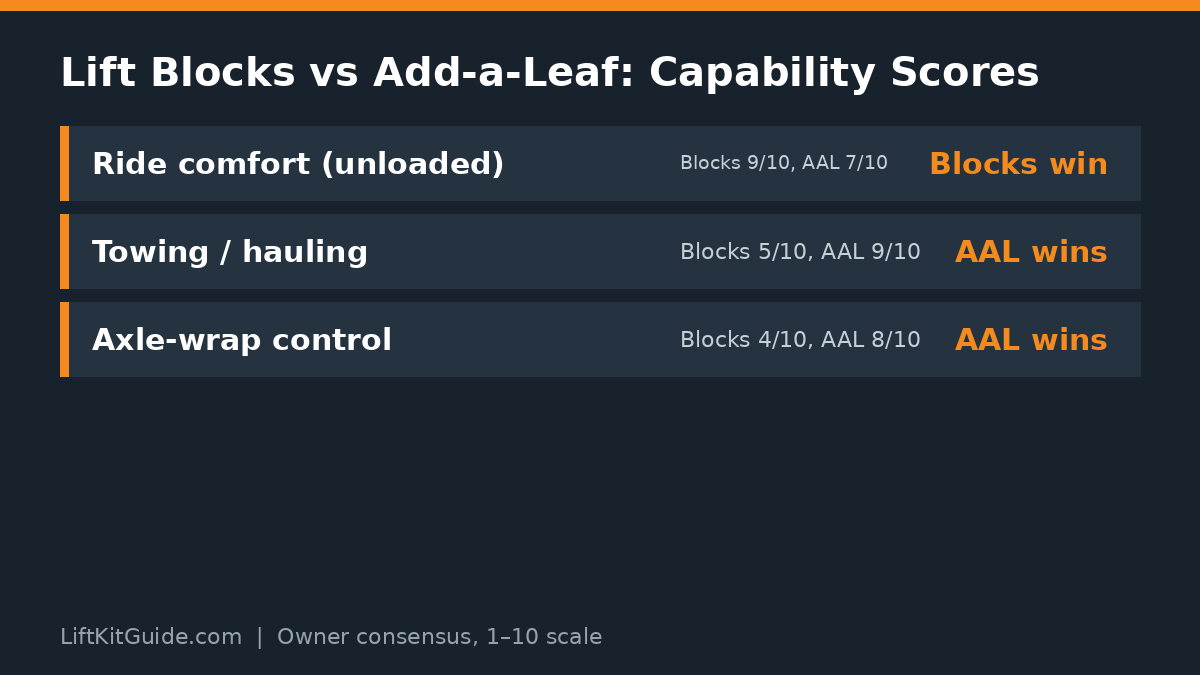
Ride quality is the most immediate difference you will feel. With lift blocks, the rear suspension is mechanically identical to stock — same springs, same shocks (assuming proper-length units), same damping. The truck rides exactly as the factory intended, which owners consistently praise. If you loved your truck’s ride before the lift, blocks preserve it perfectly.
The lift blocks vs add-a-leaf ride debate gets interesting with the AAL, because the added leaf necessarily stiffens the rear. An unloaded truck with a fresh AAL rides firmer over sharp bumps — some owners call it controlled, others call it harsh, and the truth depends on the leaf design. Long progressive AALs ride far better than short single leaves. The stiffness pays dividends when loaded, though: where a blocked truck squats and wallows with 1,000 pounds in the bed, the AAL truck stays level and composed.
Passenger comfort over long trips is where owners notice the AAL most. On a 500-mile highway day, the firmer rear of an add-a-leaf transmits more expansion-joint thump to the cabin than a blocked truck’s stock-soft springs. Some families prefer the blocks for this reason alone. But load the truck with camping gear and the story reverses: the lift blocks vs add-a-leaf comfort debate swings hard toward the AAL once weight enters the equation, as the blocked truck’s soft springs bottom out on every dip.
Which is better for towing and hauling?
For anyone who tows or hauls regularly, the add-a-leaf is the clear winner. The increased spring rate directly fights rear squat: a trailer tongue weight that drops a blocked truck 3 inches might only drop an AAL truck 1.5 inches, keeping headlights aimed correctly and weight distribution hitches in their happy range. The stiffer pack also resists the porpoising and sway that make towing with soft stock springs nerve-wracking.
Blocks neither help nor hurt towing capacity on paper — the springs are stock, so load behavior is stock. But that is precisely the limitation: if your stock springs squatted under your boat before, they will squat exactly the same after a block lift, just from a taller starting point. For occasional light towing, blocks are perfectly adequate. For a work truck or regular camper towing, the AAL’s load handling justifies its price many times over. See our towing with a lifted truck guide for the full picture.
Weight distribution hitches interact differently with each setup too. An AAL’s stiffer springs give the hitch a more stable platform to work from, making it easier to dial in proper front-axle weight restoration. With blocks, the soft stock springs compress more under tongue weight, forcing the hitch to work harder and sometimes running out of adjustment. Tower owners who have tried both consistently rank the lift blocks vs add-a-leaf towing question as one of the clearest wins for the add-a-leaf in the entire lift world.
Lift blocks vs add-a-leaf: what does each cost?
Both options are cheap by lift-kit standards, which is why the lift blocks vs add-a-leaf question comes down to performance rather than price. A quality block kit with U-bolts runs $50 to $150; add $200 to $400 for shop installation and you are all-in under $550. It is the cheapest possible rear lift, full stop.
Add-a-leafs cost slightly more: $80 to $150 for short singles, $150 to $250 for long progressive sets, with $250 to $450 installation since the leaf packs must be disassembled. All-in figures land around $330 to $700. For context, full replacement leaf packs — the upgrade both options aspire to — run $400 to $900 plus installation. Our cost to lift a truck guide puts these in full-build perspective.
Do not forget to budget for longer U-bolts and, on taller lifts, extended brake lines and shocks. A block kit’s advertised $50 to $150 price sometimes excludes the U-bolts, adding $40 to $80, while AAL kits occasionally need new center pins and bushings. These small extras apply to both sides of the lift blocks vs add-a-leaf ledger, so compare complete, install-ready kit prices rather than headline numbers when shopping.
| Rear lift option | Parts cost | Installed total | Ride / load effect |
|---|---|---|---|
| Lift blocks (1–2 in.) | $50–$150 | $250–$550 | Stock ride, stock load behavior |
| Short add-a-leaf | $80–$150 | $330–$600 | Firmer ride, better load handling |
| Long progressive AAL | $150–$250 | $400–$700 | Best ride of the AALs, good load handling |
| Full leaf pack | $400–$900 | $700–$1,400 | Engineered ride + load capacity |
What about axle wrap and long-term durability?
Axle wrap is the technical heart of the anti-block argument. Under acceleration, the axle housing tries to rotate opposite the wheels’ direction; the leaf springs resist this twisting. A lift block increases the distance between the axle centerline and the spring — lengthening the lever arm — so the same torque applies more twisting force to the springs. The result can be wheel hop on hard launches, accelerated spring fatigue, and in extreme cases with tall blocks, broken leaves.
How much this matters depends on block height and use:
Durability-wise, blocks themselves last forever — there is nothing to wear out. The concern is always what they do to the springs and U-bolts around them. Quality tapered blocks with proper pins, torqued correctly and rechecked after 500 miles, give years of trouble-free street service.
Corrosion and maintenance favor neither option dramatically. Blocks can trap moisture between the block and spring, so a dab of anti-seize on the mating surfaces during install prevents future headaches. Add-a-leafs need their center pins and clips checked periodically, as a shifted leaf changes the pack’s behavior. Either way, the lift blocks vs add-a-leaf maintenance burden is minimal — a glance during tire rotations is plenty for most owners.
- 1–2 inch blocks: minimal added leverage; most street trucks never notice any issue.
- 3–4 inch blocks: noticeably more wrap; avoid for towing, hauling, or powerful trucks.
- Add-a-leaf: actually reduces wrap by stiffening the pack — one of its real advantages.
- Full leaf packs: engineered with anti-wrap geometry; the definitive solution.
Can you run blocks and an add-a-leaf together?
Yes, and many owners do — typically a 1-inch block paired with a 1.5-inch AAL to reach 2.5 inches of rear lift while splitting the difference on ride and wrap. This combination is common in budget 3-inch overall lifts where the front sits 3 inches up and the rear needs to match with slight rake. It works fine provided total rear lift stays reasonable and U-bolts are long enough for the full stack.
The rules for stacking are simple: keep blocks at 2 inches or less when combining, always use a tapered block that matches the pinion angle, and torque everything with the truck’s weight on the wheels. Never stack multiple blocks — a tower of blocks is genuinely dangerous, multiplying leverage while halving stability. If you need more than 3 inches in the rear, stop stacking budget parts and buy the proper full leaf pack or lift system from our best lift kit brands roundup.
One more combination worth mentioning: some owners run a small block with aftermarket air bags instead of an AAL, getting the block’s stock ride when unloaded and the bags’ load support when towing. It costs more than either option alone but delivers the best of both worlds. Still, for pure simplicity and value, the classic lift blocks vs add-a-leaf choice remains the right starting point for 95 percent of rear-lift shoppers.
Which rear lift should you choose?
Choose lift blocks if your truck is a street-driven daily driver, you want the cheapest possible rear lift, and you love the stock ride. At 1 to 2 inches, blocks are honest, proven, and essentially invisible in daily driving — millions of leveled trucks run them without issue. Just respect the height limit and check torque regularly.
Choose an add-a-leaf if you tow, haul, or want the rear suspension to work better than stock rather than just sit taller. The firmer ride is the price of real load capacity and reduced axle wrap, and for a working truck it is money well spent. And if budget allows the jump, skip both: a full Deaver, OME, or Alcans leaf pack at $400 to $900 delivers the engineered ride quality and durability that blocks and AALs can only approximate. Our suspension lift kits guide and installation cost breakdown will help you plan the full build, starting with our leveling kit basics if you are new to lifting.
Whichever you choose in the lift blocks vs add-a-leaf decision, buy quality hardware and install it correctly. Name-brand tapered blocks with proper U-bolts, or a long progressive add-a-leaf from a spring specialist, will both outlast the truck’s ownership. The wrong choice is not blocks or leaves — it is cheap, no-name parts installed carelessly, which is where nearly every rear-lift horror story begins.
| Your situation | Pick this | Why |
|---|---|---|
| Street truck, tight budget | 1–2 in. blocks | Cheapest lift, stock ride preserved |
| Towing / hauling regularly | Long add-a-leaf | Load capacity, less squat and wrap |
| Daily driver + weekend toys | Long AAL or small block + AAL | Balanced ride and capability |
| Serious use / big budget | Full leaf pack | Engineered solution, best durability |
Frequently asked questions
Are lift blocks bad for your truck?
Not inherently — quality 1 to 2 inch blocks from reputable brands are safe for street-driven trucks and preserve the stock ride. Problems arise with tall 3 to 4 inch blocks, which increase axle-wrap leverage and stress the leaf springs, especially under towing or hard acceleration.
Does an add-a-leaf make the ride stiffer?
Yes, somewhat — the added leaf increases spring rate, so the unloaded rear rides firmer over sharp bumps. Long progressive add-a-leafs ride much better than short single leaves, and the stiffness becomes an advantage when towing or hauling as it resists squat.
How much lift does an add-a-leaf give?
Most add-a-leafs provide 1 to 2 inches of rear lift, with long 3-leaf progressive sets typically delivering 1.5 to 2 inches. Actual lift varies with the condition of your existing springs — worn, sagging packs will net less height than fresh ones.
Can lift blocks cause vibration?
Poorly made or improperly installed blocks can — cheap non-tapered blocks change the pinion angle, causing driveline vibration. Quality tapered blocks maintain correct pinion angle, and torquing U-bolts to spec with the truck's weight on the wheels prevents most issues.
Do you need longer shocks with lift blocks?
For 1 to 2 inch blocks, stock-length shocks usually still work but sit nearer full extension; extended-length shocks are recommended for 3+ inches or any serious off-road use. Whatever rear lift you choose, match shock length to the new ride height for proper droop travel.
How long do add-a-leafs last?
A quality add-a-leaf typically lasts 60,000 to 100,000 miles before fatiguing, though it also accelerates wear on the original leaves it is paired with. Full replacement leaf packs last longer and are the better long-term investment for trucks that work hard.
The bottom line
The lift blocks vs add-a-leaf decision is refreshingly honest: blocks are cheaper and preserve the stock ride, while add-a-leafs cost a bit more and make the truck genuinely more capable under load. Neither is wrong — they just serve different masters, and knowing which master you serve makes the choice obvious.
For the street truck on a budget, 1 to 2 inch blocks are a proven, safe answer. For the working truck that tows and hauls, the add-a-leaf’s stiffer springs and tamed axle wrap earn their premium every single week. And when you are ready for the real solution, a full leaf pack is waiting to make both arguments moot.




1 Comment