



Last updated: October 2026 Written by the LiftKitGuide Team, truck suspension installers and editors
Why is everyone against lift blocks? Mainly because of axle wrap: a lift block lengthens the lever arm between the axle and leaf spring, so acceleration torque twists the springs harder, causing wheel hop, faster spring fatigue, and in extreme cases broken leaves. The hate is height-dependent — 1 to 2 inch blocks on street trucks rarely cause issues, while 3 to 4 inch blocks on tow rigs or powerful trucks genuinely deserve the criticism.
Key takeaways
- Axle wrap is the core complaint: blocks lengthen the lever arm, multiplying the axle’s twisting force on leaf springs.
- 1–2 inch blocks on street trucks rarely cause problems; 3–4 inch blocks invite wheel hop and spring fatigue.
- Blocks add height only — no travel gain, no load improvement — which frustrates performance-minded owners.
- Tapered quality blocks, proper torque, and staying under 2 inches make blocks a safe budget choice.
- Add-a-leafs ($80–$250) and full leaf packs ($400–$900) are the upgrades when blocks are not enough.
On this page
What is axle wrap, exactly?
Axle wrap is the tendency of a solid rear axle to rotate under torque. When you accelerate, the tires grip the pavement and push the truck forward — and by Newton’s third law, an equal and opposite twisting force tries to rotate the axle housing backward. The leaf springs resist this rotation, flexing into an S-shape and then snapping back. In moderation, this is normal and harmless; every leaf-sprung truck does it to some degree.
It becomes a problem when the twisting force overwhelms the springs’ resistance. The axle winds up the springs like a rubber band, the tires break traction momentarily, the springs snap back, traction returns, and the cycle repeats several times per second — the violent shuddering known as wheel hop. Each cycle hammers the springs, U-bolts, and bushings. Understanding this mechanism is essential to understanding why is everyone against lift blocks, because blocks directly amplify the forces involved.
The S-shape flexing deserves a closer look because it explains the fatigue mechanism. Each wrap cycle bends the spring leaves beyond their designed arc, and steel fatigues with every cycle — the same way bending a paperclip back and forth eventually snaps it. A street truck might see thousands of mild wrap cycles a year; a drag-racing truck sees thousands in a weekend. This cycle-counting reality is the quiet foundation beneath the whole why is everyone against lift blocks debate.
How do lift blocks make axle wrap worse?
Here is the physics in one image: think of the block as a breaker bar on a ratchet. The axle applies torque at its centerline; the leaf spring resists at the block’s top surface. The taller the block, the longer the lever arm between those two points, and the more twisting force reaches the spring for the same engine torque. A 4-inch block roughly doubles the leverage versus the stock setup, while a 1-inch block adds only a small fraction.
This leverage multiplication is why the anti-block consensus is height-dependent rather than absolute. Doubling the lever arm on a 400-horsepower truck that tows is a genuinely different engineering situation than adding 25 percent more leverage to a street-driven V6 that never sees full throttle. The forums’ blanket ‘blocks are bad’ advice is really shorthand for ‘tall blocks on hard-working trucks are bad’ — nuance that gets lost in the shouting.
U-bolt stretch is a related failure mode that tall blocks invite. The longer U-bolts required for thick blocks flex more under the amplified wrap forces, and if they were not torqued to spec — or never rechecked — they loosen over time, letting the axle shift on the springs. This is why every discussion of why is everyone against lift blocks eventually lands on installation quality: the same 2-inch block that is perfectly safe when torqued properly becomes a genuine hazard when installed carelessly.
Aftermarket traction bars are the engineered answer for trucks that need tall rear lifts without the wrap penalty. By linking the axle directly to the frame, they cancel the rotational force entirely — which is why serious tow rigs and drag trucks run them regardless of block height.
Why is everyone against lift blocks? The 4 main complaints
Ask why is everyone against lift blocks on any truck forum and you will hear the same four grievances, ranked here from most to least legitimate:
Notice what is missing from the list: catastrophic failure. Quality blocks from reputable brands, properly installed and torqued, essentially never fail structurally — the block itself is a solid chunk of metal with nothing to break. The complaints are about what blocks do to the surrounding system, not the blocks themselves.
It is worth noting that factory trucks are not immune to these complaints. Many half-tons ship with 1 to 2 inch factory blocks from the manufacturer — Ford, GM, and Ram all do it — and nobody questions their safety. The aftermarket fear specifically targets tall blocks added on top of already-marginal setups. When someone asks why is everyone against lift blocks, the honest answer includes this irony: your truck may have come with blocks from the factory.
- Axle wrap and wheel hop: the leverage effect described above — real, measurable, and worst with tall blocks under power.
- No performance gain: blocks add height and nothing else — no travel, no damping, no load capacity — which offends enthusiasts who want every dollar to buy capability.
- Looks cheap: a visible chunk of metal between the axle and spring reads as the budget shortcut it is, and show-truck culture penalizes it.
- Spring fatigue: the added leverage accelerates wear on factory leaves, which were already the weak link on many trucks.
Are lift blocks actually dangerous?
For typical street use with 1 to 2 inch blocks, no — the danger narrative is overblown. Millions of leveled trucks run small blocks daily without incident, and there is no epidemic of block-related accidents. The engineering margins on factory leaf springs absorb the modest extra leverage without drama, provided the blocks are tapered, the U-bolts are torqued to spec, and everything is rechecked after 500 miles.
The risk profile changes with height and abuse. Four-inch blocks on a diesel that drag-races or tows heavy are genuinely asking for broken leaves or violent wheel hop — not because blocks are evil, but because the leverage math stops being forgiving. Stacked blocks (one block on another) are the one configuration that deserves the ‘dangerous’ label: the stack can shift under extreme loads, and no reputable manufacturer endorses it. One quality block, reasonable height, proper install: safe. A tower of cheap blocks: genuinely sketchy.
Insurance and liability add a wrinkle rarely discussed. In the event of a suspension-related accident, an investigator finding a stack of cheap blocks or visibly loose U-bolts gives an insurance company grounds to dispute a claim. Quality single blocks installed to spec do not create this exposure, but sketchy installations do — one more reason the why is everyone against lift blocks conversation should distinguish between the part and the installation.
When are lift blocks perfectly fine?
Blocks are the right answer more often than the forums admit. If your truck is a street-driven daily driver, you want 1 to 2 inches of rear lift to match the front, you like the factory ride, and your heaviest load is a weekend’s worth of camping gear — blocks are not a compromise, they are the optimal choice. Cheap, simple, reversible, and ride-preserving is a combination nothing else matches at the price.
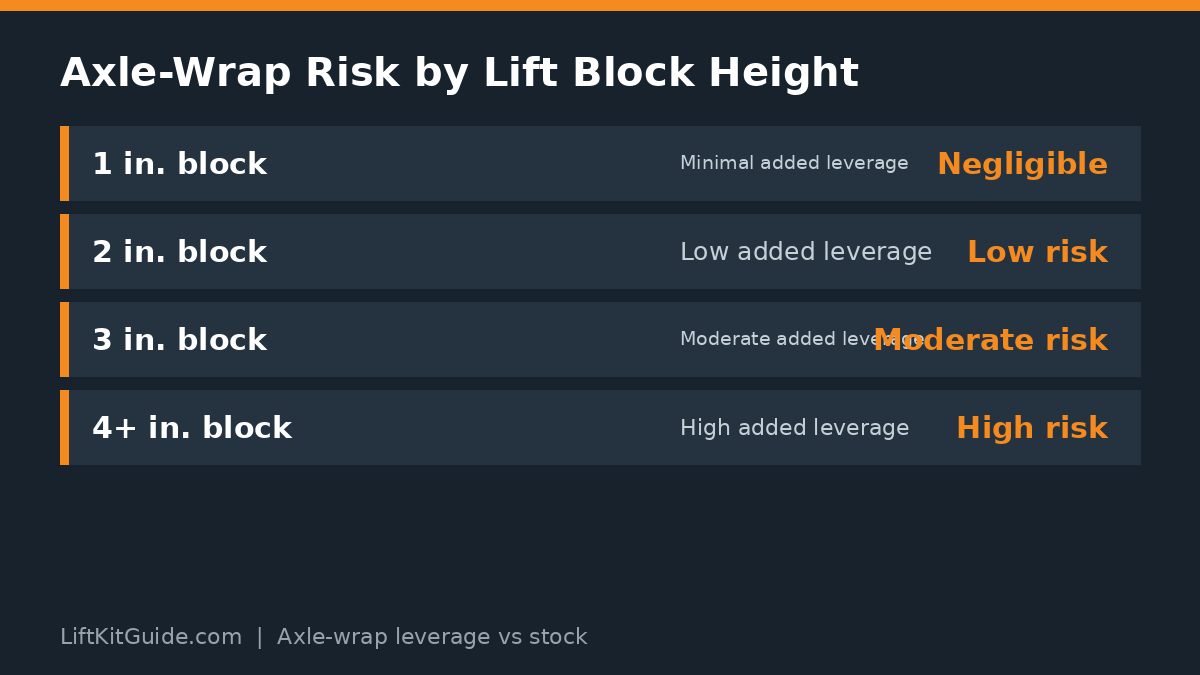
The height table below is the practical rule owners actually follow, whatever the forum rhetoric says. Stay in the green zone and the anti-block arguments barely apply; wander into the red zone and every criticism becomes valid.
Measuring your current setup before buying is a step most owners skip. Park on level ground, measure from the ground to the bottom of the frame at the rear axle, and compare side to side — many trucks have factory lean that a block will preserve or exaggerate. Knowing your baseline also tells you exactly how much block you need, preventing the common mistake of buying taller blocks than necessary and inviting the very axle-wrap problems everyone warns about.
Document your install with photos and torque specs, especially if the truck is under warranty. A clean, professional block install with quality parts rarely causes warranty disputes, but having records ends arguments before they start. When the topic of why is everyone against lift blocks comes up at the dealership, paperwork beats opinions every time.
| Block height | Axle-wrap risk | Verdict |
|---|---|---|
| 1 inch | Negligible | Safe for any street truck |
| 2 inches | Low | Fine for street; okay for light towing |
| 3 inches | Moderate | Avoid for towing; consider add-a-leaf instead |
| 4+ inches | High | Not recommended; buy full leaf packs |
What are the alternatives to lift blocks?
If blocks do not suit your use case, the upgrade ladder is well established. The first rung is the add-a-leaf at $80 to $250: an extra leaf in the pack that adds 1 to 2 inches while stiffening the springs, improving load handling and actually reducing axle wrap instead of increasing it. The ride firms up, which is the price of the capability — see our full lift blocks vs add-a-leaf comparison for the detailed tradeoff.
The top rung is a full replacement leaf pack at $400 to $900 from Deaver, Old Man Emu, or Alcan. Engineered arch, progressive rates, and anti-wrap geometry deliver the ride quality, load capacity, and durability that neither blocks nor add-a-leafs can match. For trucks that tow heavy, haul daily, or run hard off-road, the leaf pack is the buy-once solution. Our best lift kit brands guide covers the top spring manufacturers, and cost to lift a truck helps budget the jump.
Shackle lifts deserve mention as another alternative in the rear-lift menu. Longer shackles rotate the spring’s rear eye downward, adding 1 to 1.5 inches with minimal ride change and no added wrap leverage. They are cheap and simple, though they slightly alter pinion angle. For owners who want the block’s simplicity without even the theoretical wrap increase, shackles are the sleeper pick that rarely comes up when people ask why is everyone against lift blocks.
What do long-term block owners actually say?
Strip away the forum dogma and ask owners with 50,000-plus miles on block lifts: the overwhelming majority report zero issues. ‘I have yet to have any problems with my blocks,’ is the typical refrain, usually followed by noting the truck is a daily driver that occasionally hauls light loads. The silent majority of satisfied block owners simply does not post about their uneventful experience — only the failures make threads.
The complaints that do surface follow a pattern: tall blocks (3+ inches), heavy towing, aggressive launches, or cheap flat blocks that were never torqued properly. In other words, the failures validate the nuanced position, not the blanket ban. Owners who stayed at 2 inches or under, bought tapered blocks, and maintained their trucks describe the experience as completely drama-free — which is exactly what you want from a $100 modification.
Regional culture shapes the debate more than owners admit. In Texas and the Southeast, where tall trucks are a lifestyle, blocks are utterly normalized and nobody blinks at 3-inch rear blocks. In the Pacific Northwest overland scene, the same blocks draw open contempt. Neither culture is doing physics — they are doing identity. Recognizing this helps you filter advice: ask whether the person criticizing blocks has actually experienced a block failure, or is just repeating tribe wisdom.
Why is everyone against lift blocks — is the hate overblown?
So why is everyone against lift blocks, really? Partly physics — the leverage effect is real and measurable. Partly culture — truck forums reward strong opinions, and ‘blocks are trash’ is a simpler slogan than ‘blocks under 2 inches are fine for street use but suboptimal for towing.’ And partly selection bias — the people posting are enthusiasts who value performance per dollar, for whom a part that adds only height genuinely is a poor value.
The balanced verdict: the hate is about 50 percent overblown. Tall blocks on working trucks deserve every criticism; small blocks on street trucks deserve almost none. Match the part to the mission, buy quality tapered blocks, install them correctly, and ignore both the haters and the hype. Your truck, your money, your call — now at least it is an informed one. For next steps, see our suspension lift kits guide, installation costs, towing guide, and leveling kit basics.
A final practical note for the undecided: blocks are the easiest lift to undo. If you install 2-inch blocks and later decide you want the load handling of an add-a-leaf, the swap is a Saturday morning job that reuses your U-bolts. That reversibility makes blocks the ideal experiment — try the cheap, simple option first, and let your truck’s actual behavior guide any upgrade. Few questions in the why is everyone against lift blocks debate have such a low-cost way to get a personal answer.
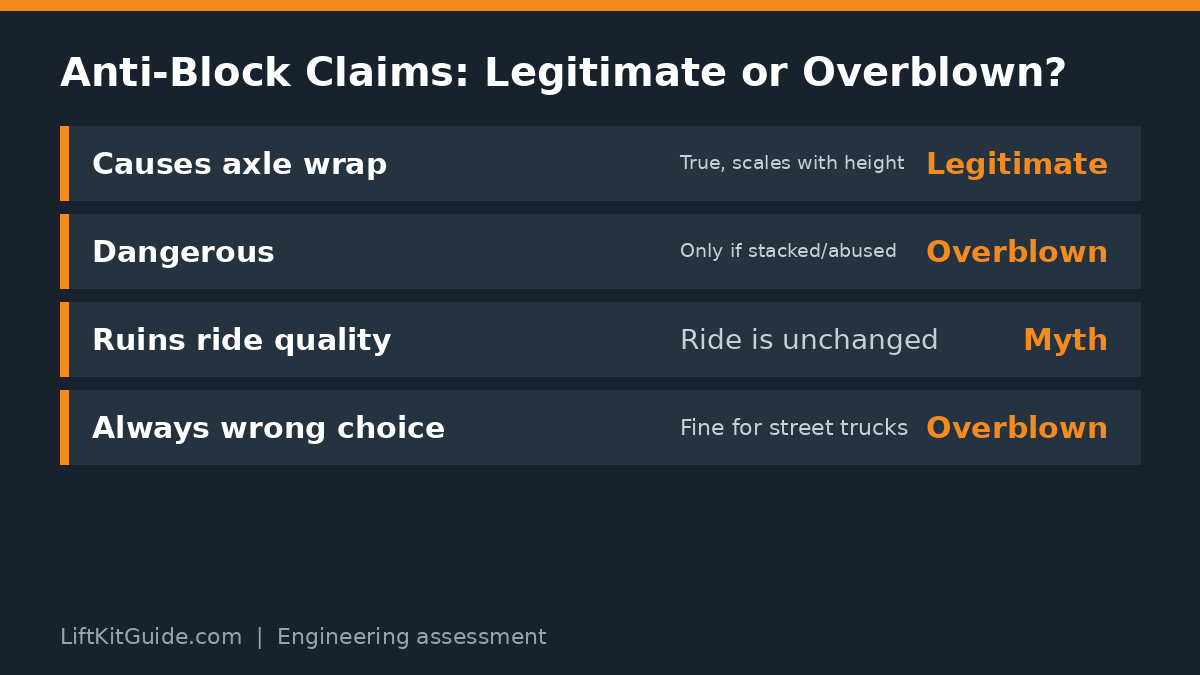
| Claim about blocks | Reality | Rating |
|---|---|---|
| Blocks cause axle wrap | True, proportional to height | Legitimate |
| Blocks are dangerous | Only when stacked or abused | Overblown |
| Blocks ruin ride quality | False — ride is unchanged | Myth |
| Blocks are always the wrong choice | False for street trucks | Overblown |
Frequently asked questions
Do lift blocks cause axle wrap?
They increase the leverage that causes axle wrap, proportional to block height — a 1-inch block adds little, a 4-inch block adds a lot. On street-driven trucks with 2 inches or less of block, most owners never experience any wrap symptoms.
Are 2-inch lift blocks safe?
Yes, for street-driven trucks — 2-inch tapered blocks from reputable brands, torqued to spec with proper U-bolts, are a proven safe budget lift used on millions of trucks. Recheck torque after 500 miles and inspect at each tire rotation.
Why do people say blocks are cheap-looking?
Because a visible metal chunk between the axle and spring telegraphs 'budget lift' to enthusiasts who value engineered solutions. It is an aesthetic and cultural judgment, not an engineering one — functionally, a quality block does its job fine.
Can lift blocks break leaf springs?
Tall blocks (3–4 inches) on hard-working trucks can accelerate spring fatigue and, in extreme cases, contribute to broken leaves — the added leverage is real. With 1–2 inch blocks on street trucks, spring breakage attributable to blocks is extremely rare.
Should I remove my lift blocks?
Only if you have a reason: upgrading to an add-a-leaf or full leaf pack for towing, experiencing wheel hop, or running 3+ inch blocks. If your 1–2 inch blocks ride fine and the truck does its job, there is no engineering case for removing them.
Do lift blocks affect towing capacity?
Blocks do not change your truck's rated towing capacity — the springs are stock, so load behavior is stock. But they do not help with squat either; if the rear sagged under your trailer before, it will sag the same after, just from a taller starting height.
The bottom line
Why is everyone against lift blocks? Because the loudest voices in truck culture value performance per dollar, and a part that buys only height will always lose that argument. The physics behind the criticism — leverage-multiplied axle wrap — is genuine, measurable, and height-dependent.
But the blanket ban is overblown for the average owner. Small tapered blocks on a street truck are safe, cheap, reversible, and ride-preserving — a rational choice, not a guilty pleasure. Reserve the hate for tall blocks on working trucks, where every criticism earns its keep.





Leave a comment