


Last updated: October 2026 Written by the LiftKitGuide Team, truck suspension installers and editors
When truck owners debate add-a-leaf vs full leaf pack, they are choosing between a budget boost and a complete rear suspension upgrade. An add-a-leaf kit ($120-$300) inserts an extra arched leaf into your factory pack for 1.5 to 2 inches of lift and about 500 to 600 pounds of added load capacity. A full replacement pack ($580-$1,200+) from Deaver, Old Man Emu, or ICON swaps every leaf for a matched engineered set. Worn springs or regular towing? Buy the full pack. Fresh springs and light loads? The add-a-leaf works.
Key takeaways
- Add-a-leaf kits cost $120-$300 and add 1.5-2 inches of rear lift plus ~500-600 lbs of load capacity.
- Full replacement leaf packs run $580-$1,200+ per pair (Deaver, OME Dakar, ICON RXT) and ride noticeably better.
- An add-a-leaf stiffens the ride because it raises spring rate; a progressive full pack can ride smoother than stock.
- Never put an add-a-leaf on a worn, sagging factory pack – it is a band-aid that stresses the old main leaf.
- For regular towing or hauling, a full leaf pack plus proper shocks beats any add-a-leaf setup.

On this page
What is an add-a-leaf and how does it lift the rear?
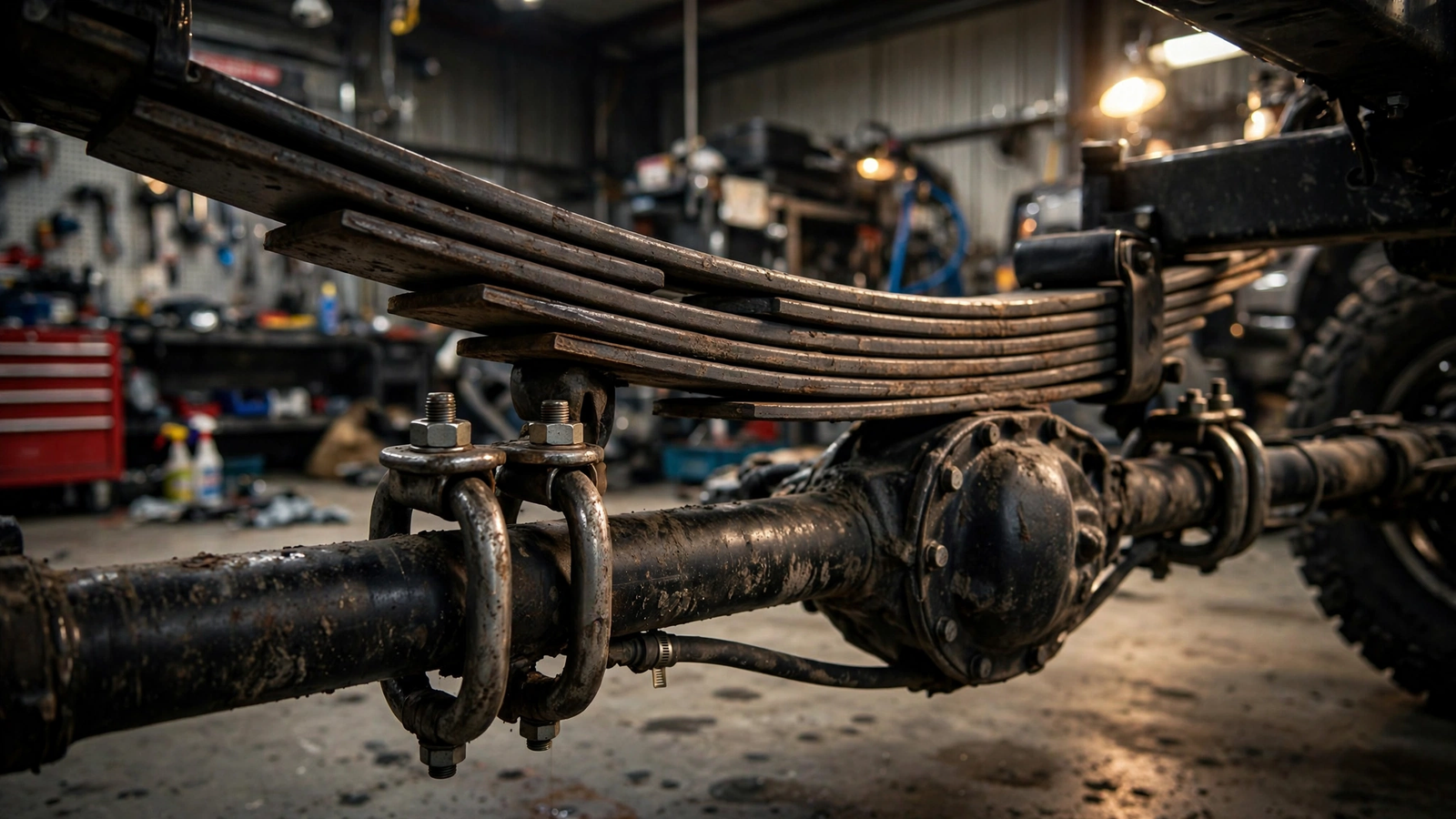
An add-a-leaf is a single, heavily arched steel leaf that installs inside your truck’s existing rear leaf spring pack. By wedging this extra leaf between the factory leaves, it increases the pack’s overall arch and spring rate, which raises the rear of the truck by roughly 1.5 to 2 inches. The added spring rate also means the rear sags less under weight, which is why owners who occasionally haul heavy loads like them. Most kits include new center pins and longer U-bolts, since the thicker pack needs extra clamping length to stay secure. This simple mechanism is exactly why the add-a-leaf vs full leaf pack question comes down to how much engineering you want behind your rear lift.
Installation means supporting the axle, removing the U-bolts, and partially disassanging the factory pack so the new leaf can be inserted in the correct position, usually just above the overload leaf. A competent DIYer with jack stands, a breaker bar, and a torque wrench can finish both sides in 3 to 5 hours. The job gets much harder on rust-belt trucks where U-bolts and shackle bolts seize, so budget penetrating oil and possibly replacement hardware. An alignment check afterward is smart, since rear ride height changes pinion angle slightly.
Not all add-a-leafs are equal. Short single-leaf kits are the cheapest and stiffest, while long add-a-leafs distribute load across more of the pack for a slightly better ride. Three-leaf progressive add-a-leaf kits from companies like ICON replace the factory overload leaf with a mini progressive pack, landing between a basic add-a-leaf and a full replacement in both cost and comfort. When owners compare add-a-leaf vs full leaf pack options, these progressive kits are often the compromise pick for trucks that split time between daily driving and weekend hauling. For a broader look at rear lift methods, see our guide to suspension lift kits.
What is a full replacement leaf pack?
A full replacement leaf pack removes every factory leaf and installs a brand-new, matched set of springs engineered as one system. Companies like Deaver, Old Man Emu (OME Dakar), ICON, and Alcan design each leaf’s length, thickness, and curvature to work together, producing a progressive spring rate that stays supple over small bumps and firms up under load. Most quality packs include military-wrapped spring eyes, anti-friction pads between leaves to prevent squeaking, and corrosion-resistant coatings. Expect 2 to 2.5 inches of lift from most aftermarket packs, with load-specific variants available. That matched engineering is the heart of the add-a-leaf vs full leaf pack value argument: you pay for a spring curve designed as a system, not a single stiff leaf.
The big advantage is that spring rate and ride height are designed together rather than hacked together. Deaver’s popular Stage I (U402) pack for the Tacoma uses 9 thin leaves for a 2-inch lift rated for 0 to 300 pounds of constant bed load, while Stage II handles 300 to 600 pounds for camper shells and drawer systems. Old Man Emu Dakar packs run slightly stiffer and cost less, around $580 to $620 per pair, making them the value choice for expedition-style builds. ICON’s RXT multi-rate pack, near $920 to $1,000, uses tip inserts and leaf separators for the best unloaded ride of the three. Load-specific pricing is well documented at Trail Manual’s leaf pack upgrade guide.
Because the entire pack is new, you also reset the clock on fatigue. Factory leaf packs flatten and lose arch over 80,000 to 120,000 miles of use, especially on trucks that tow. In the add-a-leaf vs full leaf pack decision, a tired factory pack is the tiebreaker: bolting a stiff new leaf onto worn springs just accelerates the old leaves’ decline, while a full pack starts fresh with matched metallurgy and proper heat treatment throughout.
Add-a-Leaf vs Full Leaf Pack: Which Rides Better?
Ride quality is where the add-a-leaf vs full leaf pack debate gets settled for most daily drivers. An add-a-leaf raises spring rate by forcing extra arch into the existing pack, which makes the rear noticeably stiffer over sharp bumps and expansion joints. Unloaded trucks feel this most: the rear can bounce and skitter on rough pavement because the stiffer pack no longer matches the factory shock valving. Owners routinely describe the change as going from firm to harsh, especially with short single-leaf kits.
A quality full replacement pack does the opposite trick. By using more, thinner leaves in a progressive stack, it can actually ride smoother than the factory pack while still carrying more weight. The thin leaves flex easily over small bumps, and the pack firms up progressively as it compresses under load. Deaver’s progressive packs are the benchmark here, with many owners reporting a better ride than stock both empty and loaded. That is the fundamental engineering difference: an add-a-leaf adds stiffness, while a full pack redesigns the spring curve. If your truck already rides harshly, our rough ride diagnosis guide walks through the causes.
The gap narrows if you pair either option with properly matched shocks. Factory rear shocks are valved for the stock spring rate, so any rear lift benefits from longer, lift-valved replacements like Bilstein 5100s. With good shocks, an add-a-leaf truck becomes tolerable; with good shocks, a full-pack truck becomes genuinely comfortable. Budget the $300 to $500 for rear shocks into either path, because springs without matching dampers only solve half the ride equation.
How much does an add-a-leaf cost compared to a full leaf pack?
Price is the add-a-leaf’s strongest argument. Basic single-leaf kits run $120 to $180, mid-range long add-a-leafs cost $200 to $300, and progressive 3-leaf kits land around $250 to $350. Add $300 to $600 for professional installation if you are not doing it yourself, plus $60 to $100 for an alignment check. All in, a shop-installed add-a-leaf typically totals $500 to $900, which is why budget lift kits lean on them heavily. When owners run the add-a-leaf vs full leaf pack numbers honestly, the add-a-leaf usually wins on upfront cost by five hundred to eight hundred dollars.
Full replacement packs start where add-a-leafs top out. Old Man Emu Dakar packs run about $580 to $620 per pair, Deaver Stage I packs cost $680 to $750 per pair, and ICON RXT packs approach $920 to $1,000. Custom Alcan packs built to your exact load can exceed $1,200. Installation runs $400 to $700 at a shop because the job involves more disassembly, plus new U-bolts and bushings. A realistic installed total is $1,000 to $1,800, roughly double the add-a-leaf route. Tall rear lifts pair with front height; compare 6-inch lift costs for full project budgets.
| Option | Parts cost | Typical rear lift | Installed total |
|---|---|---|---|
| Basic add-a-leaf | $120-$180 | 1.5-2 in. | $500-$800 |
| Progressive 3-leaf AAL | $250-$350 | 1.5-2 in. | $600-$950 |
| OME Dakar full pack | $580-$620 | 2-2.5 in. | $1,000-$1,300 |
| Deaver full pack | $680-$1,000 | 2 in. | $1,100-$1,600 |
| ICON RXT full pack | $920-$1,000 | 2-2.5 in. | $1,300-$1,700 |
Add-a-Leaf vs Full Leaf Pack for Towing and Hauling: Which Wins?
For regular towing, the add-a-leaf vs full leaf pack contest is not close: the full pack wins. Towing exposes every weakness of a spring setup, including sag under tongue weight, porpoising over bridge joints, and axle wrap under throttle. A full replacement pack engineered for your constant load keeps the truck level and stable, with a spring rate curve designed to control the trailer rather than just resist it. Owners who tow travel trailers or haul slide-in campers consistently report that a proper pack transforms the experience.
An add-a-leaf can work for occasional towing if the factory pack is healthy. The extra rate reduces sag when the boat or utility trailer is hooked up, and for a truck that tows six weekends a year, that may be enough. The smart pairing is an add-a-leaf plus air helper springs or Timbren bump-stop helpers: the add-a-leaf handles the lift, and the air bags handle the occasional heavy tongue weight with adjustable support. This combo costs less than a full pack and keeps the unloaded ride acceptable. Tongue-weight math matters here; see towing with a lifted truck for the full breakdown.
Watch tongue weight math regardless of which route you choose. Most half-ton trucks want 10 to 15 percent of trailer weight on the tongue, which is 500 to 900 pounds on a typical 6,000-pound trailer. A single add-a-leaf adds roughly 500 to 600 pounds of effective capacity, so it can be overwhelmed by a heavy trailer where a load-rated full pack would stay composed. If your truck squats more than an inch with the trailer hooked up, your rear springs are undersized for the job.

When is an add-a-leaf the right choice?
An add-a-leaf makes sense when three conditions line up: your factory leaf pack is still healthy, your budget is tight, and your heavy-load days are occasional rather than constant. A truck under 60,000 miles with flat, crack-free springs is a fine candidate. The add-a-leaf delivers the leveled stance and modest capacity boost you want for weekend projects, hunting season, or the annual camping trip without the four-figure commitment of a full pack. In short, the add-a-leaf vs full leaf pack choice favors the add-a-leaf only while the truck’s hauling demands stay modest and occasional.
It also works well as part of a staged build. Many owners install an add-a-leaf with their first leveling kit, then upgrade to a full pack years later when the factory springs finally tire out. Just go in with open eyes: the add-a-leaf is a stepping stone, not a destination. If you already know you will tow a travel trailer every month next summer, skip the intermediate step and buy the full pack now rather than paying for the same labor twice.
- Fresh factory springs: under 60,000 miles with good arch and no cracks or sag.
- Tight budget: you need rear lift now and the $500-$900 total fits where $1,200+ does not.
- Occasional loads: weekend hauling or seasonal towing, not daily work-truck duty.
- Matched shocks: you are also installing longer, lift-valved rear shocks.
- Realistic expectations: you accept a firmer ride in exchange for the savings.
What are the signs your factory leaf pack is too worn for an add-a-leaf?
Putting an add-a-leaf on a worn pack is the most common mistake in this upgrade. When factory leaves flatten with age and miles, their arch inverts and the pack loses its ability to share load across all leaves. Wedging a stiff new leaf into that tired stack concentrates bending force on the old main leaf, which accelerates cracking. Forum veterans call it lipstick on a pig: the truck sits higher for a few months, then the worn leaves keep sagging underneath the new one.
Inspect before you buy. Park on level ground and sight down the leaf pack: healthy springs show a gentle upward arch, while worn packs sit flat or curve downward into a W shape. Look for cracked leaves, shifted leaf alignment, and flattened or missing anti-friction pads. Measure from the ground to the bottom of the frame rail at the rear axle and compare side to side; more than half an inch of difference suggests fatigue. Any of these signs means the add-a-leaf vs full leaf pack decision is already made for you: replace the whole pack.
| Symptom | What it means | Right fix |
|---|---|---|
| Rear sits 1+ in. lower than stock | Springs have lost arch from fatigue | Full replacement pack |
| Negative (W-shaped) arch | Main leaf is permanently bent | Full replacement pack |
| Cracked or shifted leaves | Pack is structurally failing | Full replacement pack now |
| Squeaking over bumps | Worn anti-friction pads | Full pack or rebuild with new pads |
| Mild sag, good arch, <60k miles | Healthy pack needing capacity | Add-a-leaf is fine |
Should you install rear lift springs yourself or pay a shop?
An add-a-leaf is one of the more approachable suspension DIY jobs. You need jack stands, a floor jack, basic sockets, a breaker bar, and a torque wrench, plus penetrating oil for rusty hardware. The critical safety rule is to never work under a truck supported only by a jack, and to torque U-bolts to spec in a star pattern after the truck is back on its wheels. Most first-timers finish in an afternoon, and the only specialty consideration is ordering longer U-bolts if the kit does not include them. Whichever side of the add-a-leaf vs full leaf pack debate you land on, correct torque procedure matters more than brand choice for safety.
A full leaf pack swap is the same job with higher stakes and heavier parts. Each pack weighs 60 to 80 pounds, the shackle and hanger bolts are often seized, and bushing replacement adds time. Shops typically charge $400 to $700 for the swap including an alignment check, which is reasonable insurance if your truck lives in the rust belt. Either way, retorque every fastener after 500 miles: spring hardware settles, and a loose U-bolt will let the axle shift. For more on shop pricing, see our lift kit installation cost guide, and compare total project budgets with our cost to lift a truck breakdown.
Frequently asked questions
How much lift does an add-a-leaf give?
Most add-a-leaf kits deliver 1.5 to 2 inches of rear lift on a healthy factory pack. Long add-a-leafs and 3-leaf progressive kits land in the same range but with a slightly better ride. If your factory springs are already sagging an inch, expect less net lift because the new leaf is first making up for lost arch.
Will an add-a-leaf make my ride stiffer?
Yes, noticeably. An add-a-leaf increases spring rate, so the rear feels firmer over sharp bumps and expansion joints, especially when unloaded. Pairing it with lift-valved rear shocks softens the blow, but it will never ride as smoothly as a progressive full replacement pack.
Can you combine an add-a-leaf with a lift block?
You can, but it is rarely the best answer. Stacking a block on an add-a-leaf compounds axle wrap leverage while adding the stiffness of the extra leaf, giving you the downsides of both. If you need more than 2 inches of rear lift, a full replacement pack or a taller block with traction bars is the cleaner solution.
How long do add-a-leafs last?
On a healthy factory pack, a quality add-a-leaf lasts 60,000 to 100,000 miles before fatigue sets in. On an already worn pack, it may accelerate the old leaves' decline and need replacement much sooner. Full replacement packs typically outlast add-a-leafs because every leaf shares the load as designed.
Do I need longer shocks with a new leaf pack or add-a-leaf?
Yes. Any rear lift changes shock travel requirements, and factory shocks are valved for the stock spring rate anyway. Budget $300 to $500 for longer, lift-valved rear shocks like Bilstein 5100s with either upgrade. Running stock shocks on lifted springs causes topping out and a harsh, uncontrolled ride.
Do full leaf packs need a break-in period?
Yes, expect new leaf packs to settle 0.25 to 0.5 inches over the first 500 to 1,000 miles as the leaves seat against each other. Do not get your final alignment or judge ride height until after this period.
The bottom line
An add-a-leaf is the smart budget move when your factory springs are healthy, your loads are occasional, and $500 to $900 all-in fits the build. It delivers real lift and real capacity for a fraction of the cost, and paired with good shocks it rides acceptably. Just understand what you are buying: added stiffness, not redesigned suspension.
A full replacement leaf pack is the buy-once answer for trucks that tow, haul, or have tired factory springs. At $580 to $1,200-plus for parts, it costs roughly double the add-a-leaf route, but the progressive ride, matched load ratings, and long-term durability pay it back every mile. When the factory pack is worn, it is not even a choice: replace the whole pack.






Leave a comment