


Last updated: October 2026 Written by the LiftKitGuide Team, truck suspension installers and editors
Do you need a differential drop kit after lifting your 4×4? If your independent-front-suspension truck is lifted more than about 2 inches, yes. A diff drop kit lowers the front differential 1 inch (25mm) with machined spacers, restoring CV axle angles closer to stock and preventing boot and joint wear. Kits cost $30 to $300 depending on brand and vehicle, with Toyota kits starting under $30. At 2 inches or less of lift, trucks are fine without one, but anything taller on an IFS 4×4 should get the diff dropped.
Key takeaways
- A diff drop kit lowers the front differential ~1 inch to restore CV axle angles after lifting an IFS 4×4.
- The rule of thumb: lifts over 2 inches need a diff drop; 2 inches and under usually do not.
- Basic kits cost $30-$80 (Wheeler’s, generic); premium kits like Dobinsons run up to $300.
- Skipping the diff drop on a tall lift causes CV boot fins to touch, accelerated wear, and binding at full droop.
- Most kits include skid plate spacers, grade 8 hardware, and install in 1-2 hours.
On this page
What does a differential drop kit do?
A differential drop kit is a set of machined spacers and longer hardware that lowers your front differential about 1 inch (25mm) from its factory mounting position. On independent-front-suspension 4×4 trucks, the front diff is bolted to the frame, and the CV axles run from the diff out to each front wheel. When you lift the truck, the wheels drop relative to the frame, forcing the CV axles to operate at a steeper angle. Lowering the diff brings the inner CV joints back down, flattening that angle toward stock. This is the mechanism behind the eternal forum question “do you need a differential drop kit after lifting” on every 3-inch lift thread.
The kits themselves are simple. A typical Toyota kit, like the popular Wheeler’s Off-Road version at $25 to $30, includes CNC-machined 6061 billet aluminum spacers, grade 8 mounting bolts, and spacers for the factory skid plate, which also needs to drop to clear the lowered diff. Premium kits from Dobinsons or SuperPro cost $150 to $300 and may include beefier brackets, but the function is identical. Installation takes 1 to 2 hours with basic hand tools. Kit contents and pricing are listed on Wheeler’s Off-Road diff drop page.
It is worth understanding what a diff drop does not do. It does not change ride height, alignment, or ground clearance in any meaningful way; it purely corrects driveline geometry. It also does not fix every front-end issue a tall lift creates. Upper control arms, extended brake lines, and proper alignment are separate concerns. The diff drop has one job, and on trucks that need it, that job is protecting expensive CV axles from premature death.
Why does lifting a 4×4 change CV axle angles?
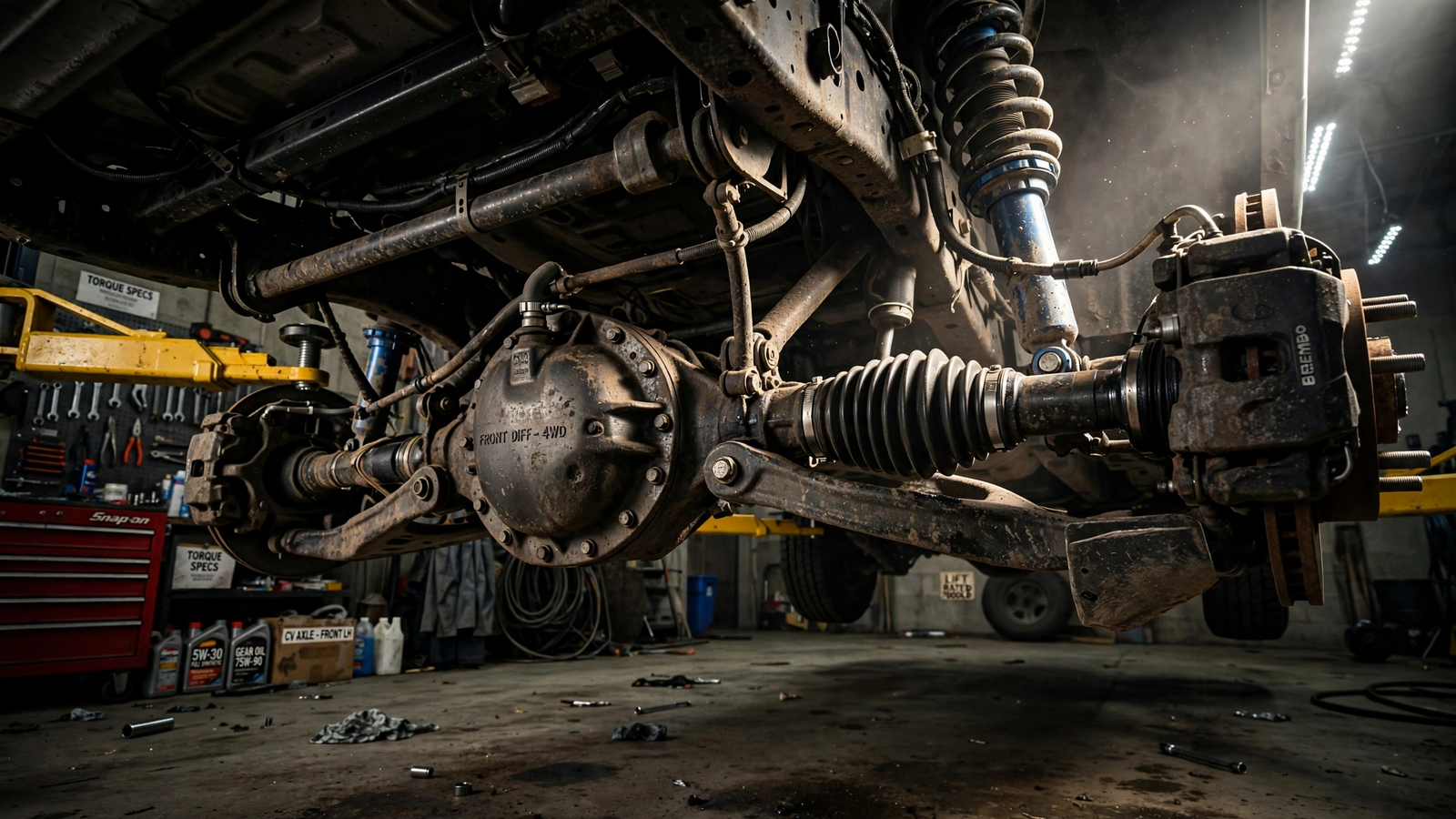
On an IFS 4×4, the front differential is fixed to the frame while the wheels move with the suspension. At stock height, the CV axles run nearly horizontal from the diff to the hubs, which is their happiest operating angle. Every inch of suspension lift drops the wheels further below the diff, tilting the axles downward at a steeper angle. The CV joints at each end must then articulate further just to transmit power in a straight line, before you even turn the steering wheel. Grasping this geometry is what lets you answer “do you need a differential drop kit after lifting” for your own truck and lift height.
CV joints tolerate angle, but only within a designed range. As the angle increases, the joint’s internal balls or tripod bearings travel further across their races with every rotation, generating more heat and friction. The rubber CV boots suffer first: at steep angles the boot’s pleats, called fins, can touch and rub each other, wearing through and slinging grease. Once a boot tears, dirt and water destroy the joint quickly, turning a $30 prevention into a $300 to $600 axle replacement per side. Bigger lifts compound every angle issue; compare 6-inch lift costs.
Full droop makes everything worse. When the suspension extends fully, such as when a wheel drops into a rut off-road, the CV angle maxes out. Lifts with extended-travel shocks add even more droop, which is why long-travel setups are hardest on CVs. A diff drop cannot eliminate angle entirely, but by lowering the inner joint it keeps the operating range closer to what the joints were designed for.
You can roughly gauge your own angles with a smartphone angle-finder app placed along the CV axle shaft, comparing the reading to stock specs posted in owner forums. Anything much beyond 25 degrees of operating angle at ride height deserves attention. While you are under there, the same inspection answers “do you need a differential drop kit after lifting” visually: fins touching means yes, regardless of what any chart says.
Do You Need a Differential Drop Kit After Lifting? The 2-Inch Rule
The short answer to do you need a differential drop kit after lifting is the 2-inch rule: lifts over 2 inches on an IFS 4×4 should get one, while 2 inches and under generally do not need it. This threshold comes straight from kit manufacturers. Dobinsons states its Land Cruiser diff drop is needed when lifting more than 2.0 inches, and the broader Toyota truck community has converged on the same line through years of trial and error. At 2 inches, CV angles increase but stay within the comfortable operating range for most trucks. That cheap-insurance logic is why most experienced owners stop debating “do you need a differential drop kit after lifting” and just install the $30 kit.
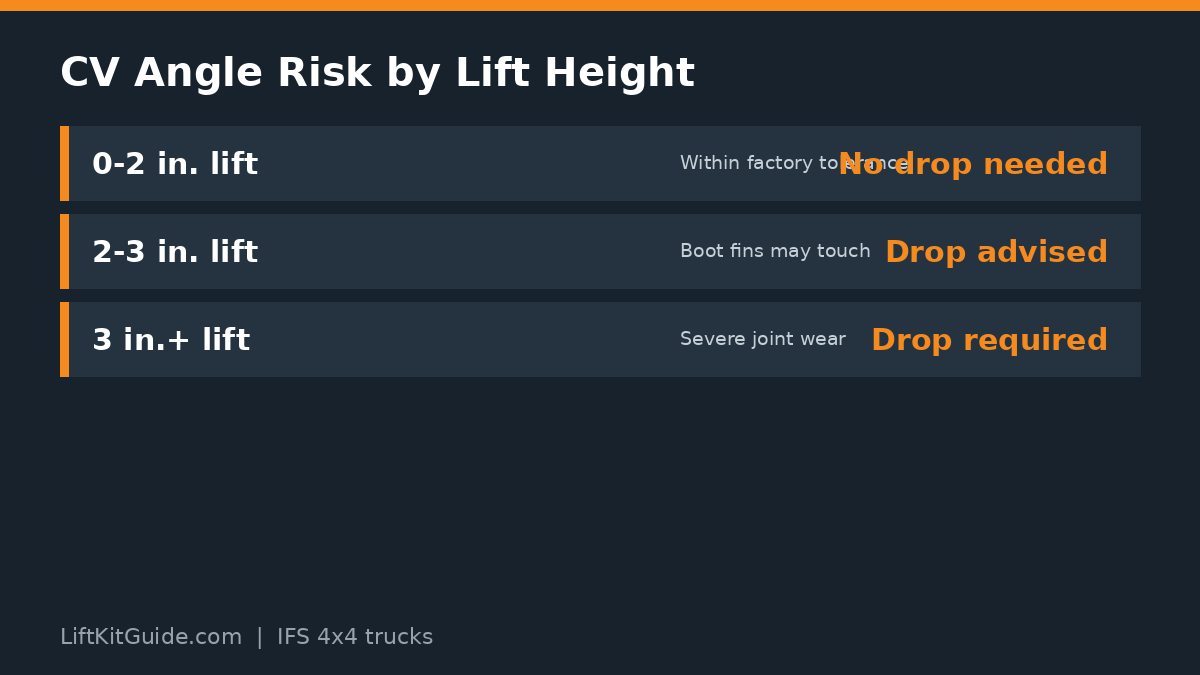
Between 2 and 3 inches is the gray zone where the answer depends on your truck and how you use it. A 2.5-inch Bilstein 5100 lift on a Tacoma that never leaves pavement might survive fine without a drop, while the same lift on a truck that sees regular off-road droop will eat CV boots. When owners ask do you need a differential drop kit after lifting to 2.5 inches, the safe advice is to install the $30 kit: it is cheap insurance against a $500 axle job, and there is no performance downside.
At 3 inches and above, the diff drop is not optional. CV angles at 3 inches of IFS lift are steep enough that boot fins commonly touch, and joint life drops dramatically. Many 3-inch lift kits for Tacomas, 4Runners, and Tundras now include a diff drop in the box, which tells you everything about the industry consensus. If your kit did not include one, buy it separately before the lift goes on; installing it during the lift costs nothing in extra labor. How the drop works with full systems is covered in suspension lift kits explained.
What happens if you skip the diff drop on a tall lift?
Skip the diff drop on a 3-inch IFS lift and the CV boots will tell you about it, usually within 10,000 to 20,000 miles. The first symptom is grease slung around the inner wheel well and suspension, meaning a boot fin has worn through from rubbing. Left alone, the joint runs dry, clicks on turns, and eventually fails outright. A failed CV on the trail can end your trip, and even on the street it means a tow and a $300 to $600 repair per side. Every one of these failures traces back to an owner who never asked “do you need a differential drop kit after lifting” until grease was already on the driveway.
Vibration is the second warning sign. Excessive CV angle can cause a subtle shudder under acceleration, particularly in 4WD, as the joints fight their own geometry. Some owners chase this vibration through wheel balancing and alignments before realizing the diff drop they skipped was the fix all along. Extended-droop situations make it worse: at full suspension extension, an un-dropped diff can push CVs past their maximum operating angle, causing binding that feels like the front end locking up. Unexplained shakes may need death wobble diagnosis instead.
| Lift height (IFS 4×4) | CV angle risk | Diff drop needed? |
|---|---|---|
| 0-2 in. | Low: within factory tolerance | No |
| 2-2.5 in. | Moderate: gray zone | Recommended ($30 insurance) |
| 2.5-3 in. | High: boot fins may touch | Yes |
| 3 in. and up | Severe: accelerated joint wear | Yes, mandatory |
Do You Need a Differential Drop Kit After Lifting Just 2 Inches?
At exactly 2 inches of lift, most IFS 4×4 trucks do not need a diff drop, and adding one provides little measurable benefit. CV angles at 2 inches sit near the upper edge of the factory tolerance band but rarely cause boot contact or premature wear in normal use. Thousands of leveled Tacomas, 4Runners, and Colorados run 2-inch front lifts for years with stock diffs and stock CVs. If your lift is a 2-inch leveling kit and you drive mostly on pavement, spend the $30 elsewhere. That inspection habit beats any rule of thumb when you are deciding “do you need a differential drop kit after lifting” on a borderline setup.
The exception is trucks that work their suspension hard. If your 2-inch lift includes extended-travel shocks that add droop, or if you regularly articulate the front end off-road, the extra down-travel can push CVs past comfortable angles even at modest lift heights. In that case the question do you need a differential drop kit after lifting gets a different answer: the $30 kit is still cheap peace of mind. When in doubt, inspect your CV boots after 5,000 miles; fins touching means you need the drop regardless of lift height. Tall lifts need more than a drop; see do you need upper control arms.
How much does a diff drop kit cost and what's included?
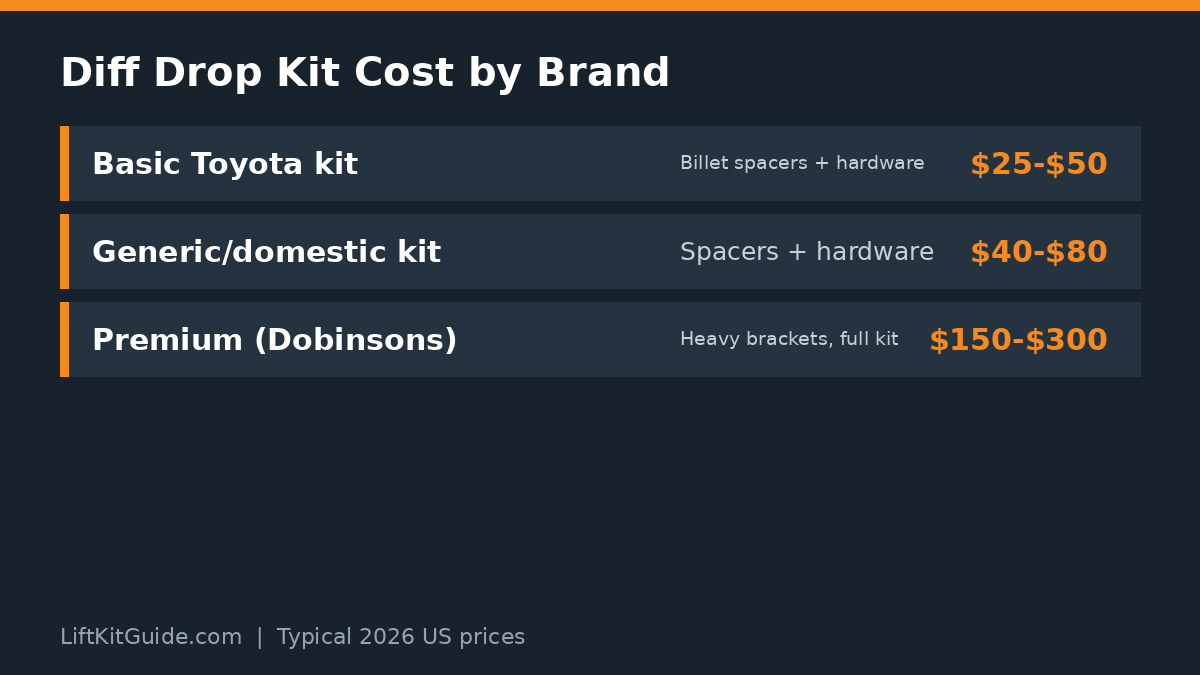
Diff drop kits are among the cheapest meaningful upgrades in the lift world. Basic kits for popular Toyota trucks (Tacoma, 4Runner, Tundra, Sequoia) cost $25 to $50 from Wheeler’s Off-Road and similar vendors, including billet spacers, grade 8 hardware, and skid plate drop spacers. Generic kits for domestic trucks run $40 to $80. Premium options from Dobinsons, SuperPro, or Total Chaos cost $150 to $300, usually with heavier brackets and more complete hardware for specific models like the Land Cruiser 100 Series.
What you get is refreshingly complete for the money. The box typically holds two to four machined spacers, longer high-grade bolts, washers, and spacers to lower the factory skid plate by the same inch. Some kits include thread locker and printed instructions. There are no wear items and nothing to maintain afterward; once installed, the spacers simply live between the diff and the frame for the life of the truck.
Fitment is model-specific, so buy the kit made for your truck rather than a universal spacer stack. Toyota Tacoma, 4Runner, Tundra, and Sequoia kits differ slightly by generation, and mixing generations causes bolt misalignment. When shopping, the question “do you need a differential drop kit after lifting” should be followed immediately by checking your exact year, make, and drivetrain against the kit’s application list.
- Billet spacers: CNC-machined 6061 aluminum blocks that lower the diff ~1 inch.
- Grade 8 hardware: longer high-strength bolts, nuts, and washers rated for the load.
- Skid plate spacers: drop the factory skid plate to clear the lowered differential.
- Instructions: torque specs and install sequence, usually a 1-2 hour job.
- What is NOT included: alignment, UCAs, or brake lines, which are separate lift concerns.
Can you install a diff drop kit yourself?
Yes, a diff drop is a beginner-friendly install. The process is straightforward: support the front differential with a jack, remove the factory mounting bolts, insert the spacers between the diff and the frame mounts, and reinstall with the supplied longer hardware torqued to spec. Then drop the skid plate with its spacers. No specialty tools are needed beyond sockets, a torque wrench, and jack stands, and most owners finish in 1 to 2 hours. Because the job is so simple, there is no reason to delay once “do you need a differential drop kit after lifting” gets a yes. Budget the job with our lift kit installation cost guide.
The smart move is installing the diff drop during the lift itself, when the front end is already apart. As a standalone job it is still easy, but you will repeat some disassembly. One caution: on rust-belt trucks, the factory diff bolts can seize, so soak them with penetrating oil the night before. Torque everything to the kit’s specification; the diff is a stressed member and loose hardware here causes clunks that are maddening to diagnose.
| Task | DIY difficulty | Time |
|---|---|---|
| Diff drop alone | Easy | 1-2 hours |
| Diff drop during lift install | Easy | 20 extra minutes |
| Full 3 in. lift + diff drop | Moderate | 6-10 hours |
| CV axle replacement (if skipped) | Moderate | 2-3 hours per side |
Are there downsides to dropping the differential?
The downsides are minor but worth knowing. Lowering the diff by an inch reduces front ground clearance by that same inch at the lowest point of the drivetrain, which matters if you rock crawl. The factory skid plate must be spaced down to match, and on some trucks the lowered diff can interfere with certain aftermarket skid plates designed for the stock position; most quality skid manufacturers account for this, but verify before buying armor. Weighing these minor tradeoffs, “do you need a differential drop kit after lifting” still gets a yes for any IFS truck lifted over 2 inches.
There is also a persistent myth that diff drops cause more harm than good by changing oiling or putting stress on mounts. In practice, a 1-inch drop does not meaningfully change the diff’s internal oiling, and the load path through the mounts is unchanged. Millions of lifted Toyotas run diff drops without issue. The real risk was never the drop; it is skipping it and letting steep CV angles eat $500 axles instead. Plan the full project with our cost to lift a truck breakdown.
Frequently asked questions
Does a diff drop affect 4WD performance?
No. A diff drop does not change gear ratios, traction, or 4WD engagement in any way. It only repositions the differential housing to improve CV axle angles. Your 4WD system works exactly as before, just with happier CV joints.
Do I need a diff drop with a leveling kit?
Usually not. Most leveling kits provide 2 inches or less of front lift, which keeps CV angles within tolerance on IFS 4×4 trucks. If your leveling kit exceeds 2 inches or includes extended-travel shocks, add the $30 diff drop for insurance.
Will a diff drop fix existing CV vibration?
It can help if the vibration comes from excessive CV angle, but it will not repair a joint that is already damaged. If your CVs click on turns or have torn boots, replace the axles first, then install the diff drop to protect the new ones.
Do solid-axle trucks need a diff drop?
No. Diff drops are only for independent front suspension (IFS) 4×4 trucks where the differential is frame-mounted. On solid-axle trucks, the whole axle moves with the suspension, so lifting does not change the angles at the diff.
How do I know if my CV angles are too steep?
Inspect the CV boots: if the rubber fins (pleats) are touching each other, the angle is too steep. Also look for grease slung around the wheel well, clicking on sharp turns, or vibration under acceleration in 4WD.
Does a diff drop change ground clearance?
Minimally. Lowering the diff 1 inch reduces clearance directly under the differential by that amount, but the diff was never the lowest point by much and the skid plate still protects it.
The bottom line
A differential drop kit is $30 of cheap insurance that every IFS 4×4 lifted over 2 inches should have. It takes an hour to install, has no meaningful downsides, and protects CV axles that cost ten times more to replace. If your lift kit did not include one, order it before the lift goes on.
At 2 inches and under, you can skip it with confidence on most trucks. The 2-inch rule has held up across millions of lifted Toyotas, Chevys, and Fords: below it, CVs live happily; above it, the diff drop pays for itself the first time you do not buy new axles.




Leave a comment