


Last updated: October 2026 Written by the LiftKitGuide Team, truck suspension installers and editors
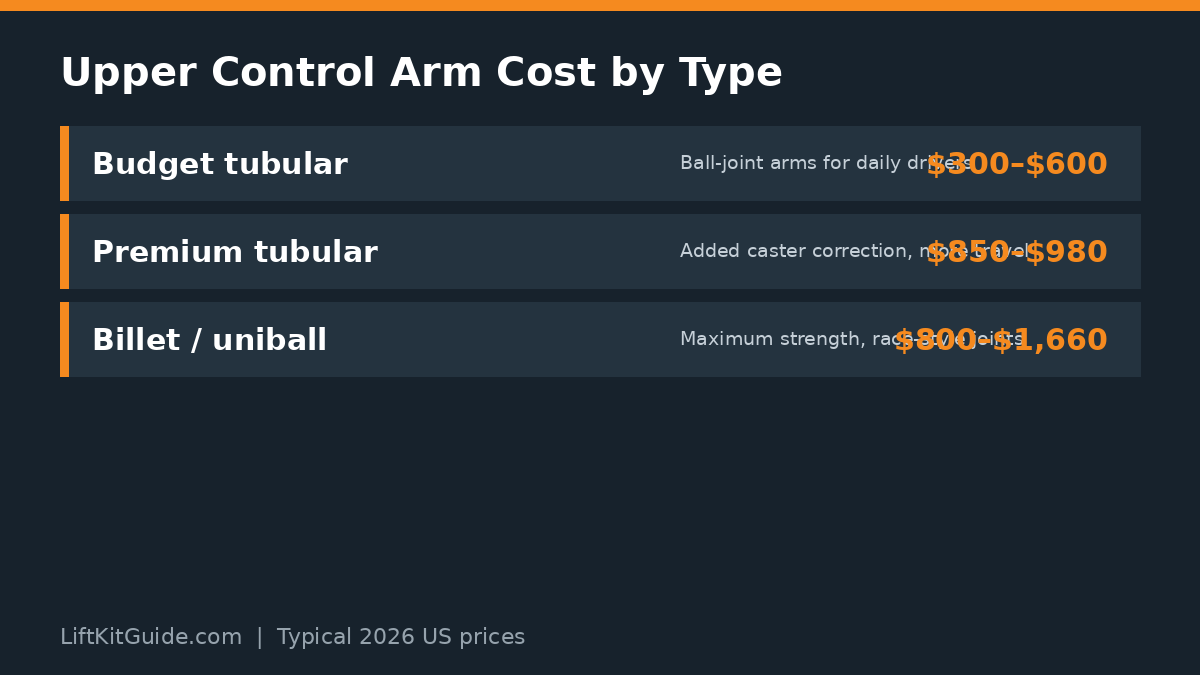
Do you need upper control arms with a 3 inch lift? Yes, on most trucks. Three inches of front lift pushes stock arms past their geometry: ball-joint angles go steep, caster drops below spec, droop travel shrinks, and the factory cams can no longer bring the truck back into range. Lift-built upper control arms correct the joint angle and typically restore 2 to 4 degrees of caster. Budget tubular pairs cost $300 to $600, premium tubular sets $850 to $980, and billet or uniball arms $800 to $1,660.
Key takeaways
- Most installers and alignment shops treat 2.5 to 3 inches as the tipping point — beyond it, stock upper control arms run out of geometry and adjustment range.
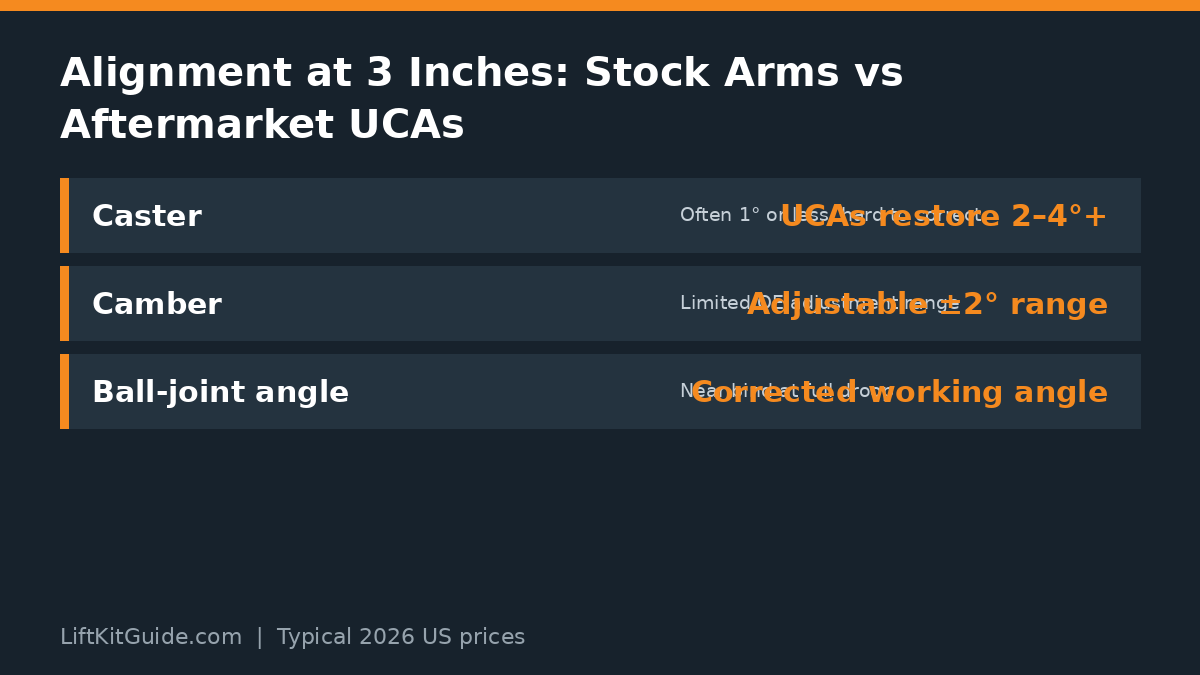
- At 3 inches, caster commonly drops to 1 degree or less, while most trucks want 2 to 3 degrees for stable tracking and steering return-to-center feel.
- Aftermarket UCAs restore alignment range: adjustable designs offer 0 to +4 degrees of caster and ±2 degrees of camber, with some ball joints articulating up to 80 degrees.
- Typical pair pricing in 2026: budget tubular $300–$600, premium tubular $850–$980, billet or uniball $800–$1,660; installation takes about 1–2 hours plus an $80–$200 alignment.
- Uniball joints handle harder off-road use but can squeak and demand cleaning and lube; sealed ball joints are quieter, greasable, and better suited to daily drivers in wet or salty climates.
On this page
Do you need upper control arms with a 3 inch lift?
Do you need upper control arms with a 3 inch lift if your truck drives fine right now? The honest answer is that fine today does not stay fine for long. At 3 inches, the stock arm sits at a much steeper angle than its designers intended, the upper ball joint works near the edge of its range, and the truck gives up droop travel it used to have. An alignment shop may still get the numbers close, but it is working with little margin. That is the condition aftermarket arms are built to fix. For many trucks, that margin is the difference between an alignment that holds and tires that wear unevenly.
The question “do you need upper control arms with a 3 inch lift” keeps coming up because 3 inches lands right at the limit of what factory geometry tolerates. Below about 2.5 inches, most trucks align fine on stock arms and live happily for years. At 3 inches, the arm and ball-joint stud rotate far enough that caster disappears and the factory adjustment cams run out of range. That is why many complete suspension lift kits in the 3-inch class either include upgraded arms or list them as a required companion part. Skipping them rarely saves money once tire wear is factored in.
There is also a practical middle ground: if you already lifted and skipped the arms, do you need upper control arms with a 3 inch lift right away, or can you wait? Get the alignment checked first. If caster is stuck near 1 degree or the shop reports the cams are maxed out, order the arms before the tires pay the price. If everything is comfortably in spec, you can plan the upgrade for the next tire or shock service — but treat it as a when, not an if. Watch for wandering steering or edge wear as early warning signs.
What happens to your front suspension at 3 inches of lift?
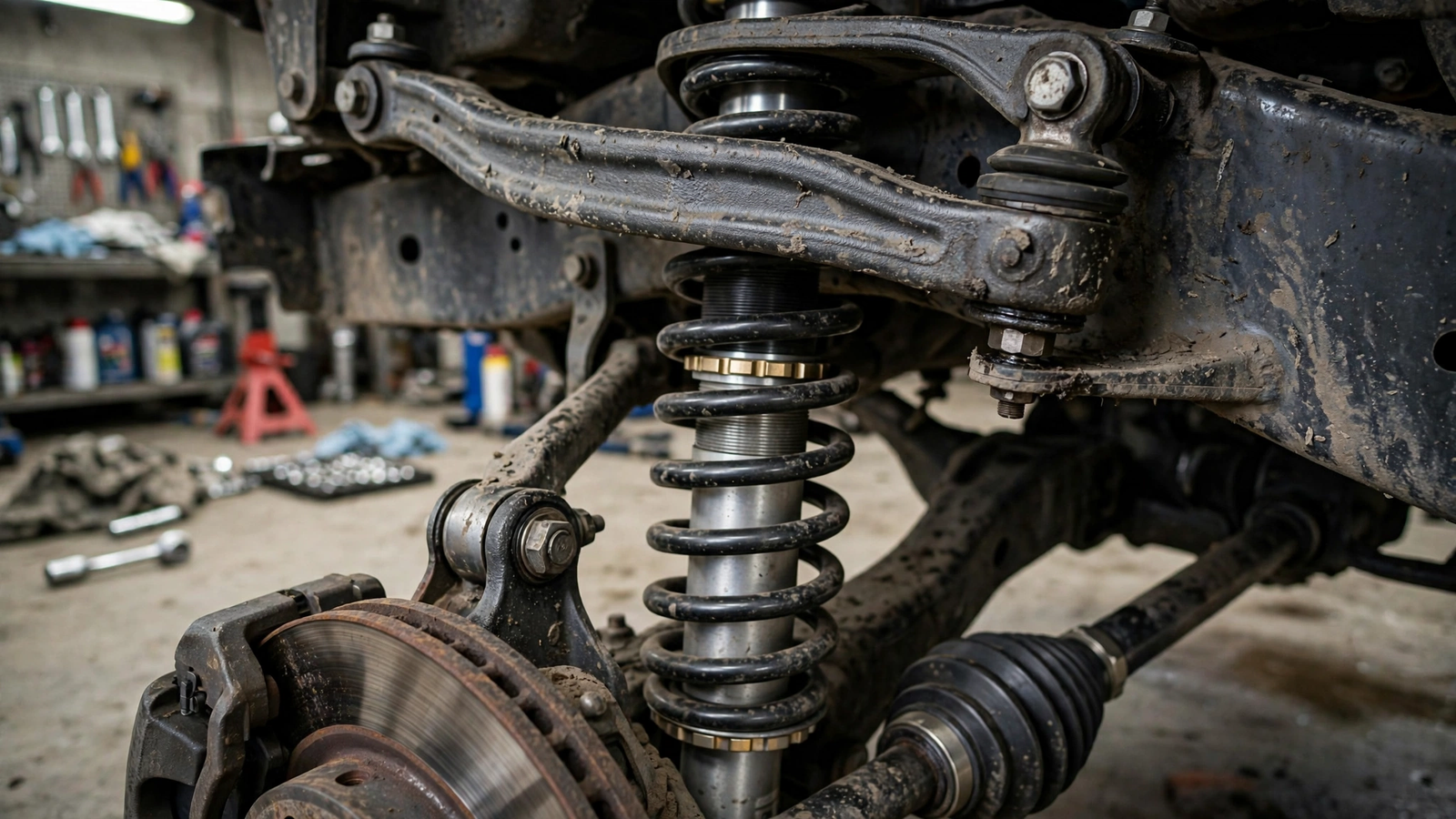
Anyone researching do you need upper control arms with a 3 inch lift should start with the mechanical picture. Raising the front by 3 inches rotates the whole steering knuckle assembly downward relative to the frame. The upper arm, designed to sit roughly level, now points steeply downward toward the wheel, and the ball joint stud operates at a sharp angle instead of near its sweet spot. Lift-built arms reposition the joint so it works straight again — a point made clearly in SuspensionMAXX’s tech guide on when lifted trucks need upper control arms, which treats geometry correction as the whole purpose of the upgrade, not extra lift. That correction is the entire value proposition.
The second casualty is droop travel — how far the wheel can extend downward into a pothole or off a ledge. Because the arm starts 3 inches lower in its arc, it reaches the droop stop sooner, so the suspension tops out over bumps it used to absorb. Drivers feel this as a sharp jolt and a busy front end on broken pavement. Aftermarket arms add clearance around the spring bucket and use joints with more articulation — some designs claim up to 80 degrees of ball-joint movement — specifically to recover the travel the lift took away. Regaining it is a primary reason lifted trucks ride better with proper arms.
On four-wheel-drive trucks there is a third concern: the taller ride height steepens CV axle angles and puts the upper ball joint through more side load with every mile. None of this fails overnight, but it accelerates wear on the joints, bushings, and tires. Owners who post about alignments that will not hold or ball joints that die young at 3 inches are almost always describing these geometry problems, not defective parts. Correcting the arm angle fixes the root cause instead of repeating the symptom. Addressing geometry first keeps the rest of the front end living longer.
Why does a 3 inch lift cost you caster?
Caster is the single biggest reason the question do you need upper control arms with a 3 inch lift exists. Caster is the backward tilt of the steering axis — it keeps the truck tracking straight and pulls the wheel back to center after a turn. Lifting the front rotates the knuckle the wrong way for caster, so a truck that measured a healthy 2 to 3 degrees stock can roll onto the alignment rack with 1 degree or less, and the technician cannot dial the lost caster back with factory cams alone. No alignment trick can recover adjustment the factory cams never had.
That wandering feel is the real-world symptom behind the question do you need upper control arms with a 3 inch lift. Low caster makes the truck drift at highway speed, demand constant small corrections, and feel nervous in crosswinds or semi ruts. The fix is arms with extra caster built in: many fixed designs add about 2 degrees, while adjustable arms let the technician fine-tune caster and camber independently. The goal is never more caster than stock — it is getting the factory numbers back. The difference on a long highway drive is immediately obvious.
Do you need upper control arms with a 3 inch lift for daily driving?
Do you need upper control arms with a 3 inch lift even if the truck never leaves the pavement? Usually yes, and the math is about tires, not trails. A daily driver racks up the miles where a bad alignment does its damage: feathered edges, cupping, and a set of 33s worn out thousands of miles early. A single prematurely worn set of all-terrains can cost more than the arms that would have saved them, which is why shops push the upgrade hardest on commuters, not rock crawlers. Highway miles punish marginal alignment faster than any trail ever will.
There are exceptions worth knowing. Some trucks measure true lift under 3 inches even with a nominal 3-inch kit — coilovers set conservatively, heavier front ends that settle, or spacer stacks that deliver less than advertised. If the alignment sheet shows caster comfortably in spec with adjustment left on the cams, stock arms can serve for a while. But measure, do not assume: the difference between 2.5 and 3 inches of actual lift is exactly the difference between optional and necessary. When in doubt, the alignment printout is the tiebreaker.
Budget is the other honest factor. If the lift kit, tires, and wheels already stretched the budget thin, do you need upper control arms with a 3 inch lift immediately, or can they wait one tire cycle? They can wait only if the alignment is genuinely in spec today — then start a small fund, because the arms are the next purchase before the next alignment. Our breakdown of how much it costs to lift a truck 3 inches shows where the arms fit in the full budget so there are no surprise line items later. Planning for them now beats financing new tires later.
Which type of upper control arm should you buy: tubular, billet, or uniball?
Once you accept that do you need upper control arms with a 3 inch lift is answered yes, the next choice is which kind. Tubular arms are the mainstream pick: steel tube construction, a corrected ball-joint angle, and OE-style or heavy-duty ball joints, from about $300 for value brands to roughly $850–$980 for premium names. Reputable makers publish fitment and alignment guidance — start with the manufacturers in our best lift kit brands roundup and buy the arm engineered for your exact truck and lift height. That documentation separates engineered arms from generic ones.
Billet and uniball arms are the step up. Billet aluminum or boxed plate arms with a 1-inch spherical uniball typically run $800 to over $1,600 a pair and target hard off-road use: more articulation, higher strength, and a joint that can be pressed out and replaced. The trade is maintenance — the exposed bearing wants regular cleaning and lubrication, and it can develop noise in daily street service. For a street-driven 3-inch truck, a quality tubular arm with a sealed ball joint usually delivers everything needed for less money and less upkeep. Buy for the truck you drive daily, not the one in the brochure photos.
| Arm type | Typical pair cost | Joint style | Best for |
|---|---|---|---|
| Budget tubular | $300–$600 | Sealed or greasable ball joint | Daily drivers and mild trail use |
| Premium tubular | $850–$980 | Heavy-duty ball joint, added caster | 3-inch lifts needing full alignment correction |
| Billet / uniball | $800–$1,660 | 1-in. spherical uniball | Hard off-road and high-articulation builds |
Ball joint vs uniball: which lasts longer on the street?
The phrase “do you need upper control arms with a 3 inch lift” in an off-road forum gets one instant reply: uniball. But the full answer depends on where you drive. A uniball is a spherical bearing: extremely strong, huge misalignment range, and the standard in race trucks. On the street, though, that exposed bearing meets road salt, grit, and pressure washers. Owners commonly report squeaks developing over time and a real maintenance routine of cleaning and lubricating to keep the joints quiet and tight. A quick spray of lube quiets most of them, but the routine never really ends.
A sealed or greasable ball joint is the calmer street choice. It runs quieter, shrugs off winter road grime, and when it eventually wears, a replacement joint is cheap and any shop can press it in. Modern hybrid joints try to split the difference — combining ball-joint sealing with uniball-like articulation — and they suit drivers who want durability without the upkeep ritual. Match the joint to your reality: daily-driven miles in salt country point to ball joints; frequent hard trail miles point to uniballs you will actually maintain. Be honest about your climate and your patience before choosing.
- Choose ball joints for daily drivers, winter climates, and quiet operation with minimal maintenance.
- Choose uniballs for dedicated off-road rigs where maximum articulation and strength outweigh upkeep.
- Grease on schedule: greasable joints need fresh grease at service intervals; uniballs need cleaning and lube when they start talking.
- Listen after install: a new squeak over bumps usually means a dry joint, not a failed one.
- Check boots and seals: torn boots let grit into ball joints fast — inspect them at every tire rotation.
What should your alignment specs be after installing upper control arms?
Once installed, the question “do you need upper control arms with a 3 inch lift” gives way to a better one: what numbers should the shop target? Start with the factory specifications for your truck — the arms exist to get you back there, not to invent new geometry. As a general planning range, most half-ton trucks want roughly 2 to 3 degrees of positive caster, camber at zero to slightly negative, and toe at zero to very slightly negative. Adjustable arms make those numbers reachable again by adding up to 4 degrees of caster and ±2 degrees of camber adjustment. That adjustability is exactly what the stock arms lack at 3 inches.
Insist on the printed alignment report, not a verbal ‘it’s in spec.’ Check that caster is even side to side within a few tenths — a big split causes pulling — and that camber and toe sit near the middle of the factory range rather than clinging to an edge. Then drive it: straight tracking, a wheel that recenters after turns, and no new vibration mean the geometry is right. Recheck the alignment after a few hundred miles once everything settles, and again any time you change tire size or ride height. A good shop will walk you through the numbers without being asked.
| Setting | Typical target | Why it matters |
|---|---|---|
| Caster | 2 to 3 degrees positive | Straight tracking and steering return-to-center |
| Camber | 0 to slightly negative | Even tire wear across the tread |
| Toe | 0 to very slightly negative | Tire life and stable turn-in |
How much does adding upper control arms to a 3 inch lift cost?
Parts are only part of the bill. A value tubular pair lists around $300 to $350 — Rough Country’s forged arms for common half-tons sit near $340 — while premium tubular arms from names like Peak or Dirt King run $850 to $980, and billet or uniball pairs span $800 to about $1,660. Installation is straightforward at roughly 1 to 2 hours of shop time, and a proper alignment after the work typically runs $80 to $200, up to $250 for custom lifted-truck specifications. See our lift kit installation cost guide for how labor stacks up across lift types. Ask for the alignment as a separate line item on every quote.
Budget honestly for the whole project: on a value build, parts plus install and alignment typically add $500 to $1,200 to a 3-inch lift, while premium arms with professional labor land around $1,100 to $2,100. Anyone still asking do you need upper control arms with a 3 inch lift at the quote stage should know pricing varies by truck — fitment, bushing design, and joint type differ across platforms, so consult a model-specific resource like our Ram 1500 lift kit guide or the equivalent for your truck before ordering. Cheap arms on an expensive truck are a false economy.
One last thing the “do you need upper control arms with a 3 inch lift” decision touches: factory coverage. Arms themselves do not void a warranty outright, but dealers can deny a claim on a failed part they can tie to the modification — see does a lift kit void the warranty for the full picture. Keep the alignment report, the torque specs, and the receipt; documentation is what turns a warranty argument from a guess into a case. That paperwork costs nothing and has saved many owners real money at the service desk. File it with the rest of your lift paperwork.
Frequently asked questions
Can I drive with stock upper control arms on a 3-inch lift for a while?
Briefly, yes, if the alignment is genuinely within factory spec and nothing is binding — but treat it as temporary. At 3 inches, stock arms run steep ball-joint angles and low caster, which accelerates tire wear and joint fatigue. Get an alignment check first, and plan the arm upgrade before your next tire service rather than running the setup indefinitely.
Will aftermarket upper control arms fix my alignment after a 3-inch lift?
They fix the geometry problems a 3-inch lift creates: corrected ball-joint angle, recovered droop travel, and restored adjustment range. Fixed arms typically add about 2 degrees of caster, while adjustable designs offer 0 to +4 degrees of caster and ±2 degrees of camber. The arms get the truck back to factory specs — they do not replace the alignment itself, so budget $80 to $200 for a professional alignment after the install.
Are uniball upper control arms bad for a daily driver?
Not bad, just higher maintenance. Uniballs are stronger and articulate further than ball joints, but the exposed bearing can collect grit and start squeaking, especially in winter road salt. They need periodic cleaning and lubrication. For a street-driven truck, a sealed or greasable ball-joint arm is quieter, shrugs off grime, and costs less to replace when it eventually wears.
Do I need upper control arms with a 3-inch leveling kit, or only with a full lift?
It depends on how the height is made, not what the box is called. A 3-inch front leveling setup stresses the stock upper arms the same way a 3-inch suspension lift does, because the geometry change comes from ride height. If the truck measures a true 3 inches up front, the same caster and ball-joint concerns apply. Measure actual lift, then decide.
How much does it cost to install upper control arms?
Parts run $300 to $600 for budget tubular pairs, $850 to $980 for premium tubular arms, and $800 to about $1,660 for billet or uniball pairs. Shop installation typically takes 1 to 2 hours, and a follow-up alignment costs $80 to $200 (up to $250 for custom lifted specs). All in, most owners spend $500 to $1,200 on a value setup or $1,100 to $2,100 with premium parts.
Do upper control arms add lift to my truck?
No. Upper control arms do not create lift — the springs, coilovers, or spacers do that. The arm's job is to correct the geometry changes the lift already caused: ball-joint angle, caster, and suspension travel. If a product page promises extra height from arms alone, that is marketing, not mechanics.
The bottom line
Three inches is where a lift stops being a simple stance change and starts demanding geometry correction. Stock upper control arms can physically survive at that height, but they give up caster, droop travel, and alignment margin — and your tires pay for all three. Aftermarket arms built for lifted trucks put the ball joint back in its working range and hand the alignment technician the adjustment needed to hit factory specifications.
For most owners, a quality tubular arm with a sealed ball joint is the sweet spot: roughly $300 to $980 a pair, quiet on the street, and enough correction for a true 3-inch lift. Step up to billet or uniball arms only if hard off-road use justifies the extra cost and maintenance. Either way, finish with a professional alignment and keep the printed report — it is the cheapest insurance in the whole project.



1 Comment