


Last updated: October 2026 Written by the LiftKitGuide Team, truck suspension installers and editors
Do you need longer sway bar end links after a lift? In most cases, yes, once the front goes up 2 inches or more. A lift rotates the sway bar out of its neutral position, which preloads the bar, binds the suspension, and restricts wheel travel. Longer end links, typically 1 inch longer than stock for a leveling kit and more for taller lifts, restore the bar to its factory angle. Budget extended links cost around $70, while premium rebuildable sets run up to $585.
Key takeaways
- A front lift of 2 inches or more rotates the sway bar out of neutral, causing bind and restricted travel.
- Budget extended end links cost about $70; premium rebuildable sets like Carli run up to $585.
- Leveling kits usually need links 1 inch longer than stock; taller lifts need proportionally longer links.
- Sway bar drop brackets are a cheaper alternative that repositions the bar instead of lengthening the links.
- Install takes about 1 hour per axle, and the bar should sit level at ride height when done.
On this page
Do You Need Longer Sway Bar End Links After a Lift?
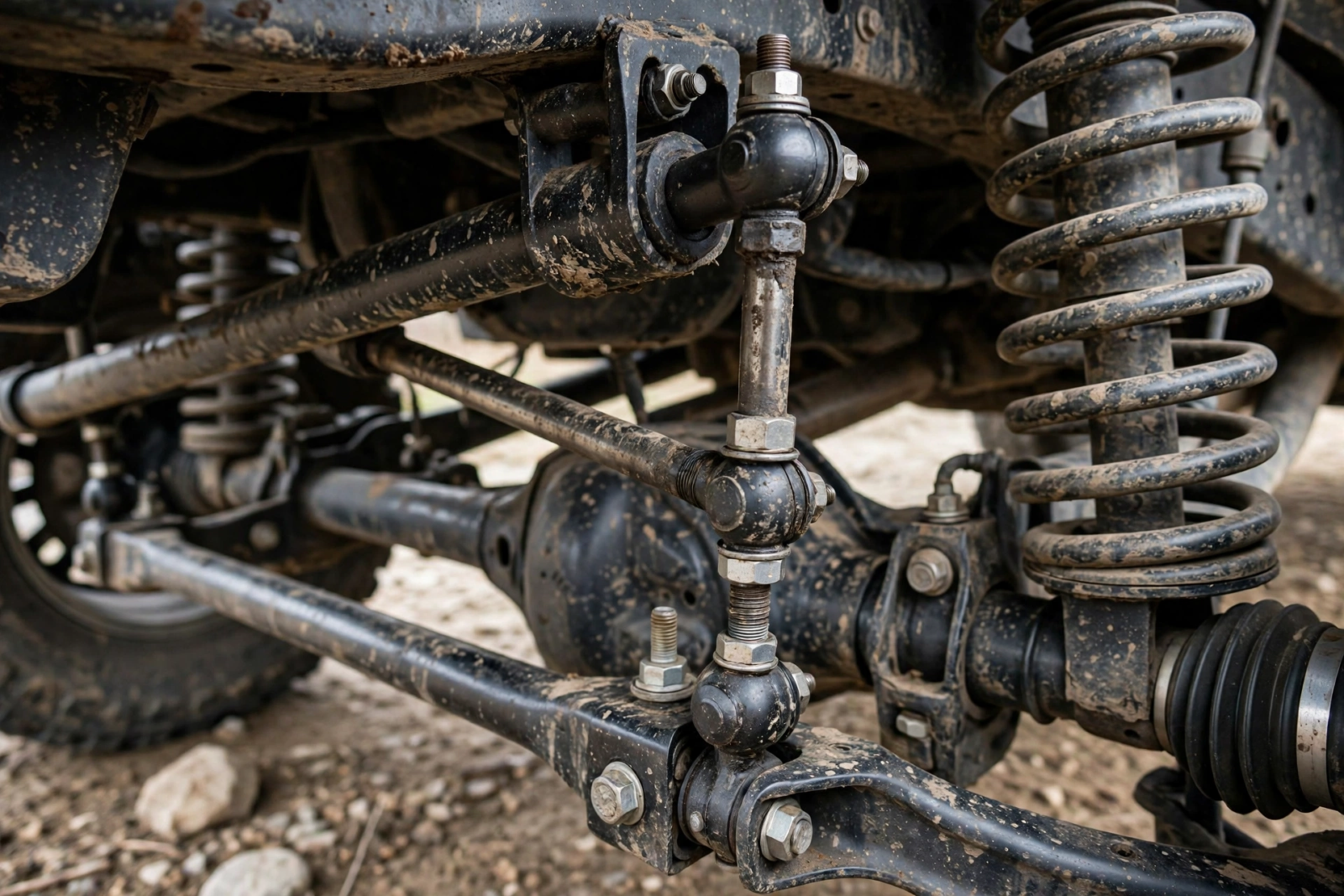
Ask do you need longer sway bar end links after a lift on any truck forum and the experienced answers converge fast: if the front is lifted 2 inches or more, the sway bar geometry needs correction. The sway bar, also called the stabilizer bar, connects the left and right sides of the suspension to resist body roll. At factory height the bar sits near level, with the end links vertical. Raise the front suspension and the frame moves up while the axle stays put, which rotates the bar ends downward and pulls the links into a constant preload.
That preload is the problem. A preloaded sway bar fights the suspension instead of just resisting roll, so the front end feels bound over bumps, articulation suffers off-road, and the links themselves wear out faster. Owners describe it as the truck feeling tight and harsh over small bumps after a leveling kit, which is the opposite of what a lift should feel like. When you ask do you need longer sway bar end links after a lift, you are asking how to put the bar back to neutral so it only works when it is supposed to.
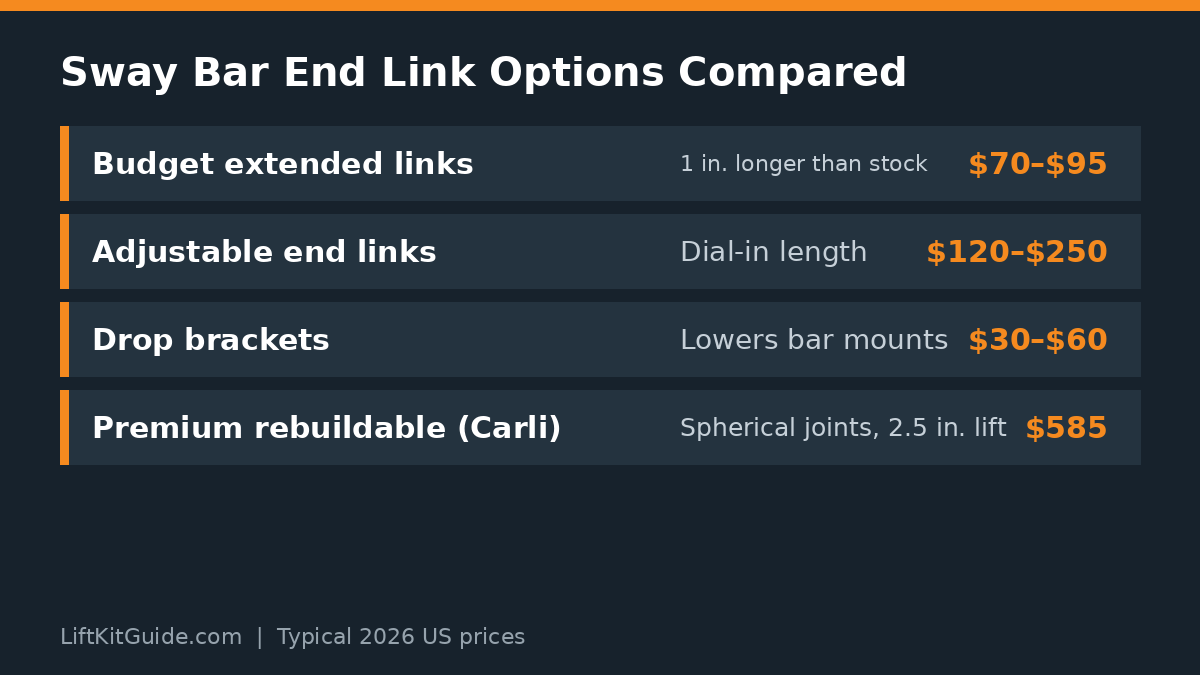
The fix is straightforward: longer end links that match the new distance between the bar and the axle mount, or drop brackets that lower the bar’s frame mounts by the same amount. ProForged makes a popular 1-inch-longer-than-stock set for leveled GM 2500HD trucks at $69.95, and BD Diesel offers a similar 1-inch-longer set around $70. Either one restores the neutral angle that the suspension lift kit disturbed. If you are still deciding do you need longer sway bar end links after a lift, start with the visual check above, then read our leveling kit versus lift kit guide to understand how each lift type changes the bar angle. (See ProForged’s 1-inch extended sway bar end link kit for owner-reported results.)
What Are the Symptoms of Sway Bar Bind After a Lift?
The telltale symptom is a front end that feels harsh and restricted over small bumps right after a leveling kit or lift install. The truck may have ridden smoothly before, and now every expansion joint feels sharper. That is the preloaded sway bar transmitting forces it should be absorbing. A second symptom is reduced articulation: one wheel stuffs into the fender while the other barely droops, because the bound bar is limiting independent wheel movement.
Listen for clunks too. Worn or overstressed end link bushings clunk over bumps, and a bar pulled far out of position can contact the coil spring, shock body, or tie rod. TacomaWorld’s lift-troubles thread specifically lists sway bar interference from oversized coilovers as a known issue. If you hear new contact noises after a lift, look at the bar angle before blaming the shocks.
There is a simple visual check. Park on level ground and look at the sway bar from the side: at ride height it should sit roughly level, with the end links close to vertical. If the bar ends point sharply downward and the links lean at a steep angle, the geometry is off. This is the same kind of post-install inspection that a quality lift kit installation should include, and it takes thirty seconds.
How Much Longer Should Sway Bar End Links Be?
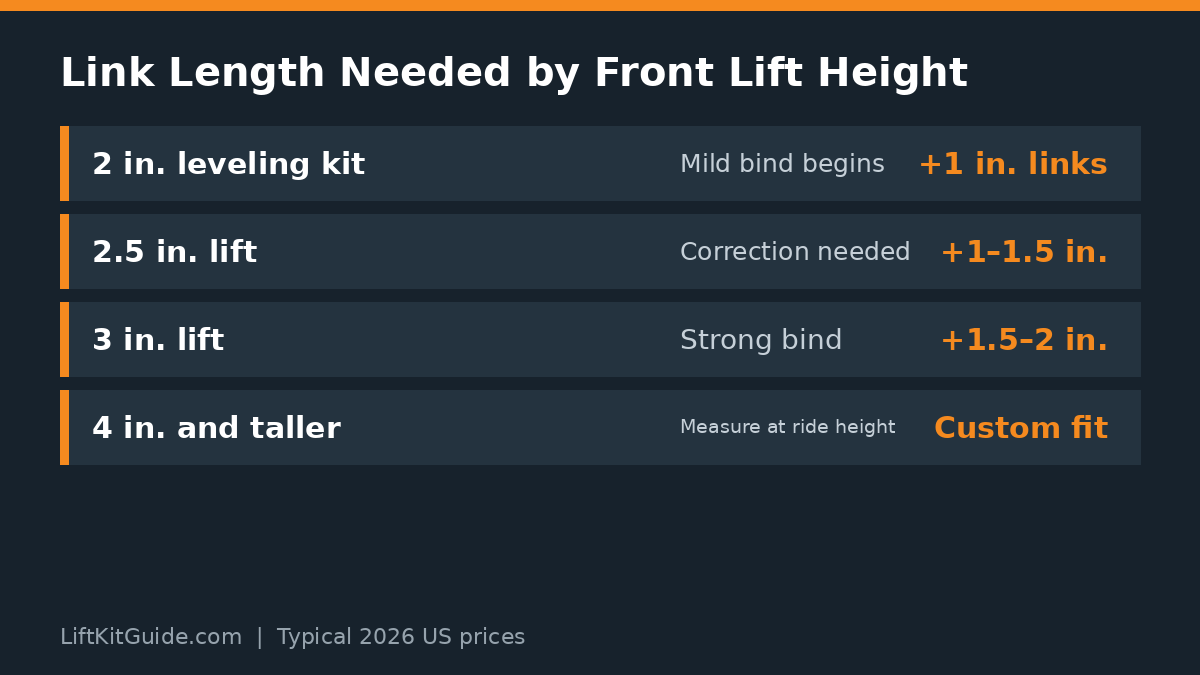
The rule of thumb is that the end links should grow by roughly the same amount as the front lift. A 2-inch leveling kit typically needs links about 1 inch longer than stock, because the bar mount geometry means the link does not need the full lift height. For a 3-inch lift, look for links 1.5 to 2 inches longer than stock, and for taller lifts, measure the actual distance at ride height rather than guessing.
Measuring is easy and worth doing. With the truck at ride height on level ground, measure from the sway bar end mounting point to the axle or control arm mounting point, and compare with the stock link length. Buy links that put the bar back to level. Adjustable end links exist for this reason: they let you dial in the exact length, which is handy if you change lift height later or run aftermarket control arms that move the mounting points.
Do not overdo it. Links that are too long rotate the bar past neutral in the other direction, which creates the same bind problem in reverse. This is why the question do you need longer sway bar end links after a lift is really a measurement question, not a guess. When in doubt, contact the link manufacturer with your lift height and truck model; companies like Carli and ProForged publish fitment charts for exactly this purpose.
| Front lift height | Typical link length needed | Example product |
|---|---|---|
| 2-inch leveling kit | 1 inch longer than stock | ProForged extended set, $69.95 |
| 2.5-inch lift | 1 to 1.5 inches longer | Carli 2.5-inch kit, $585 |
| 3-inch lift | 1.5 to 2 inches longer | Adjustable links, $120 to $250 |
| 4-inch and taller | Measure at ride height | Adjustable or custom links |
Sway Bar Drop Brackets vs Longer End Links: Which Is Better?
The alternative to longer links is a sway bar drop bracket, which lowers the bar’s frame mounts instead of lengthening the links. Drop brackets are cheaper, often $30 to $60, and they work well on mild lifts where the stock links are still in good shape. The tradeoff is ground clearance: the brackets hang the bar lower, which matters if you off-road. Longer end links keep the bar tucked up in its factory position, which is why most premium kits include them instead of brackets.
There is also a strength argument. Factory end links use small ball joints or rubber bushings that were sized for stock loads. A lifted truck with bigger tires puts more force through the bar, so upgrading to stronger links with polyurethane bushings or spherical joints kills two birds: correct geometry and stronger parts. BD Diesel’s longer high-strength through-bolt design is a good example of this thinking. That dual benefit is why most installers answering do you need longer sway bar end links after a lift recommend links over brackets for daily drivers.
For most daily-driven lifted trucks, quality longer links are the better answer to do you need longer sway bar end links after a lift. Drop brackets make sense as a budget fix or when the stock links are nearly new. Either way, the goal is identical: a sway bar that sits level at ride height with vertical links, doing nothing until body roll asks it to work. See our best lift kit brands ranked to see which manufacturers include proper sway bar correction in their kits.
| Solution | Typical cost | Pros | Cons |
|---|---|---|---|
| Longer end links | $70 to $585 | Keeps bar tucked up, stronger parts available | Costs more than brackets |
| Drop brackets | $30 to $60 | Cheapest fix, reuses stock links | Reduces ground clearance |
| Adjustable end links | $120 to $250 | Dial-in fit, future-proof | More parts to maintain |
Do You Need Longer Sway Bar End Links After a Lift If You Tow?
Towing makes the question do you need longer sway bar end links after a lift more important, not less. A trailer adds tongue weight that compresses the rear and pitches the truck, and a bound front sway bar compounds the handling weirdness by making the front end unpredictable over bumps. Owners who tow with a leveled truck and stock links often report a nervous, darty feel that disappears once the bar geometry is corrected. If your truck tows regularly, prioritize this fix.
The bar’s job also matters more with a load. Body roll increases with trailer sway, and a preloaded bar cannot manage roll progressively, it is already partway into its travel before any roll begins. The result is a truck that feels fine unloaded but sketchy with 8,000 pounds behind it. Longer links restore the full working range of the bar, which is exactly what you want when a trailer starts pushing.
For heavy towers, consider upgrading the bar itself, not just the links. Larger-diameter aftermarket sway bars from Hellwig or Roadmaster dramatically reduce roll, and they are designed to work with lifted heights. Pair the bar with correctly sized links and the truck will handle a trailer better lifted than it did stock, which surprises many owners who expect lifting to ruin towing manners.
Can You Install Longer Sway Bar End Links Yourself?
Yes, this is a beginner-friendly driveway job. The end links are accessible with the truck on jack stands and the wheels on or off. Each link has two mounting points: the sway bar end and the axle or control arm mount. Remove the nuts, swap in the longer links, and torque to spec. BD Diesel quotes about 1 hour for the install, and most owners beat that with hand tools.
The one critical detail is to tighten everything at ride height, not at full droop. If you torque the link bushings with the suspension hanging, the bushings twist into a preload when the truck settles, which recreates a mild version of the bind you just fixed. Lower the truck onto ramps or blocks so the suspension is loaded, then do the final torque. This ride-height torque rule applies to most suspension bushings.
After installation, verify the geometry visually: bar level, links vertical, no contact with nearby parts through the full steering sweep. Then drive it. The difference is usually immediate, with small-bump compliance noticeably improved. If you are already scheduling a full 6-inch lift installation, have the shop include the links, since the truck is already on the lift and the marginal labor is minimal.
- Measure at ride height: buy links that return the bar to level, not just the longest available.
- Torque at ride height: tighten bushings with the suspension loaded to avoid preload.
- Check full steering sweep: longer links must clear tie rods, springs, and shocks lock to lock.
- Grease serviceable joints: polyurethane and spherical joints last longer with periodic grease.
- Recheck after 500 miles: new links settle and hardware needs a follow-up torque check.
What Happens If You Run a Lift With Stock End Links?
Short term, you get the harsh ride and restricted travel described above. Medium term, the constantly preloaded links wear out: bushings crack, ball joints loosen, and the clunking starts. Long term, the bind stresses the sway bar mounting tabs on the frame and the axle brackets, and owners have cracked mounts by ignoring the geometry for tens of thousands of miles. The bar itself can also fatigue from working in a range it was not designed for.
There is a handling safety angle too. A bound sway bar behaves unpredictably in emergency maneuvers, since it is already loaded before the maneuver begins. The truck may feel fine in normal driving and then surprise you in a sudden lane change. Given that the fix costs $70 and an hour, running stock links on a lifted truck is a false economy, which is the practical bottom line of do you need longer sway bar end links after a lift.
One exception: if your lift kit included properly sized links or drop brackets, you are already covered. This is a point in favor of complete kits over pieced-together spacer lifts. When comparing options in our cost to lift a truck breakdown, factor in the $70 to $150 for sway bar correction that budget kits omit. While the wheels are off, it is also a good moment to inspect the control arm bushings and ball joints, since the same lift that disturbed the sway bar geometry accelerates wear on every nearby joint.
Do Rear Sway Bar End Links Need Lengthening Too?
On most trucks the rear sway bar, if one exists, needs less attention, because rear lifts change the bar angle less dramatically than front lifts do. Many half-tons do not even have a rear sway bar from the factory. But if your truck has one and you added rear lift blocks or taller springs, the same geometry check applies: look at the bar at ride height, and if it is rotated well out of level, correct it with longer links or drop brackets.
Jeeps are the notable exception. Complete 3-inch Jeep lift kits routinely include rear sway bar end links or brackets, because the short wheelbase and coil-spring rear make the geometry change significant. The MaxTrac 3-inch JL kit, for example, ships with rear sway bar end links in the box. If your kit included them, install them; the manufacturer put them there for a reason.
For trucks, the front is where the question do you need longer sway bar end links after a lift really lives. Fix the front first, verify the improvement, and then decide whether the rear needs attention. Most owners find the front correction transforms the truck and the rear can wait until the next maintenance window. Budget for the correction as part of the lift rather than as an afterthought, and you will never experience the bound, harsh ride that makes some owners regret lifting in the first place.
Frequently asked questions
How much longer should sway bar end links be after a leveling kit?
About 1 inch longer than stock for a typical 2-inch leveling kit. The link does not need the full lift height because of the bar mount geometry. For taller lifts, measure the actual distance at ride height.
Can I use sway bar drop brackets instead of longer end links?
Yes. Drop brackets lower the bar's frame mounts by the lift amount and cost $30 to $60. They work well on mild lifts, but they reduce ground clearance, so longer links are better for trucks that go off-road.
How long does it take to install sway bar end links?
About 1 hour per axle with hand tools. The critical detail is to do the final torque with the suspension at ride height, not hanging at full droop, so the bushings are not preloaded.
Will longer sway bar end links improve ride quality?
They restore the ride quality the lift took away. By returning the bar to neutral, the suspension regains its small-bump compliance and articulation. Owners usually notice the improvement immediately on the first drive.
Do I need longer end links with just a 1-inch level?
Usually not. A 1-inch change keeps the bar close enough to neutral that most trucks show no symptoms. The 2-inch mark is where bind becomes noticeable and correction is worthwhile.
Should I upgrade the sway bar itself on a lifted truck?
If you tow heavy, consider it. Larger-diameter aftermarket bars from Hellwig or Roadmaster reduce body roll significantly, and paired with correctly sized links they can make a lifted truck handle a trailer better than stock.
The bottom line
For any front lift of 2 inches or more, the answer to whether you need longer sway bar end links is yes. A preloaded sway bar binds the suspension, ruins small-bump ride quality, and wears out links and mounts prematurely, all for the lack of a $70 part and an hour of driveway work.
Measure at ride height, buy links that return the bar to level, torque everything with the suspension loaded, and verify with a test drive. It is one of the highest value-per-dollar corrections in lifting.




Leave a comment