


Last updated: October 2026 Written by the LiftKitGuide Team, truck suspension installers and editors
Is it safe to install a lift kit yourself? For a mechanically careful owner with the right tools, yes — thousands of driveway installs happen every year without incident. The real risks are specific and manageable: a slipping coil spring compressor, a truck falling off inadequate jack stands, and torquing critical fasteners by feel instead of spec. If you respect those three hazards, use proper equipment, and know when a step exceeds your skill, a DIY install is as safe as a shop job.
Key takeaways
- DIY lift kit installs are safe when you control three hazards: spring energy, vehicle support, and fastener torque.
- A compressed truck coil spring stores thousands of pounds of force — never improvise spring tools.
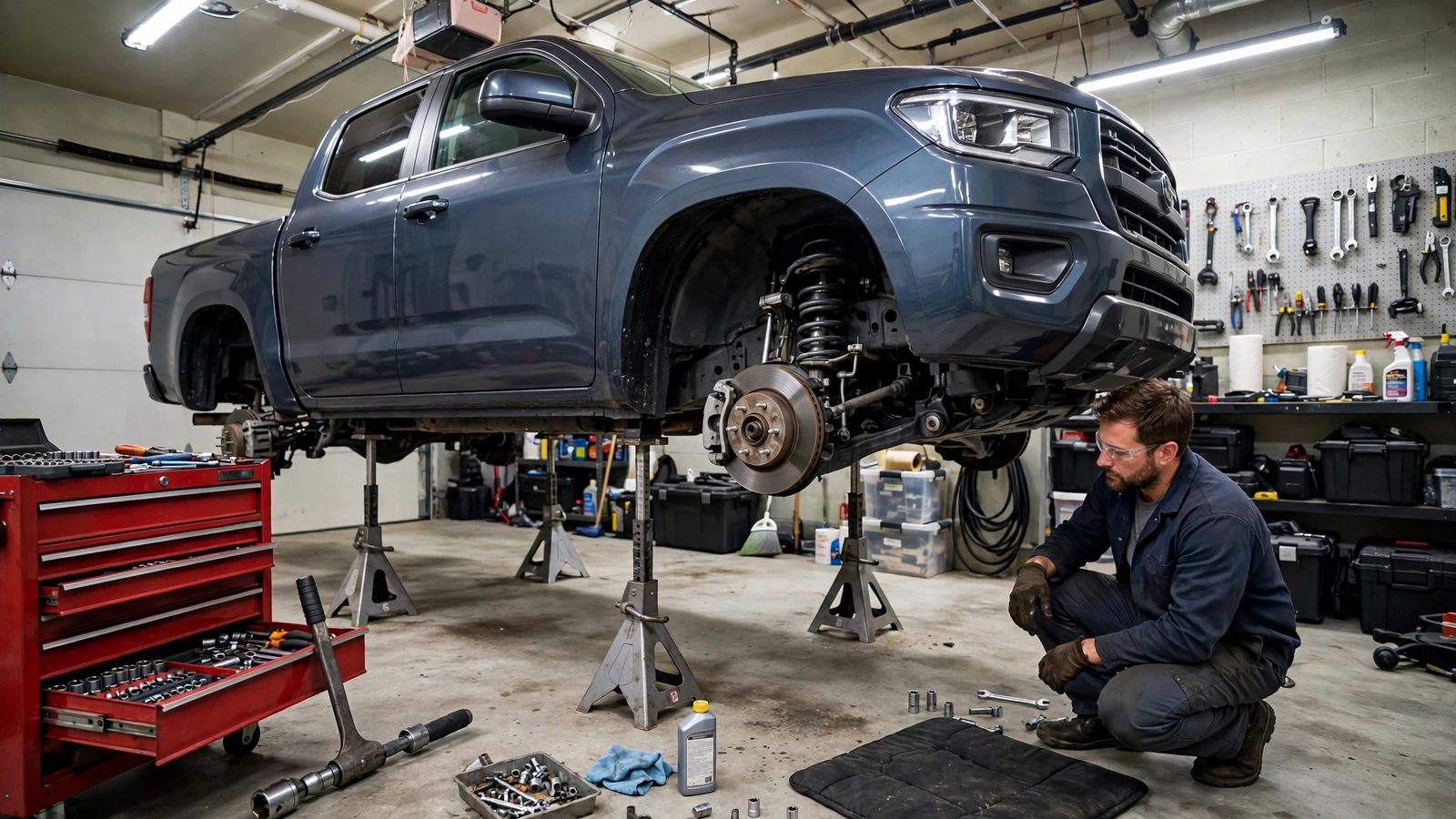
- Use tall 6-ton jack stands on the frame, chock the wheels, and shake-test before going underneath.
- Torque every suspension fastener to spec — lug nuts alone run 140–150 ft-lbs on most half-tons.
- Skip the DIY route for frame cutting, welding, or gear setup; those jobs belong in a shop.
On this page
Is it safe to install a lift kit yourself?
The honest answer to is it safe to install a lift kit yourself is that it is as safe as the person doing it. Lift kit manufacturers themselves hedge — Rough Country’s instructions recommend installation by a certified technician, and Bilstein warns that installing without proper tools and expertise risks serious bodily injury. Those warnings are real, but they describe what happens when people skip steps, not an inherent danger in the job itself. For the manufacturer perspective, read the Rough Country installation instructions, which recommend certified-technician installation and detail the rollover warnings.
Thousands of owners install 2- to 6-inch kits in driveways every year without incident, and the pattern among successful installs is consistent: proper jack stands, a torque wrench used on every fastener, a quality spring compressor handled carefully, and the humility to stop when something does not look right. The failures — and they do happen — almost always trace back to one of three shortcuts: working under a jack with no stands, guessing at torque, or fighting a spring with the wrong tool. That is the real answer to is it safe to install a lift kit yourself: safe is a process, not a personality trait.
Your experience level matters less than your discipline. A first-timer who follows the instructions step by step and torques everything is safer than a veteran who rushes. If you are weighing the DIY path against paying a shop, our lift kit installation cost guide lays out the real price difference so you can decide with full information.
What can go wrong during a DIY lift kit install?
The nightmare scenarios are specific. A coil spring slipping out of a cheap or misused compressor can launch with enough force to break bones — this is the single most feared event in suspension work and the reason every guide stresses quality compressors. A truck slipping off a jack or collapsing a too-short stand can crush anyone underneath. And a wheel coming loose at highway speed from under-torqued lug nuts is a failure that endangers everyone on the road, not just the installer. Asking is it safe to install a lift kit yourself means asking whether you will respect each of these failure modes.
Less dramatic but more common problems include cross-threaded strut mount nuts, rounded-off rusted bolts that stall the job for a day, ABS wires torn by excessive droop, and brake lines stretched past their limit when the axle hangs too far. None of these will kill you, but each one turns a Saturday project into a multi-day headache — and a stretched brake line is a genuine safety defect that must be fixed before driving.
The encouraging news is that every one of these failures has a known prevention. Quality stands prevent falls. A torque wrench prevents loose wheels. Penetrating oil and patience prevent rounded bolts. Supporting the axle with a second jack during disassembly protects brake lines and ABS wires. DIY danger comes from unknown unknowns — which is exactly why reading the full instructions before touching a bolt is the most important safety step.
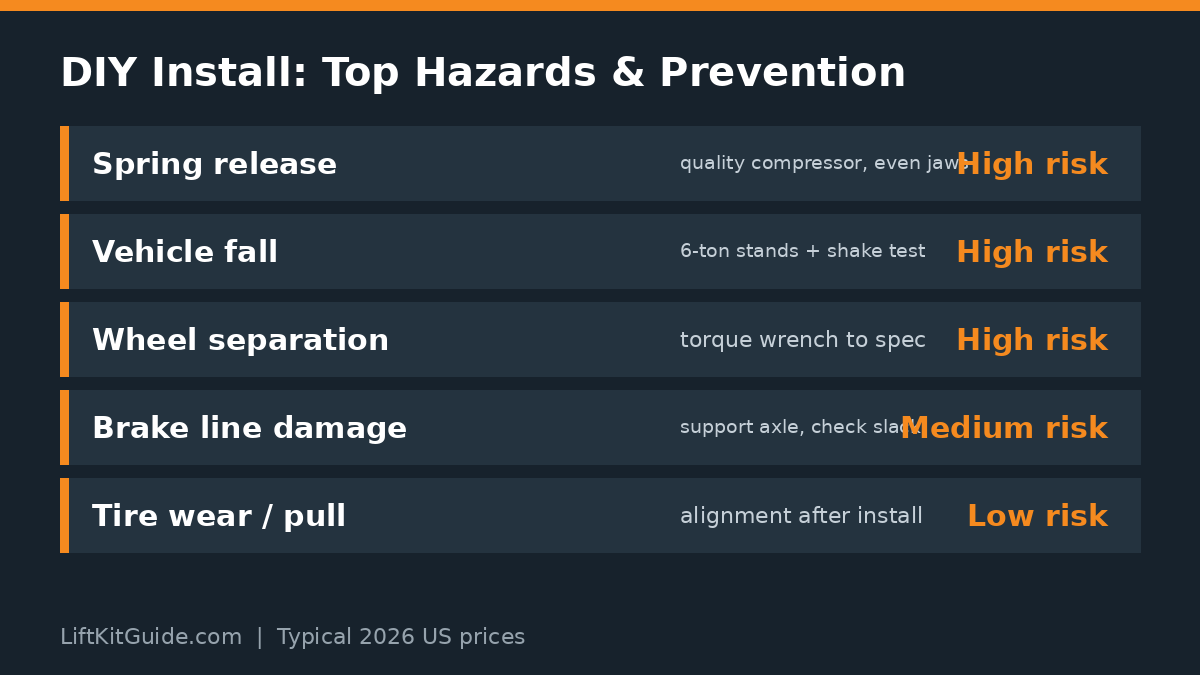
| Hazard | What causes it | Prevention |
|---|---|---|
| Spring release injury | Slipping/cheap compressor | Quality compressor, even tightening, body clear |
| Vehicle fall | Jack only, short/weak stands | Tall 6-ton stands on frame + shake test |
| Wheel separation | Under-torqued lug nuts | Torque wrench to spec, re-torque at 50–100 mi |
| Brake line damage | Excessive axle droop | Support axle with second jack; check line slack |
| Alignment-related crash risk | Skipping alignment | Professional alignment before highway driving |
How dangerous is a coil spring compressor really?
A coil spring compressor deserves your full respect. A truck coil spring compressed for strut disassembly stores thousands of pounds of potential energy — if a compressor jaw slips, that energy releases instantly in whatever direction the spring is pointing. Injuries range from broken hands to fatal head trauma, and they happen to experienced mechanics too, not just beginners. This is the one tool where there are no acceptable shortcuts.
The safe method is specific: jaws seated on flat coils 180 degrees apart, tightened evenly a few turns per side, compressing only as much as needed to free the upper mount. Never use an impact wrench on the compressor — the hammering can shock the jaws loose. Keep your face and torso out of the spring’s axis the entire time, wear safety glasses and gloves, and work with the strut secured in a vise or firmly on the ground. Respect the tool and is it safe to install a lift kit yourself stays a yes.
Here is the reassuring part: you can often avoid the compressor completely. Top-mount spacer kits and pre-assembled struts never release the spring, which removes the most dangerous step from the job. Choosing a no-compressor kit is a legitimate safety strategy, not a cop-out — and our suspension lift kits guide explains which kit designs require strut disassembly.
What are the most common DIY lift kit mistakes?
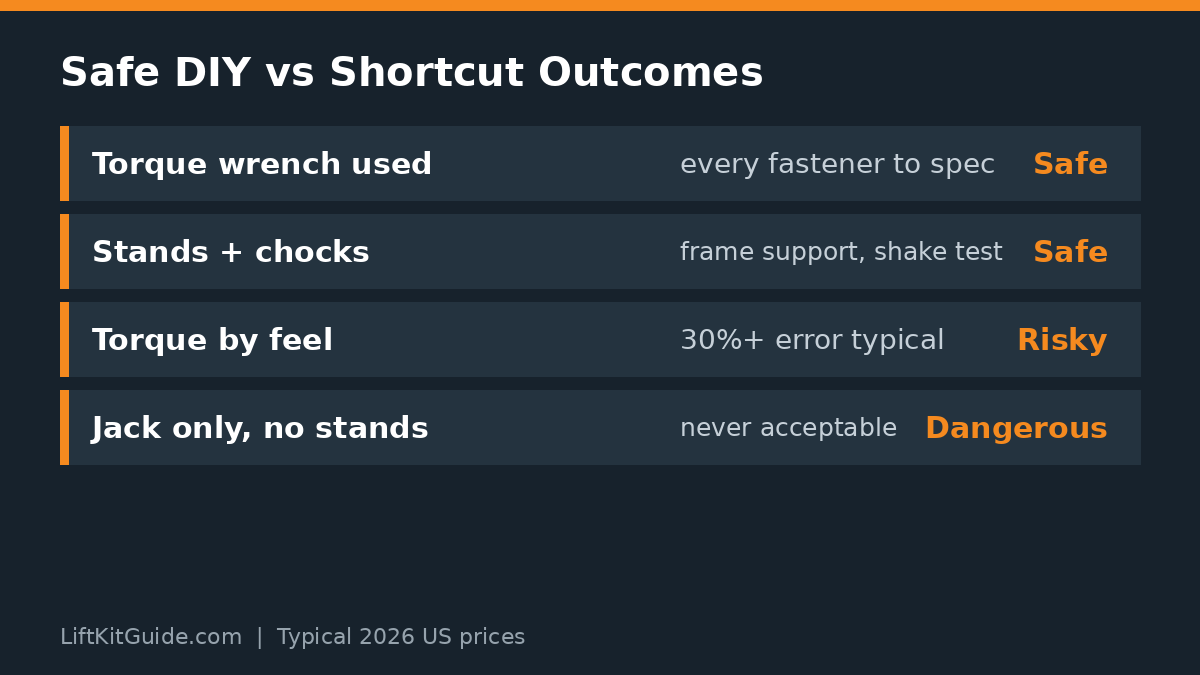
The most common mistake is also the most boring: skipping the torque wrench. Owners tighten suspension bolts by feel, and feel is a terrible torque meter — studies of hand-tightening show errors of 30 percent or more in both directions. Under-torqued control arm bolts work loose and wallow out mounting holes; over-torqued ball joint studs stretch and can snap. Every critical fastener has a published spec, and the torque wrench is how you hit it. Every one of these mistakes is a vote against is it safe to install a lift kit yourself — so do not make them.
The second classic mistake is reusing torque-to-yield or damaged hardware. Some factory bolts are designed to stretch once and must be replaced, not reused — your kit instructions will flag these. The third is skipping the alignment: a lifted truck with wrong toe will chew through a $1,200 set of tires in a few thousand miles and can dart unpredictably under braking. Fourth is ignoring the break-in re-torque — lug nuts and suspension bolts settle, which is why every guide says to re-torque after 50 to 100 miles.
Finally, people underestimate rust. A truck from the salt belt can turn a 4-hour install into a 12-hour fight, and the temptation to force things is where bolts snap and knuckles break. Soak everything in penetrating oil a full day ahead. If a bolt will not move with a breaker bar and heat, stop and reassess rather than snapping it off in the frame — extracting a broken bolt costs more time than patience ever will. If rust has you considering a simpler project, our leveling kit cost guide compares the easier 2-inch option.
When should you NOT install a lift kit yourself?
Know your limits — some jobs genuinely belong in a shop. Any kit that requires cutting or welding the frame (some 6-inch drop-bracket kits notch the frame) needs a welder and the skill to use it structurally. Gear setup for regearing differentials is a precision job measured in thousandths of an inch; get it wrong and the gears howl or fail. And if your truck needs extensive rust repair on mounting points, a shop with a lift and torches will do in hours what takes you days.
Your workspace matters too. A sloped driveway, soft dirt, or gravel under jack stands is a hard no — stands need level, solid concrete. If you do not have room to safely position four stands and still move around the truck, pay the shop. The same goes for time pressure: starting a lift kit the night before a road trip is how steps get skipped. When the workspace or the job exceeds your setup, is it safe to install a lift kit yourself? No — and paying a shop is the safe call.
There is no shame in a hybrid approach. Many owners do the bolt-on portions themselves and pay a shop for the alignment, the strut disassembly, or the gear setup. You still save hundreds while keeping the skilled steps professional. And if the legal side worries you, check our lift kit legality guide — some states inspect lift heights and bumper heights regardless of who installed the kit.
| Job | DIY or shop? | Why |
|---|---|---|
| Bolt-on spacer/leveling kit | DIY | Hand tools + stands suffice |
| Coilover/strut replacement | DIY with compressor | Rent a quality compressor; no shortcuts |
| Frame cutting/welding | Shop | Structural skill + equipment required |
| Regearing differentials | Shop | Precision setup in thousandths of an inch |
| Alignment | Shop | Requires alignment rack for accuracy |
| Heavy rust repair | Shop | Lift, torches, and experience save days |
What safety gear and setup do you need for a DIY install?
Personal protective equipment is cheap insurance. Safety glasses are mandatory — rust flakes, spring hardware, and grinding sparks all target eyes. Mechanic’s gloves protect against sharp edges and hot parts while keeping grip. Steel-toe boots matter when a brake rotor or control arm slips. And a fire extinguisher should be within reach whenever you grind or cut near fuel and brake lines. Gear up properly and is it safe to install a lift kit yourself becomes a much easier yes.
The workspace setup is equally important. Level concrete, good lighting, and enough room to walk completely around the truck on stands. Chock the wheels that stay on the ground, set the parking brake, and keep the keys out of the ignition so nobody accidentally starts the truck. A helper is strongly recommended — not just for heavy lifting, but as a second set of eyes on stand placement and a person who can call for help if something goes wrong. For project planning, our cost to lift a truck guide helps you budget the full job including safety gear.
Keep a phone within reach, not in your pocket under the truck. Tell someone you are doing suspension work and check in when done. These sound like overkill until you consider the alternative: pinned under a truck with no way to call out. Professional shops have these protocols written down — adopt them and your driveway is just as safe.
How do you know your DIY install is safe to drive?
Before the wheels touch the ground, run a systematic check. Every fastener torqued to spec with the torque wrench — not by feel. Cotter pins installed on every castle nut (ball joints, tie rods). Brake lines have slack at full droop with no kinks or stretching. ABS wires reconnected and clipped away from moving parts. Sway bar end links reconnected. Nothing rubbing that should not rub — turn the steering lock to lock and check tire, brake line, and harness clearance.
The test drive is graduated. First, a slow roll around the block listening for clunks, grinding, or rubbing. Then surface streets, checking that the truck tracks straight and brakes evenly. Only then a highway run, feeling for vibrations at 55 to 70 mph that signal driveline angle issues or a wheel balance problem. Any pulling, vibration, or noise means back to the garage for diagnosis — not hope. That graduated checkout is what makes is it safe to install a lift kit yourself true in practice, not just theory.
The non-negotiable final step is a professional alignment, ideally within a day or two of the install. Then re-torque every lug nut and suspension bolt after 50 to 100 miles, because fasteners settle as parts seat. Many shops offer a free alignment recheck after 500 miles — take it. A methodical checkout is what separates a safe DIY install from a lucky one.
- Torque check: every suspension fastener hit with a torque wrench to published spec.
- Cotter pins: installed on all castle nuts — ball joints and tie rod ends.
- Brake lines: slack at full droop, no kinks, no stretching, brackets reattached.
- Clearance check: steering lock-to-lock with no tire, line, or harness contact.
- Graduated test drive: parking lot, then streets, then highway — stop at any abnormal noise.
- Alignment + re-torque: professional alignment immediately; re-torque all hardware at 50–100 miles.
Is it safe to install a lift kit yourself if you have never done suspension work?
If you have never touched suspension before, the answer to is it safe to install a lift kit yourself is still yes — with the right first project. Start with a simple 2-inch leveling kit rather than a 6-inch system: fewer parts, no frame work, and instructions written for beginners. Watch a full install video for your exact truck before ordering, read the kit instructions twice, and give yourself a full weekend with no deadline pressure. Start small, follow the process, and is it safe to install a lift kit yourself will be yes from the first bolt.
Your first install will take roughly twice the quoted time, and that is normal. Budget the extra day, keep the parts store’s number handy for the inevitable missing tool, and do not start at 4 p.m. on Sunday. The learning curve is real but manageable — suspension work is mostly large, visible fasteners, not delicate electronics. Most owners report that the second side takes half the time of the first.
One more consideration for beginners: your install quality affects more than your truck. If a wheel comes off at speed, other drivers pay the price — which is why the torque wrench and the alignment are moral obligations, not suggestions. Do the job right, and check how the numbers pencil out in our cost to lift a truck guide. Done carefully, your first DIY lift will be safe, straight, and something to be proud of.
Frequently asked questions
What is the most dangerous part of installing a lift kit yourself?
The coil spring compressor — a slipping tool can release thousands of pounds of spring force. Use a quality compressor carefully, or choose a no-compressor kit.
Can a truck fall off jack stands during a lift install?
Yes, if stands are too short or misplaced. Use tall 6-ton stands on the frame, on level concrete, chocked wheels, and shake-test first.
Do I really need a torque wrench for a lift kit?
Yes — hand-tightening misses specs by 30%+, and suspension fasteners are safety-critical. A basic click-type wrench costs $40–$120.
Should a beginner install a 6-inch lift kit alone?
No — start with a 2-inch leveling kit. Six-inch kits add brackets, possible frame work, and driveline angles best left to experience or a shop.
Is it safe to drive right after a DIY lift install?
Only after torquing everything to spec, checking clearances, a graduated test drive, and a professional alignment — then re-torque at 50–100 miles.
Does installing a lift kit myself void the warranty?
Not automatically — dealers must prove the mod caused the failure. Keep receipts, torque records, and alignment printouts as documentation.
The bottom line
Is it safe to install a lift kit yourself? The evidence says yes for careful owners: the hazards are well understood, the preventions are straightforward, and thousands of driveway installs prove it every year. Respect the spring, support the truck properly, and torque everything — those three disciplines cover nearly all the real risk.
The flip side is equally clear: skip the stands, guess at torque, or fight a spring with the wrong tool, and a DIY install can hurt you or someone else on the road. Safety in suspension work is not about bravery or experience — it is about process. Follow the process and drive with confidence.



Leave a comment