


Last updated: October 2026 Written by the LiftKitGuide Team, truck suspension installers and editors
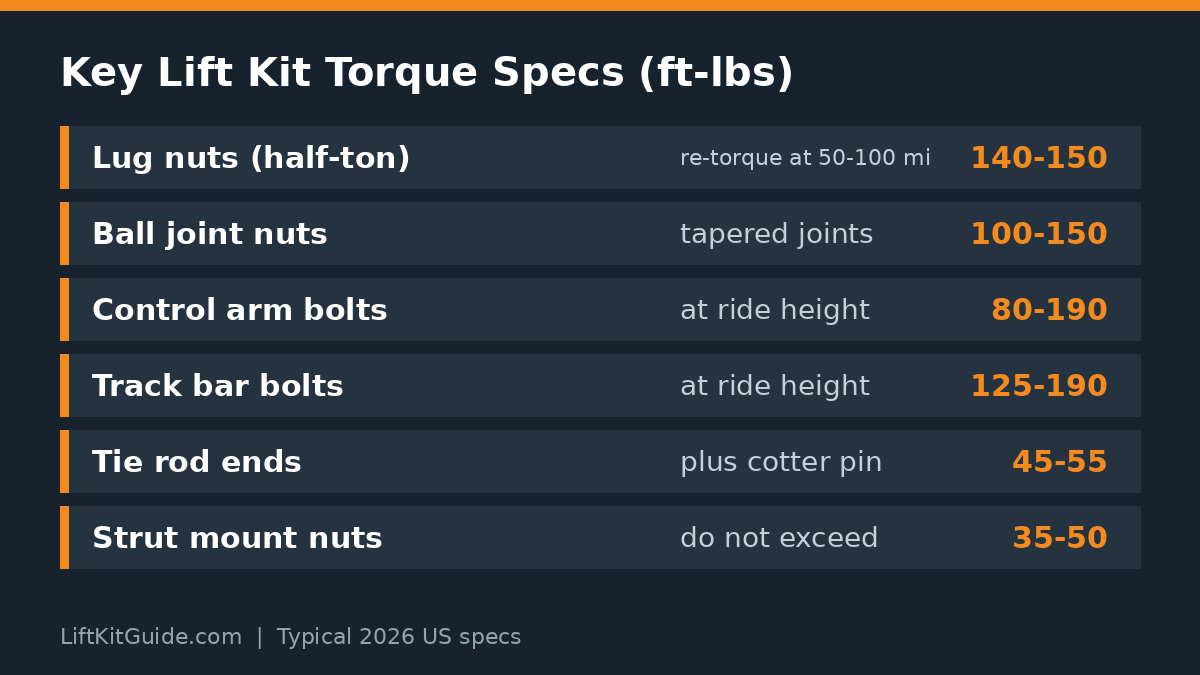
Do you need a torque wrench to install a lift kit? Yes — it is the single most important precision tool in a suspension install. Suspension fasteners are safety-critical: lug nuts typically require 140 to 150 ft-lbs, control arm and track bar bolts run 80 to 190 ft-lbs depending on the kit, and ball joint nuts often spec 100 to 150 ft-lbs. Hand-tightening misses these targets by 30 percent or more, which is why every kit manufacturer publishes torque specs and every professional shop uses a wrench.
Key takeaways
- You need a torque wrench — hand-tightening misses suspension specs by 30% or more.
- Lug nuts: typically 140–150 ft-lbs on half-tons; always re-torque after 50–100 miles.
- Buy two ranges if you can: 10–80 ft-lbs (small hardware) and 25–250 ft-lbs (suspension).
- Never use an impact wrench for final torque — it cannot measure clamping force.
- Torque suspension bushings at ride height, not with the axle hanging, to avoid preloading them.
On this page
Do you need a torque wrench to install a lift kit?
The short answer to do you need a torque wrench to install a lift kit is an unequivocal yes. A torque wrench is not a nice-to-have precision instrument for engine builders — it is the tool that keeps your wheels attached. Every suspension fastener on your truck was engineered for a specific clamping force, and the only way to hit that force repeatably is to measure it. Guessing by feel is how bolts come loose on the highway.
Consider what is at stake. Lug nuts on a typical half-ton truck spec 140 to 150 ft-lbs. Control arm bolts, track bar bolts, and strut hardware run anywhere from 35 to 190 ft-lbs depending on the application and the kit — one popular Jeep lift kit specs its front lower control arm bolts at 190 ft-lbs versus the factory 103 ft-lbs plus 50 degrees. These are not numbers you can feel accurately; even experienced mechanics miss by wide margins without a wrench.
The cost argument settles it. A decent click-type torque wrench costs $40 to $120 — less than one replacement tire, and far less than the consequences of a wheel separating at speed. If you are pricing the whole project, our lift kit installation cost guide shows where a torque wrench fits in the DIY tool budget. Still asking do you need a torque wrench to install a lift kit after seeing the price? The wrench costs less than one tire.
What happens when suspension bolts are under-torqued?
Under-torqued fasteners are the more common failure, and they fail slowly enough to lull you into confidence. A control arm bolt below spec allows micro-movement, and that movement wallows out the mounting hole over hundreds of miles — by the time you notice the clunk, the bracket itself may need repair. Sway bar end links loosen and rattle. Strut mount nuts back off and let the assembly shift.
The catastrophic version is wheel separation. Lug nuts below spec loosen progressively under the cyclic loading of driving, and a wheel departing at highway speed endangers everyone around you — this is not a theoretical risk, it happens regularly enough that every tire shop has a re-torque policy. The standard guidance is to re-torque lug nuts after the first 50 to 100 miles because fasteners settle as parts seat, and skipping that step is one of the most common DIY oversights. That is why do you need a torque wrench to install a lift kit is really a question about everyone else on the road.
Under-torquing also ruins alignments. Control arm and track bar bolts that are not fully clamped allow the alignment to drift, and owners chase the resulting tire wear and pulling with repeated alignments when the real fix was proper torque the first time. A torque wrench used once during install prevents all of it. Our suspension lift kits guide explains which components each kit height adds.
| Fastener | Typical spec range | Failure if under-torqued |
|---|---|---|
| Lug nuts (half-ton) | 140–150 ft-lbs | Wheel loosening / separation |
| Control arm bolts | 80–190 ft-lbs | Wallowed holes, alignment drift |
| Track bar bolts | 125–190 ft-lbs | Death wobble, wandering |
| Ball joint nuts | 100–150 ft-lbs | Joint slippage, alignment loss |
| Strut mount nuts | 35–50 ft-lbs | Assembly shift, clunking |
| Tie rod ends | 45–55 ft-lbs | Steering play, toe change |
What happens when suspension bolts are over-torqued?
Over-torquing is the quieter killer because it feels like doing a thorough job. Stretching a bolt past its yield point permanently weakens it — the fastener holds fine until a pothole or hard bump applies the load it can no longer handle, and then it snaps without warning. Ball joint studs are especially vulnerable: over-torqued tapered studs can crack the knuckle or snap the stud itself, both of which mean instant loss of steering control on that corner. See cost to lift a truck for the full project budget including tools.
Threads are the other casualty. Aluminum components — common in control arms and steering racks — strip easily under excessive torque, turning a simple bolt into a helicoil repair. Even steel threads gall and deform. And over-torqued lug nuts warp brake rotors, causing the pulsing pedal that owners blame on cheap rotors when the real cause was the impact wrench at the tire shop. The answer to do you need a torque wrench to install a lift kit for over-torque prevention is the same tool: it stops at spec.
The fix is the same tool: a torque wrench stops exactly at spec instead of wherever your arm gives out. Note that specs assume clean, dry threads unless stated otherwise — oil or anti-seize on threads reduces friction and increases clamping force for the same torque reading, so follow the kit’s lubrication instructions exactly.
Which lift kit fasteners need exact torque specs?
Prioritize by consequence. Lug nuts top the list — they hold the wheels on, the spec is in your owner’s manual (commonly 140 to 150 ft-lbs for half-tons), and they need re-torquing after 50 to 100 miles. Next are ball joint nuts and tie rod ends: these are tapered joints where proper torque seats the taper, and the spec often runs 45 to 150 ft-lbs depending on the joint. Under-torqued tapers slip and destroy alignment; over-torqued ones crack.
Control arm bolts, track bar bolts, and strut hardware come next. These carry the suspension loads, and many use large specs — 125 to 190 ft-lbs is common on track bars and lower control arms. Your kit’s instructions list every one of these; aftermarket kits sometimes spec higher values than factory (one Jeep kit specs 190 ft-lbs where factory calls for 103 plus angle), so always follow the kit manufacturer’s numbers over your memory of the stock spec. A useful real-world comparison of factory versus aftermarket specs is documented in this JL Wrangler Forums torque spec thread.
Smaller hardware matters too, just with smaller numbers. Strut upper mount nuts often spec just 35 ft-lbs with an explicit do-not-exceed warning, because crushing the mount distorts it. Brake caliper bolts, skid plate bolts, and ABS bracket bolts all have specs — look them up rather than guessing. When in doubt, the answer to do you need a torque wrench to install a lift kit for this particular bolt is always yes.
Do not forget the small fasteners when asking do you need a torque wrench to install a lift kit — strut upper mount nuts often spec just 35 ft-lbs with an explicit do-not-exceed warning, because crushing the mount distorts it and changes alignment. Brake caliper bolts, skid plate bolts, and ABS bracket bolts all have published specs too, and a 3/8-inch drive wrench in the 10–80 ft-lbs range handles them accurately. Guessing on small hardware strips threads just as surely as guessing on big hardware snaps studs.
What torque wrench range do you need for a lift kit install?
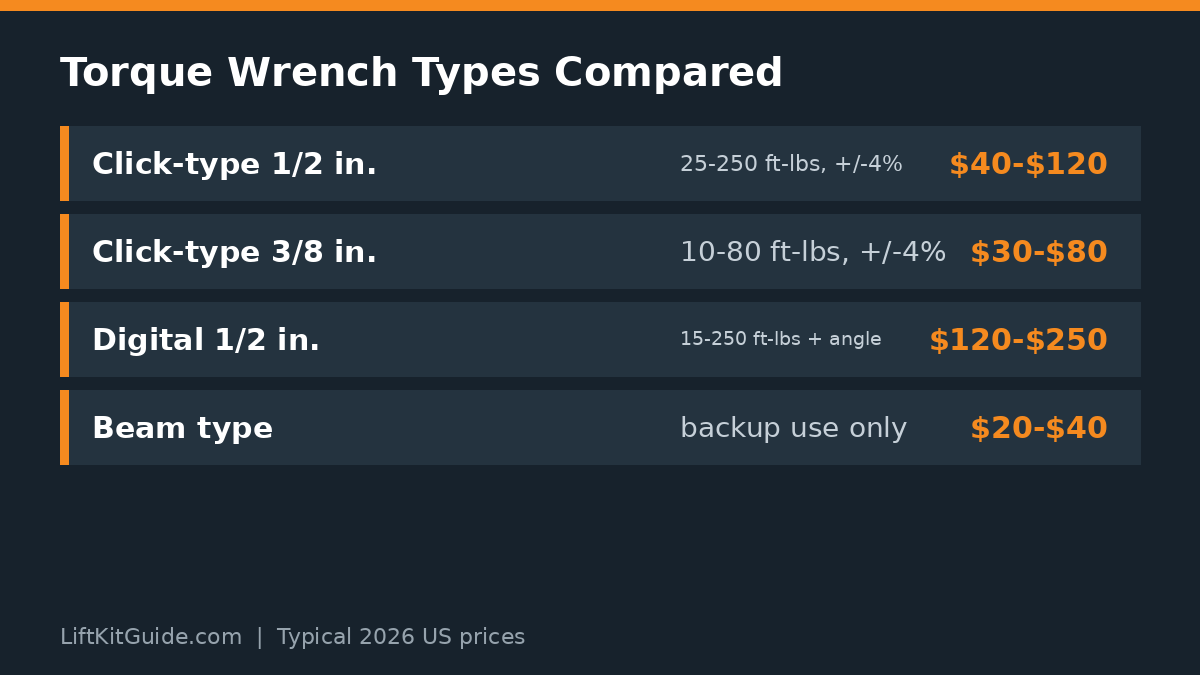
One wrench cannot cover the whole job accurately. Torque wrenches are most accurate in the middle of their range — typically rated accurate from 20 percent to 100 percent of full scale — so a single 10–150 ft-lbs wrench is marginal at both ends of a suspension install. The practical setup is two wrenches: a 3/8-inch drive covering roughly 10 to 80 ft-lbs for small hardware, and a 1/2-inch drive covering 25 to 250 ft-lbs for the big suspension fasteners.
The big wrench handles lug nuts, control arms, track bars, and ball joints — everything from about 50 ft-lbs up. The small wrench handles strut mount nuts, caliper bolts, and skid plates where the big wrench would be inaccurate at the bottom of its range. Together they cost $70 to $200 for decent click-type models, and they cover virtually all future automotive work too. So do you need a torque wrench to install a lift kit in two sizes? Ideally yes — accuracy lives in the middle of each wrench’s range.
If you can only buy one, get the 1/2-inch 25–250 ft-lbs wrench and borrow the small one — the safety-critical fasteners are all in the big wrench’s sweet spot. Store both unwound at their lowest setting; leaving a click-type wrench wound up weakens its spring and ruins calibration. For the broader tool picture, see our suspension lift kits guide to match tools to your kit height. Compare kit types in our leveling kit explainer before you buy.
| Wrench | Range | Handles | Typical cost |
|---|---|---|---|
| 1/2 in. drive click-type | 25–250 ft-lbs | Lug nuts, control arms, track bar, ball joints | $40–$120 |
| 3/8 in. drive click-type | 10–80 ft-lbs | Strut mounts, calipers, skid plates | $30–$80 |
| Digital 1/2 in. drive | 15–250 ft-lbs | Same as click-type + angle measurement | $120–$250 |
| Beam type | 0–150 ft-lbs | Backup / rough work | $20–$40 |
Click-type vs digital vs beam: which torque wrench should you buy?
Click-type wrenches are the sweet spot for DIY suspension work. You set the desired torque on the handle, pull until you feel and hear the click, and stop. They are simple, durable, accurate to about plus or minus 4 percent (the ANSI standard), and affordable at $40 to $120. For lift kit installs, a click-type is all you will ever need.
Digital torque wrenches add a display, audible alerts, and often angle measurement — useful because some factory specs use torque-plus-angle (like 103 ft-lbs plus 50 degrees). They cost $120 to $250 and are genuinely nicer to use, but the electronics and batteries add failure modes in a greasy garage. Buy digital if you do a lot of wrenching; otherwise the click-type does the job.
Beam-type wrenches are the old-school option: a bending beam and a pointer scale, accurate but hard to read at awkward angles under a truck. At $20 to $40 they work as a backup, but do not make one your primary suspension tool. Whatever type you choose, have it calibrated if it has been dropped or stored wound up — a $25 calibration is cheap compared to a snapped stud. Whatever you buy, the question do you need a torque wrench to install a lift kit is only half of it — the other half is keeping it calibrated.
How do you torque suspension bolts correctly?
Technique matters as much as the tool. Torque in stages — run fasteners down snug by hand, then bring them to about half spec, then to full spec — so the joint seats evenly. On lug nuts, always use a star (crisscross) pattern; on multi-bolt flanges, work in a similar crossing sequence. Pull smoothly and slowly; jerking the wrench overshoots the click.
The ride-height rule is the technique most DIYers miss: torque control arm and track bar bolts with the suspension at normal ride height, not with the axle hanging. Bushings twisted at full droop stay preloaded when the truck sits back down, which tears them prematurely and changes alignment. Lower the truck onto ramps or stands under the axle, bounce the suspension to settle it, then torque. Follow that sequence and do you need a torque wrench to install a lift kit becomes do you know how to use it — which you now do.
Finally, respect the no-impact rule for final torque. Impact wrenches are for removal and rough assembly only — they cannot measure clamping force and will happily run a fastener 50 percent past spec. One leveling kit’s instructions state it explicitly: torque the upper strut nuts to 35 ft-lbs, do not exceed, and never use an impact on strut hardware. Your torque wrench is the last tool to touch every critical fastener.
- Stage it: hand-snug, then half spec, then full spec for even joint seating.
- Star pattern: crisscross sequence on lug nuts and multi-bolt flanges.
- Ride height: torque bushings with the suspension loaded, not hanging.
- Smooth pull: slow steady force — jerking overshoots the click point.
- No impacts: final torque is always by hand with the torque wrench.
- Re-torque: recheck lug nuts and suspension bolts after 50–100 miles.
Do you need a torque wrench to install a lift kit or can you rent one?
If buying is not in the cards right now, renting is a perfectly good answer to do you need a torque wrench to install a lift kit on a budget. Most auto parts store loaner programs include torque wrenches alongside spring compressors — same deal, refundable deposit, free on return. Borrowing from a friend works too, with one condition: confirm the wrench has not been abused, dropped, or stored wound to max, all of which wreck calibration.
That said, a torque wrench is one of the highest-value tools you can own. Unlike a spring compressor you might use twice, a torque wrench gets used on every wheel rotation, brake job, and suspension project for the rest of your driving life. At $40 to $120, it pays for itself the first time it prevents a warped rotor or a loose control arm bolt.
Whichever route you take, treat calibration as part of ownership. Click-type wrenches should be stored unwound, never used as breaker bars, and recalibrated after any drop. A torque wrench you cannot trust is worse than none at all — it gives you false confidence. Buy it, borrow it, or rent it, but when the wheels go back on, every critical fastener gets measured. For kit selection help, our leveling kit vs lift kit comparison keeps the project matched to your tools.
Frequently asked questions
What torque wrench size do I need for a lift kit?
A 1/2-inch drive (25–250 ft-lbs) for lug nuts, control arms, and ball joints; add a 3/8-inch (10–80 ft-lbs) for smaller hardware.
Can I use an impact wrench instead of a torque wrench?
No. Impacts cannot measure clamping force and overshoot specs — use them for removal only, then finish with a torque wrench.
What are typical lift kit torque specs?
Lug nuts 140–150, ball joints 100–150, tie rods 45–55, control arms/track bar 80–190, strut mounts ~35 ft-lbs. Follow your kit's specs.
Do I need to re-torque after installing a lift kit?
Yes — re-torque lug nuts and suspension bolts after 50–100 miles as parts settle.
Should I torque suspension bolts at ride height?
Yes — torquing bushings at full droop preloads and tears them. Load the suspension to ride height first, then torque.
How accurate are cheap torque wrenches?
Good enough — ±4% per ANSI standards, and suspension work rarely needs better than ±5%. Store unwound and recalibrate after drops.
The bottom line
Do you need a torque wrench to install a lift kit? Everything about suspension safety says yes. It is the only tool that turns a torque spec from a suggestion into a measurement, and at $40 to $120 it is the cheapest insurance in your toolbox. Hand-tightening misses by 30 percent or more — on fasteners that hold your wheels on, that margin is unacceptable.
Buy the 1/2-inch drive wrench first, add the 3/8-inch when you can, torque in stages at ride height, and re-torque after 50 to 100 miles. Do that, and every bolt on your lift will be exactly where the engineers intended — which is the whole point of the tool.



Leave a comment