


Last updated: October 2026 Written by the LiftKitGuide Team, truck suspension installers and editors
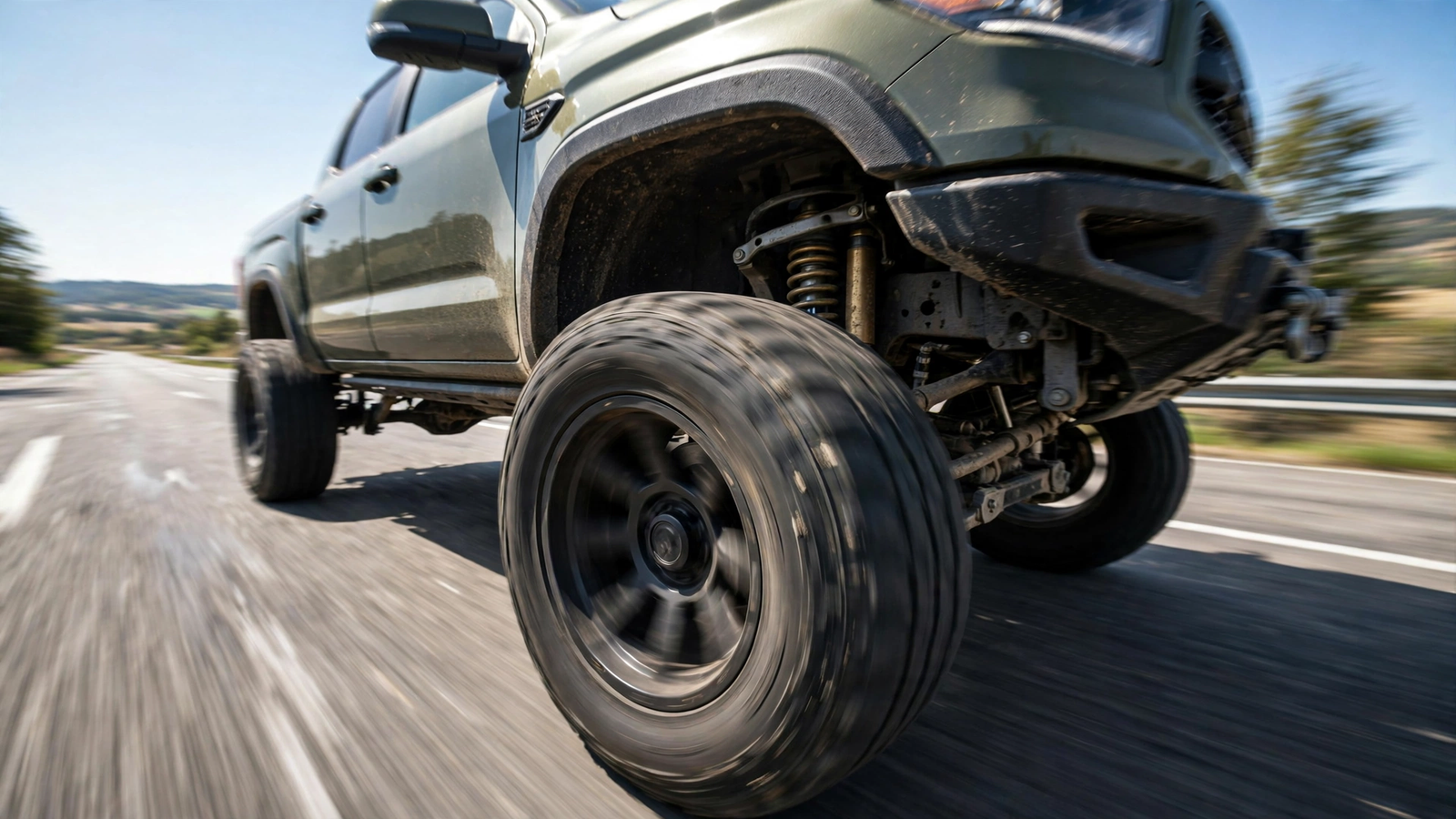
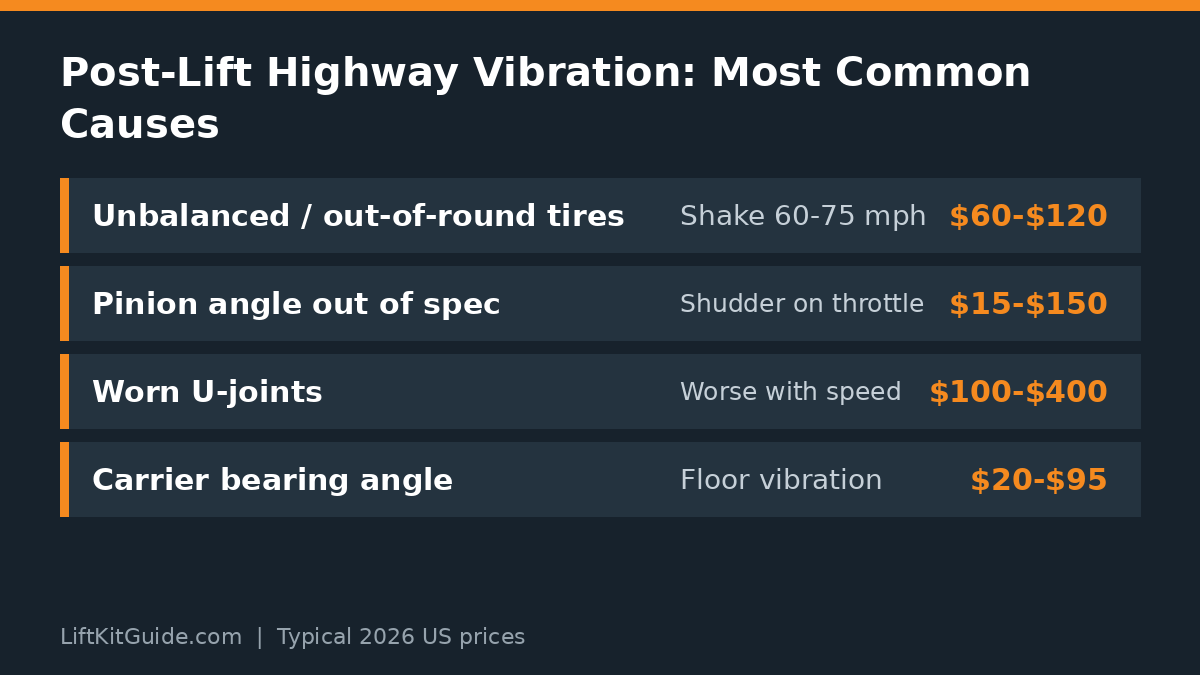
Why does my lifted truck vibrate at highway speeds? The two most common causes are driveline angles and tire balance: lifting steepens the driveshaft and pinion angles, and bigger tires are harder to balance. At 60 to 75 mph those issues show up as a shaking steering wheel or a vibration in the seat and floor. Rebalance the wheels first (about $60 to $120), then check pinion angle, carrier bearing, and U-joints if the shake lives in the floor instead of the wheel.
Key takeaways
- Two culprits cause most post-lift highway vibration: driveline angles and tire/wheel balance.
- Steering-wheel shake usually means a tire or wheel problem; seat/floor vibration usually means a driveline problem.
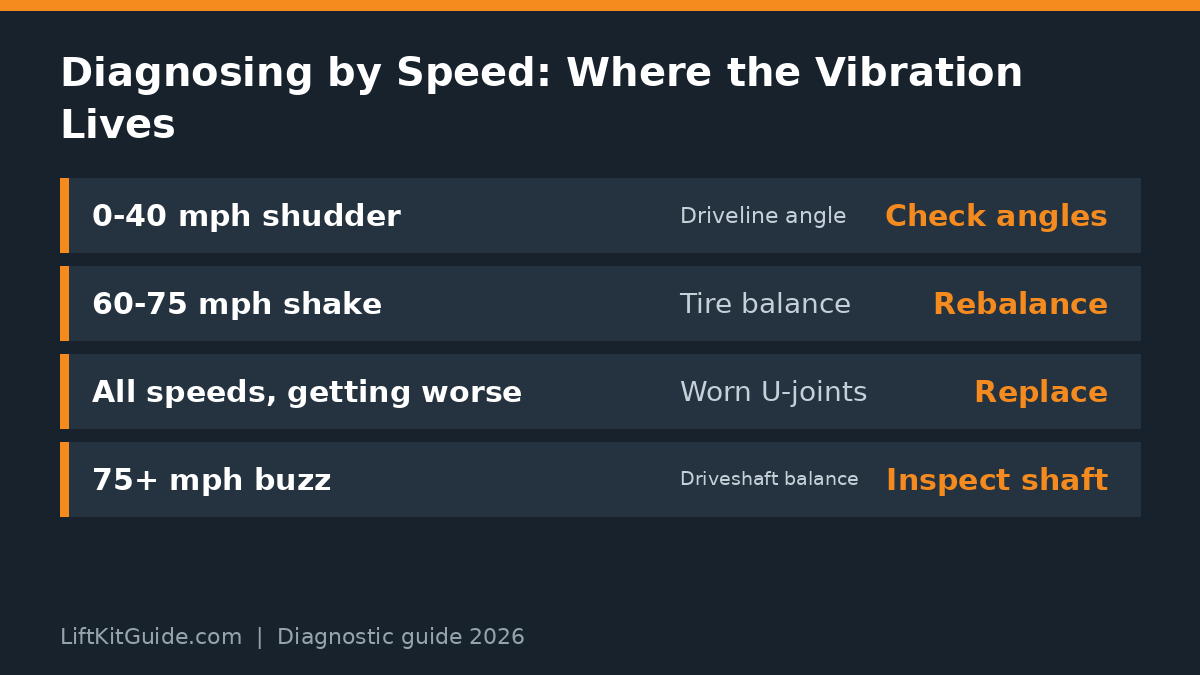
- Angle-related vibration often appears at 0–40 mph under throttle and fades off the gas; balance vibration peaks at 60–75 mph.
- A simple carrier bearing drop ($20–$95) or 3-degree axle shims can fix pinion-angle vibration.
- Rebalance wheels first — it is the cheapest fix ($60–$120) and rules out the most common cause.
On this page
Why does my lifted truck vibrate at highway speeds right after the install?
Lifting a truck changes two things that have to stay in harmony: the angles of the driveshaft and the way the tires spin. The suspension lift raises the frame and body, which tilts the transfer case output and the rear pinion into steeper working angles for the U-joints. If those angles are no longer equal and opposite, the driveshaft speeds up and slows down twice per revolution, and that uneven rotation is what you feel as a vibration. This is the classic reason why does my lifted truck vibrate at highway speeds right after an install — the geometry changed before anything had time to wear out.
The second half of the story is almost always the tires. Lift kits are usually installed alongside bigger, heavier tires, and a 35-inch mud tire is dramatically harder to balance than a stock highway tire. Even a half-ounce of imbalance that was invisible at city speeds becomes a rhythmic shake at 70 mph. That is why a fresh lift plus fresh tires can produce two separate vibrations at once — a driveline shudder and a tire-balance shake — which makes proper diagnosis order important before you spend money on parts.
How can you tell whether the vibration is driveline or tire related?
Start with where you feel it. A vibration that shakes the steering wheel almost always comes from the front tires and wheels — imbalance, a bent wheel, or uneven wear. A vibration you feel in the seat, floor, or center console usually comes from the driveline: the driveshaft, pinion angle, carrier bearing, or U-joints. This seat-versus-wheel test is the single most useful diagnostic step, because it immediately points you at the front axle or the driveshaft.
Speed behavior is the second clue. Tire-balance vibrations build steadily and peak in a specific band, usually 60 to 75 mph, then often smooth out above it. Driveline-angle vibrations are different: they tend to appear as a shudder from 0 to 40 mph, get worse under heavy throttle or uphill load, and fade when you lift off the gas or shift into neutral. If the vibration started immediately after the lift was installed, that timing itself is strong evidence of an angle problem, a point confirmed in this TacomaWorld driveline vibration thread where owners traced identical symptoms to changed driveshaft angles.
There is one more simple test that settles the debate when owners ask why does my lifted truck vibrate at highway speeds after every other check looks clean. Find an empty stretch of road, get the vibration going, then shift into neutral and let the truck coast. If the shake stays exactly the same, it is almost certainly tire or wheel related, because the driveline is no longer under load. If it fades or disappears in neutral, the problem is load-dependent and lives in the driveline — pinion angle, U-joints, or the carrier bearing. This coast test takes two minutes and has saved countless owners from buying parts they did not need, which is why vibration complaints are so often misdiagnosed at first.
Why does my lifted truck vibrate at highway speeds only between 60 and 75 mph?
The 60-to-75-mph band is the resonance sweet spot for tire and wheel imbalance on a lifted truck. Every tire has a natural frequency where a small imbalance gets amplified by the suspension, and on trucks running 33- to 37-inch tires that frequency usually lands right in highway cruising range. Below 60 the imbalance is too small to feel; above 75 it often smooths out as the tire’s rotation moves past resonance. If your shake appears in that window and disappears at 80, suspect balance first. It is the classic pattern behind the question of why does my lifted truck vibrate at highway speeds on trucks that are otherwise healthy.
Heavier tires make this worse. A 37-inch mud-terrain can weigh 80 to 90 pounds per corner, and balancing that much rotating mass precisely is difficult — some tires simply will not balance perfectly and keep going out of balance as they wear. Stick-on wheel weights can also fall off on the trail. Before assuming the worst, have the wheels rebalanced on a road-force balancer, which measures both weight imbalance and tire stiffness variation; it catches out-of-round tires that a standard spin balancer misses. At $15 to $30 per wheel, it is cheap insurance against a misdiagnosis.
Can bad pinion angle cause a highway vibration?
Yes — and after a lift, pinion angle is one of the most common root causes of driveline vibration. On a two-piece driveshaft, the carrier bearing and the pinion need working angles that are equal and opposite (usually within about 1 to 3 degrees of each other). Lifting the rear steepens the driveshaft while the pinion stays roughly where it was, and that mismatch forces the U-joints to accelerate and decelerate twice per revolution. The result is the classic low-speed shudder that owners often feel long before they notice anything at highway speed. The thread is a goldmine for anyone asking why does my lifted truck vibrate at highway speeds after a suspension change.
The fix depends on your setup. For a leaf-spring rear, tapered axle shims (commonly 2 to 3 degrees, narrow edge forward) rotate the pinion up to match the new driveshaft angle and typically cost $30 to $60. For a two-piece shaft, dropping the carrier bearing with washers or a dedicated drop bracket ($20 to $95) re-levels the front shaft section. Many owners report that a simple carrier bearing drop cures most of the vibration, though driveline specialists note that shims are the more complete fix because they correct the angle at its source rather than compensating downstream. Either way, measure your angles with an angle finder ($15 to $25) before buying parts.
Measuring is easier than most owners expect, and it answers why does my lifted truck vibrate at highway speeds with numbers instead of guesses. Park on level ground, chock the wheels, and place a digital angle finder on the driveshaft tube, then on the pinion flange, and write both numbers down. On a conventional two-joint shaft the two working angles should be equal and opposite within about one to three degrees; on a double-cardan setup the pinion should point almost straight at the transfer case. If the numbers are off by more than three degrees, shims or a carrier bearing drop are the fix — not a new driveshaft. Many owners skip this step and throw parts at the truck, which is exactly the kind of expensive lift mistake that turns a $40 shim kit into a $600 driveshaft you never needed.
| Symptom | Most likely cause | What to check first |
|---|---|---|
| Shudder 0–40 mph, worse on throttle | Pinion angle out of spec | Measure driveshaft vs pinion working angles |
| Shake 60–75 mph in steering wheel | Tire or wheel imbalance | Road-force rebalance all four |
| Vibration in seat/floor at speed | Driveline: U-joints, carrier bearing | Inspect U-joints for play, check carrier bearing |
| Buzz or hum above 75 mph | Driveshaft balance | Check for dents, missing weights, bent shaft |
Do bigger tires vibrate more at highway speeds?
They do, for three reasons: mass, stiffness, and imperfection. Bigger tires are heavier, so the same tiny imbalance produces a larger shaking force at speed. Mud-terrain and aggressive all-terrain treads are stiffer and less perfectly round than highway tires, so they transmit more vibration into the cabin. And large tires are simply harder to manufacture perfectly — a 37-inch tire can have enough radial runout (out-of-roundness) that no amount of balancing fully cures it.
There are practical ways to fight this. Road-force balancing is the gold standard for big tires, and some shops will ‘match mount’ the tire’s high spot to the wheel’s low spot to minimize runout. Beadlock or internal balancing beads are popular with hardcore off-roaders because they rebalance continuously as the tire wears, though results vary. Also check air pressure: running 35s at 28 psi when they want 35 psi lets the tire squirm and shake. Keep a log of which wheel needed the most weight — if one tire keeps eating weight, it may be a defective tire worth warrantying.
One overlooked detail is that the question why does my lifted truck vibrate at highway speeds sometimes has a different answer on the front axle than the rear. On 4×4 trucks the front driveshaft spins even in 2WD on many models, and a lifted front end can put the front shaft’s CV joint or U-joints at a harsh angle. If the vibration is strongest in 4WD or you feel it through the floorboards up front, pull the front driveshaft (four to six bolts on most trucks) and take a short test drive in 2WD. If the vibration disappears, you have found your culprit. A front shaft rebuild or a high-angle CV shaft ($300 to $600) fixes it. This is also a good moment to review what your lift kit actually included, since some budget kits skip the front driveshaft considerations entirely.
What does a worn U-joint vibration feel like after a lift?
A worn U-joint usually announces itself as a vibration that gets steadily worse with speed and load, sometimes with a metallic clunk when you shift between drive and reverse or take off from a stop. Unlike a balance shake that peaks in a band, a bad U-joint keeps getting angrier the faster you go, and you may also hear a rhythmic squeak at low speed that disappears as speed rises. After a lift, U-joints run at steeper angles than stock, which accelerates wear — a joint that was marginal before the lift can fail within months. Understanding this failure mode matters when the question of why does my lifted truck vibrate at highway speeds keeps coming up at every oil change.
Inspection is simple and free: chock the wheels, put the truck in neutral, crawl under, and twist the driveshaft by hand while watching each U-joint. Any visible play, rust-colored dust around the bearing caps, or a joint that feels notchy means replacement time. U-joints typically cost $25 to $60 each in parts, and a shop charges $100 to $400 to replace them depending on how many and whether the driveshaft has to come out. Greasable joints last longer if you actually grease them — every other oil change is a good habit on a lifted truck.
Lift height is the multiplier that decides whether marginal U-joints survive, which is why why does my lifted truck vibrate at highway speeds comes up most often on trucks lifted four inches or more. At two to three inches, stock U-joints usually tolerate the new angles for years. At six inches, the same joints run near their design limit every mile, and heat plus angle eats the needle bearings fast. If you are running a tall lift, upgrading to greasable 1350-series joints ($40 to $80 each) during the next replacement buys a meaningful strength margin. And while you are under there, check the transmission and transfer case mounts — a collapsed mount lets the whole driveline sag, changing every angle at once, a subtle issue covered in our guide to post-lift ride problems.
How do you diagnose a post-lift vibration step by step?
Work from cheapest to most expensive, and change one thing at a time. Re-torque the lug nuts to spec first — loose or unevenly torqued lugs after a tire install can cause a vibration that feels exactly like a balance problem, and the fix is free. Then check tire pressures against the tire’s recommended range for its load, not the door sticker (which was for the stock tires). Then get the wheels road-force balanced.
If the vibration survives balancing, move to the driveline. Measure the working angles at the transfer case, carrier bearing, and pinion with an angle finder and compare them — you are looking for equal-and-opposite angles within a couple of degrees. Inspect the U-joints for play and the carrier bearing rubber for cracking. Only after all of that checks out should you consider a new driveshaft, a slip-yoke eliminator with a CV shaft on Jeeps, or a custom double-cardan shaft, which run $400 to $900 installed. This order matters, because the question of why does my lifted truck vibrate at highway speeds is usually answered by the $60 fix rather than the $600 one.
- Note where you feel it: steering wheel points to front tires/wheels; seat and floor point to the driveline.
- Note the speed band: 60–75 mph peak suggests balance; 0–40 mph shudder on throttle suggests angles.
- Check the cheap stuff first: lug nut torque (re-torque after 50 miles), tire pressure, and visible wheel damage.
- Rebalance the wheels: use a road-force balancer before buying any driveline parts.
- Measure your angles: an angle finder on the driveshaft and pinion tells you if shims or a carrier bearing drop are needed.
- Inspect U-joints and the carrier bearing: look for play, rust dust, and cracked rubber.
- Test-drive after each change: fix one thing at a time so you know what actually worked.
When should you stop driving on a vibration?
Most post-lift vibrations are annoying rather than dangerous, but some are warnings of a part about to fail. Stop and inspect immediately if the vibration is getting rapidly worse, if you hear clunking from under the truck, or if the steering wheel suddenly develops significant play — those can signal a U-joint about to let go or a loose suspension bolt. A driveshaft that separates at highway speed can pole-vault the truck or tear through the floor, so this is not theoretical.
Also park it if the vibration is accompanied by visible wobble in a wheel (bent wheel or loose lugs), grinding from a wheel bearing, or the truck pulling hard to one side. For everything else — a steady 65-mph shimmy or a mild takeoff shudder — you can drive gently to a shop, but do not ignore it for months. Vibration accelerates wear on everything it touches: bearings, seals, bushings, and tires all die faster on a truck that shakes, which turns a $100 balance job into a $1,000 repair bill. In the end, why does my lifted truck vibrate at highway speeds is a diagnostic question, not a parts question — and knowing the true cause also protects you if a dealer ever questions a warranty claim.
| Fix | Typical DIY cost | Typical shop cost |
|---|---|---|
| Wheel rebalance (4) | $0 (shop only) | $60-$120 |
| Lug re-torque | $0 | $0-$25 |
| Axle shims (pair) | $30-$60 | $150-$300 |
| Carrier bearing drop kit | $20-$95 | $100-$250 |
| U-joint replacement (each) | $25-$60 | $100-$400 |
| Custom double-cardan shaft | $400-$700 | $600-$900 |
Frequently asked questions
Will an alignment fix a vibration after a lift?
Usually not. Alignment corrects toe, camber, and caster, which affect tire wear and handling — not vibration. Check wheel balance and driveline angles first.
Can wheel spacers cause vibration?
Yes, if they are not hub-centric or not torqued evenly. Buy hub-centric spacers and re-torque after 50 miles.
Why does the vibration go away above 75 mph?
Tire imbalance peaks at the tire's resonance frequency, usually 60–75 mph on big tires. The imbalance still wears tires unevenly even when you cannot feel it.
Do I need a new driveshaft after lifting?
Not usually for 2 to 4 inches. Shims, a carrier bearing drop, or rebalancing fix most cases; 6-inch-plus lifts may need a new driveshaft.
Can a lift kit void my warranty over a vibration?
A dealer cannot void the whole warranty over a lift, but can deny claims on parts the lift affected, like U-joints or wheel bearings.
The bottom line
Most of the time, the reason why a lifted truck vibrates at highway speeds comes down to two fixable things: tire balance and driveline angles. Diagnose by feel — steering wheel means tires, seat and floor mean driveline — and always start with the cheapest fix first. A rebalance, a re-torque of the lugs, and an angle check will solve the large majority of post-lift vibrations without buying a single major part.
Do not just live with the shake. Vibration is a wear multiplier that shortens the life of U-joints, bearings, bushings, and tires, and it can mask a genuinely dangerous failure like a dying U-joint or a loose wheel. Spend the diagnostic hour now, fix angles or balance once, and your lifted truck will ride as smoothly as it looks.





Leave a comment