


Last updated: October 2026 Written by the LiftKitGuide Team, truck suspension installers and editors
Why does my lifted truck ride so rough? In most cases the answer is tire pressure set too high, shocks that are not valved for the new ride height, or excessive coilover preload — not the lift height itself. Start free: drop pressures to a chalk-tested value (many trucks ride best 5–10 PSI below the door-jamb number on bigger tires). If it is still harsh, the fix is lift-specific shocks with proper valving, corrected preload, and upper control arms that restore alignment geometry.
Key takeaways
- Why does my lifted truck ride so rough? Check tire pressure first — over-inflation is the most common and cheapest cause.
- Use the chalk test to set pressure; many lifted trucks ride best well below the tire’s maximum PSI.
- Shocks must be valved and sized for the lifted height — stock-length or generic dampers are a top harshness source.
- Excessive coilover preload (cranking for height) firms the ride; about 1/4 inch of thread equals roughly 1/2 inch of height.
- At 3 inches of front lift and above, upper control arms restore the alignment range a harsh truck is often missing.
On this page
Why does my lifted truck ride so rough right after the install?
Why does my lifted truck ride so rough the week after the lift went on? Because a lift changes the three things that define ride quality — spring rate, damper tuning, and suspension travel — and budget installs often get at least one of them wrong. A taller spring with a higher rate, a shock valved for stock height, or a suspension sitting on its bump stops will all punish you over broken pavement. The good news is that harshness after a fresh install is almost always diagnosable, and the fixes run from free to a few hundred dollars rather than a whole new kit.
Start by separating two different complaints. A truck that crashes over sharp bumps usually has a damping or travel problem, while one that feels jittery and nervous on smooth highway often has a tire pressure or alignment problem. Naming the symptom correctly points at the cause: sharp impacts implicate shocks, preload, and bump-stop contact, while constant vibration implicates balance, pressure, and toe settings. Work the checklist below in order instead of guessing.
Give a fresh lift a short break-in before judging it. New springs and bushings settle over the first few hundred miles, and a truck that feels stiff on day two of why does my lifted truck ride so rough complaints can soften noticeably by mile 500. That said, break-in only smooths the edges — if the truck is genuinely punishing, do not wait it out; start the chalk test and preload checks immediately. The components that need attention will still need it after the springs settle, and driving on a bad setup just wears tires unevenly in the meantime.
Is tire pressure the real reason your lifted truck rides rough?
More often than owners expect, yes. Big all-terrain tires carry far more load capacity than a half-ton truck needs, so the pressure that feels ‘safe’ is usually far above what the truck requires. Just because a tire’s sidewall lists a maximum load at 65 PSI does not mean the tire should run there — at maximum inflation a set of 37s can be rated for 14,000 pounds on a truck that weighs 6,000. Every PSI above what the load needs turns the tire into a harder spring, and the suspension has to absorb what the tire no longer will.
The correct method is the chalk test: draw a chalk line across the tread, drive a short distance, and adjust pressure until the chalk wears evenly. Many lifted trucks land well below the door-jamb figure on oversized tires, and dropping from 40 to 32 PSI transforms the ride on some setups. Recheck after any load change, watch for cupping that signals too little pressure, and remember that pressure is seasonal — a setting that was perfect in July will read several PSI lower in January. For a practical walkthrough of this and other fixes, see the lifted-truck ride quality guide at Tundra Headquarters.
Tire load range matters as much as pressure. A Load Range E tire has stiff sidewalls built for 3,000-plus pounds per tire, and on an unloaded half-ton that stiffness never gets used — it just transmits every crack in the road. If you are shopping tires and ride quality is the priority, a Load Range D or even C tire in the same size rides noticeably softer. This is one reason why does my lifted truck ride so rough is such a common complaint on trucks running E-rated mud terrains as daily drivers: the toughest tire is rarely the most comfortable one.
| Pressure approach | Typical result | Verdict |
|---|---|---|
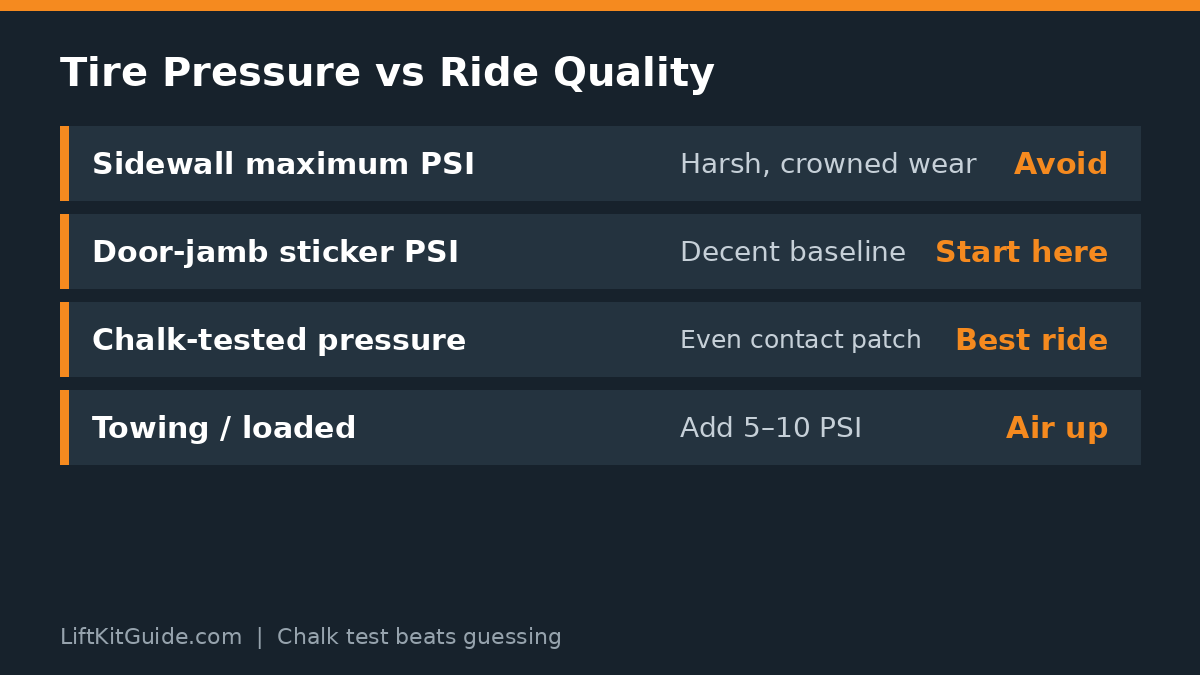
| Sidewall maximum PSI | Harsh ride, crowned tread wear | Almost always wrong for an unloaded truck |
| Door-jamb sticker PSI | Decent baseline for stock tires | Start here, then chalk-test |
| Chalk-tested pressure | Even contact patch, best ride | The correct answer for big tires |
| Towing or fully loaded | Add 5–10 PSI over chalk value | Air up for the load, then air back down |
How do shocks and valving change the ride?
Shocks are the single biggest ride-quality lever after tire pressure, and they are where cheap lifts cut corners first. A damper’s valving controls how fast the suspension can move: too little low-speed damping lets the truck wallow and dive, while too much high-speed damping makes it skitter across sharp bumps instead of absorbing them. Factory shocks are valved for stock weight, stock height, and stock travel — bolt them onto a lifted truck and they operate in the wrong part of their stroke with the wrong forces.
Lift-specific shocks from Bilstein, Fox, or Icon are valved for the new ride height and the spring rates that come with it, which is why a shock upgrade alone can transform a harsh truck. Match the shock to the actual setup: extended-travel coilovers need matching rear dampers, and a truck with a heavy bumper or winch needs valving that accounts for the weight. If your lift reused the factory shocks with spacers, that shortcut is a prime suspect in answering why does my lifted truck ride so rough.
Adjustable shocks are worth considering if your use case changes. A single-adjustable shock lets you soften compression for the daily commute and firm it up for towing or off-road weekends, which directly addresses the split personality behind many why does my lifted truck ride so rough complaints. They cost more than fixed-valve dampers — typically $200 to $400 extra per pair — but one set can cover two different trucks’ worth of needs. Set them soft for the street, firm for the load, and write down your favorite settings so you are not guessing each time.
Can too much coilover preload make the ride harsh?
Absolutely — cranking preload to gain height is one of the most common self-inflicted ride problems. Preload compresses the spring to raise the truck, and every turn of the collar both lifts the ride height and firms the initial spring rate. On most independent-front-suspension trucks the motion ratio is just under 2:1, so about 1/4 inch of thread adjustment equals roughly 1/2 inch of ride height at the tire. Owners chasing an extra inch of stance can easily add far more preload than the spring wants.
The telltale sign is a truck that feels fine over rolling dips but brutal over sharp edges, with very little droop travel left. Back the preload down to the coilover maker’s recommended range and get the height from the correct spring rate instead. If you need the height and the ride, the answer is the right spring — not more collar. While you are in there, confirm the shocks are not topping out at full droop, another classic harshness source on cranked setups.
Measure preload before you change it. With the truck on the ground, measure from the spring seat to a fixed point on the coilover body, then compare against the manufacturer’s spec sheet — most makers publish a recommended exposed-thread or installed-length range. Owners who answer why does my lifted truck ride so rough with ‘I cranked it two inches’ often discover they are an inch past the maker’s maximum. Write down the starting measurement so you can always return to it; preload adjustments are free and reversible, which makes them the perfect first experiment.
Do upper control arms affect ride quality?
Indirectly but significantly. Once front lift passes about 3 inches, the factory upper control arms run out of adjustment range: the ball joint sits at a bad angle, caster drops, and the alignment shop cannot get the numbers back to spec. The truck then drives with nervous steering, darting over grooves and fighting crosswinds — which is why so many owners ask why does my lifted truck ride so rough even though the springs and shocks are fine. The harshness is really instability.
Aftermarket upper control arms with corrected ball-joint geometry restore caster and camber adjustment, letting the alignment land where the truck tracks straight and calm. They do not soften the springs, but they remove the twitchiness that makes every mile tiring. If your alignment printout shows caster at the ragged edge of spec — or the shop says it cannot get there at all — UCAs are the missing piece, and they are covered in more depth in our suspension lift kits guide.
Does the rear suspension cause the rough ride?
Frequently, and it is the most overlooked half of the truck. A rear lift done with an add-a-leaf firms the spring pack by design, and if the factory rear shocks were reused they are now operating extended with valving meant for the stock pack — the classic recipe for a rear end that bounces and kicks over bumps. Owners often chase the front end for months while the real culprit is behind the cab.
The fix is matching components: rear shocks valved and sized for the new pack and height, installed as a set with the front. On trucks with heavy constant loads — campers, tools, towing — consider whether the spring rate itself suits the weight rather than just the height. And check the simple things: a rear sway bar binding after a lift, or bump stops making early contact, can both masquerade as a spring problem. Our lift kit installation cost guide shows what a complete four-corner job should include so the rear does not get forgotten.
If the truck rides rough only when loaded, air helper springs beat stiffer leaf packs for ride quality. Air bags let you keep soft rear springs for the daily commute and add support only when the trailer or camper is hooked up — a flexibility that fixed-rate add-a-leaves cannot match. This split duty cycle is behind many why does my lifted truck ride so rough complaints that appear only on towing weekends. Run minimum pressure unloaded, air up for the load, and the truck rides soft 90 percent of the time instead of punishing you every day for the 10 percent it works hard.
What is the cheapest fix for a rough-riding lifted truck?
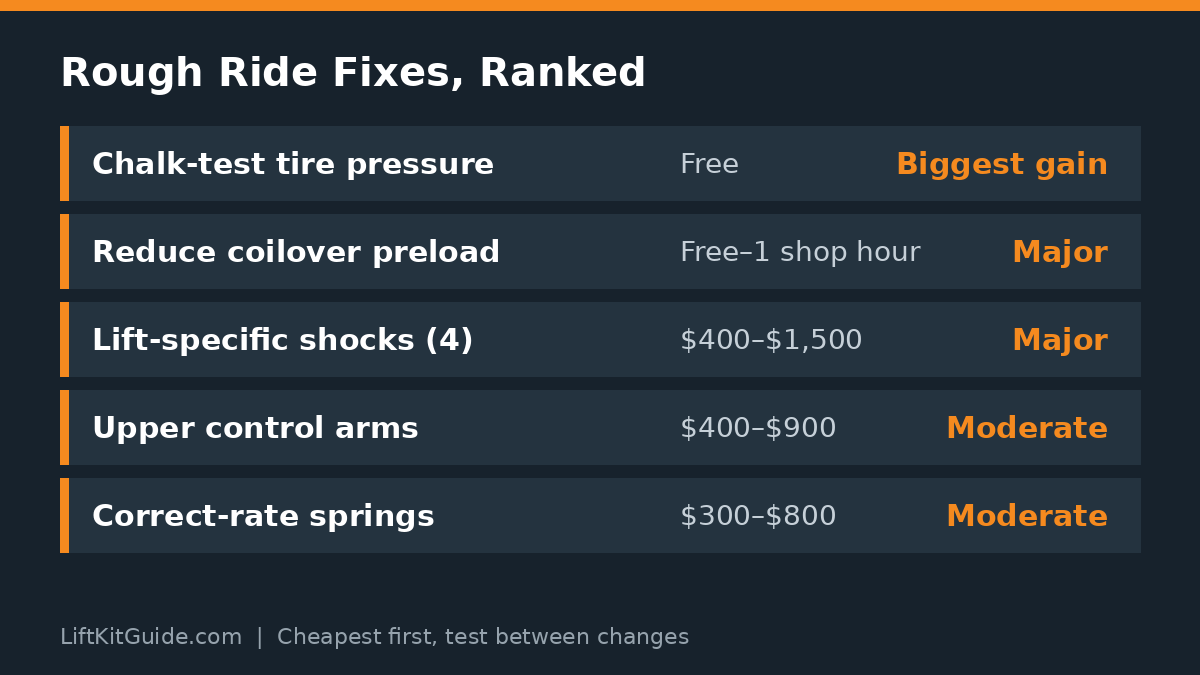
Work cheapest-first and you will usually solve it before spending real money. Step one is free: chalk-test the tire pressure and set it for the actual load. Step two is nearly free: back off excessive coilover preload and confirm nothing is contacting the bump stops early. Those two steps alone resolve a surprising share of ‘why does my lifted truck ride so rough’ complaints, because they address the two adjustments most installers set by guesswork.
If the truck is still harsh, spend money in this order: lift-specific shocks ($400–$1,500 for a set of four depending on brand), upper control arms if alignment range is the issue ($400–$900), and finally springs with the correct rate for your truck’s weight. Resist the urge to start with the most expensive part — a $1,500 coilover set cannot fix 45 PSI in the tires. For budgeting the whole correction, the cost to lift a truck guide and our best lift kit brands roundup help you price quality components once instead of buying twice.
| Fix | Typical cost | Ride improvement |
|---|---|---|
| Chalk-test tire pressure | Free | Often the biggest single gain |
| Reduce coilover preload | Free to 1 shop hour | Restores compliance and droop |
| Lift-specific shocks (set of 4) | $400–$1,500 | Major — corrects damping for the height |
| Upper control arms | $400–$900 | Fixes alignment-range instability |
| Correct-rate springs | $300–$800 | Matches the truck’s actual weight |
| Softer load-range tires | $800–$1,600 | Noticeable if coming from stiff Load E |
Why does my lifted truck ride so rough even with good shocks?
Why does my lifted truck ride so rough even after a shock upgrade? When quality dampers do not fix it, the cause is usually geometry or contact: bump stops engaging too early, a sway bar binding at the new angles, control arm bushings bound from being torqued at the wrong ride height, or tires still over-inflated. Good shocks can only control motion — they cannot fix a suspension that is mechanically fighting itself.
The systematic approach is a full inspection at ride height: cycle the suspension and watch for anything touching early, verify torque with weight on the tires, and confirm the alignment numbers are truly in spec rather than ‘close enough.’ Trucks that have lived harsh for years sometimes have two or three small issues stacked, and each one you remove makes the next test drive more informative. If you are still deciding on the lift itself, our leveling kit explainer and leveling kit cost guide cover the mildest option, which preserves the most factory ride to begin with.
- Chalk-test tire pressure: set for the actual load — this alone answers why does my lifted truck ride so rough for many owners.
- Check preload: back coilover collars down to the maker’s recommended range.
- Look for contact: bump stops, binding sway bars, or anything touching early in travel.
- Verify torque at ride height: bound bushings from wrong-condition torquing cause harshness.
- Read the alignment printout: confirm caster, camber, and toe are truly in spec.
- Match the shocks: lift-specific valving and correct extended length, front and rear.
Frequently asked questions
Why does my lifted truck ride so rough on the highway?
Highway harshness on a lifted truck is most often tire pressure set too high or an alignment with insufficient caster after the lift. Chalk-test the pressures first, then check the alignment printout — a truck that darts and follows grooves feels rough even when the springs are fine. Balance issues show up as vibration at specific speeds rather than general harshness.
Will better shocks really fix a rough lifted truck?
Often yes, if the shocks are the actual problem. Lift-specific dampers with correct valving and travel transform trucks that are running stock or generic shocks at the wrong height. But shocks cannot fix over-inflated tires, excessive preload, or binding components — diagnose in cheapest-first order so you do not spend $1,000 masking a free fix.
What tire pressure should a lifted truck run?
Whatever the chalk test says for your tire, truck, and load — not the sidewall maximum. As a starting point, many half-tons on 35s land in the low 30s PSI unloaded, versus 35–40+ where owners often set them by habit. Air up 5–10 PSI for towing or heavy loads, then air back down. Check monthly and seasonally.
Does lifting a truck always make the ride worse?
No. A well-engineered lift with correct spring rates, matched dampers, proper preload, and a real alignment can ride as well as stock or better — many owners report improved control. The lifts that ride badly are the ones with mismatched components, guessed-at pressures, and skipped alignment steps. Height does not dictate harshness; setup does.
Why does my lifted truck ride so rough over speed bumps only?
Harshness isolated to sharp bumps like speed bumps points at high-speed damping or travel limits: shocks with too much compression damping, bump stops engaging early, or preload leaving no droop. Tire pressure matters less here than damper behavior. Check for bump-stop contact first — it is a five-minute visual inspection.
Should I remove my lift to fix the ride?
Almost never. Removing a lift to fix harshness treats the symptom by deleting the modification instead of correcting the setup, and you lose the clearance and stance you paid for. Work the checklist — pressure, preload, shocks, alignment, contact points — and the vast majority of harsh trucks are fixed without touching the lift height.
The bottom line
Why does my lifted truck ride so rough? Because somewhere between the tire pressure, the shock valving, the preload, and the alignment, the setup stopped matching the truck. The fix is almost never more lift or less lift — it is the correct pressure from a chalk test, dampers valved for the height, preload in the maker’s range, and an alignment with real numbers.
Work cheapest-first, change one thing at a time, and test drive between changes. Trucks that felt punishing become genuinely pleasant once the setup is right, which is the real lesson: a lift does not have to ride rough, and when it does, it is telling you exactly where to look.






1 Comment