


Last updated: October 2026 Written by the LiftKitGuide Team, truck suspension installers and editors
What causes death wobble on a lifted Jeep? Almost always it is looseness in the front steering or suspension: the track bar bushing or bolts (the number one culprit), worn ball joints, loose tie rod ends, or worn control arm bushings. The lift itself does not create death wobble — it exposes play that was already there by changing geometry and adding bigger tires. A steering stabilizer will not fix it; only replacing the loose parts will. Start with a track bar torque check, which is free.
Key takeaways
- The track bar (bushings and mounting bolts) is the number one cause of death wobble on lifted Jeeps.
- A steering stabilizer masks death wobble — it never fixes the root cause.
- Death wobble is a violent, self-sustaining oscillation usually triggered by a bump at 45–65 mph.
- Fix costs range from $0 (re-torquing bolts) to $200–$600+ in parts for ball joints or a steering box.
- After any lift, torque track bar and control arm bolts at ride height and re-torque after 50 miles.

On this page
What causes death wobble on a lifted Jeep most often?
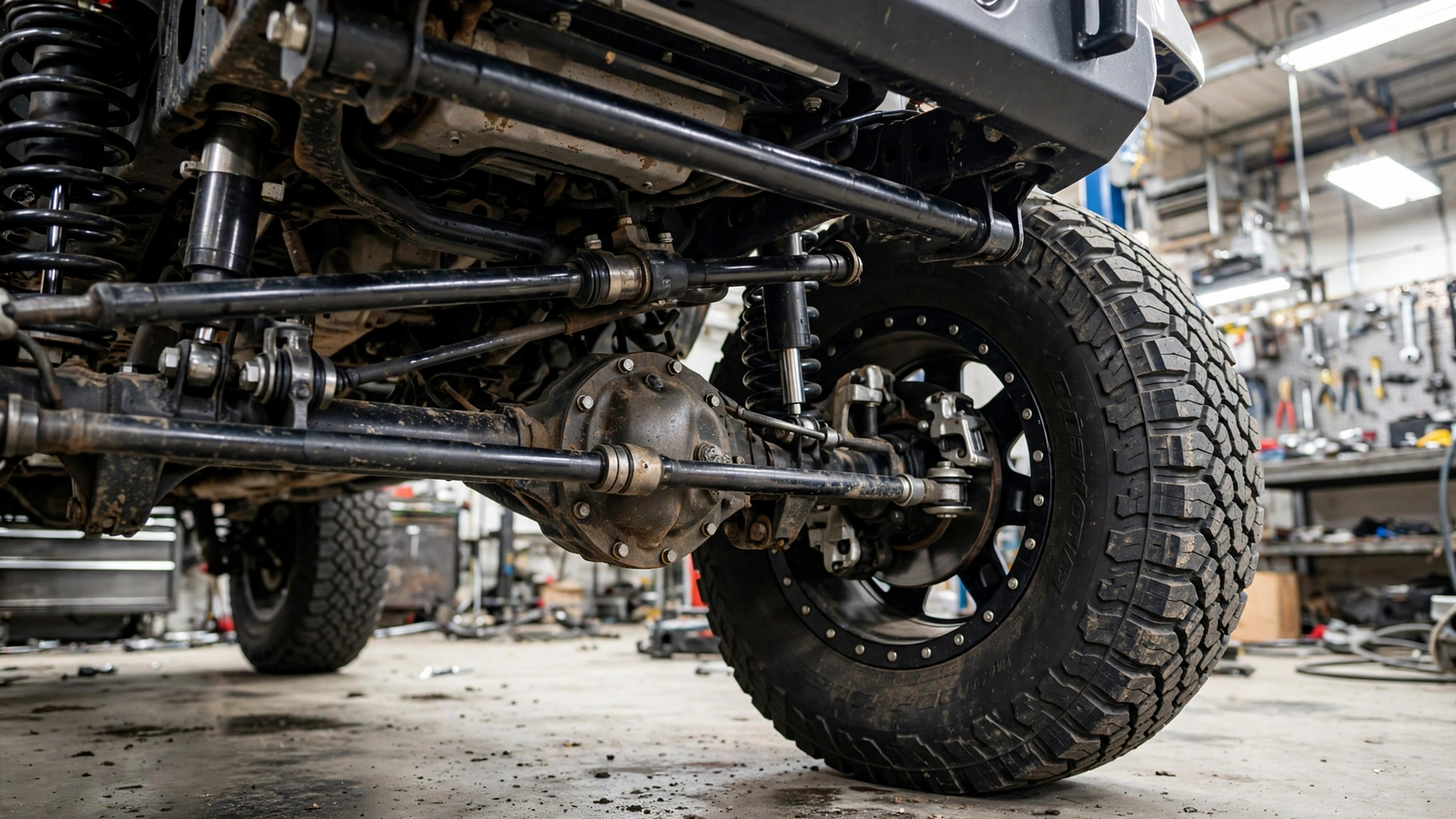
When owners ask what causes death wobble on a lifted jeep, the answer is almost always the track bar. The track bar is the single link that keeps the front axle centered under the Jeep, and any play in its bushings or mounting bolts lets the axle shift side to side. At speed, a bump starts the axle oscillating, and the play in the track bar lets that oscillation feed on itself until the whole front end is shaking violently. Wrangler forum veterans consistently rank the track bar as the first thing to check, and for good reason — a surprising number of death wobble cases end with a loose track bar bolt that simply needed proper torque.
The lift connection is geometry, not magic. Raising the Jeep steepens the track bar angle, increases leverage on every bushing, and usually comes with heavier 35- or 37-inch tires that hit bumps harder. All of that turns small, previously harmless wear into a self-sustaining wobble. So what causes death wobble on a lifted jeep after an install usually means the lift revealed worn parts rather than creating a new problem — though an improperly installed lift (bolts torqued with the suspension hanging, not at ride height) can absolutely be the direct cause.
Why is the track bar the number one suspect?
The track bar does one job — holding the axle laterally centered — and it does it under enormous load. Every bump, turn, and braking force pushes the axle sideways against this single bar. The bushings at each end absorb that abuse, and once they wallow out even slightly, the axle gains a fraction of an inch of side play. That tiny play is all a 45-mph bump needs to start the oscillation. The axle-side bracket is equally critical: severe wobble can crack its welds or wallow out the bolt hole, turning a bushing job into a bracket repair.
Diagnosis starts with a helper. Have someone turn the steering wheel back and forth a few inches with the engine off while you watch the track bar ends — any visible movement between the bar and the bracket means the bushing or bolt is done. Check the torque on both mounting bolts against the factory spec (commonly around 125 ft-lbs on JK/JL models, but verify for your year). Many owners find the bolts were never re-torqued after the lift install, and simply torquing them properly at ride height — full weight on the tires — ends the wobble. If the bushing is shot, an adjustable heavy-duty track bar ($150 to $300) is the lasting fix and also re-centers the axle, which a lift almost always shifts sideways.
There is a detail about installation torque that answers what causes death wobble on a lifted jeep for a lot of fresh builds. The track bar bolts must be torqued with the Jeep sitting at its new ride height — full weight on the tires — because the bushings need to be pinched in their neutral position. Torque them with the axle hanging on a lift and the bushings bind; the first pothole then tears them, and the wobble begins weeks after an install that felt perfect on day one. This single procedural mistake is so common that experienced installers treat the 50-mile re-torque as non-negotiable, right alongside choosing a quality lift kit with proper hardware in the first place.
Can worn ball joints cause death wobble?
Yes. Ball joints are the pivot points that let the steering knuckles turn, and when they wear, the knuckle gains play in every direction. That play joins the oscillation the same way a loose track bar does — each wobble cycle hammers the worn joint a little further, which is why death wobble tends to get worse over time rather than staying constant. If you are chasing what causes death wobble on a lifted jeep and the track bar checks out, ball joints are the next stop.
Test them with the front end jacked up and the tire grabbed at 12 and 6 o’clock — rock it in and out and watch the ball joints for movement. Any visible play means replacement, and it is smart to do both sides at once since they wear together. Ball joint replacement is a bigger job (the old joints press out of the knuckle), with parts running $200 to $600+ and labor adding several hundred more at a shop. On a lifted Jeep running 37s, consider heavy-duty aftermarket ball joints; the stock units were designed for stock-size tires and stock angles.
| Component | Wobble role | Typical parts cost |
|---|---|---|
| Track bar bushings/bolts | Lets axle shift sideways — #1 cause | $0-$300 |
| Ball joints | Steering knuckle play feeds oscillation | $200-$600+ |
| Tie rod ends | Slop in steering linkage | $50-$100 |
| Control arm bushings | Axle fore-aft movement | $100-$400 |
| Wheel bearings | Hub play at speed | $80-$250 |
| Steering stabilizer | Masks symptoms only — not a fix | $60-$150 |
What causes death wobble on a lifted Jeep right after a new lift install?
When the wobble starts the week the lift goes on, the cause is usually installation error rather than worn parts. The most common mistake is torquing the track bar and control arm bolts with the Jeep on a lift — suspension hanging at full droop — instead of at ride height with the full weight on the tires. Torqued at droop, the rubber bushings get pinched in a twisted position; at ride height they are pre-loaded and bind, which causes weird handling, premature bushing failure, and exactly the kind of instability that becomes death wobble. The fix is to loosen those bolts, settle the suspension at ride height, rock the Jeep side to side, and re-torque everything to spec.
The second install-related cause is skipped re-torquing. New bushings and bolts settle in the first 50 miles, and the track bar bolts in particular need a re-torque after that break-in — then again after every hard wheeling trip and at every oil change. Plenty of owners have cured fresh-install wobble with nothing but a torque wrench. This is also why the most regretted lift mistakes lists include rushing the install: an hour of careful torquing at the end prevents months of chasing a wobble. Document the dates and what you torqued — if what causes death wobble on a lifted jeep ever becomes a warranty discussion, that log is your evidence.
Does a steering stabilizer fix death wobble?
No — and this is the most expensive myth in the Jeep world. A steering stabilizer is a shock absorber for the steering linkage; it dampens vibration but cannot remove the mechanical play that causes death wobble. Installing a shiny new dual stabilizer setup on a Jeep with a loose track bar is like turning up the radio to fix an engine knock — the shaking feels smaller for a while, but the worn parts keep wearing, and the wobble comes back worse. Shops that sell you a stabilizer as the cure are selling you a bandage.
That said, a stabilizer has a legitimate supporting role once the real causes are fixed. After you have replaced the worn track bar, ball joints, or tie rod ends and corrected the alignment, a quality stabilizer ($60 to $150) smooths out normal road feedback and protects the fresh parts from constant hammering. Think of it as the last step, not the first. If someone’s ‘death wobble fix’ starts and ends with a stabilizer, find a different shop — and check out our full death wobble guide for the complete diagnosis order.
It helps to understand why the stabilizer myth refuses to die when people ask what causes death wobble on a lifted jeep on forums. A fresh stabilizer genuinely makes the steering feel tighter for a few weeks, because it is damping the same oscillation the loose parts are creating. Owners post success stories, others copy the ‘fix,’ and the underlying wear keeps progressing silently until the wobble returns worse than before. The honest test is simple: if your wobble started after the stabilizer aged out, the stabilizer was never the fix — it was the mask. Spend that $60 to $150 on a torque wrench and an inspection first, and read up on post-lift ride diagnosis so you can tell damping problems from geometry problems.
How does caster angle relate to death wobble?
Caster is the fore-aft tilt of the steering axis, and it is the angle that gives your steering its self-centering stability. Lifting a Jeep rotates the front axle and typically reduces caster, which makes the steering feel light and twitchy — and a twitchy front end is far more willing to start oscillating when a bump hits. This is a key part of what causes death wobble on a lifted jeep on trucks and Jeeps that were ‘fine before the lift’: the lift stole 2 to 3 degrees of caster, and the front end lost the stability that was masking minor wear.
The fix is adjustable control arms, which let you dial caster back to 5.5 to 6.5 degrees on most lifted Jeeps (check your lift manufacturer’s recommendation). Many owners report that correcting caster transforms the Jeep from nervous to planted even before replacing a single worn part. Note the trade-off: more caster rotates the pinion down, which can steepen front driveshaft angles — on tall lifts you may need to balance caster against driveline vibration, another reason proper geometry correction matters more than any single part.
Here is a practical number to remember when what causes death wobble on a lifted jeep comes up in the context of a recent alignment. Factory caster on many Jeeps sits around 4 to 5 degrees; a 2.5-inch lift can pull it down near 3 degrees, which is where the steering starts feeling nervous. Adjustable lower control arms let you push it back to the 5.5-to-6.5-degree sweet spot most lift manufacturers recommend. Get the alignment printout and actually read the caster numbers — if the shop set ‘toe and go’ without touching caster, you paid for half an alignment and the wobble risk is still sitting in your driveway.
What is the right order to diagnose death wobble?
Always work from free to expensive, because the most common causes are also the cheapest to rule out. Start with the torque check — track bar bolts, then control arm bolts — done at ride height with the full weight on the tires. Then do the helper test on the track bar ends, then the jacked-up play tests on ball joints (12-and-6) and tie rod ends (3-and-9). Only after the mechanical inspection comes up clean should you spend money on tires, balancing, and alignment. Skipping layers is the reason what causes death wobble on a lifted jeep stays unanswered for months on forum build threads.
This order matters because death wobble is often a stack of small problems rather than one big one. A slightly loose track bar plus slightly worn ball joints plus slightly low caster can combine into a violent wobble even though no single part looks destroyed. Fixing just one layer and declaring victory is why so many owners chase the wobble for months. Work the whole list, fix everything you find, and finish with a professional alignment — that systematic approach is what separates a permanent fix from a temporary one, a point echoed in this Jeep death wobble fix guide.
- Torque check first: track bar bolts and control arm bolts, at ride height, to factory spec — free and fixes a shocking number of cases.
- Watch the track bar: helper turns the wheel while you look for movement at both ends.
- Check ball joints and tie rod ends: jack up each side and feel for play at 12-and-6 and 3-and-9.
- Inspect control arm bushings: look for cracking, binding, or bolts torqued at the wrong ride height.
- Balance and inspect tires: rule out bent wheels, separated belts, and bad balance.
- Verify alignment: caster, toe, and thrust angle — then add the stabilizer last.
Is it safe to keep driving with death wobble?
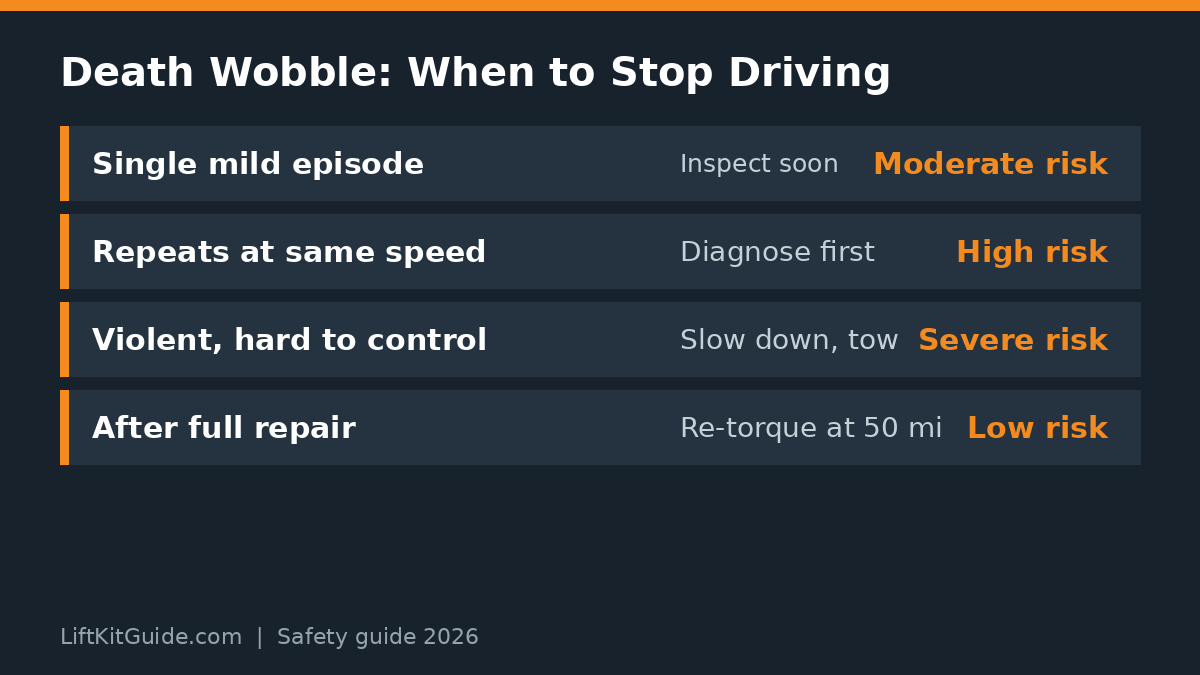
No. Death wobble is genuinely dangerous — the violent shaking can tear the steering wheel out of your hands and make the Jeep dart across lanes. If it hits at speed, grip the wheel firmly, do not slam the brakes, and slow down gradually until the oscillation stops, then pull over when safe. Driving on with repeated episodes risks breaking the track bar bracket welds, wallowing out bolt holes, and destroying the bushings completely, which turns a bushing job into frame-bracket surgery.
There is also a legal and financial angle worth knowing. If your Jeep is still under warranty and the wobble persists after repeated dealer repair attempts, document every incident with dates, mileage, and repair orders — owners in some states have pursued lemon-law claims over chronic death wobble. And if you are running a lift, understand that a lift can complicate warranty claims on steering parts, so keep records showing whether the wear predated the lift or the install caused it.
One last thing worth knowing about what causes death wobble on a lifted jeep is that the violence of a full episode can create new damage that becomes the next episode’s cause. A severe wobble can crack the track bar bracket welds, oval out mounting holes, and permanently deform a bushing — so the truck that ‘just needs an alignment’ after its third wobble may actually need bracket repair too. This cascade is why catching the first episode early matters so much: every unaddressed wobble raises the eventual repair bill and narrows the list of parts you can reuse.
| Situation | Risk level | What to do |
|---|---|---|
| Single mild episode, then normal | Moderate | Inspect soon; torque-check track bar bolts |
| Repeats at the same speed/bump | High | Diagnose fully before highway driving |
| Violent shaking, hard to control | Severe | Slow down safely; tow if it recurs |
| After replacing worn parts | Low | Re-torque after 50 miles; monitor |
Frequently asked questions
Can a bad alignment alone cause death wobble?
Rarely by itself. Bad alignment makes wobble more likely, but true death wobble needs mechanical play in the track bar, ball joints, or tie rod ends.
How much does it cost to fix death wobble?
From $0 for a torque check to $200–$600+ in parts for ball joints; most cases cost $150–$500 total.
Will bigger tires cause death wobble?
Not directly, but heavier tires amplify existing wear and stress steering joints, turning marginal play into full wobble.
How do I know if my ball joints are bad?
Jack up the wheel and rock the tire at 12 and 6 o'clock; visible movement at the joint means it is worn.
Can death wobble happen on a stock Jeep?
Yes — worn track bar bushings, ball joints, or unbalanced tires can cause it on stock Jeeps; lifts just make it more likely.
Should I replace the track bar or just the bushings?
Bushings suffice if the bar is straight and holes are round; replace the whole bar if it is bent, holes are wallowed, or a lift shifted the axle.
The bottom line
Death wobble looks terrifying, but its causes are mechanical and findable: a loose track bar, worn ball joints, tired tie rod ends, or bad install torque, with low caster and unbalanced tires as accomplices. Work the diagnosis in order — free torque checks first, then the play tests, then tires and alignment — and fix everything you find rather than the first thing you find.
Never let a shop sell you a steering stabilizer as the cure. The stabilizer is the finishing touch after the real repair, not the repair itself. Get the geometry right, torque everything at ride height, re-torque after 50 miles, and your lifted Jeep will track straight and shake-free.



Leave a comment