


Last updated: October 2026 Written by the LiftKitGuide Team, truck suspension installers and editors
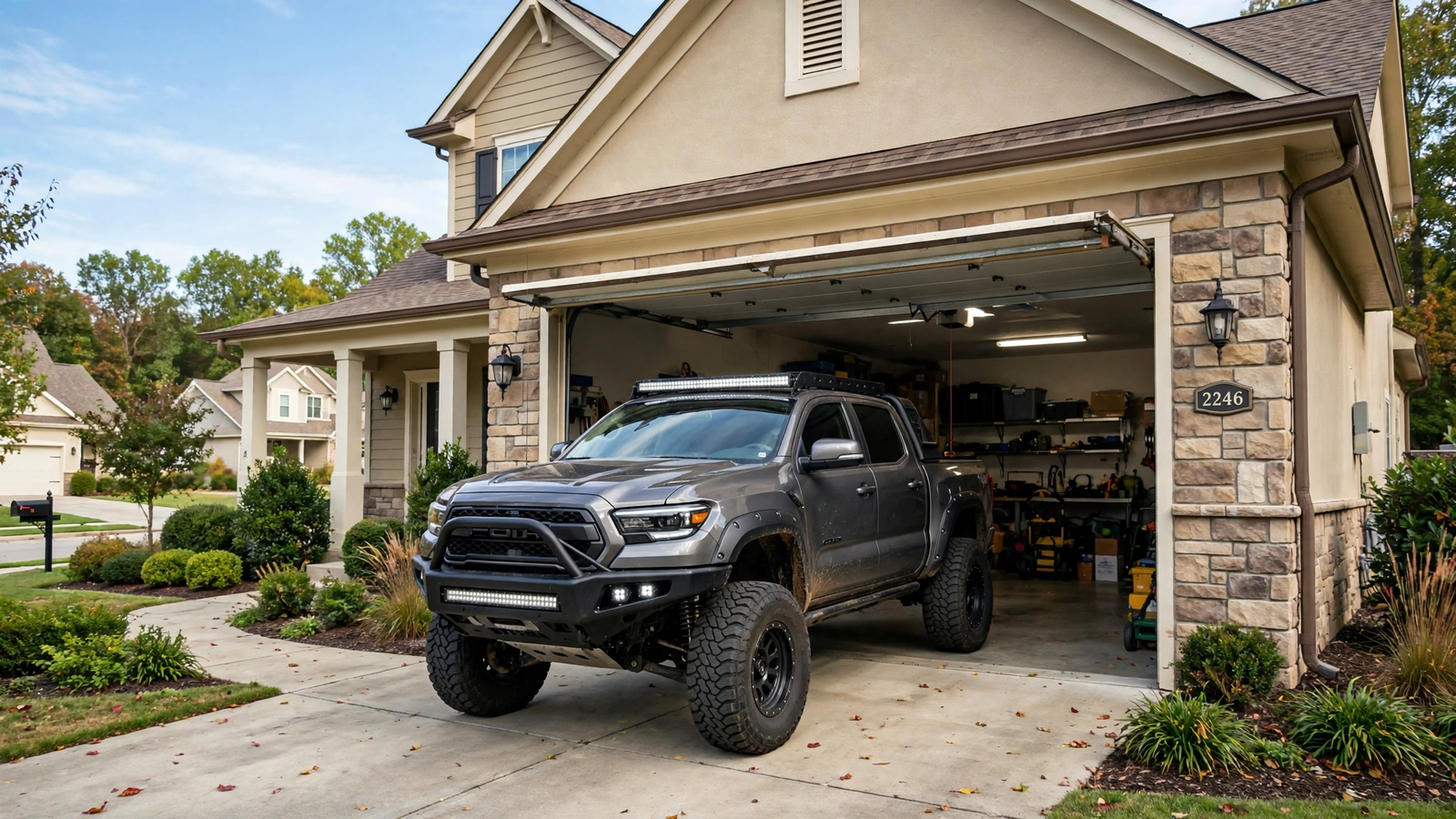
Can you fit a lifted truck in a standard garage? Usually yes with a 2 to 4 inch lift, and usually no with a 6 inch lift on 37s. A standard garage door is 7 feet tall, and a 4 inch lifted half-ton typically measures 6 feet 8 inches to 6 feet 10 inches, which clears with inches to spare. A 6 inch lift with 37s usually lands at 7 feet or taller and does not fit. Measure your truck’s highest point and the door’s lowest obstruction before you build.
Key takeaways
- Standard garage doors are 7 feet tall; 8 foot doors are common in newer homes.
- A 4 inch lift with 35s usually fits a 7 foot door with 2 to 4 inches to spare.
- A 6 inch lift with 37s is typically 7 feet or taller and usually does not fit.
- Truck height = stock height + lift + half the tire diameter increase.
- Measure the truck and the door’s lowest obstruction; never guess.
On this page
Can you fit a lifted truck in a standard garage?
Can you fit a lifted truck in a standard garage? For most mild lifts, the answer is yes. A standard residential garage door opening is 7 feet tall, and a half-ton truck with a 2 to 4 inch lift on 33 to 35 inch tires typically stands 6 feet 6 inches to 6 feet 10 inches tall. That leaves a few inches of clearance, which is enough if you measure carefully and watch for the garage door opener rail. This is the core of can you fit a lifted truck in a standard garage: the margin is small but workable.
The answer changes with height. Once you step to a 6 inch lift with 37 inch tires, most half-tons land at or above 7 feet, and the truck simply does not fit under a standard door. Heavy-duty trucks start taller, so a 4 inch lifted Super Duty can be as tight as a 6 inch lifted half-ton. The only honest answer for your truck comes from a tape measure, not a forum post.
Garage fit is one of the most practical reasons owners choose a 4 inch lift over a 6 inch. If the truck sleeps in the garage every night, those few inches decide whether the build works for your life. Anyone asking can you fit a lifted truck in a standard garage should measure before buying the lift, not after, because suspension is much harder to return than it is to research.
How tall is a standard garage door?
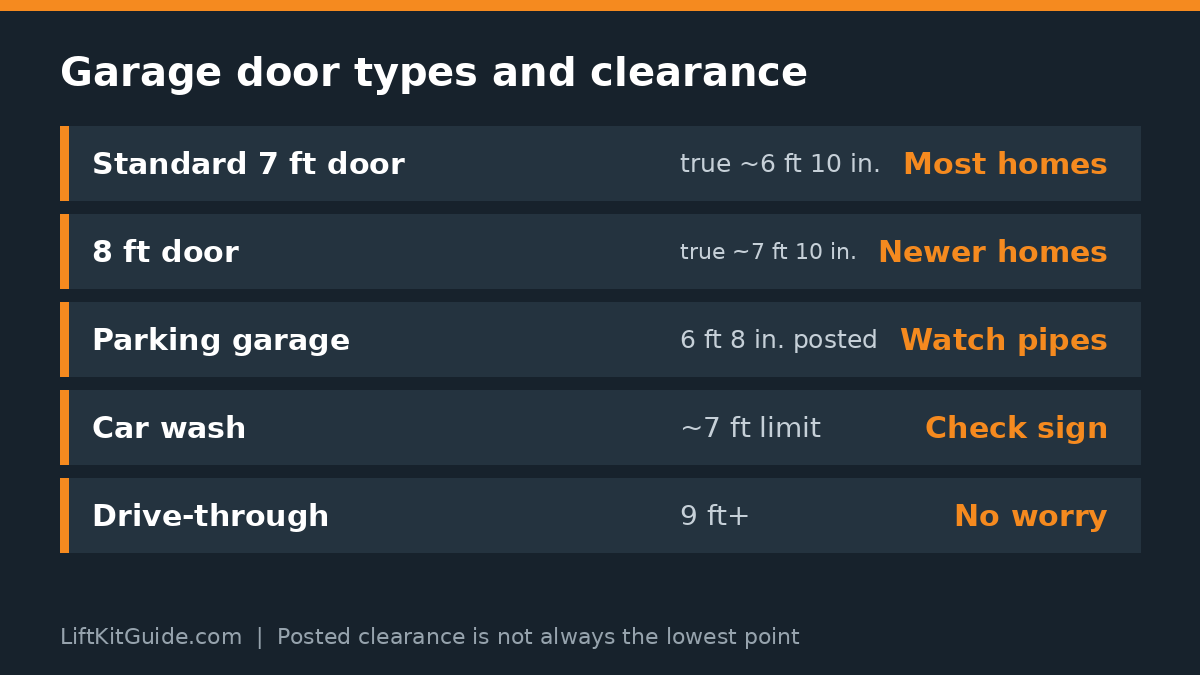
Residential garage doors in the US are most commonly 7 feet tall by 9 feet wide for a single door, or 16 feet wide for a double. That 7 foot dimension is the door panel height, but the actual clearance is often less: the door opener rail, the open door itself, and weather stripping can steal 1 to 3 inches. Many owners discover their true clearance is 6 feet 10 inches, not 7 feet. When people ask can you fit a lifted truck in a standard garage, they usually mean the 7 foot door, so know that true clearance is often less. Measure the door yourself; builder specs and real openings differ more often than you would think.
Newer homes increasingly use 8 foot tall doors, which changes the math completely. An 8 foot door swallows a 6 inch lifted truck with room to spare and makes garage fit a non-issue for almost any half-ton build. If you are house hunting with a lifted truck, door height is worth checking alongside the kitchen.
Commercial parking garages are a different world. Most post clearances of 6 feet 8 inches to 7 feet, and hanging pipes, sprinklers, and signs often sit below the posted number. A truck that fits its home garage may not fit the downtown parking structure. Always read the clearance bar at the entrance and believe the lowest pipe you see, not the sign.
How tall is your lifted truck really?
The formula is simple: stock height + lift height + half the tire diameter increase = new overall height. A stock crew cab half-ton is about 75 to 77 inches tall. Add a 4 inch lift and go from 32 inch stock tires to 35s, and you gain 4 inches from the lift plus 1.5 inches from the tires, landing around 81 to 82 inches, or 6 feet 9 inches to 6 feet 10 inches. This formula is the entire answer to can you fit a lifted truck in a standard garage: run it before spending a dollar.
The highest point is not always the roof. Antenna fins, roof-mounted light bars, and roof racks often poke 2 to 4 inches above the cab. A stubby antenna swap can buy back 3 inches at the tallest point, which is sometimes the entire margin. Measure to the actual highest point with the truck on level ground, tires at street pressure. Tire pressure matters more than people think: a tire 10 PSI low can drop the truck half an inch, which is not a strategy but is worth knowing when you are close.
Can you fit a lifted truck in a standard garage if you are right at the limit? Only with margin to spare. You want at least 2 inches between the truck’s highest point and the door’s lowest obstruction, because suspension settles, tires vary with temperature, and an inclined driveway changes the angle as the truck enters. A half inch of clearance on paper is zero clearance in real life.
Can you fit a lifted truck in a standard garage with a 6 inch lift?
Can you fit a lifted truck in a standard garage with a 6 inch lift? Usually not under a 7 foot door. The math is unforgiving: 76 inches stock plus 6 inches of lift plus 2.5 inches from 37s puts you around 84 to 85 inches, which is 7 feet to 7 feet 1 inch before accounting for the antenna. That is at or above the door height, with no margin for the opener rail.
There are exceptions. A 2WD half-ton starts 2 to 3 inches lower than a 4WD, so a 6 inch lifted 2WD on 35s can sneak under 7 feet. Some owners also run slightly smaller tires or accept a tight squeeze with the antenna removed. But these are edge cases, and daily-driving a truck that clears by a quarter inch is stressful; one frost heave or tire pressure change and you are scraping. Roof racks and light bars are the usual culprits when a truck that should fit does not; remove or account for them before remeasuring.
If the garage is non-negotiable and you want the 6 inch look, the realistic options are an 8 foot door upgrade, which costs $1,500 to $3,000 installed, or dropping to a 4 inch lift. Many owners choose the 4 inch lift and never look back, since the cost difference between 4 and 6 inch lifts buys a lot of other upgrades.
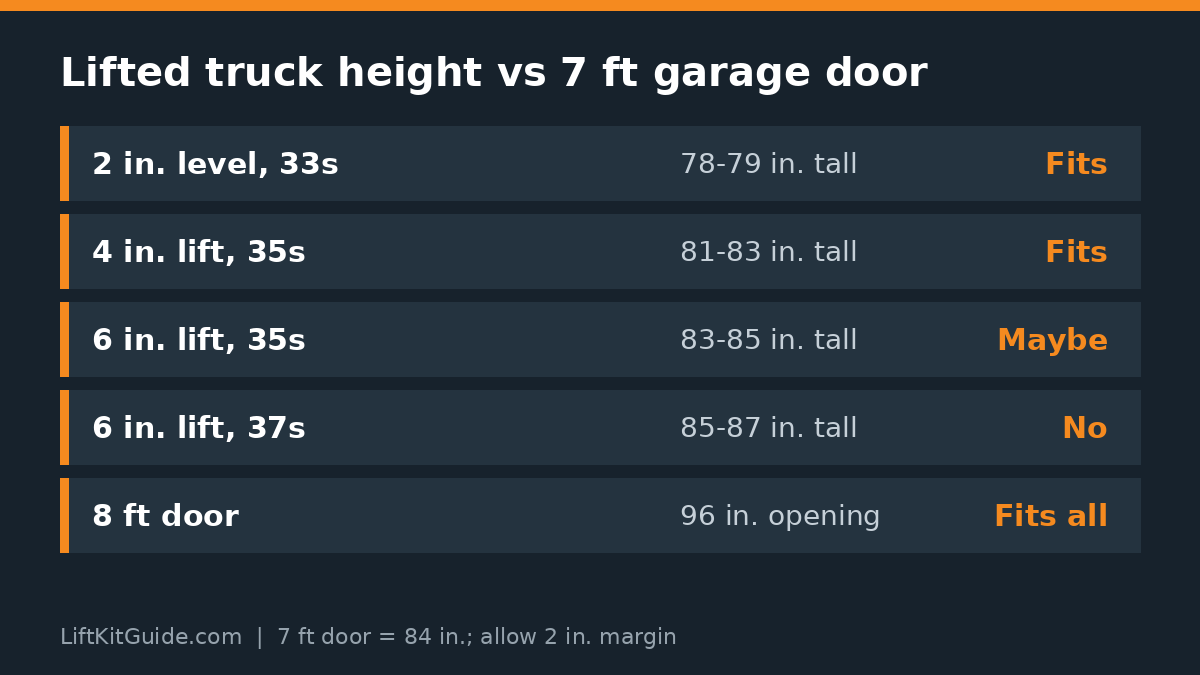
| Setup | Approx. overall height | Fits 7 ft door? | Margin |
|---|---|---|---|
| Stock half-ton 4WD | 75-77 in. | Yes | 7-9 in. |
| 2 in. level, 33s | 78-79 in. | Yes | 5-6 in. |
| 4 in. lift, 35s | 81-83 in. | Yes | 1-3 in. |
| 6 in. lift, 35s | 83-85 in. | Maybe | 0-1 in. |
| 6 in. lift, 37s | 85-87 in. | Usually no | Negative |
What about parking garages and car washes?
Public parking garages are tighter and less forgiving than home garages. Posted clearances of 6 feet 8 inches are common, and the real lowest point is often a pipe or sprinkler head below the sign. Spiral ramps add another challenge: the truck leans on the turn, momentarily gaining height at the roof rail. So can you fit a lifted truck in a standard garage at home but not downtown? Commonly yes: owners of tall trucks learn to skip downtown garages or scout them on foot first.
Automatic car washes have similar limits, typically 7 feet, and the guide rails add width constraints too. A 4 inch lifted truck usually fits; a 6 inch truck often does not. Touchless washes tend to be more generous than friction washes, but the only safe move is checking the posted limits before entering. Hand washing is the fallback every tall-truck owner eventually accepts. Some owners keep a cheat sheet of local garages with their clearances taped to the sun visor.
Drive-throughs are rarely a problem. Most fast-food lanes clear 9 feet or more, and bank canopies are usually 8 feet plus. The exceptions are older urban buildings with low overhangs, which deserve a glance before you commit. When in doubt, park and walk in; it is faster than explaining a roof strike to your insurance company.
How do you measure for garage fit?
Measuring takes ten minutes and two people. Park the truck on level ground in front of the garage, at normal street tire pressure, loaded as it usually sits. Hold a long straightedge or level across the highest point of the truck, usually the antenna fin or roof, and measure straight down to the ground. Write the number down; this is your truck height.
Then measure the garage. Measure the door opening height, then find the lowest obstruction inside: the open door panel, the opener rail, lights, or storage racks. Measure from the floor to that obstruction. Subtract the truck height from the obstruction height. If the result is 2 inches or more, then can you fit a lifted truck in a standard garage? Confidently yes. Less than 2 inches means measure again and consider your options.
Do not forget the driveway angle. If the driveway slopes up into the garage, the truck’s nose rises as it enters and the effective clearance shrinks at the door header. Test by creeping in slowly with a spotter watching the highest point the first time. Many owners who measure 1 inch of clearance on paper discover the slope eats it. The leveling kit versus lift kit guide can help if you decide a smaller change fits your life better.
- Measure the truck: level ground, street tire pressure, to the highest point (antenna fin or roof).
- Measure the door: opening height, then the lowest inside obstruction (rail, open door, lights).
- Subtract and require 2+ inches: less than that is not a real fit.
- Check the driveway slope: an uphill entry steals clearance at the header.
- Test with a spotter: creep in slowly the first time and watch the highest point.
- Recheck after changes: new tires, roof gear, or settling all change the number.
What if your lifted truck does not fit?
If the truck does not fit, you have five options, roughly in order of cost. First, the stubby antenna swap: $20 to $50, buys 3 to 4 inches if the fin is the tallest point. If the antenna fin is the tallest point, the $30 stubby antenna is the best dollars-per-inch mod in the truck world. Second, air down slightly or choose a shorter tire at replacement time; dropping from 37s to 35s buys 1 inch. Third, adjust the garage door opener and tracks for maximum travel, which can gain an inch.
Fourth, replace the door with an 8 foot tall door, typically $1,500 to $3,000 installed, which solves the problem permanently and adds home value. Fifth, reconsider the lift height. Trading a 6 inch kit for a 4 inch kit is drastic after the fact, but some owners do it when the garage wins the argument. Check how big you can go without a lift if you are rethinking the whole build.
What does not work: letting air out of the tires every night, which damages sidewalls and is miserable, or forcing it and scraping the roof, which damages the truck and the door. A truck that does not fit is a problem to solve, not a ritual to endure. Pick one of the real fixes and move on.
| Fix | Height gained | Typical cost | Effort |
|---|---|---|---|
| Stubby antenna | 3-4 in. | $20-$50 | 10 minutes |
| Smaller tires (37 to 35) | 1 in. | $0 at replacement | None extra |
| Opener/track adjustment | 1 in. | $0-$150 | Afternoon |
| 8 ft door upgrade | 12 in. | $1,500-$3,000 | Professional install |
| Drop to 4 in. lift | 2 in. | $500-$1,500 | Shop day |
How to plan your build around your garage?
Plan the build around the garage from day one. Before ordering any lift, measure the door and decide your minimum clearance. Then work backward: door clearance minus 2 inches of margin minus half the tire diameter increase tells you the maximum lift height that fits. This two-minute calculation is how you answer can you fit a lifted truck in a standard garage with certainty, and it prevents the most common lifted-truck regret.
Choose tires with the garage in mind. The 35s fitment guide shows how much height each tire size adds, and picking 35s over 37s is often the difference between fitting and not. Keep the roof clean: skip the light bar and roof basket if clearance is tight, since roof accessories are usually the tallest point. Take a photo of the tape measure at the highest point; it settles every future argument about whether the truck fits.
Finally, remember that a leveling kit that clears 33s keeps nearly every truck garage-friendly while delivering most of the look. And check your state’s lift laws while planning, since some states regulate bumper and headlight height. A build that fits the garage, the law, and the budget is a build you will enjoy every day instead of fighting.
Frequently asked questions
What is the standard garage door height?
The most common residential garage door is 7 feet tall. The actual usable clearance is often 1 to 3 inches less because of the opener rail and the open door panel. Newer homes increasingly have 8 foot doors.
Will a 4 inch lift fit in a standard garage?
Usually yes. A 4 inch lifted half-ton on 35s is typically 6 feet 9 inches to 6 feet 11 inches tall, which clears a 7 foot door with a small margin. Always measure your specific truck and door.
Will a 6 inch lift fit in a standard garage?
Usually not under a 7 foot door. A 6 inch lift with 37s typically stands 7 feet or taller. It fits fine under 8 foot doors, which are common in newer homes.
How do I measure my truck's height?
Park on level ground at street tire pressure. Hold a level across the highest point (often the antenna fin) and measure straight down to the ground. Compare against the door's lowest obstruction, not the posted door height.
Can I make my lifted truck fit by airing down tires?
Not practically. Airing down daily damages tires and is miserable. Fix it properly with a stubby antenna, smaller tires at replacement, opener adjustment, or an 8 foot door upgrade.
Does a roof rack affect garage fit?
Yes, often decisively. Roof racks, light bars, and cargo boxes are frequently the tallest point on the truck. If clearance is tight, keep the roof clean or account for the accessories in your measurement.
The bottom line
Most lifted trucks fit a standard 7 foot garage up to a 4 inch lift with 35s, and most do not at 6 inches with 37s. The dividing line is simple arithmetic: stock height plus lift plus half the tire size increase, measured against the door’s lowest obstruction with 2 inches of margin.
Measure before you build, not after. Two minutes with a tape measure beats a $3,000 door upgrade or a lift you have to undo. Plan the height around the garage and the truck will fit your life as well as it fits your driveway.



Leave a comment