


Last updated: October 2026 Written by the LiftKitGuide Team, truck suspension installers and editors
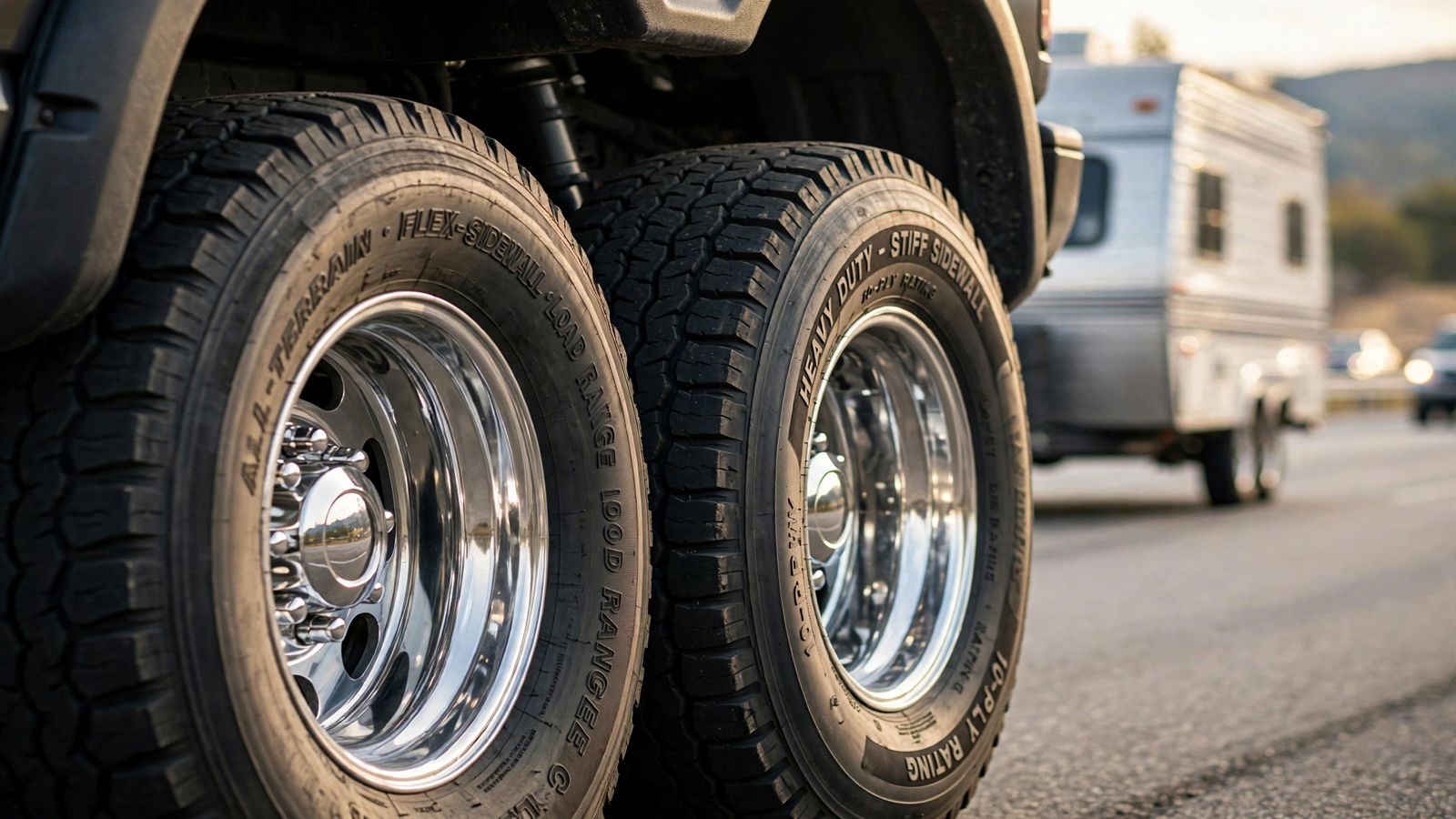
When comparing load range D vs E for towing, the practical difference is capacity and stiffness: load range D (8-ply) tires max out at 65 PSI and carry roughly 2,600 to 2,800 pounds per tire, while load range E (10-ply) tires handle 80 PSI and about 3,400 to 3,600 pounds per tire. For trailers under 7,000 pounds, D is usually plenty and rides better; for heavier towing, E is the safer choice.
Key takeaways
- Load range D means 8-ply construction with a 65 PSI maximum; load range E means 10-ply with an 80 PSI maximum.
- Typical per-tire capacity is 2,600–2,800 lb for D and 3,400–3,600 lb for E, though exact figures vary by tire size.
- E-rated tires ride stiffer when unloaded and cost 1–2 MPG versus comparable D-rated tires.
- For trailers under 7,000 lb, D is usually sufficient; above 7,000 lb, E is the recommended choice.
- Never run a tire below your truck’s placard load rating, and never mix D and E tires on the same axle.

On this page
What is the difference between load range D vs E for towing?
The core difference in the load range D vs E for towing debate is how much air pressure the tire can hold, because pressure is what actually carries the load. Load range D tires use 8-ply-rated construction and max out at 65 PSI. Load range E tires use 10-ply-rated construction and go up to 80 PSI. That extra 15 PSI of capacity is what lets an E-rated tire support substantially more weight, and it is also what makes the tire ride stiffer when the truck is empty.
Ply rating is a historical term. Modern tires do not literally contain 8 or 10 layers of cord; the rating describes strength equivalent to that many plies of old cotton-cord construction. What matters for towing is the combination of max PSI and load index printed on the sidewall. A larger D-rated tire can actually out-carry a smaller E-rated tire, so always compare the specific load index numbers rather than assuming the letter tells the whole story. For towing, the letter is a starting filter, not the final answer.
One detail that trips up shoppers in the load range D vs E for towing debate is the E2 sub-rating. Some E-rated tires, particularly in larger metric sizes, max out at 65 PSI instead of 80 and are marked E2 by some retailers. An E2 tire still has 10-ply-rated construction, but its lower max pressure means it behaves more like a D tire for capacity purposes. Always read the actual max PSI molded into the sidewall rather than assuming every E tire hits 80 PSI, because that single number changes the entire load range D vs E for towing calculation.
How much weight can load range D and E tires carry?
In common light-truck sizes, load range D tires typically carry 2,600 to 2,800 pounds per tire at their 65 PSI maximum, while load range E tires carry 3,400 to 3,600 pounds per tire at 80 PSI. Multiply by four tires and a D-rated set supports roughly 10,400 to 11,200 pounds of total vehicle weight, versus 13,600 to 14,400 for E. Those totals comfortably exceed what most half-ton trucks can legally carry, which is why D is sufficient for so many towing setups.
The important nuance is that capacity changes with pressure. A tire only delivers its rated capacity at its rated pressure, and running an E-rated tire at 50 PSI does not give you E-rated capacity. Use the tire manufacturer’s load-inflation table to find the minimum PSI for your actual axle weights. Many owners are surprised to learn their D-rated tires at full 65 PSI carry more than enough for a 6,000-pound travel trailer, making the jump to E unnecessary for their use case.
Width also plays a role that the letter rating hides. A 37×12.50R17 in load range D often carries a higher load index than a 265/70R17 in load range E, simply because there is more air volume doing the work. This is why experienced towers in the load range D vs E for towing discussion insist on comparing the four-digit load index, like 121 versus 125, instead of the letter. Two tires with the same letter can differ by 400 pounds of capacity, and two tires with different letters can be nearly identical. The letter gets you in the right aisle; the load index picks the tire.
| Spec | Load Range D (8-ply) | Load Range E (10-ply) |
|---|---|---|
| Max inflation pressure | 65 PSI | 80 PSI |
| Typical capacity per tire | 2,600–2,800 lb | 3,400–3,600 lb |
| Sidewall stiffness | Moderate | High |
| Ride when unloaded | Smoother, more comfortable | Stiffer, firmer |
| Fuel economy impact | Baseline | About 1–2 MPG worse |
| Puncture resistance | Good | Excellent |
| Typical price per tire | $180–$280 | $220–$350 |
Does load range E ride rougher than load range D?
Yes, and this is the tradeoff every tower feels daily. Load range E tires are engineered to stay rigid under heavy loads, and that rigidity does not disappear when you unhook the trailer. Owners consistently report feeling expansion joints, bridge seams, and potholes more sharply on E-rated tires, and some find the ride genuinely fatiguing on long highway drives. Load range D tires flex more through the sidewall, absorbing small road imperfections before they reach the cabin.
The ride gap narrows if you manage pressures intelligently. Many E-rated tire owners run 50 to 55 PSI for unloaded daily driving and air up to 70 to 80 PSI only when towing, which softens the empty ride considerably. But even aired down, an E tire never rides quite as softly as a comparable D tire. If your truck spends 80 percent of its life unloaded commuting and 20 percent towing a mid-size camper, the D tire’s everyday comfort is a real quality-of-life advantage worth weighing against the E tire’s extra headroom.
Consider your climate too. E-rated tires with their stiffer carcasses tend to stay rounder and more stable in extreme summer heat when towing across the desert Southwest, where tire temperatures climb fast. Owners who tow through Arizona and Nevada in July often choose E specifically for the heat margin, even when D would technically cover the weight. If your towing is mostly flat highway in mild weather, the load range D vs E for towing decision tilts back toward D for comfort. Match the tire to your roads as well as your trailer, and see our cost to lift a truck guide if bigger tires are part of the plan.
When does load range D vs E for towing actually matter?
The load range D vs E for towing decision, which confuses even experienced truck owners, matters most at the extremes. If you tow a 9,000-pound travel trailer with a half-ton truck, E-rated tires are the clear answer: the stiffer sidewalls resist sway, handle the tongue weight without excessive flex, and give you meaningful safety margin on hot highway days. Commercial users, hotshot drivers, and anyone regularly near their truck’s gross vehicle weight rating should default to E without hesitation.
It matters least in the middle ground where most owners live. A 5,500-pound boat or a 6,000-pound camper sits comfortably within D-rated capacity on most half-tons, and the D tire will tow it just fine at proper pressures. The mistake is buying E tires for a truck that never tows heavy, then enduring the harsh ride for capability you never use. Be honest about your heaviest realistic tow, add a 15 to 20 percent safety margin, and let that number pick your load range. For a deeper look at how towing interacts with lifted suspension, see our towing with a lifted truck guide.
| Trailer weight | Recommended | Why |
|---|---|---|
| Under 5,000 lb | Load range D | Plenty of capacity, best ride and MPG |
| 5,000–7,000 lb | D or E | Either works; E adds margin for frequent towers |
| Over 7,000 lb | Load range E | Stability, sway resistance, heat margin |
| Commercial / max payload | Load range E | Required headroom for the job |
Can you run load range D tires on a 3/4-ton truck?
Generally no, and this is one case where the letter really does matter. Most 3/4-ton trucks leave the factory with load range E tires because their gross axle weight ratings, especially on diesel models with heavy front ends, exceed what D-rated tires can support. The door jamb placard specifies the minimum load rating, and running below it is both a safety issue and a potential insurance headache if a blowout causes damage.
There is a narrow exception worth knowing. Because capacity depends on size as well as construction, some very large D-rated tires carry as much as smaller E-rated tires by load index. If you can document that your specific D tire meets or exceeds every placard requirement at your running pressure, you are technically compliant. But for the vast majority of 3/4-ton owners, especially those towing goosenecks or fifth wheels, E-rated tires are simply the correct and intended choice.
A final wrinkle: wheels have load ratings too. An 8-lug steel wheel might be rated for 3,500 pounds while a cast aluminum show wheel is rated for 2,500, and the assembly is only as strong as its weakest part. Pairing E-rated tires with under-rated wheels wastes the tire’s capability and creates a false sense of security. When settling the load range D vs E for towing question, verify the wheel’s max load stamp on the back of the spokes and make sure it meets or beats your tire choice. Quality wheel makers publish these figures, and our best lift kit brands roundup covers companies whose wheels are built for real truck duty.
- Check the door placard first: most 3/4-ton trucks specify load range E minimum from the factory.
- Capacity math rarely works: a diesel 2500’s rear axle rating often exceeds what four D tires can legally carry.
- Insurance risk: running below placard rating can complicate claims after a tire failure.
- The exception: some large-diameter D tires carry E-equivalent loads; verify by load index, not by letter.

What PSI should you run when towing with D or E tires?
Set pressure by load, not by habit. The correct method is to weigh your loaded axles, consult the tire maker’s load-inflation table, and run the minimum PSI that covers your actual weight plus a small margin. For towing, most owners end up near the tire’s maximum: 60 to 65 PSI for D-rated tires and 70 to 80 PSI for E-rated tires. Under-inflation is the number one cause of towing blowouts because a soft tire flexes excessively, builds heat, and can fail catastrophically at highway speed.
Check pressures cold, before driving, and recheck whenever ambient temperature swings significantly, since proper inflation is the whole point of the load range D vs E for towing upgrade. A good rule of thumb is that tire pressure changes about 1 PSI for every 10 degrees Fahrenheit of temperature change. Many towers keep a portable 12-volt compressor in the truck so they can air up at the campsite before hitching up and air back down for the unloaded drive home. That two-pressure strategy gives you E-rated towing stability and D-like daily comfort from the same set of tires.
Do 10-ply tires last longer than 8-ply tires?
All else equal, 10-ply E-rated tires tend to deliver slightly longer tread life than 8-ply D tires, mainly because their stiffer construction resists uneven wear and they run cooler under load. Heat is the enemy of tire life, and an E tire working well within its capacity generates less heat than a D tire working near its limit. Owners who tow heavy frequently often report getting 5,000 to 10,000 more miles from E-rated tires in identical sizes.
But tread life is not the whole cost picture. E-rated tires cost more upfront, typically $40 to $70 more per tire, and their extra weight costs 1 to 2 MPG over the tire’s life. On a truck driven 15,000 miles a year, that fuel penalty alone can exceed $200 annually. For a truck that tows heavy regularly, the durability advantage pays for itself. For a truck that tows a bass boat twice a summer, the D tire’s lower purchase price and better fuel economy usually win on total cost. Our MPG loss guide breaks down how tire choices affect fuel costs.
Rotation discipline matters more with towing tires than most owners realize. Trailer towing concentrates wear on the rear axle, and the inside edges of dual-rear-wheel trucks wear faster still. Rotating every 5,000 miles, or with every oil change, keeps the set even and lets you spot alignment or pressure problems before they eat an expensive E-rated tire. During rotation, inspect the inner sidewalls for the cracking and weathering that the load range D vs E for towing debate rarely mentions but that ends tire life in sun-belt states regardless of tread depth.
Which load range should you buy for your truck?
When you have worked through the load range D vs E for towing math above, buy for your heaviest realistic use, not your fantasy use. If the biggest thing you will ever tow is a 6,000-pound camper a few weekends a year, load range D tires give you all the capacity you need with a better ride and lower cost every other day of the year. If you tow a 8,500-pound trailer monthly, run a truck camper, or haul near payload limits for work, load range E is the responsible choice and the ride tradeoff is simply part of the job.
When you shop, compare load index numbers at your intended pressure rather than shopping by letter alone, and never buy below your door placard’s minimum rating. If you are also lifting the truck, remember that bigger tires change gearing and braking demands too, so read our suspension lift kits overview and best lift kit brands ranking before finalizing the build. The right tire is the one that matches your actual weights, and now you know how to do that math.
Frequently asked questions
Can you tow with load range C tires on 37s?
They can, but it is not recommended. The taller, softer sidewalls flex more under load, which hurts stability and increases heat buildup. Most 37-inch tires are only offered in load range D or E anyway, and E is the better pick for a heavy truck on 37s.
Does load range E always carry more weight than load range D?
Higher load range does not automatically mean higher capacity in every size. A large D-rated tire can carry more than a small E-rated tire because capacity depends on size and load index, not just the letter. Always compare the actual load index numbers on the sidewall.
Can you run lower PSI in load range E tires for a better ride?
Yes, within reason. Many owners run 50 to 55 PSI in E-rated tires for daily driving to soften the ride, then air up to 70 to 80 PSI when towing. Never exceed the max PSI on the sidewall, and never run below the pressure needed for your actual load.
Is it safe to mix load range D and E tires on the same truck?
It is strongly discouraged. Different sidewall stiffnesses cause uneven handling, and the lower-rated tire becomes the weak link for the whole axle. If you must mix temporarily, keep the same rating on each axle and replace the odd tires as soon as possible.
How do you know what load range your truck actually needs?
Divide your truck's gross axle weight ratings by the number of tires on each axle, then choose a tire whose load capacity at your running PSI exceeds that number with margin. Your owner's manual and the tire placard on the door jamb list the minimum ratings your truck requires.
Does running the wrong load range affect insurance or warranty?
Higher load range alone does not void coverage, but running tires below your truck's required load rating can give an insurer or warranty administrator grounds to dispute a claim after a blowout-related incident. Always meet or exceed the placard rating.
The bottom line
For most half-ton truck owners who tow campers and boats under 7,000 pounds, load range D tires deliver the best balance of capability, comfort, and cost. They carry plenty of weight for the job while riding noticeably better every day you are not towing.
Step up to load range E when your trailer pushes past 7,000 pounds, when you tow near your truck’s limits regularly, or when puncture resistance on rough job sites matters more than ride comfort. Either way, match the load index to your actual weights, run the right PSI, and check pressures before every tow.






Leave a comment