


Last updated: October 2026 Written by the LiftKitGuide Team, truck suspension installers and editors
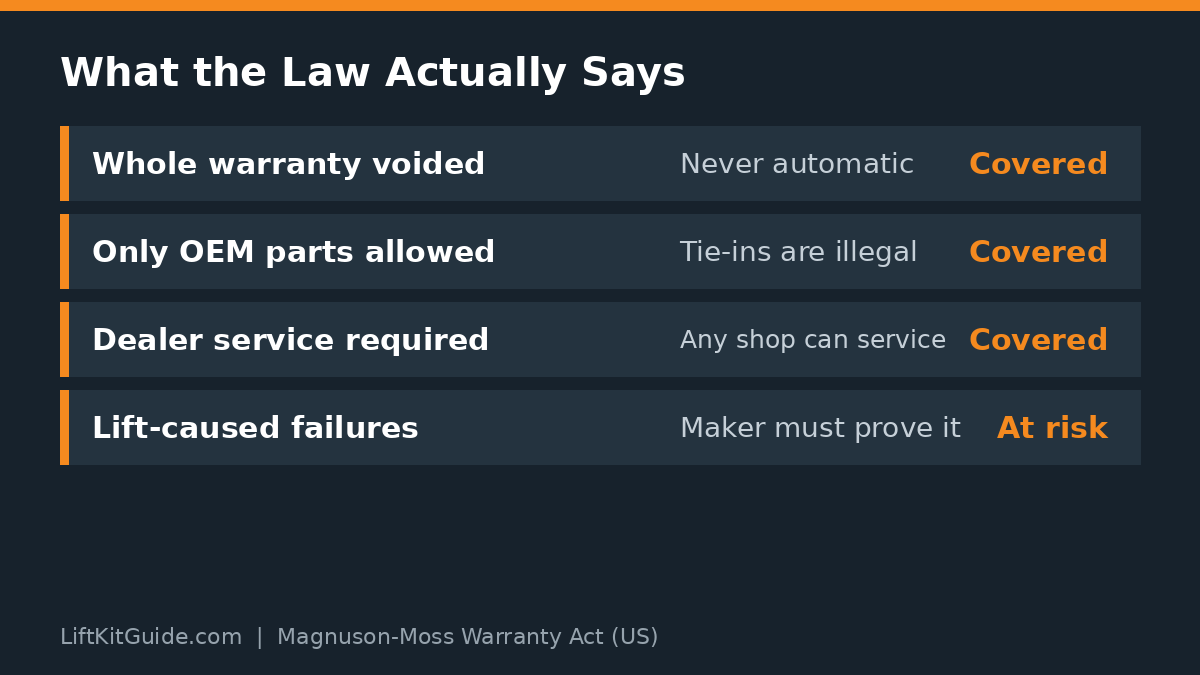
Does a lift kit void warranty coverage on your truck? No. Under the Magnuson-Moss Warranty Act, a federal law in place since 1975, installing a lift kit cannot void your truck’s warranty by itself. A manufacturer or dealer can only deny a specific claim if they prove the lift kit, or the way it was installed, caused the failure. The rest of your coverage — engine, electronics, paint and everything unrelated to the lift — stays in force, and the burden of proof sits with them, not with you.
Key takeaways
- A lift kit cannot void your entire warranty. Under federal law, only an individual claim can be denied, and only if the manufacturer proves the lift caused that failure.
- The Magnuson-Moss Warranty Act (in force since 1975) bans tie-in clauses, so requiring OEM parts or dealer-only service to keep your coverage is illegal unless they are free.
- Claims on parts a lift stresses — CV axles, ball joints, wheel bearings, steering and driveline parts — are the ones a manufacturer can realistically fight.
- Factory and dealer-installed lifts, such as the Toyota TRD lift kit and Ford Performance or GM factory packages, are the lowest-risk route because the lift parts themselves stay covered.
- Extended service contracts are private contracts, not factory warranties, and many exclude lifted trucks outright — read the exclusions before you buy one.
On this page
Can a dealer void your whole warranty because of a lift kit?
No. There is no single switch that turns a truck’s warranty off, and a lift kit does not flip one. Coverage is written part by part and system by system, so a manufacturer cannot cancel the whole warranty just because aftermarket suspension parts are fitted. When owners ask does a lift kit void warranty coverage completely, the honest answer is that a dealer can only refuse an individual claim, and only with evidence that the lift caused that particular failure. Everything unrelated to the modification keeps the same coverage it had the day you bought the truck.
The myth survives because warranty booklets warn that modifications “may affect” coverage, and some service advisors stretch that into a blanket threat. Read carefully, though, and the wording is conditional: a modification matters only where it connects to a failure. Does a lift kit void warranty protection for the engine, the infotainment screen or a paint blister? No. Those systems share nothing with ride height, and a dealer who denied those claims over a lift would have no causation argument to stand on if you challenged the decision.
What does the Magnuson-Moss Warranty Act actually say?
The Magnuson-Moss Warranty Act is the federal law that governs consumer product warranties, including vehicle warranties. Passed in 1975 and administered by the Federal Trade Commission, it stops manufacturers from using warranty terms to lock owners into their own parts and service network. The key provision bans “tie-in” clauses: a warrantor cannot condition coverage on you using a particular brand of part, or a particular shop, unless that part or service is supplied free of charge. Requiring OEM-only parts or dealer-only servicing to keep your warranty is therefore illegal.
The Act also sets the standard for denials, which is the real answer to the question does a lift kit void warranty coverage: a claim can only be refused when the manufacturer shows that the aftermarket part, or a faulty installation of it, caused the failure. Speculation is not enough, and the burden of proof sits with them. The FTC still enforces this — in 2022 it acted against Harley-Davidson over warranty language that threatened owners who used independent dealers or third-party parts. For the primary source, read the FTC’s guide to federal warranty law alongside your warranty booklet, and note that a suspension lift kit is treated like any other aftermarket part.
Which warranty claims are actually at risk after a lift?
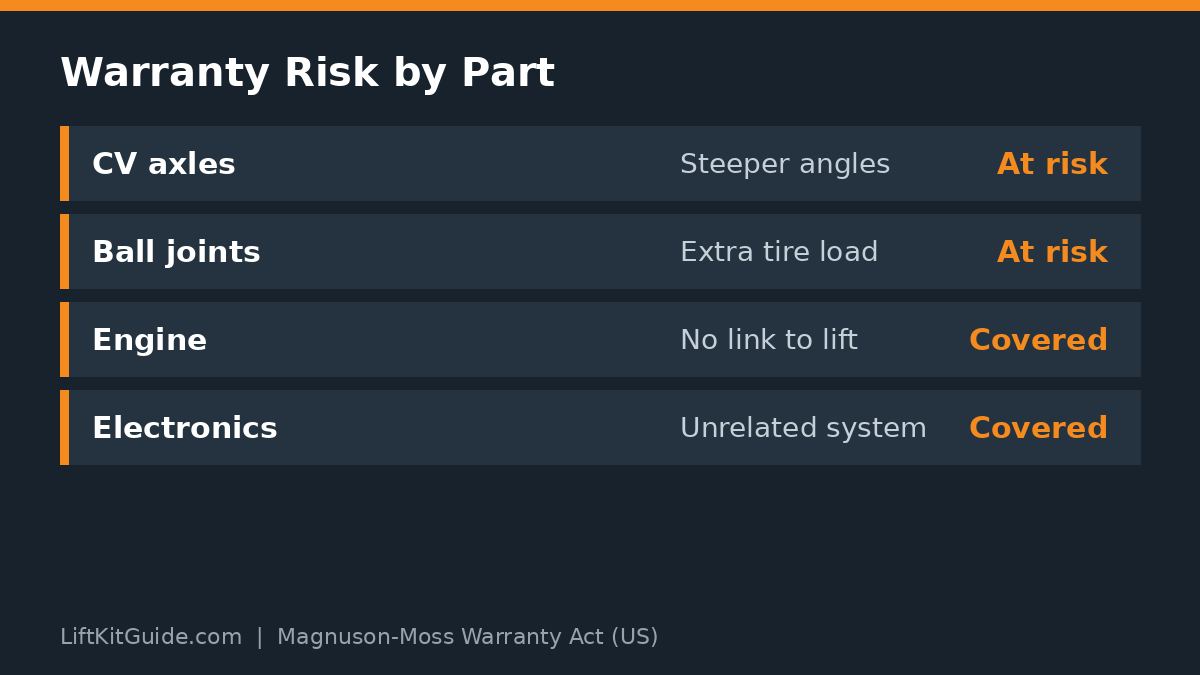
The parts a lift actually stresses are where denials become realistic. Raising the truck steepens CV axle angles, and taller, heavier tires load the ball joints and wheel bearings harder. Driveshaft and U-joint angles change, steering components work at new geometry, and a transmission can be blamed when oversized tires go on without regearing, because the drivetrain effectively pulls a taller final drive everywhere. If one of these parts fails, the manufacturer has a plausible causation story — and those are the claims that get fought over.
Even in this risk zone, a denial is not automatic, and “the truck is lifted” is not evidence by itself. A ball joint that wears out at high mileage may simply be worn out, and the manufacturer still has to connect the failure to the modification. Scale matters too: a mild leveling kit barely changes operating angles, while a tall lift on 37-inch tires changes them a lot. Ask the sharper question — does a lift kit void warranty coverage for these parts, or does it just make claims harder? It is the second one.
| Claim | Typical outcome | Why |
|---|---|---|
| CV axle or boot failure | At risk | Steeper operating angles after a lift |
| Ball joint or wheel bearing wear | At risk | Extra load from taller, heavier tires |
| Driveshaft or U-joint failure | At risk | Changed driveline angles |
| Transmission failure on oversized tires | Contested | No regear means extra strain; causation argued both ways |
| Engine internal failure | Covered | No mechanical link to ride height |
| Electronics or infotainment fault | Covered | Unrelated system |
| Paint or body corrosion | Covered | Unrelated to the suspension |
Are dealer-installed and factory lift kits safer?
Many owners assume the answer to does a lift kit void warranty depends on who installs the kit. Legally it barely does, but the route you choose changes how much argument you will ever face. Factory lift packages are the lowest-risk route: when Toyota sells a TRD lift kit, or GM and Ford Performance offer factory-engineered lift packages, the parts are designed and validated by the manufacturer itself, and coverage stays intact — including coverage on the lift components. Our Tacoma lift kit guide shows how the factory TRD option compares with aftermarket kits.
Dealer-installed aftermarket kits sit in the middle: your legal rights are identical, but a dealer that sold and fitted the kit has little appetite for blaming it later. Having an independent shop do the install changes nothing either — an install by a competent 4×4 shop voids nothing by itself. What matters is the quality of the work and the paper trail: correct torque, the right supporting parts and a post-install alignment. Budget for a proper job using our lift kit installation cost guide, and keep the invoice and alignment printout with your service records.
Does an extended service contract treat a lift kit differently?
Yes — and this is where most horror stories come from. Despite being sold as “extended warranties,” these are private contracts between you and an administrator, not the manufacturer’s warranty. The Magnuson-Moss tie-in protections do not rewrite a private contract, so if the exclusions page says modified or lifted vehicles are not covered, or sets a maximum lift height, the administrator can deny claims on exactly those terms. So does a lift kit void warranty-style protection under a service contract? It can, completely, if the contract says so.
Before buying any contract, read the exclusions section line by line, and get the answer about your planned kit height in writing. Some administrators sell plans that explicitly cover lifted and modified trucks; those cost more but remove the ambiguity. If you already hold a contract, check it before the lift goes on, not after the first claim — by then the terms are already locked in, and a denied contract claim is much harder to appeal than a factory warranty denial.
| Factory warranty | Extended service contract | |
|---|---|---|
| What it is | Manufacturer’s written warranty | Private contract with an administrator |
| Governed by | Magnuson-Moss Warranty Act | The contract’s own terms |
| Can it exclude lifts outright? | No — claims judged case by case | Yes, if the exclusions say so |
| Who must prove causation? | The manufacturer | Depends on the contract wording |
Can you install a lift kit on a leased truck?
A leased truck lives under two rulebooks. The factory warranty still follows Magnuson-Moss, so a lift does not void it in the legal sense. But your lease is a separate contract with the leasing company, and most leases prohibit modifications or require the vehicle to be returned in its original condition. Breach the lease and you face end-of-term charges or demands to restore the truck — a problem no warranty law can help you with, even if every warranty claim would have been honored.
The practical options are straightforward. Get the lessor’s permission in writing before touching the suspension, or choose a reversible setup — a leveling kit rather than a full lift — and keep every factory part so the truck can go back to stock before turn-in. If neither works, wait until you buy the truck out. For a lease, does a lift kit void warranty coverage? The warranty is not the issue. The lease paperwork is. Either way, keep every factory take-off part stored safely until the lease ends.
How can you protect your warranty when you lift your truck?
Paperwork is what turns your legal rights into a won argument. The manufacturer has to prove causation, but you make that proof harder to fake when your records are complete: a quality kit from an established brand, installed correctly, aligned properly and maintained on schedule. Start the folder before the install, not when the first claim is questioned — receipts are easy to keep in the moment and hard to reconstruct a year later. Setting the folder up takes an hour, and it pays off for as long as you own the truck.
A short conversation up front also helps. Tell your service advisor what is fitted and ask how the dealership handles lifted trucks; some dealers are openly modification-friendly, and knowing that before a claim avoids surprises. The same records protect you if an installer error, rather than the kit itself, is blamed for a failure. None of this changes the legal answer — does a lift kit void warranty rights? No — but records decide real-world arguments, and the owner with the folder usually wins them.
- Keep every receipt: the kit invoice, part numbers and the install invoice, all in one folder.
- Save the alignment printout: before-and-after specs prove the truck was set up correctly after the lift.
- Photograph the install: dated photos of the fitted components help if an installation error is ever alleged.
- Record tire size and gearing: note whether you regeared for larger tires — it undercuts the “extra strain” argument.
- Service on schedule: keep maintenance records wherever the work is done, so a denial cannot be pinned on neglect.
What should you do if a warranty claim is denied because of your lift?
If a claim is denied, slow the conversation down and get everything in writing: which part was denied, under what warranty term, and what evidence links the failure to your lift. A verbal “it’s the lift” is not proof of causation, and the manufacturer knows it. Then escalate past the service desk to the manufacturer’s customer care team or zone representative, attaching your receipts, alignment printouts and maintenance records. Keep notes of every call — dates, names and what was promised.
If escalation stalls, complain to the FTC and your state attorney general’s consumer protection office; manufacturers track those complaints and often reopen files. SEMA, the specialty equipment industry association, also publishes guidance for owners disputing modification-related denials. Remember the standard throughout: the question is never simply does a lift kit void warranty — it is whether the lift caused this specific failure, and that is the manufacturer’s claim to prove, not yours to disprove. Organized owners with complete records win these disputes far more often than owners who rely on verbal assurances.
Frequently asked questions
Does a lift kit void warranty if the dealer installs it?
No. Dealer installation does not change the law — a claim still cannot be denied without proof that the kit caused the failure. Dealer- and factory-installed packages, like the Toyota TRD lift kit, are the lowest-risk option because the dealer stands behind its own work and factory packages keep coverage on the lift parts themselves.
Does a lift kit void warranty coverage on unrelated parts?
No. Systems with no connection to the suspension — engine internals, electronics, paint and interior trim — remain covered. The manufacturer would have to prove a mechanical link between the lift and the failure, and for unrelated systems there isn't one. Blanket denials of unrelated claims are exactly what the Magnuson-Moss Warranty Act prevents.
Will bigger tires alone void my warranty?
No. Tires alone cannot void coverage either. Oversized tires do raise the stakes for related claims, though: they add load to wheel bearings and ball joints, and they can strain the transmission if the truck is not regeared. Keep the tire size moderate or regear to match, and keep your receipts, so a drivetrain claim stays defensible.
Do I have to use OEM parts and dealer service to keep my warranty?
No. Requiring a specific brand of parts, or dealer-only service, as a condition of coverage is a "tie-in," and it is illegal under the Magnuson-Moss Warranty Act unless the parts or service are provided free. You can use quality aftermarket parts and any competent shop — just keep records of the parts fitted and the service dates.
Does a lift kit void warranty protection on a leased truck?
The factory warranty follows the same rules on a leased truck, but your lease is a separate contract, and most leases restrict modifications. Check the lease first, get permission in writing, and favor a reversible kit you can remove before turn-in if the lessor requires the truck back in stock condition.
What if the dealer says my lift voided the whole warranty?
Ask for the denial in writing, naming the specific part denied and the evidence that the lift caused the failure. A blanket statement is not enough under federal law. Escalate to the manufacturer's zone representative with your records, and if the denial still doesn't hold up, file a complaint with the FTC or your state attorney general.
The bottom line
So, does a lift kit void warranty coverage on your truck? No — not the whole warranty, and not automatically. Federal law puts the burden on the manufacturer to prove a lift caused a specific failure before that claim can be denied, while unrelated systems stay covered. The genuine risk is narrow: stressed suspension and driveline parts, oversized tires without regearing, and extended service contracts with lift exclusions.
Lift with your paperwork in order — quality parts, a careful install, an alignment printout and full records — and a warranty fight becomes one you are well placed to win. Still planning the build? Compare the numbers in our guides to how much it costs to lift a truck and the itemized cost to lift a truck breakdown before you commit. This article is general information about US warranty law, not legal advice.



1 Comment