


Last updated: October 2026 Written by the LiftKitGuide Team, truck suspension installers and editors
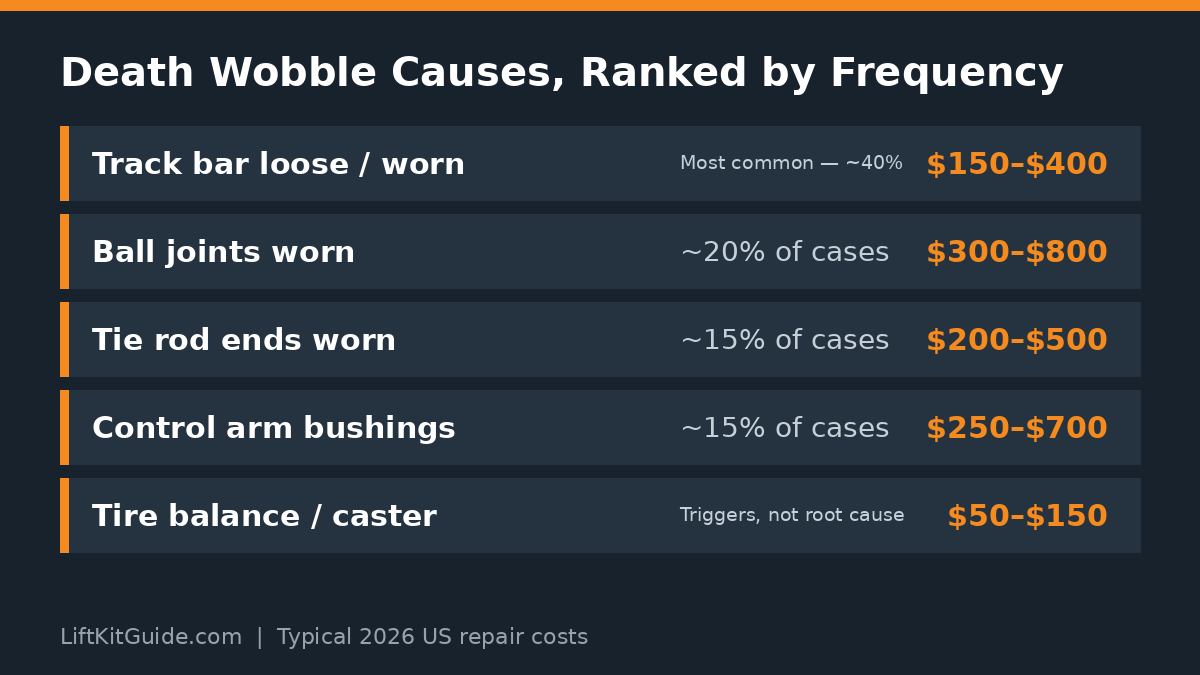
Death wobble after lift kit installation is a violent front-end oscillation, usually between 40 and 60 mph, that starts when a bump sets the axle shaking and loose parts keep it going. The track bar is the most common culprit: bolts torqued with the suspension hanging instead of at ride height, or never retorqued after 50 miles, let the axle shift sideways. Fix it by torque-checking the track bar and control arms at ride height first, then inspecting ball joints, tie rod ends, bushings, and tire balance.
Key takeaways
- Death wobble after lift kit installs most often traces to a loose or improperly torqued track bar — inspect and torque it first.
- Torque all suspension bolts at ride height with the full weight on the tires, then retorque after 50 miles and at every oil change.
- Death wobble typically strikes between 40 and 60 mph after a bump, expansion joint, or pothole.
- A steering stabilizer only masks the oscillation; it never fixes the root cause of death wobble.
- Fixes range from free (a proper retorque) to $300–$800 for ball joints, tie rod ends, or a replacement track bar.
On this page
What is death wobble after lift kit installation?
Death wobble after lift kit installation is not a shimmy or a mild vibration. It is a violent, whole-front-end oscillation that shakes the steering wheel hard enough to feel like the axle is trying to tear itself loose, and it does not stop until you slow down well below the speed where it started. It usually appears between 40 and 60 mph, triggered by a bump, bridge joint, or pothole that knocks the front axle slightly off center. If worn or loose parts allow the axle to keep moving side to side, the motion feeds on itself.
Lifting a truck makes the condition more likely because it changes steering and suspension geometry and adds leverage from taller, heavier tires. Death wobble after lift kit work is rarely a mystery defect in the kit itself; it is almost always an installation detail that was skipped or a worn part the new angles exposed. Understanding that distinction matters, because it turns a frightening experience into a systematic checklist instead of a parts-throwing guessing game.
Many owners confuse death wobble after lift kit installs with bump steer, but the two feel completely different. Bump steer is a mild tug on the wheel when one tire hits a bump; it ends the moment the bump is past. Death wobble is self-sustaining — once the axle starts oscillating, it keeps shaking until you slow down dramatically. Knowing which one you have changes the fix entirely, because bump steer is a geometry issue solved with a dropped pitman arm or raised track bar bracket, while death wobble is a looseness issue solved with a torque wrench.
Why is the track bar the number one cause of death wobble after lift kit installs?
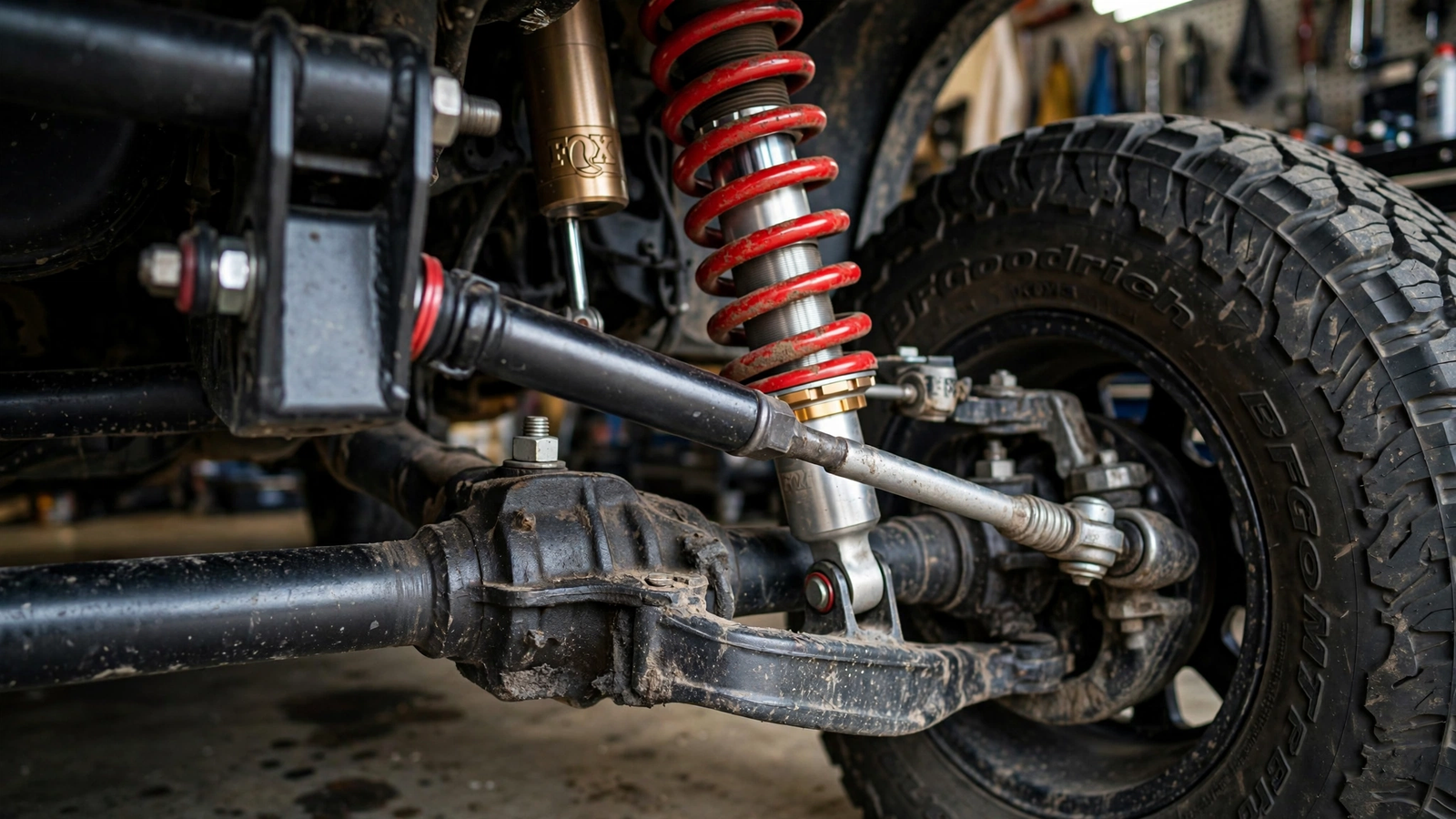
On solid-front-axle trucks and Jeeps, the track bar is the single link that centers the axle side to side under the frame. If its bolts are even slightly loose, the axle can shuffle laterally, and that sideways movement is exactly the motion death wobble needs to sustain itself. The most common installer mistake is torquing the track bar while the truck is on a lift with the suspension drooping. The bushings get pinched in a twisted position, and once the truck is back on its tires, the bolts are effectively under-torqued for real-world loads.
The second classic mistake is skipping the retorque. New bushings settle, hardware seats, and bolts that were perfect on day one can be loose by mile 50. That is why experienced shops insist on a retorque after the first 50 miles, after every hard off-road trip, and at every oil change. A severe episode can even wallow out the bolt hole in the axle-side bracket or crack its welds, so a track bar that has survived repeated wobble deserves a close look at the bracket itself, not just the bolt. If you are planning the job, our lift kit installation cost guide explains what a thorough shop should be doing during and after the install.
Can a worn steering stabilizer cause death wobble?
No. A worn or missing steering stabilizer does not cause death wobble, and a new one does not cure it. The stabilizer is a horizontal shock absorber on the steering linkage whose job is to damp small kicks from the road. When the root cause is a loose track bar or worn ball joints, a fresh stabilizer can hide the symptom for a while, which is why some owners install a heavy-duty stabilizer and declare victory — until the underlying wear gets worse and the wobble returns stronger.
Treat the stabilizer as a supporting actor, not the fix. If your stabilizer is leaking or original with high miles, replacing it with a quality unit is reasonable maintenance, and reputable damper brands are covered in our best lift kit brands guide. But always diagnose and repair the mechanical looseness first. Any shop that proposes a stabilizer as the entire solution to your wobble is selling you a bandage, so find a shop that starts with a torque wrench and a pry bar instead.
A common question is whether a dual steering stabilizer setup finally fixes death wobble after lift kit installs, and the answer is still no — two dampers just hide the problem twice as well. Dual stabilizers have a legitimate use on trucks running 37-inch-plus tires, where the extra tire mass genuinely benefits from more damping, but they belong at the end of a repair, not the beginning. Install them only after the track bar, ball joints, and tie rod ends have all tested tight. If the wobble persists with the stabilizers removed, you have proven the steering is sound; if it vanishes, you have only proven the dampers were doing the joints’ job.
How do you diagnose death wobble step by step?
Start with the truck on the ground at normal ride height, because checking torque with the suspension hanging tells you nothing useful. Have a helper saw the steering wheel back and forth through a few inches of play while you lie underneath and watch every joint: track bar ends, tie rod ends, drag link ends, and ball joints. Any visible lateral movement at a joint that should only pivot is a failed part. Then put a torque wrench on the track bar bolts, control arm bolts, and steering hardware, working to the factory specifications for your truck.
Next, look at what merely triggers the event rather than causing it. Improperly balanced tires, bent wheels, excessive air pressure, separated belts, and poor alignment numbers — especially low caster or insufficient toe-in — can all start the shake that loose parts then sustain. They precipitate death wobble after lift kit installs, but they are not the root cause, so do not stop at a rebalance. Finish by inspecting control arm bushings for binding or tearing, unit bearings for play, and the track bar bracket for ovalled holes or cracked welds. For a deeper look at how lifts change front-end geometry, see our suspension lift kits explained guide.
Keep a simple log of every episode, because the pattern of death wobble after lift kit ownership tells a mechanic more than a vague complaint. Note the speed, the road surface, whether it started after a bump or on smooth pavement, and whether it stops at 45 mph or needs 30. Episodes that always start at the same speed on the same stretch of road point toward tire or balance issues; random episodes at varying speeds point toward looseness. Bring the log to the shop — a technician who sees ‘three episodes, all 52 mph, all after bridge joints’ will reach for the torque wrench before the parts catalog.
- Torque check at ride height: track bar, control arms, and steering bolts to factory spec with weight on the tires.
- Helper steering test: watch each joint for lateral play while someone works the wheel.
- Ball joints and tie rods: jack the axle, pry at 12-and-6 and 3-and-9, and feel for clunks.
- Tires and wheels: balance, bent rims, belt separation, and pressure set to the chalk-test value.
- Alignment numbers: verify caster and toe are within spec for the lifted height.
- Bracket inspection: look for wallowed bolt holes or cracked welds at the track bar mounts.
What torque specs matter most after installing a lift?
The track bar bolt is the single most important fastener in this conversation. As a reference point, the Jeep Wrangler JK track bar bolt specs at 125 ft-lb — but every truck has its own numbers, so always use your factory service manual or the kit manufacturer’s sheet rather than guessing. What matters more than the number is the condition: torque must be set with the full weight of the vehicle on the tires at the new ride height, never with the axle drooping on a lift, or the bushings bind and the reading is meaningless.
Control arm bolts deserve the same treatment, because arms torqued at stock height get their bushings pinched and twisted when the truck settles at its new lifted height. Bound bushings cause strange handling, accelerated wear, and can contribute to the looseness that sustains wobble. After any front-end work, the non-negotiable schedule is a retorque at 50 miles, another after the first serious off-road trip, and a check at every oil change. Skipping this is how death wobble after lift kit jobs shows up weeks after an install that felt perfect on day one.
Torque sequence matters as much as the number when you are chasing death wobble after lift kit installs. Tighten track bar and control arm bolts in stages — snug them with the truck on the ground, bounce the suspension to let the bushings find their neutral position, then bring each bolt to final spec in a crossing pattern rather than cranking one side fully first. Uneven tightening twists the bushings and preloads the axle sideways, recreating the exact looseness you are trying to eliminate. Mark each bolt head and bracket with a paint pen after final torque; a quick visual check at each oil change then shows immediately if anything has rotated.
| Fastener | Why it matters | Torque rule |
|---|---|---|
| Track bar bolts | Centers the axle; the #1 wobble source | Factory spec (e.g. ~125 ft-lb on Jeep JK), set at ride height |
| Control arm bolts | Bound bushings cause handling faults | Loosen before lift, retorque at new ride height |
| Tie rod and drag link ends | Steering play feeds oscillation | Factory spec plus new cotter pins where applicable |
| Lug nuts | Loose wheels mimic front-end wobble | Star pattern to factory spec, recheck after 50 miles |
Do bigger tires make death wobble worse?
Bigger tires do not create death wobble by themselves, but they amplify every weakness in the system. A taller, heavier tire acts as a longer lever on the steering and suspension, so the same small amount of play that was invisible on stock tires becomes a full oscillation on 35s or 37s. That is why wobble so often appears right after a lift and tire upgrade even though the underlying wear — a tired ball joint, a slightly loose track bar — was there all along.
Tire condition still deserves attention during diagnosis. A tire with a separated belt, a bent wheel, or 15 pounds too much air can supply the triggering kick, and an out-of-balance assembly will keep feeding energy into the shake. Set pressures by the chalk test rather than the sidewall maximum, and rule balance in or out early since it is cheap to check. If you are sizing up, our guide to 6-inch lift costs covers the supporting parts — including steering upgrades — that taller tires demand.
Wheel backspacing and offset deserve their own mention, because they quietly decide how hard your tires fight the steering once death wobble after lift kit repairs are complete. Pushing the wheels outward with low-offset or deep-dish wheels increases scrub radius, which multiplies the leverage every bump has on the steering linkage. A truck that is cured of wobble on stock-offset wheels can develop it again after a wheel swap, even with the same tires. If you are choosing wheels with the lift, stay as close to factory backspacing as the tire width allows; the stance looks slightly less aggressive, but the steering stays calm.
How much does it cost to fix death wobble?
The cheapest fix is also the most common one: a proper torque check and retorque at ride height costs nothing but an hour of your time, and it resolves a large share of cases where the install was simply never finished correctly. If hardware or bracket damage is found, a heavy-duty replacement track bar typically runs $150 to $400, and a reinforced bracket is a smart add on trucks that have wobbled hard more than once.
Worn steering parts move the bill upward but stay reasonable. Ball joint replacement commonly lands between $300 and $800 depending on the truck and whether you do the work yourself, while tie rod ends and a drag link refresh usually fall in the $200 to $500 range. A full front-end rebuild with quality parts can approach $1,000 to $1,500 installed. Compare that against the cost of ignoring it: repeated wobble hammers brackets, bushings, and bearings, turning a free retorque into a four-figure repair. If the episode raised warranty questions, our lift kit warranty guide explains where you stand.
| Fix | Typical cost | When it applies |
|---|---|---|
| Retorque at ride height | Free (DIY) | Most common fix; always the first step |
| Replacement track bar | $150–$400 | Worn bushings, bent bar, or damaged ends |
| Track bar bracket reinforcement | $50–$200 | Wallowed bolt holes or cracked welds |
| Ball joints | $300–$800 | Vertical or lateral play at the knuckle |
| Tie rod ends / drag link | $200–$500 | Steering play found in the helper test |
| Steering stabilizer | $80–$250 | Maintenance only — never the actual cure |

How do you prevent death wobble after lifting your truck?
Prevention is almost entirely about installation discipline. Insist that the shop loosens control arm and track bar bolts before the lift, sets the truck on its tires at the new ride height, rocks the suspension to settle it, and only then torques everything to spec. Ask for the alignment printout with caster and toe numbers rather than accepting a verbal ‘it is within spec.’ A shop that balks at either request is a shop to avoid, and model-specific guidance like our Silverado lift kit guide can tell you what correct looks like for your truck.
After the install, the maintenance schedule is what keeps death wobble after lift kit ownership a non-issue. Retorque at 50 miles, recheck after hard wheeling trips, rotate and balance the big tires on schedule, and keep pressures at the chalk-test value instead of the sidewall maximum. Catching a bolt that has backed off a quarter turn during a routine check is infinitely cheaper than catching it at 55 mph. Do that, and the wobble stays a story other people tell.
Frequently asked questions
What does death wobble feel like?
Death wobble feels like the entire front end is shaking violently side to side, with the steering wheel jerking hard in your hands. It usually starts between 40 and 60 mph after hitting a bump and will not stop until you slow down significantly. It is unmistakable and frightening — if you are unsure whether what you felt qualifies, it was probably just a shimmy.
Is it safe to drive with death wobble?
No. Death wobble can damage track bar brackets, crack welds, wallow out bolt holes, and destroy bushings and bearings with each episode, and in extreme cases it can contribute to a loss of control. When it starts, ease off the throttle and let the truck slow on its own rather than braking hard, then drive gently to a qualified 4×4 shop. Do not keep driving at highway speed hoping it was a one-time event.
Will an alignment fix death wobble after lift kit installation?
An alignment alone will not fix death wobble after lift kit installation if the root cause is a loose track bar or worn steering parts — no alignment setting can tighten a bolt. However, correct caster and toe-in are important supporting factors, and poor alignment numbers can trigger episodes in a front end that is already marginal. Get the mechanical looseness fixed first, then verify the alignment is set correctly for the lifted height.
How tight should track bar bolts be?
Use your truck's factory service manual specification — as a reference, the Jeep Wrangler JK track bar bolt specs at 125 ft-lb. The critical detail is torquing with the full weight on the tires at ride height, not with the suspension drooping on a lift. Always retorque after the first 50 miles, after hard off-road trips, and at every oil change, since settling bushings let hardware loosen.
Should I upgrade my steering stabilizer to stop death wobble?
A steering stabilizer upgrade is fine as maintenance, but it will not stop death wobble because it only damps the symptom. Spend that money on the actual diagnosis first: torque check, ball joints, tie rod ends, and bushings. Once the front end is mechanically tight, a quality stabilizer is a reasonable supporting upgrade — never the primary fix.
Can death wobble damage my truck?
Yes. Repeated episodes can crack track bar bracket welds, oval out bolt holes, destroy bushings, and hammer ball joints and unit bearings. The damage compounds: each wobble loosens and wears the parts that the next wobble needs to be tight. That is why fixing it at the first occurrence — starting with a free torque check — saves far more than the repair itself.
The bottom line
Death wobble after lift kit installation is scary but almost always traceable to a short list: a track bar torqued in the wrong condition or never retorqued, worn ball joints or tie rod ends, or damaged brackets from previous episodes. Work the checklist in order — torque at ride height first, then joints, then tires and alignment — and resist the urge to start with a steering stabilizer.
The 50-mile retorque is the single highest-value habit in lifted truck ownership. It costs nothing, takes an hour, and prevents the most common cause of death wobble before it ever starts. Do the install right, maintain the torque, and the wobble stays someone else’s problem.




Leave a comment