


Last updated: October 2026 Written by the LiftKitGuide Team, truck suspension installers and editors
Do you need a tune after bigger tires? For most trucks, no — a speedometer calibrator that corrects the computer for the new tire diameter is enough. Taller tires make the speedometer and odometer read slow (about 6 percent slow going from 33s to 35s, so 65 mph indicated is roughly 69 actual), and they can confuse shift points, cruise control, and MPG math. A plug-in calibrator ($150–$250) fixes the readings; a full ECU tune is only worth it if you also want firmer shifts, throttle response, or have regeared.
Key takeaways
- Do you need a tune after bigger tires? Usually not — a speedometer calibrator ($150–$250) corrects the readings a taller tire throws off.
- Going from 33-inch to 35-inch tires makes the speedometer read about 6 percent slow: 65 mph indicated is roughly 69 mph actual.
- The odometer under-records miles with bigger tires, which also skews MPG math and maintenance intervals.
- A full ECU tune is worth considering only if you want revised shift points, sharper throttle, or have changed gear ratios.
- Popular calibrators include the Hypertech Inline Speedometer Calibrator and the Rough Country calibrator, plus dealer reflash on some trucks.
On this page
Do you need a tune after bigger tires, or just a calibrator?
Do you need a tune after bigger tires, or will a simple calibrator do the job? For the vast majority of daily-driven trucks, a calibrator is the right answer. A calibrator is a small plug-in module that tells the truck’s computer the true tire diameter, so the speedometer, odometer, and systems that depend on vehicle speed read correctly again. It does not change engine power, fuel maps, or transmission behavior — it just fixes the math the bigger tire broke.
A full ECU tune is a different animal. Tunes rewrite engine and transmission parameters: shift points, shift firmness, throttle mapping, and sometimes speed limiters. If your only change is one tire size up, a tune is overkill and an unnecessary expense. The question do you need a tune after bigger tires really becomes interesting when the tire change is large (35s to 37s), when the transmission hunts for gears, or when you have also regeared the axles and want everything working as one system.
Some owners ask whether a phone app or OBD-II dongle can do the same job as a dedicated calibrator, and the honest answer to do you need a tune after bigger tires stays the same either way: the truck needs its programmed tire diameter corrected, and the tool is just the delivery method. App-based tools work on certain newer trucks, but coverage is spotty and updates can break compatibility overnight. A dedicated inline calibrator from an established brand is the boring, reliable choice — it stays with the truck, survives dealer visits, and never needs a subscription.
How far off is your speedometer with bigger tires?
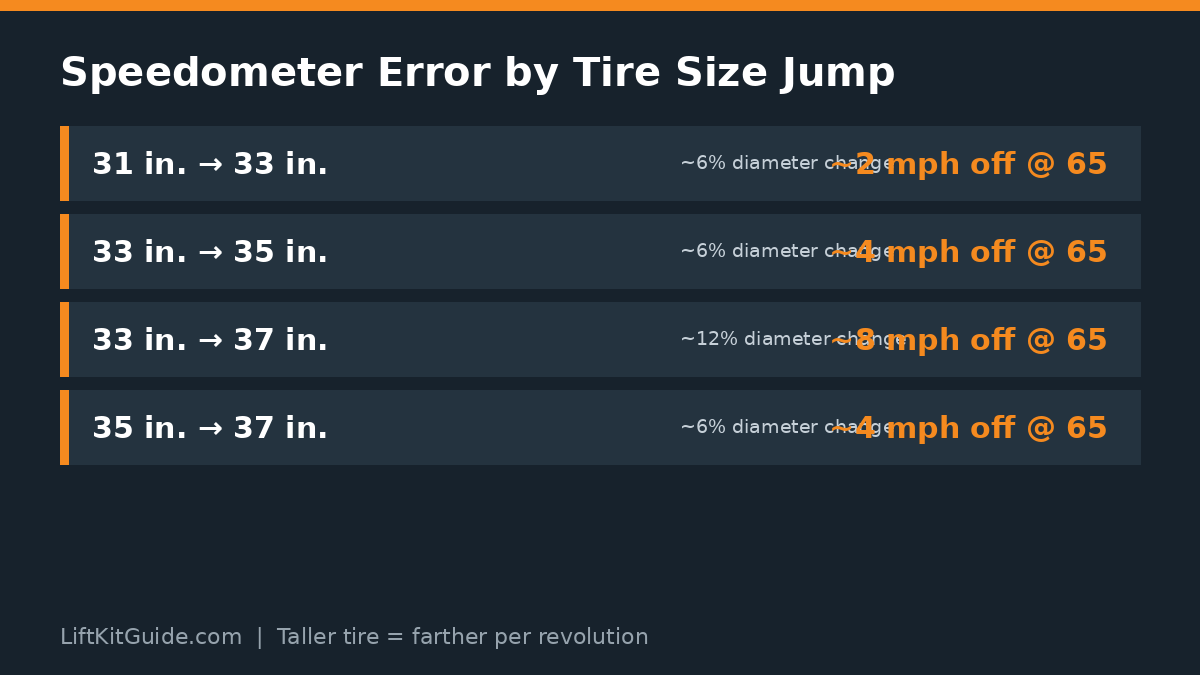
The math is simple: a taller tire travels farther per revolution, so the speedometer under-reads. Going from a 33-inch tire to a 35-inch tire is roughly a 6 percent increase in diameter, which means the speedometer reads about 6 percent slow. At an indicated 65 mph you are actually doing close to 69 mph, and at an indicated 80 you are near 85. Jump from 33s to 37s and the error doubles to roughly 12 percent — enough to matter for speeding tickets and following distances.
The error also drifts over the tire’s life. A new 35 can measure close to its advertised height, while a worn one may be nearly an inch shorter, shifting the error by several percent as tread disappears. Factory speedometers are rarely perfect to begin with — many read 2 to 3 mph optimistic from the showroom — so some owners find a one-inch taller tire actually brings the reading closer to true. Measure against a GPS app before spending money; you can compute your exact percentage with a tire size calculator that shows speedometer error.
| Tire change | Diameter change | Speedometer error | 65 mph indicated = |
|---|---|---|---|
| 31 in. to 33 in. | About +6% | Reads ~6% slow | About 69 mph actual |
| 33 in. to 35 in. | About +6% | Reads ~6% slow | About 69 mph actual |
| 33 in. to 37 in. | About +12% | Reads ~12% slow | About 73 mph actual |
| 35 in. to 37 in. | About +6% | Reads ~6% slow | About 69 mph actual |
What does a speedometer calibrator actually fix?
A calibrator corrects every system that derives its information from wheel speed. The speedometer reads correctly, the odometer records true miles (important for resale value and warranty mileage), trip MPG math becomes honest again, and cruise control holds the speed you actually set. On many trucks it also settles down stability and traction control systems that compare wheel speeds and can get confused when the programmed tire size no longer matches reality.
What it does not do is add power or change how the transmission behaves beyond restoring correct speed input. If your truck with 35s feels sluggish off the line or the transmission constantly hunts between gears on grades, that is an effective-gearing problem, not a calibration problem — and no plug-in module fixes gearing. That distinction is exactly why the do you need a tune after bigger tires question has two different answers depending on whether your complaint is wrong readings or wrong behavior.
One system a calibrator does not touch is tire pressure monitoring. TPMS sensors live inside the wheels and report pressure, not size, so do you need a tune after bigger tires has no bearing on TPMS — but the bigger tire changes the correct pressure value. A 35-inch tire typically wants less pressure than the door-jamb sticker specifies for the stock tire, because the larger air volume carries the load at lower PSI. Set pressure with the chalk test after the size change, then reset the TPMS baseline so the warning light triggers at the right threshold instead of the factory one.
- Speedometer: reads true speed again instead of under-reading by the diameter percentage.
- Odometer: records actual miles, protecting resale value and service intervals.
- Cruise control: holds the speed you set rather than a slower true speed.
- MPG calculations: trip computer math becomes accurate instead of optimistic.
- ABS and stability systems: stop comparing wheel speeds against a wrong baseline.
When do you need a tune after bigger tires?
Do you need a tune after bigger tires when the jump is two sizes or more? Often yes, at least in the sense of addressing drivability rather than just the speedometer. With 37s on stock gearing, many trucks feel lazy, downshift constantly on highways, and run the transmission hotter — symptoms a calibrator cannot touch because they come from the effective gear ratio getting taller, not from bad speed data. In that situation the real fixes are regearing the axles, a transmission tune with revised shift strategy, or both.
A tune also makes sense when you have stacked changes: bigger tires plus a lift, plus heavier wheels, plus armor or a winch. Each change loads the drivetrain a little more, and a quality tune can restore throttle response and shift logic for the finished package. If you are budgeting the whole build, our cost to lift a truck guide helps you price tires, gears, and tuning together instead of discovering the costs one surprise at a time.
Diesel owners face a slightly different calculus. A diesel’s torque curve tolerates taller effective gearing better than a gas V8, so do you need a tune after bigger tires on a Power Stroke or Cummins is more often answered with just a calibrator. That said, diesels respond exceptionally well to transmission tuning when towing on 35s, because holding gears longer and locking the converter sooner keeps exhaust gas temperatures in check on grades. Gas trucks feel the gearing loss more immediately and are the better candidates for regearing first.
Can the dealer recalibrate your speedometer?
Sometimes. Many dealers can reprogram the tire size in the computer for sizes within the factory-supported range, often for a half hour to an hour of labor. The catch is the range: dealer tools typically only accept tire sizes the truck could have come with or modestly larger, so a jump to 35s or 37s is frequently outside what the factory software allows. It is worth one phone call with your exact tire size before buying anything, since a dealer reflash is clean, warranty-friendly, and invisible.
When the dealer cannot do it, the aftermarket takes over. The Hypertech Inline Speedometer Calibrator is the benchmark product, supporting all valid gear ratios with no upper tire-size limit, and the Rough Country calibrator is a popular rebadged alternative at a similar price. Jeep owners have the Tazer, and Superchips Flashcal covers many applications. All of them install in under an hour with basic hand tools, and none of them is a ‘tune’ in the ECU-remap sense — which is fine, because calibration is all most trucks need.
How do bigger tires affect shift points and MPG readings?
Bigger tires make the effective gearing taller, so the engine turns fewer RPM at a given road speed. The transmission’s shift schedule was written for the stock tire, which means upshifts arrive at the wrong road speed and the converter unlocks more often under load. Around town you may barely notice; on grades or towing, the hunting between gears is the classic symptom. This is mechanical, not electronic — correcting the speedometer does not restore the lost mechanical advantage, which is why regearing exists.
MPG readings lie in two directions at once. The odometer under-records miles, so hand-calculated economy looks worse than reality, while the trip computer’s optimism varies by vehicle. Bigger, heavier tires also genuinely burn more fuel through rolling resistance, aerodynamic drag, and weight — typically 1 to 3 MPG on a half-ton. If economy matters to you, the honest answer to do you need a tune after bigger tires includes accepting that no tune recovers the physics of pushing a heavier, taller tire down the road.
If the gear hunting drives you crazy before you can afford a regear, the tow/haul mode is a free interim fix. Tow/haul raises shift points and firms shifts using factory programming, which partially compensates for what do you need a tune after bigger tires complaints describe: late upshifts and constant converter unlocking. It will cost you some fuel economy and it is not a substitute for correct gearing, but for a daily driver on 35s it takes the edge off. Think of it as the factory’s own mild transmission tune, included free with every truck.
How much does speedometer calibration or a tune cost?
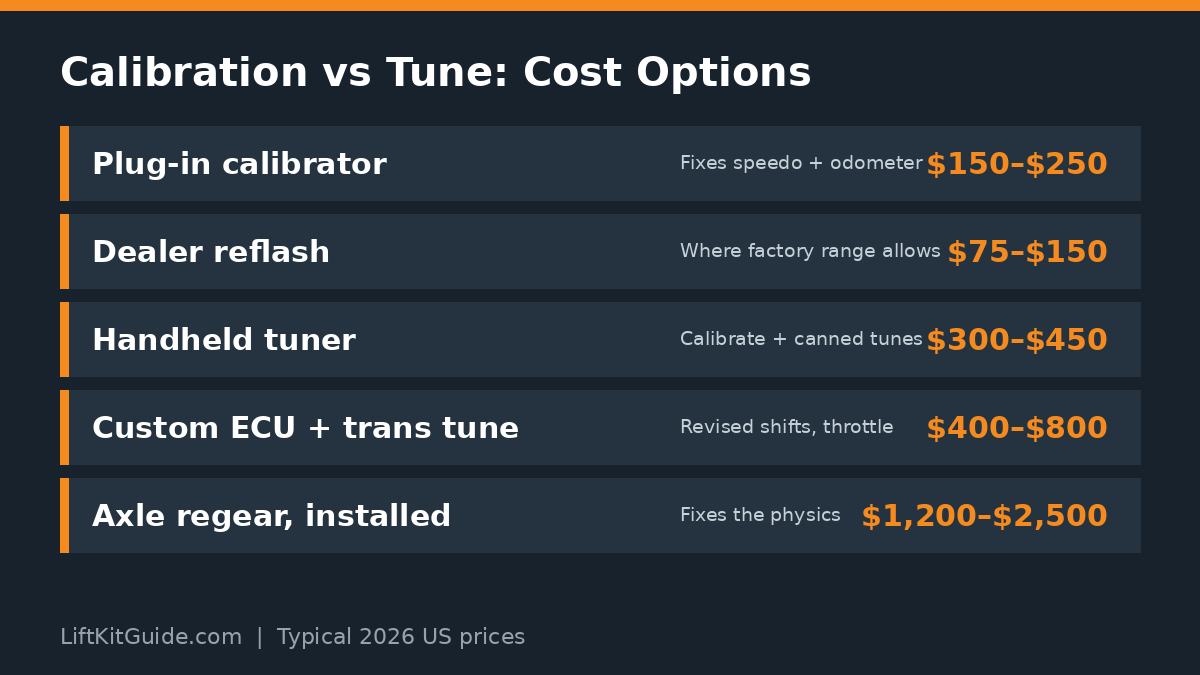
Speedometer calibration is one of the cheaper corrections in the lifted-truck world. Plug-in calibrators run $150 to $250, a dealer reflash (when supported) is typically $75 to $150 in labor, and installation is a driveway job on most trucks. Compared with the tires themselves, it is a small line item — which is why skipping it makes little sense once the error passes about 5 percent.
A full custom ECU and transmission tune is a bigger commitment at $400 to $800 including the device and tunes, and it makes the most sense bundled with regearing. Axle regearing itself is the expensive piece at $1,200 to $2,500 for both axles installed. Our lift kit installation cost breakdown shows how these supporting costs stack onto the lift itself, and the suspension lift kits guide explains which lift heights push you into 35-plus territory where all of this starts to matter.
Budget the calibration as part of the total build, not as an afterthought. Tires, wheels, lift, gears, and calibration together define the real price of going bigger — our 6-inch lift cost guide breaks down the full stack so the calibrator does not arrive as a surprise line item. Owners who price everything up front almost always end up happier than those who discover supporting costs one credit-card statement at a time, and calibration is the cheapest of those surprises to prevent.
| Option | Typical cost | Best for |
|---|---|---|
| Plug-in calibrator (Hypertech, Rough Country) | $150–$250 | Correcting speedometer and odometer on most trucks |
| Dealer reflash | $75–$150 | Trucks where the new size is within factory range |
| Handheld tuner with tire-size setting | $300–$450 | Owners who also want canned performance tunes |
| Custom ECU + transmission tune | $400–$800 | Stacked mods, regeared axles, drivability complaints |
| Axle regear (both axles, installed) | $1,200–$2,500 | 35s and larger with hunting gears or towing duty |
Do you need a tune after bigger tires for 35s?
Do you need a tune after bigger tires if you are running 35s? For most half-ton trucks, the answer is a calibrator, not a tune. Thirty-fives are the sweet spot where the speedometer error (about 6 percent over stock 33s) is big enough to fix but the drivability change is small enough that most drivers adapt within a week. Set the calibrator, verify against GPS, and spend the tune money on something the truck actually needs.
The exceptions are trucks that tow heavy, live in the mountains, or came with tall factory gearing (like 3.21s) where 35s make every grade a downshift battle. In those cases the honest fix is gears first and a tune second, because no electronic adjustment replaces mechanical advantage. And if you started from a smaller stock tire — say 31s to 35s in one jump — treat it like the two-size change it is and budget accordingly. For the full picture on what 35s demand from the rest of the truck, see our benefits of lifted trucks guide and the leveling kit explainer if you are still deciding how much lift the 35s actually need.
Frequently asked questions
Do you need a tune after bigger tires for just one size up?
No. Going up one tire size (for example 33s to 35s) changes the speedometer by about 6 percent, which a $150–$250 plug-in calibrator corrects completely. A full ECU tune is unnecessary unless you are also chasing drivability problems like gear hunting or want revised shift logic for towing.
Will bigger tires void my warranty if I do not recalibrate?
Bigger tires alone do not automatically void a warranty, but an uncorrected odometer can complicate warranty mileage claims, and dealers have denied drivetrain claims when oversized tires were clearly overloading components. A calibrator keeps your recorded mileage honest, which removes one argument.
Does a speedometer calibrator affect the odometer too?
Yes — and that is a feature, not a side effect. The odometer, trip computer, and maintenance reminders all derive from the same vehicle-speed signal, so correcting the tire diameter fixes them together. With 35s uncorrected, you are under-recording roughly 6 percent of your miles, which skews service intervals and resale mileage.
Do you need a tune after bigger tires and a lift kit together?
Not necessarily. The lift itself does not change what the computer needs — the tire diameter does. A truck with a 3-inch lift and 35s needs the same calibration as a stock-height truck with 35s. Consider a full tune only if the combination also brought drivability complaints: gear hunting, lazy throttle, or towing struggles that calibration alone cannot fix.
Can I just do the speedometer math in my head instead?
You can — many owners simply remember they are 6 percent fast — but the odometer, MPG math, cruise control, and service intervals stay wrong, and anyone else driving the truck will not know the trick. At $150–$250, a calibrator is cheap permanent accuracy versus a lifetime of mental math and skewed records.
Will a tuner fix gear hunting with 35s?
Partially. A transmission tune with revised shift points can reduce hunting, but it cannot replace the mechanical advantage lost to taller tires — that requires regearing the axles. Think of it as a hierarchy: calibrator fixes the readings, tune improves the behavior, gears fix the physics. For trucks that tow or live in hills on 35s-plus, budget for gears.
The bottom line
Do you need a tune after bigger tires? For one size up, the answer is almost always a calibrator, not a tune: $150 to $250 restores honest speedometer, odometer, cruise, and MPG readings in under an hour. It is the cheapest correction in the lifted-truck world and the one most often skipped.
Reserve the full tune — and the regear it usually accompanies — for real drivability problems: gear hunting, towing struggles, or jumps of two sizes and more. Fix the math first with calibration, then spend tune money only on behavior the calibrator cannot change.





1 Comment