


Last updated: October 2026 Written by the LiftKitGuide Team, truck suspension installers and editors
Body lift vs suspension lift comes down to this: a body lift raises only the body on spacers for $200–$600 in parts, creating tire room without touching the suspension or frame height, while a suspension lift replaces working components for $500–$5,300, raising the frame for real ground clearance and travel. Choose a body lift for looks and mild tires on a budget; choose a suspension lift for off-road performance, bigger tires, and genuine clearance.
Key takeaways
- Body lift vs suspension lift: a body lift ($200–$600 parts) raises the body only; a suspension lift ($500–$5,300) raises the frame.
- A body lift adds zero frame ground clearance — only bigger tires raise the axles and differentials.
- Body lifts top out around 3 inches and usually need no alignment; suspension lifts need alignment and geometry correction.
- For off-road use, a suspension lift wins on clearance, travel, and articulation every time.
- A popular compromise is a 2-inch suspension lift plus a 1-inch body lift for big tires with milder geometry changes.
On this page
What is the difference between body lift vs suspension lift?
The mechanical difference is simple. A body lift installs spacers or pucks between the body and the frame, raising the cab and bed while the frame, suspension, axles, and drivetrain stay exactly where they were. A suspension lift replaces or modifies springs, shocks, control arms, and related parts so the frame itself rises, carrying the body up with it. Same advertised inches, completely different trucks underneath.
That distinction drives every other difference in the body lift vs suspension lift debate. Because a body lift never touches the suspension, it does not change ride quality, does not alter suspension geometry, and generally does not require a wheel alignment. A suspension lift changes all of those things, which is why it costs more, takes longer to install, and demands more supporting parts — but also why it is the only option that actually improves off-road capability.
Body mounts are the unsung hardware in this decision. A body lift reuses the factory body mounts with taller pucks, which is why the body lift vs suspension lift choice affects long-term maintenance: aging rubber mounts should be replaced while the body is already lifted, since you are paying the labor either way. Polyurethane replacement mounts firm up the body-to-frame connection and last longer than rubber, and installing them during the lift adds only the parts cost. It is the kind of while-you-are-in-there upgrade that separates a careful install from a rushed one.
How much does body lift vs suspension lift cost?
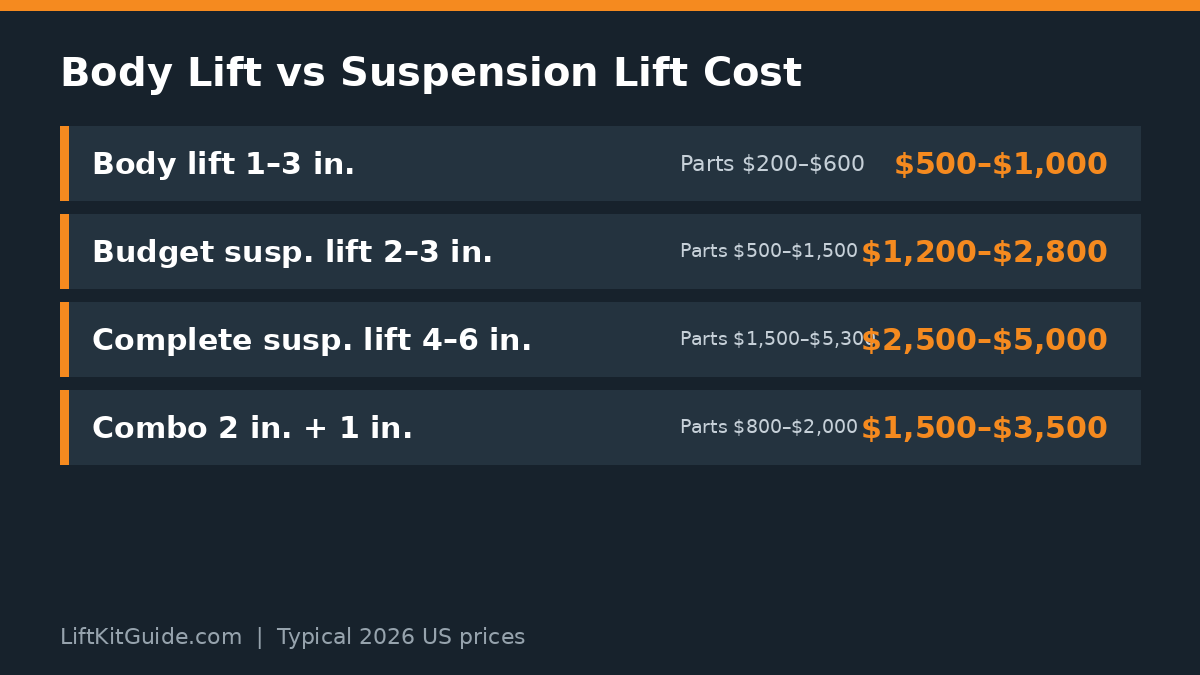
On cost, body lift vs suspension lift is not close. Body lift kits typically run $200 to $600 for the parts — around $300 buys a complete kit for many trucks — and installation is straightforward enough that total bills often land between $500 and $1,000. The kit is mostly spacers, hardware, and brackets, so there is simply less to buy and less labor to pay for.
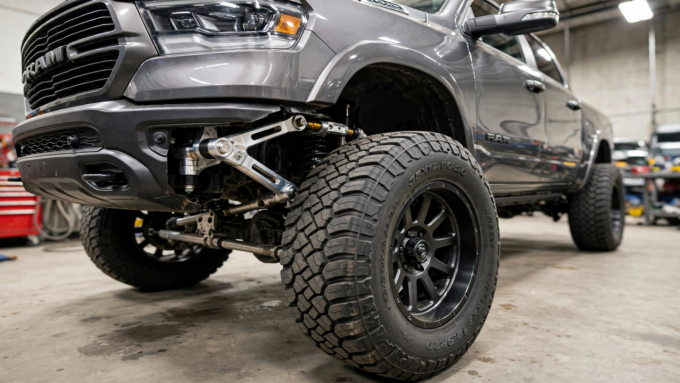
Suspension lift kits range from about $500 for basic spacer-and-block setups to $5,300 or more for complete engineered systems with quality dampers and geometry correction. Installed totals commonly run $1,200 to $5,000 depending on height and components. Our lift kit installation cost guide and cost to lift a truck breakdown show how labor, alignment, and supporting parts stack up on the suspension side.
Resale value rarely favors either choice strongly, but it punishes extremes. A clean 2-inch body lift on a street truck barely moves the needle with buyers, while a hacked-together 6-inch suspension lift with cheap components can scare them off. The builds that hold value are the ones with receipts: name-brand kits, professional installation, alignment printouts, and matching tires with even wear. Whatever you spend, keep the paperwork — a folder of receipts turns ‘lifted truck’ from a buyer’s risk into a seller’s selling point.
| Lift type | Typical parts cost | Typical installed total |
|---|---|---|
| Body lift (1–3 in.) | $200–$600 | $500–$1,000 |
| Budget suspension lift (2–3 in.) | $500–$1,500 | $1,200–$2,800 |
| Complete suspension lift (4–6 in.) | $1,500–$5,300 | $2,500–$5,000 |
| Combo: 2 in. suspension + 1 in. body | $800–$2,000 | $1,500–$3,500 |
Which lift gives more ground clearance?
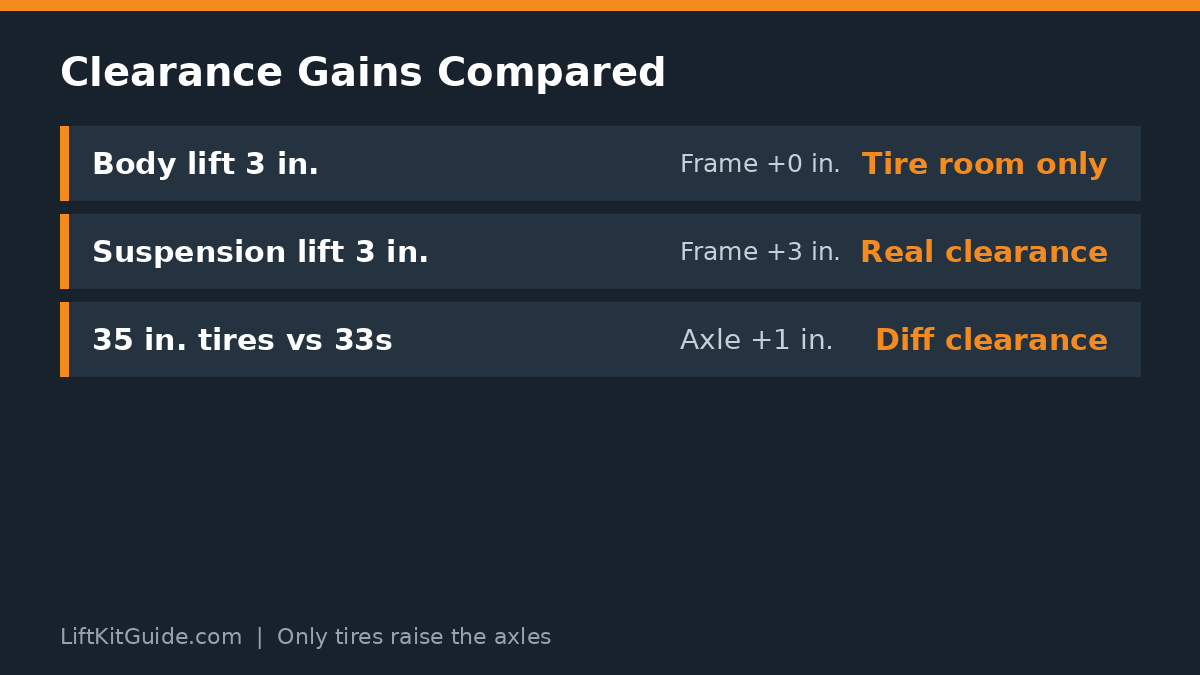
The suspension lift, by a wide margin — and this is the most misunderstood point in the body lift vs suspension lift comparison. Ground clearance that matters off-road is measured at the lowest hanging components: differentials, the frame, and skid plates. A body lift raises none of them. The frame sits at exactly stock height, so the only clearance gain comes from whatever larger tire the extra fender room allows — and only the tire’s radius gain counts, which is half the diameter increase.
A suspension lift raises the frame roughly one inch for every inch of lift, plus whatever the bigger tires add at the axles. That is real, usable clearance under the chassis where rocks and ruts actually hit. If your goal is clearing obstacles rather than clearing fenders, there is no debate: only the suspension lift moves the parts that drag.
Breakover angle is the forgotten measurement in the body lift vs suspension lift clearance debate. Approach and departure angles get all the attention, but breakover — the angle over the crest of a hill — is determined by wheelbase and underbody height, and only a suspension lift improves it. A body-lifted truck with 35s still drags its belly on sharp crests where a suspension-lifted truck on the same tires clears. If your trails include V-ditches and rocky crests rather than just mud, breakover angle alone settles the choice.
How do they compare for off-road performance?
Off-road, the comparison is lopsided. A suspension lift improves approach and departure angles, increases suspension travel and articulation, and keeps the tires in contact with uneven ground longer. Those are the capabilities that get a truck through rocks, ruts, and washouts. A body lift improves none of them — the suspension cycles exactly as stock, just with a taller body riding on top.
That does not make body lifts useless off-road; the bigger tires they allow do add traction and a small clearance gain at the diffs. But a truck with a body lift and 35s will still high-center where a suspension-lifted truck on the same tires walks through, because its frame is three inches lower. For anything beyond light trails and forest roads, the suspension lift kits guide is where the serious capability lives, and our benefits of lifted trucks article breaks down what that capability is worth.
Articulation — how far each wheel can travel independently — is where suspension lifts earn their money off-road. Longer shocks, corrected control arm angles, and sometimes dropped brackets let the axle droop and compress through a much wider range, keeping tires planted on uneven ground. A body lift leaves articulation exactly at stock levels, so on crossed-up terrain the body-lifted truck lifts tires and spins while the suspension-lifted truck walks through. Tire size helps both equally; only the suspension lift changes what the suspension can do with it.
| Capability | Body lift | Suspension lift |
|---|---|---|
| Frame ground clearance | No change | Gains ~1 in. per inch of lift |
| Suspension travel | No change | Increased with proper components |
| Approach/departure angles | Slight (tire only) | Significantly improved |
| Ride quality | Unchanged | Depends on kit quality |
| Wheel alignment needed | Usually not | Always |
What are the downsides of a body lift?
Body lifts have honest drawbacks you should know before buying on price alone. The most visible is the gap: with the body three inches higher, you can see daylight between the frame and the body, the bumpers sit low relative to the body, and the trailer hitch hangs exposed. Gap guards and relocated bumpers fix the look, but they are extra parts and extra work that narrow the price advantage.
There are functional details too. Fuel filler hoses, shift linkages, steering shafts, and wiring may need extending; the higher center of gravity affects handling slightly; and most kits top out at 3 inches, which limits the tire size. Off-roaders also note that body lifts put additional leverage on the body-mount bolts, so quality Grade 8 hardware and proper torque matter more, not less. None of this disqualifies the body lift — it just means the cheapest option has its own bill of details.
The steering shaft extension is the body lift vs suspension lift detail that worries engineers most. Raising the body three inches stretches the distance between the steering column and the steering box, and the extension joint becomes another wear point in the most safety-critical system on the truck. Quality kits include a proper extension with correct splines and a secure clamp; cheap kits sometimes leave the shaft barely engaged. During installation, verify full spline engagement and cycle the steering lock to lock before the truck ever moves under its own power.
- Visible frame gap: plan on gap guards or accept seeing between body and frame.
- Bumper mismatch: bumpers stay with the frame; relocation brackets cost extra.
- Small details multiply: filler necks, linkages, and wiring extensions add up.
- 3-inch ceiling: most kits max out, limiting how big a tire you can chase.
- No performance gain: beyond tire room, the truck works exactly as stock.
Can you combine a body lift and a suspension lift?
Yes, and it is one of the smartest compromises in the body lift vs suspension lift world. A mild 2-inch suspension lift plus a 1-inch body lift nets three inches of tire clearance with far less suspension geometry change than a 3-inch suspension lift alone. You get most of the look and tire room while keeping driveline angles, steering geometry, and alignment closer to happy.
There are two caveats. First, some suspension lift manufacturers discourage or void warranty coverage when their kit is combined with a body lift, so check the fine print before stacking. Second, the combination still carries the body lift’s cosmetic details — gap guards, bumper brackets, linkage extensions — so budget for those. Done thoughtfully, though, the combo is how many owners clear 35s without paying for a full bracket lift. For a deeper dive on the suspension side, the comparison at AxleAddict’s body lift vs suspension lift breakdown is a solid second opinion.
Check local inspection rules before stacking lifts. Some states measure bumper height or headlight height from the ground, and a combined lift can push a truck past the legal limit even when each lift alone would pass. Frame-height laws in particular target the exact thing a body lift adds, so the combo that looks clever in the garage can fail at the inspection station. A quick check of your state’s modified-vehicle rules takes ten minutes and beats discovering the problem with a rejection sticker.
Which is better for daily driving?
For a pure daily driver that never leaves pavement, the body lift has a genuine case. It preserves the factory ride, factory handling, and factory reliability because it changes nothing mechanical — it is the only lift that leaves the truck driving exactly as the engineers tuned it. If the goal is stance and slightly bigger tires for the street, spending $500 to $1,000 instead of $3,000 is rational, not cheap.
The suspension lift’s daily-driving case rests on quality. A well-engineered kit with proper dampers and alignment can ride as well as stock or better, and many owners prefer the more controlled feel. But a cheap suspension lift rides worse than stock while costing more than a body lift — the worst of both worlds. For daily use, the rule is simple: either keep it factory-simple with a body lift, or spend enough on the suspension lift to do it right. Our leveling kit cost guide covers the mildest suspension change of all, which many daily drivers prefer over either lift.
Insurance is the quiet cost in the body lift vs suspension lift decision for daily drivers. Most insurers do not care about a mild body lift, but a 6-inch suspension lift with 37s can trigger questions, higher premiums, or in rare cases a non-renewal if the truck is classified as substantially modified. Disclose the modifications honestly — an undeclared lift gives the insurer an excuse to dispute a claim. A five-minute call to your agent before buying the kit beats an argument after an accident.
Body lift vs suspension lift: which should you choose?
Body lift vs suspension lift ultimately asks what you want the truck to do. Choose the body lift if your priorities are looks, mild tire gains, and budget — a street truck that needs room for one size up and an owner who values factory ride and reliability. Choose the suspension lift if you need real clearance, travel, and articulation for trails, or if you are fitting 35s and larger and want the truck to work as good as it looks.
And remember the third option: the combination. A small suspension lift for genuine capability plus a small body lift for extra tire room splits the difference better than either extreme for many builds. Whichever route you take, budget the complete job — the best lift kit brands guide will help you compare what quality looks like at each price point, because the cheapest kit of either type is rarely the cheapest truck when the job is done.
Test drive both setups before you buy if you can. Local truck clubs and off-road parks are full of owners happy to show off their builds, and ten minutes in the passenger seat teaches more than ten hours of forum reading. Pay attention to the things that matter daily — road noise, steering feel, parking effort — not just the stance in the parking lot. The right choice usually announces itself within the first mile: the truck either feels like yours or it does not.
Frequently asked questions
Is a body lift bad for your truck?
No, a properly installed body lift with quality hardware is not bad for a street-driven truck. It does not change suspension geometry, ride quality, or reliability. The criticisms — visible gaps, no clearance gain, limited height — are real but cosmetic or capability-related, not durability problems, as long as Grade 8 hardware is torqued correctly and the kit's extension details are handled.
Does a body lift affect ride quality?
No. A body lift does not touch the springs, shocks, or suspension geometry, so the ride is identical to stock. This is one of its genuine advantages over a cheap suspension lift, which can easily ride worse than factory. If preserving the stock ride matters most, the body lift is the safest choice.
How big a tire can you fit with a body lift?
A 3-inch body lift typically allows one to two tire sizes up — often 33s or 35s depending on the truck, wheel offset, and trimming. The body lift creates fender room, but wheel width, offset, and bumper shape still determine whether a given tire clears at full steering lock and full suspension compression.
Do you need an alignment after a body lift?
Usually not, because a body lift does not change any suspension angles. That is a real cost and hassle saving versus a suspension lift, which always requires a professional alignment. Still, it is cheap insurance to have the alignment checked if the truck has high miles or the steering feels off after the install.
Body lift vs suspension lift: which is safer off-road?
The suspension lift is safer and more capable off-road because it raises the frame, increases clearance under vulnerable components, and improves suspension travel. A body lift adds leverage on body-mount bolts without any clearance benefit, which is why experienced off-roaders prefer suspension lifts — or the smallest body lift necessary — for trail work.
Can you install a body lift yourself?
Yes — a body lift is one of the most DIY-friendly truck modifications, typically a weekend job with hand tools, jack stands, and patience for the small extension details. A suspension lift is also DIY-able but demands more skill, spring compressors or strut tools, and always a professional alignment afterward.
The bottom line
Body lift vs suspension lift is a budget-versus-capability decision, not a good-versus-bad one. The body lift wins on price, simplicity, and preserving the factory ride; the suspension lift wins on clearance, travel, and everything that matters off-road. Match the lift to the job the truck actually does.
If you are still torn, price the finished truck both ways — including gap guards, bumpers, alignment, and tires — and be honest about how often it leaves pavement. Most owners who choose wrong chose on price alone; the right choice is the cheapest lift that does the whole job.



Leave a comment