


Last updated: October 2026 Written by the LiftKitGuide Team, truck suspension installers and editors
In the ReadyLift vs Rough Country leveling kit Tacoma debate, the honest answer is that both level the truck and both are made from T6061 billet aluminum. ReadyLift costs $240 to $250 and installs faster with a monolithic spacer plus sway bar brackets, while Rough Country costs $70 to $150 and needs strut disassembly. Shop-installed totals run $400 to $600 for ReadyLift versus $250 to $400 for Rough Country. Either way, budget for an alignment right after the install.
Key takeaways
- ReadyLift’s monolithic 2-inch spacer installs without strut disassembly; Rough Country uses a 1-inch spacer plus 1-inch collar.
- Both Tacoma spacers are T6061 billet aluminum, not plastic, despite persistent internet rumors.
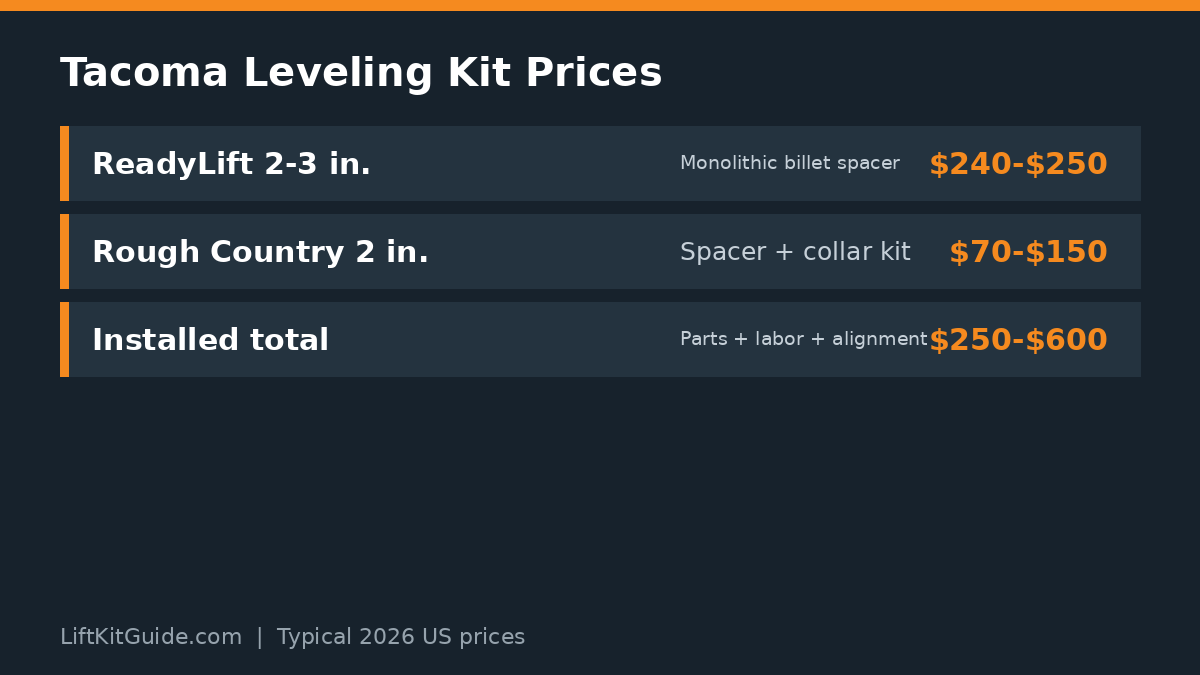
- Parts cost $240-$250 for ReadyLift versus $70-$150 for Rough Country; installed totals are $400-$600 versus $250-$400.
- Both clear 265/70R17 tires with no rub and 285/70R17 with minor trimming.
- Neither kit requires upper control arms at 2 inches on a daily-driven Tacoma.
On this page
What separates ReadyLift vs Rough Country leveling kit Tacoma options?
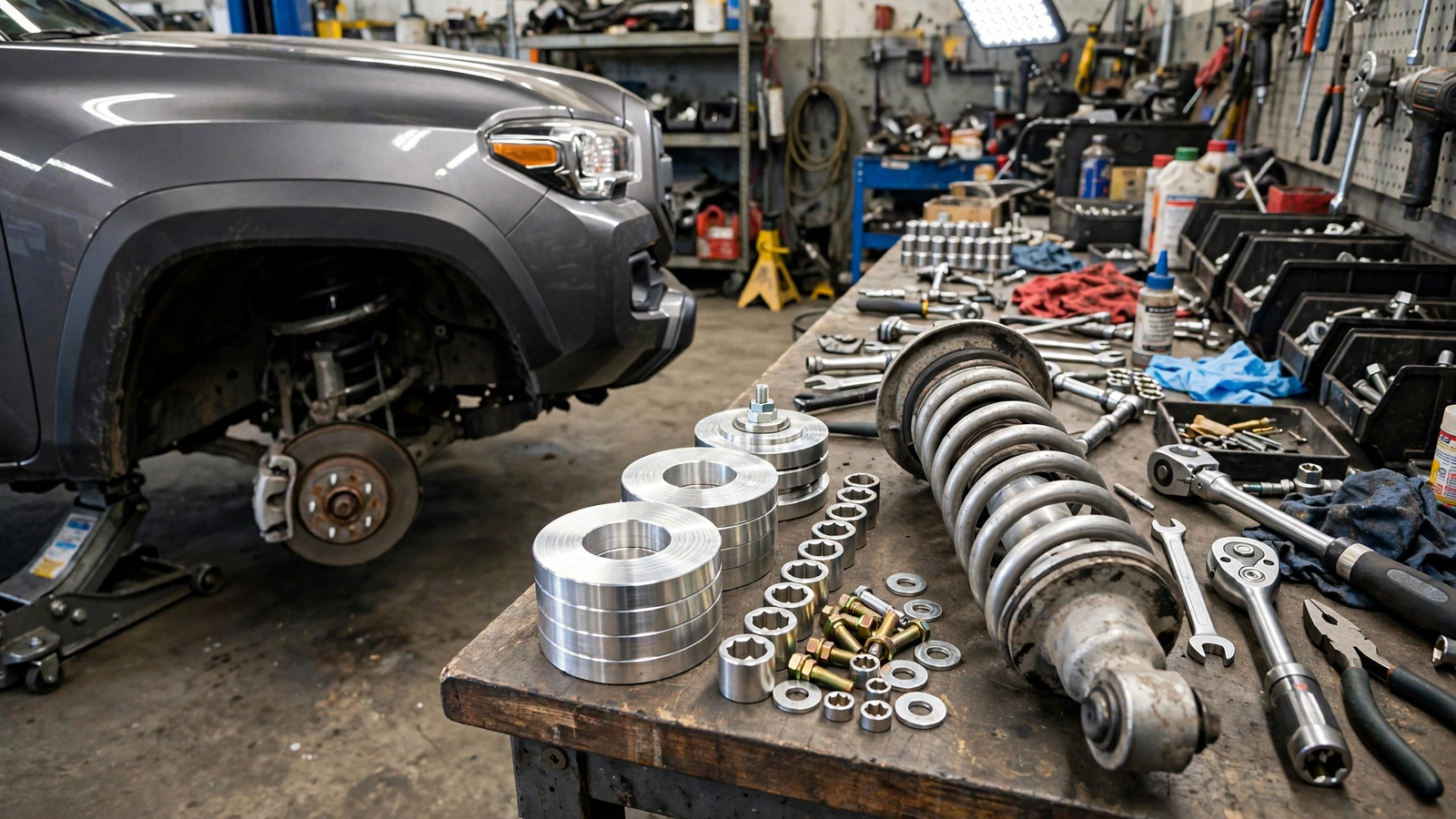
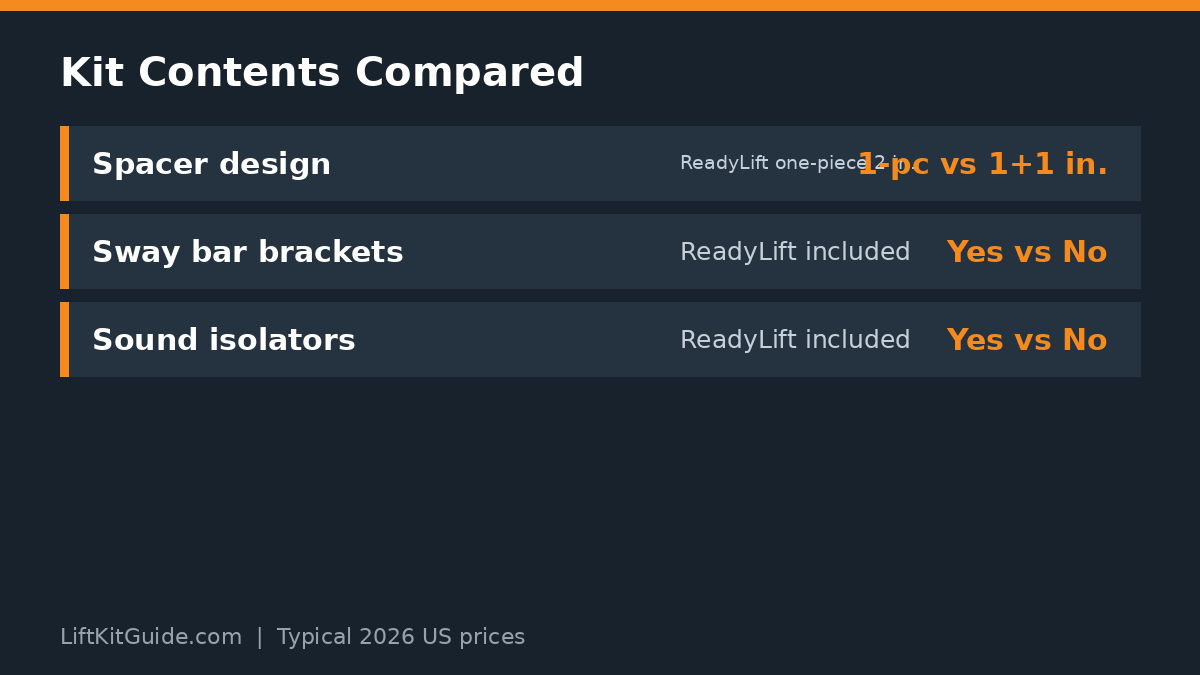
Tacoma owners shopping for a level face a classic fork in the road, and the ReadyLift vs Rough Country leveling kit Tacoma debate captures it perfectly. ReadyLift’s Tacoma kit uses a single monolithic 2-inch billet aluminum spacer that sits on top of the strut, while Rough Country combines a 1-inch top spacer with a 1-inch preload collar as two separate pieces. Both level the truck, but the engineering philosophy behind each is completely different.
The ReadyLift vs Rough Country leveling kit Tacoma comparison also comes down to what is in the box. ReadyLift includes sway bar relocation brackets, enhanced sound isolators between the spacer and spring, and hardware designed around factory geometry. Rough Country’s kit is deliberately barebones: spacers and the essential hardware, with shock extension brackets on some applications, and nothing you do not strictly need.
Both companies machine their Tacoma spacers from T6061 billet aluminum, so the internet rumor that one is plastic and the other is metal is simply wrong. The real differences are design geometry, included hardware, install convenience, and price. Understanding those four factors makes the choice straightforward.
One more angle on the ReadyLift-versus-Rough-Country decision for a Tacoma is long-term ownership. Both kits use corrosion-resistant billet aluminum that shrugs off road salt, and neither has a meaningful failure mode at 2 inches. The hardware you pay extra for with ReadyLift is about install day and ride refinement, not about one kit outlasting the other over a decade of daily driving.
It is also worth noting that the ReadyLift vs Rough Country leveling kit Tacoma rivalry has cooled over the years as both designs matured. Early Rough Country kits had more install complaints, but the current two-piece design goes together smoothly with proper tools. Early ReadyLift kits cost even more relative to the competition, but street prices have settled. Today’s buyer is choosing between two proven products, not a safe bet and a gamble.
How much does ReadyLift vs Rough Country leveling kit Tacoma cost installed?
On parts alone, the ReadyLift vs Rough Country leveling kit Tacoma price gap is dramatic. The ReadyLift 2.75 to 3-inch front leveling kit for the Tacoma typically sells for $240 to $250, while the Rough Country 2-inch leveling kit often goes for $70 to $150 depending on sales. That is a two-to-three-times price difference for two kits that both level the truck.
Installation narrows the gap. The ReadyLift vs Rough Country leveling kit Tacoma install story favors ReadyLift because its monolithic spacer does not require strut disassembly on most applications, cutting shop labor by roughly an hour. A shop typically charges $400 to $600 all-in for the ReadyLift including alignment, versus $250 to $400 for the Rough Country. The parts gap shrinks once labor enters the math.
For the full labor picture, check our lift kit installation cost guide and cost to lift a truck breakdown. DIYers with a spring compressor erase most of the labor difference, which makes the Rough Country kit the clear budget winner for home installs.
Do not forget the alignment in your budget math. The ReadyLift vs Rough Country leveling kit Tacoma totals above both assume a $75 to $100 alignment immediately after install, which is mandatory for either kit. Skipping the alignment to save money will cost far more in premature tire wear within a few thousand miles.
| Kit | Parts price | Typical installed total |
|---|---|---|
| ReadyLift 2-3 in. leveling kit | $240-$250 | $400-$600 with alignment |
| Rough Country 2 in. leveling kit | $70-$150 | $250-$400 with alignment |
| Price gap | ~$170 parts | ~$150 installed |
Does the monolithic spacer really install faster?
Yes, and this is ReadyLift’s strongest practical advantage. Because the monolithic spacer is a single tall piece, the installer does not need to disassemble the strut or compress the spring on most Tacoma applications. You unbolt the strut assembly, set the spacer on top, and bolt everything back together. Shops report saving 45 minutes to an hour compared with multi-piece kits.
The Rough Country approach with a separate spacer and preload collar requires strut disassembly, which means a spring compressor and more careful work. It is not difficult for an experienced mechanic, but it adds steps where mistakes can happen. For a driveway DIYer without a compressor, the ReadyLift design removes the most intimidating part of the job.
There is also a middle path some Tacoma owners take: buying the Rough Country kit and having a shop do the strut work. Even with paid labor for the spring swap, the total often lands around $350, still well under the ReadyLift installed price. It is the least convenient option but the cheapest way to get a professionally installed level.
Finally, think about who will live with the result. A truck that spends its life commuting on smooth highways will never reveal the differences between these kits, so buy on price and move on. A truck that tows a camper every summer weekend deserves the easier install and better isolators. Honest self-assessment about your real use beats brand loyalty every time.
Which kit keeps factory geometry closer?
ReadyLift designs its spacers to emulate factory geometry with what the company calls a slightly modified twist. The stabilizer bar spacers sit closer to stock positioning, and the overall stack height is engineered so alignment stays within a friendly range. Owners and shops generally report easier alignments and fewer post-install quirks with the ReadyLift kit.
The Rough Country kit gets the truck level and aligns fine in most cases, but the two-piece design with a preload collar changes the spring’s operating point slightly more. That can make the ride a touch firmer and, on some trucks, push ball joint angles a bit further. Neither kit is dangerous at 2 inches, but the ReadyLift is the more refined geometry solution.
Geometry is also why our upper control arm guide matters: at 2 inches most Tacomas align fine on stock arms, but anything taller deserves aftermarket UCAs.
One practical tip for the ReadyLift vs Rough Country leveling kit Tacoma alignment: ask the shop to set caster toward the high side of the factory spec. Tacomas like positive caster for highway stability, and a good alignment tech can usually find another half degree even with stock arms. That single adjustment does more for steering feel than any spacer brand choice.
What tire size can each leveling kit clear on a Tacoma?
Here the ReadyLift vs Rough Country leveling kit Tacoma tire question has a simple answer: both clear the same rubber. A leveled Tacoma, regardless of which brand leveled it, typically fits 265/70R17 or 265/75R16 tires with no rubbing, and 285/70R17 tires with minor trimming or the right wheel offset. The leveling kit brand does not change tire clearance because both deliver the same 2 inches of front lift.
Where they differ is ride quality with bigger tires. Heavier E-rated all-terrains amplify every harshness trait, so the kit with better geometry and sound isolation has a small but real advantage once you bolt on aggressive rubber. If you are planning 285s, the ReadyLift’s isolators and geometry earn their keep.
Read our leveling kit explainer for the basics and leveling kit vs lift kit comparison if you are torn between leveling and a full lift.
Tire choice interacts with the ReadyLift vs Rough Country leveling kit Tacoma ride question more than most buyers expect. A stiff E-rated mud terrain will dominate the ride character no matter which spacer sits on the strut. If you are running aggressive tires, put the kit price difference toward a better tire, because rubber matters more than spacers for daily comfort.
Keep your factory takeoff parts no matter which kit you install. If you ever sell the truck, returning it to stock takes an afternoon and widens your buyer pool. Stored in a dry garage, the original struts and hardware will be ready whenever you need them.
Do you need upper control arms with either kit?
At 2 inches of front lift, most Tacomas do not need aftermarket upper control arms with either the ReadyLift or the Rough Country kit. The factory arms still allow a proper alignment, and ball joint angles stay within acceptable limits. This is one reason 2-inch leveling kits are so popular: they are a complete solution with no hidden extras.
The exception is trucks that see serious off-road use or owners chasing perfect alignment numbers. If your alignment shop maxes out the factory cams and still cannot hit ideal caster, UCAs solve it regardless of which leveling kit you chose. The UCA question is about lift height and use case, not about ReadyLift versus Rough Country.
For trucks that tow small trailers or carry a constant bed load, neither leveling kit changes rear capacity, since both only lift the front. If your Tacoma squats under load, address the rear separately with air bags or an add-a-leaf rather than expecting the front level to fix a rear problem.
| Factor | ReadyLift | Rough Country |
|---|---|---|
| Spacer material | T6061 billet aluminum | T6061 billet aluminum |
| Spacer design | Monolithic 2 in. one-piece | 1 in. spacer + 1 in. collar |
| Sway bar brackets | Included | Not included |
| Sound isolators | Included | Not included |
| Strut disassembly | Usually not required | Required |
Which kit do Tacoma owners regret less?
Dig through TacomaWorld and a pattern emerges in the ReadyLift vs Rough Country leveling kit Tacoma owner reports. Rough Country buyers almost never regret the purchase itself; they regret nothing because the kit does exactly what it promises for very little money. The complaints that do appear center on slightly firmer ride and the occasional install headache with the two-piece design.
ReadyLift buyers report high satisfaction with install ease and ride quality, and the regret they voice is usually about price: did I really need to spend two and a half times more for a level? Owners who paid a shop tend to say yes, because the labor savings closed the gap. DIYers who already owned a spring compressor more often say they should have saved the money.
The honest summary from the forums: nobody’s truck was ruined by either kit, and both hold up fine over years of daily driving. Buy the Rough Country if budget rules, buy the ReadyLift if convenience rules.
Warranty anxiety comes up in every ReadyLift vs Rough Country leveling kit Tacoma thread, so here is the short version: under federal law, a leveling kit cannot void your whole warranty. A dealer must prove the kit caused the specific failure. Keep the stock spacers and hardware in a labeled box, and document your alignment, and you will have no trouble with unrelated warranty claims.
- Choose ReadyLift if: a shop is installing it, you lack a spring compressor, or you want the most refined geometry and quietest ride.
- Choose Rough Country if: you are installing it yourself, budget is the priority, or you simply want the truck level for the least money.
- Skip both if: you want more than 2 inches of lift or room for 35s, in which case a full lift kit is the right tool.
Which leveling kit should your Tacoma get?
For a daily-driven Tacoma that just needs the factory rake gone, the Rough Country kit is the rational choice. It levels the truck for under $150 in parts, installs in an afternoon, and leaves budget for the alignment and tires that actually transform the truck. Most owners will never feel the difference the extra ReadyLift hardware makes in normal driving.
The ReadyLift justifies its premium when convenience has real value: paying shop labor, no spring compressor in the garage, or a strong preference for the quietest, most factory-like result. The included sway bar brackets and isolators are genuinely nice touches, not marketing fluff.
Whichever you pick, start with our best lift kit brands ranking for the wider market context. The ReadyLift vs Rough Country leveling kit Tacoma decision is a good problem to have, because both answers are correct for different buyers.
A final thought on the ReadyLift vs Rough Country leveling kit Tacoma value question: resale. Neither kit meaningfully changes what a dealer or private buyer will pay, but a clean professional install with an alignment printout signals a cared-for truck. Keep your stock parts in a box in the garage so the next owner has options.
Frequently asked questions
Is ReadyLift better than Rough Country for a Tacoma?
ReadyLift is the more refined kit with a monolithic spacer, included sway bar brackets, and easier installation, while Rough Country is the better value at roughly a third of the price. For a simple 2-inch level on a daily-driven Tacoma, most owners are happy with either.
How much does it cost to level a Tacoma?
A Rough Country leveling kit with professional installation and alignment typically totals $250 to $400, while a ReadyLift kit installed runs $400 to $600. DIY installation with a $50 alignment brings either option under $300 in total outlay.
Will a leveling kit void my Tacoma warranty?
A leveling kit cannot void your entire warranty under the Magnuson-Moss Warranty Act. The dealer must prove the kit caused a specific failure to deny that claim. Suspension-related claims get the most scrutiny, so keep your stock parts in case you need warranty work.
Do I need an alignment after a leveling kit?
Yes, always. Any change to front ride height alters camber, caster, and toe. Get the alignment done immediately after the install, and ask the shop for a printout showing all three angles within spec before you drive home.
Can a leveling kit cause vibrations on a Tacoma?
A properly installed 2-inch leveling kit rarely causes vibrations on a Tacoma. If vibes appear, the usual culprits are an overdue alignment, a failing carrier bearing, or needle bearing wear in the front differential, not the spacer itself.
What is the biggest tire that fits a leveled Tacoma?
A leveled Tacoma fits 265/70R17 tires with zero rubbing, and 285/70R17 tires with minor fender-liner trimming or aftermarket wheels with proper offset. Going to 35s requires a true lift kit plus trimming and usually a cab mount chop.
The bottom line
The ReadyLift vs Rough Country leveling kit Tacoma choice is really a question about how much you value convenience. The ReadyLift is objectively the nicer kit with better geometry, included brackets, and a faster install. The Rough Country is objectively the better value, delivering the same leveled stance for a fraction of the price.
Match the kit to your situation: paying a shop or lacking a spring compressor points to ReadyLift, while DIY installs and tight budgets point to Rough Country. Either way, budget for an immediate alignment and enjoy the leveled look.



Leave a comment