



Last updated: October 2026 Written by the LiftKitGuide Team, truck suspension installers and editors
When shoppers compare Rancho QuickLift vs Bilstein 5100, the headline difference is convenience versus value. The Rancho QuickLift is a pre-assembled loaded strut at about $222 to $245 per corner that bolts in within an hour per side with no spring compressor, plus 9-position ride adjustability. The Bilstein 5100 costs roughly half at $94 to $130 per corner, reuses your factory spring, and usually rides better, but demands a spring compressor and more install time.
Key takeaways
- Rancho QuickLift loaded struts cost about $444-$490 per front pair, roughly double the $188-$260 Bilstein 5100 front pair.
- QuickLift installs in about 1 hour per side with no spring compressor; Bilstein 5100s take 2-3 hours per side for first-timers.
- Only the Rancho offers 9-position manual ride adjustability; only the Bilstein offers multiple snap-ring height settings.
- Both level the front about 2 inches and clear 35-inch tires on most half-ton trucks.
- Owner consensus: Bilstein rides more composed, Rancho wins on convenience and fresh-spring value for high-mileage trucks.

On this page
What is the real difference in Rancho QuickLift vs Bilstein 5100?
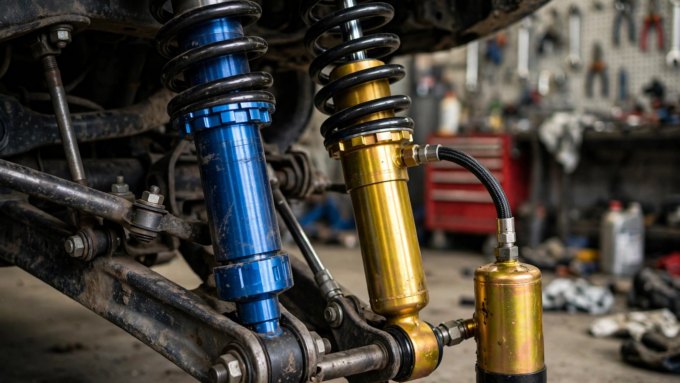
When truck owners research Rancho QuickLift vs Bilstein 5100, the core difference comes down to what arrives in the box. The Rancho QuickLift is a loaded, pre-assembled strut assembly that includes a new coil spring, the shock body, and a fresh upper mounting plate, all put together at the factory. The Bilstein 5100 is a standalone performance strut that reuses your truck’s factory coil spring and upper mount, which means your installer must compress and transfer the old spring onto the new shock.
The Rancho QuickLift vs Bilstein 5100 debate really starts with installation philosophy. Rancho bets that most driveway mechanics would rather unbolt a complete assembly and bolt in a new one than wrestle with a spring compressor. Bilstein bets that keeping your proven factory spring, and simply upgrading the damper with height-adjustable snap-ring grooves, delivers better ride quality and longer service life for less money.
Both options level the front of the truck by roughly 2 inches and clear up to 35-inch tires on most half-ton applications. The Rancho adds its 9-position manual adjustability knob, letting you fine-tune compression damping from soft to firm without tools. The Bilstein 5100 offers no external adjustment, but its multiple snap-ring height settings let you dial in 0 to about 2.8 inches of front lift depending on the application.
For shoppers torn between Rancho QuickLift vs Bilstein 5100, it helps to think of it as a complete assembly versus a component upgrade. The Rancho replaces everything from the mount down, which is ideal when the truck has accumulated significant miles. The Bilstein keeps the factory spring and mount, which is ideal when those parts are still healthy and you simply want better damping and a leveled stance.
How much does Rancho QuickLift vs Bilstein 5100 cost in 2026?
On price, the Rancho QuickLift vs Bilstein 5100 comparison favors Bilstein by a wide margin. A pair of Rancho QuickLift loaded struts typically runs $444 to $490 for the front pair, working out to about $222 to $245 per corner at major retailers. A pair of Bilstein 5100 front struts usually costs $188 to $260, or roughly $94 to $130 each, which owners on RamForum describe as roughly half the price of the Ranchos.
That price gap narrows once you factor in installation. If you are paying a shop, compressing and swapping springs onto Bilstein 5100s adds labor time, and most shops charge an extra hour or so per side for strut disassembly. The Rancho QuickLift bolts in as a complete unit in about an hour per side, so the total installed bill for either option often lands within $100 to $150 of each other at a professional shop.
For the full picture on what shops charge, see our lift kit installation cost guide and the broader cost to lift a truck breakdown. If you are doing the work yourself and already own a spring compressor, the Bilstein 5100 is the clear budget winner. If you would have to buy or rent a compressor, the Rancho’s convenience premium starts to look reasonable.
Over a five-year ownership span, the Rancho QuickLift vs Bilstein 5100 cost picture can flip depending on your starting point. If your factory struts and mounts are worn out at 90,000 miles, the Rancho’s included hardware saves you from buying those parts separately. If your suspension is fresh, the Bilstein’s lower buy-in price keeps more money in your pocket for tires or an alignment.
| Option | Front pair price | What is included |
|---|---|---|
| Rancho QuickLift loaded | $444-$490 | New coil spring, shock, upper mount, pre-assembled |
| Bilstein 5100 | $188-$260 | Height-adjustable struts only, reuse factory spring |
| Shop install adder | $150-$300 | Extra labor for spring swap on Bilsteins |
Which one installs faster in your driveway?
The Rancho QuickLift is the undisputed champion of driveway installs. Because it arrives pre-assembled, you jack up the truck, support the lower control arm, unbolt the old strut assembly, and bolt in the new one. Owners consistently report about an hour per side with basic hand tools, and there is no spring compressor involved at any point, which removes the single most dangerous step of strut work.
The Bilstein 5100 demands more effort and more caution. You must remove the factory strut, compress the coil spring with a rented or purchased spring compressor, transfer the spring and mount to the new Bilstein body at your chosen snap-ring height, and then reinstall. First-timers should budget two to three hours per side, and anyone uncomfortable with a loaded spring under tension should let a shop handle the swap.
The Rancho QuickLift vs Bilstein 5100 install gap matters most to first-time DIYers. Compressing a coil spring stores an enormous amount of energy, and a slipping compressor can cause serious injury, which is why many beginners gladly pay the Rancho premium. Experienced wrenches with a quality wall-mounted compressor will find the Bilstein swap routine.
How does Rancho's 9-position adjustability work?
Every Rancho QuickLift uses the RS9000XL 9-position tuning system, a small knob on the shock body that changes compression damping across nine detents. Turn it toward the soft end for a cushier around-town ride, or crank it firm when you are towing, hauling, or heading off-road. It is a genuinely useful feature for trucks that split duty between commuting and weekend work, and no other leveling strut in this price class offers anything like it.
The trade-off is maintenance. Several owners report that the adjuster knobs can seize after a year or two of road salt and neglect, especially if you never turn them. A shot of penetrating oil twice a year keeps them free. The Bilstein 5100 has no external adjuster to seize, which is one less thing to maintain, but it also means you cannot soften the ride for an empty commute and firm it up for a loaded trailer without changing the snap-ring setting.
There is also a subtle geometry point worth knowing: the QuickLift’s fixed 2-inch height is not adjustable, while the Bilstein’s snap-ring grooves give you multiple heights. If you want exactly 1.4 or 2.1 inches of level rather than a flat 2 inches, only the Bilstein lets you choose.

Which rides better on a daily driver?
Ride quality is where opinions split hardest, and it depends on what you value. The Bilstein 5100’s monotube design with digressive valving feels controlled and planted, with noticeably less float over highway dips than stock. Owners who switched from worn factory struts to 5100s frequently call it the best ride-per-dollar mod they have done, describing the truck as more composed without feeling harsh.
The Rancho QuickLift rides well at its softer settings, and the new coil spring can actually improve ride over a tired factory spring with 80,000-plus miles on it. But at the middle and firm detents it feels stiffer than the Bilstein, and a few owners note that the Rancho’s twin-tube-based design does not control big hits quite as crisply. If your priority is the smoothest empty daily commute, the Bilstein 5100 usually wins the comparison.
That said, the Rancho’s adjustability is a real-world advantage for mixed use. Set it soft for the work week, firm it up for towing the boat, and you have effectively two shocks in one. The Bilstein cannot do that trick, so drivers who tow or haul regularly sometimes prefer the Rancho despite the firmer baseline.
In back-to-back drives over the same broken pavement, the Rancho QuickLift vs Bilstein 5100 difference shows up in how each handles repeated hits. The Bilstein’s monotube design resists fade and keeps the truck settled through a series of potholes. The Rancho feels plusher on the first hit at soft settings but can feel busier over washboard surfaces.
Which setup lasts longer?
Bilstein’s reputation for longevity is one of the strongest in the aftermarket. The 5100’s zinc-plated monotube body resists corrosion well, the seals are robust, and it is common to see 5100s still performing at 80,000 to 100,000 miles. There are no external adjusters to seize and no proprietary spring to wear at a different rate than the damper.
The Rancho QuickLift carries a limited lifetime warranty against defects, which is reassuring on paper. In practice, owner reports are mixed: many get years of trouble-free service, but there are credible reports of adjuster knobs seizing and a few early shock failures, including one Tacoma owner whose Rancho shocks were blown before 10,000 miles. Keep the adjusters exercised and the bodies washed in winter, and most QuickLifts live a normal service life.
One more longevity angle: with the Bilstein you keep your factory coil spring, whose lifespan is already proven on your truck. With the Rancho you get a new spring of Rancho’s spec, which is great if your factory springs are sagging, but introduces a new variable. High-mileage trucks often benefit most from the Rancho’s fresh-spring approach.
Warranty claims for Rancho QuickLift vs Bilstein 5100 are rare for either brand, and both carry a limited lifetime warranty against manufacturing defects. The practical difference is what fails: a seized Rancho adjuster knob is an annoyance you can work around, while a worn Bilstein simply gets replaced. Neither brand has a widespread failure pattern that should scare you off.
| Spec | Rancho QuickLift | Bilstein 5100 |
|---|---|---|
| Design | Loaded assembly, 9-position adjustable | Monotube strut, snap-ring height settings |
| Front lift | Fixed ~2 inches | 0 to ~2.8 inches by application |
| Spring compressor | Not required | Required for install |
| Warranty | Limited lifetime | Limited lifetime |
What do owners report after switching brands?
Forum threads on this exact matchup go back a decade, and the pattern is consistent. Owners who switch from stock to either option report a big improvement. Owners who switch from Bilstein 5100s to Rancho QuickLifts usually do it for the easier install or the adjustability, and most say the ride is good but not quite as composed as the Bilsteins. Owners who go the other direction, Rancho to Bilstein, almost always cite better ride control as the reason.
The most telling reports come from owners who have run both on the same truck. The consensus: Bilsteins feel more premium over broken pavement, Ranchos win on convenience and versatility. Almost nobody calls either one a bad product, which is why this comparison has stayed alive for so long. Your use case matters more than the badge.
For related reading, our leveling kit explainer covers the basics, leveling kit costs breaks down budgets, and best lift kit brands ranks the broader market.
Ask ten owners about Rancho QuickLift vs Bilstein 5100 and you will hear the same split we found in the forums. Daily drivers who prioritize comfort lean Bilstein by a clear margin. Owners who installed the kit themselves in a driveway lean Rancho just as strongly. Both camps agree that either choice is a massive upgrade over worn factory struts.
- Choose Rancho QuickLift if: you are installing it yourself, your factory springs have high miles, or you want adjustable ride firmness.
- Choose Bilstein 5100 if: you want the best ride per dollar, multiple height settings, and maximum long-term durability.
- Either way: get an alignment immediately after install and retorque all hardware after 500 miles.
Which should you buy for your truck?
For most daily-driven half-tons, the Bilstein 5100 is the smarter buy. It costs roughly half as much, rides better in most owners’ judgment, offers multiple height settings, and has the stronger long-term durability record. The only real cost is installation effort, and even that disappears if a shop is doing the work or you already own a spring compressor.
The Rancho QuickLift earns its premium in three specific situations: you are doing a driveway install and want to avoid spring compressors entirely, your truck has high miles and needs fresh springs anyway, or you genuinely want the 9-position adjustability for mixed towing and commuting duty. In those cases the extra $200 or so for the pair is money well spent.
Whichever you choose, you are getting a proven leveling solution backed by a lifetime warranty. Check our suspension lift kits guide if you decide you want more than a level, and read the owner discussion we consulted at the link below before you buy.
The bottom line on Rancho QuickLift vs Bilstein 5100 is that there is no wrong answer, only a better answer for your situation. Choose the Rancho for the easiest install, fresh hardware, and adjustable ride. Choose the Bilstein for the lowest price, the best ride quality, and multiple height options. Match the product to the job and you will be happy.
Frequently asked questions
Are Rancho QuickLift struts worth the extra money over Bilstein 5100s?
They are worth it if you value the pre-assembled install, need fresh coil springs, or want the 9-position ride adjustability. If you want the best ride quality per dollar and do not mind using a spring compressor, the Bilstein 5100 is the better value at roughly half the price.
Do Rancho QuickLift struts need a spring compressor to install?
No. Rancho QuickLift struts arrive pre-assembled with the coil spring and upper mount already installed, so you simply unbolt the old assembly and bolt in the new one. This is the biggest practical advantage over the Bilstein 5100, which requires compressing and transferring your factory spring.
How much lift does a Rancho QuickLift give?
Most Rancho QuickLift applications provide a fixed 2 inches of front lift, which levels the factory rake on most half-ton trucks. Unlike the Bilstein 5100, the lift height is not adjustable, so if you want 1.4 or 2.8 inches instead, the Bilstein's snap-ring settings are the better choice.
Can you adjust Rancho QuickLift struts after they are installed?
Yes. The 9-position knob on the shock body can be turned by hand at any time, even with the strut installed on the truck. Owners recommend exercising the adjuster a few times a year and applying penetrating oil in winter climates to prevent the knob from seizing.
Do Bilstein 5100s ride stiffer than stock?
Bilstein 5100s feel more controlled than worn factory struts, which some drivers initially read as stiffness. Most owners report the ride is actually smoother over dips and broken pavement because the digressive valving settles the truck faster, with less float and bounce than stock.
Will either option clear 35-inch tires?
On most half-ton trucks, a 2-inch level from either the Rancho QuickLift or Bilstein 5100 clears 35-inch tires, though wheel offset and tire width matter. Aggressive offsets or 12.5-inch-wide tires may still rub the fender liners at full lock, so check fitment for your exact wheel and tire combo.
The bottom line
The Rancho QuickLift vs Bilstein 5100 decision is really a question about who is turning the wrenches and what your truck needs. Paying a shop or working in your own driveway without a spring compressor makes the Rancho’s pre-assembled design and fresh springs genuinely worth the premium. You get a faster, safer install and a new spring and mount at every corner.
If ride quality per dollar is the goal and you can handle or outsource the spring swap, the Bilstein 5100 remains the benchmark. It is cheaper, more adjustable in height, and has the stronger reputation for long-term durability. Either way, align the truck immediately and enjoy a level stance.




Leave a comment