


Last updated: October 2026 Written by the LiftKitGuide Team, truck suspension installers and editors
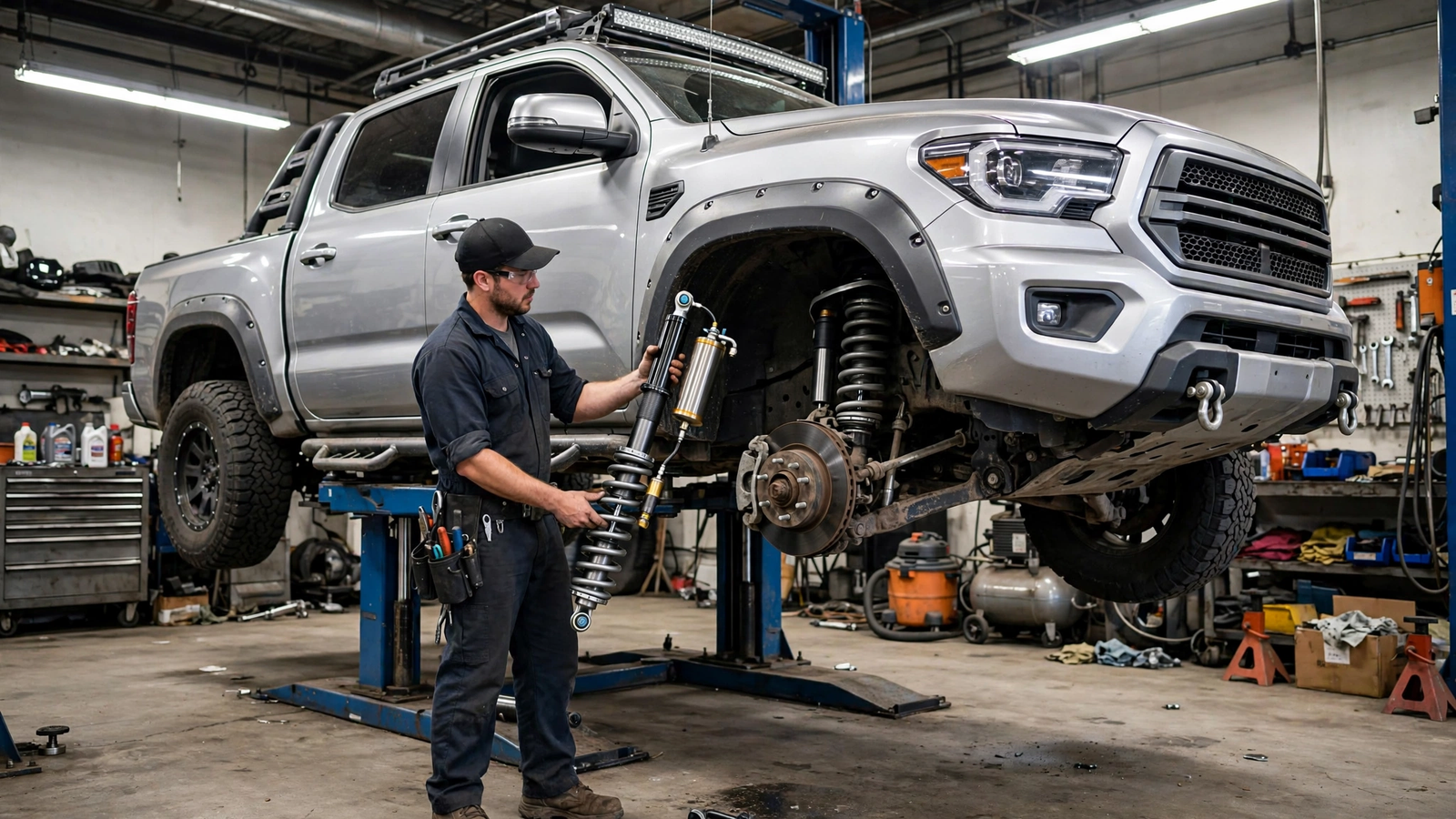
Do you need new shocks with a 3 inch lift kit? In most cases, yes. A 3-inch suspension lift moves your shock mounts roughly 3 inches farther apart at ride height, so replacement shocks need about 3 extra inches of extended length compared with stock. Reusing factory shocks leaves them riding near full extension, which causes topping out, a harsh ride, and premature seal failure. The only exceptions are kits that include shock extension brackets or strut spacers engineered for stock-length shocks, and even then new longer shocks ride better.
Key takeaways
- Replacement shocks for a 3-inch lift need roughly 3 extra inches of extended length versus stock to restore proper droop travel.
- Reusing stock shocks causes topping out — a harsh clunk as the shock slams its extension stop — plus accelerated seal wear.
- Some 3-inch kits include shock extenders or strut spacers that preserve stock shock travel, making new shocks optional but still beneficial.
- A quality set of four longer shocks (Bilstein 5100, Rancho RS9000XL) typically costs $300–$700 before installation.
- Match both extended AND compressed length: too long compressed lets the shock bottom out before the bump stops engage.
On this page
Do you need new shocks with a 3 inch lift kit?
Do you need new shocks with a 3 inch lift kit? For the great majority of trucks and SUVs, the honest answer is yes. A 3-inch suspension lift relocates your shock mounting points roughly 3 inches farther apart at normal ride height, which eats up the working travel your factory shocks were designed around. Your stock shocks end up operating near full extension all the time, and that single change is responsible for most of the ride complaints, clunks, and premature shock failures owners report after lifting.
The reason the question do you need new shocks with a 3 inch lift kit comes up so often is that some 3-inch kits on the market do not include shocks at all. Budget spacer kits and a few coil-spring kits are sold shock-free to hit a lower price point, which leaves the buyer deciding whether to reuse factory units, bolt on shock extension brackets, or buy proper longer shocks. Understanding what each path costs you in ride quality and durability makes the decision much easier.
Truck owners researching do you need new shocks with a 3 inch lift kit often discover that the answer depends on how the lift is achieved, not just how tall it is. A 3-inch lift built from replacement coil springs changes the suspension’s operating point dramatically, while a 3-inch strut spacer simply relocates the factory assembly downward. Both give you 3 inches of height, but only the first one fundamentally alters where the shock works in its travel. Knowing which type of kit you bought is the first step toward answering the shock question correctly for your specific truck.
What happens to stock shocks after a 3-inch lift?
A shock absorber only works correctly inside its designed travel window. When you add 3 inches of lift, the static distance between the upper and lower shock mounts grows by about the same amount, so a stock-length shock spends its life stretched close to its maximum extended length. Every pothole, speed bump, or driveway lip that lets the axle droop then slams the shock against its internal extension stop, a condition owners call topping out. You hear it as a sharp clunk and feel it as a jolt through the chassis.
Repeated topping out is brutal on a shock’s internals. The piston and rod seals take impact loads they were never engineered for, which accelerates wear and eventually lets damping fluid escape. Once a shock loses its oil charge, it can no longer control spring oscillation, and the truck starts to bounce, wander, and dive under braking. Many drivers blame the lift kit itself for a rough ride after lifting, when the real culprit is a stock shock being asked to do a longer shock’s job. That is why asking do you need new shocks with a 3 inch lift kit matters more than most buyers realize before they spend a dollar.
Beyond comfort, there is a genuine safety dimension. A topped-out shock cannot keep the tire pressed to the pavement over dips and crests, which lengthens braking distances and makes emergency lane changes sketchier. Off-road, the problem multiplies: at full droop the shock becomes the down-travel limiter, hammering ball joints and CV joints with forces the suspension was never designed to route through them. Owners who wheel their trucks hard report that the correct longer shocks transform not just comfort but control, because the suspension can finally use its full designed travel in both directions.
- Sharp clunking over bumps: the classic symptom of a shock hitting its extension stop because it is too short for the new ride height.
- Bouncy, uncontrolled ride: worn seals let oil escape, so the shock can no longer damp spring movement effectively.
- Visible oil on the shock body: weeping around the shaft seal means the unit is already failing and needs replacement.
- Rear end hopping on washboard roads: topped-out rear shocks cannot keep the tires planted on uneven surfaces.
- Steering wander after the lift: uncontrolled front suspension movement makes the truck feel vague at highway speed.
How much longer do replacement shocks need to be?
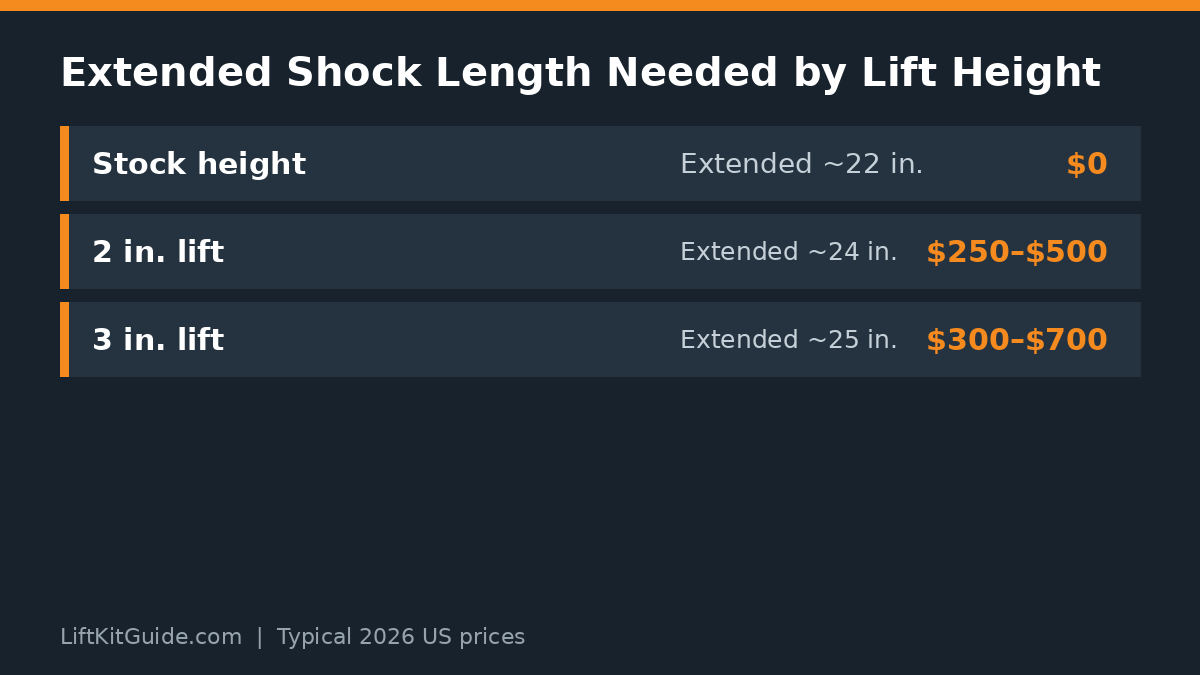
The rule of thumb used across the industry is straightforward: for a 3-inch lift, replacement shocks need roughly 3 extra inches of extended length compared with the stock units they replace. Extended length is measured from mounting eye to mounting eye with the shock fully pulled apart, and it is the single most important number when shopping. If the extended length is too short, the shock becomes the suspension’s limiting strap and tops out constantly.
Equally important is compressed length, the eye-to-eye measurement with the shock fully collapsed. A longer shock with too much compressed length will bottom out internally before the factory bump stops engage, which can bend the shock shaft or blow the seals on a hard hit. Quality lift-kit shocks are engineered as a matched pair of measurements: long enough extended to restore droop travel, short enough compressed to let the bump stops do their job at full compression. This is why buying shocks valved and sized for your exact lift height beats guessing with universal parts. It is also the engineering reason the answer to do you need new shocks with a 3 inch lift kit is almost always yes for true suspension lifts.
One practical tip: measure before you buy. With the truck on the ground at its new ride height, measure eye-to-eye on the installed shock, then remove it and measure it fully extended. If less than an inch of extension travel remains at ride height, the shock is effectively maxed out just sitting still. Many owners are surprised to find their stockers have nearly zero droop travel left after a 3-inch lift, which makes the decision to upgrade less of a debate and more of an obvious next step.
| Lift height | Extra extended length needed | Typical extended length (full-size truck) | Stock shocks OK? |
|---|---|---|---|
| Stock height | 0 in. | About 22 in. front / 24 in. rear | Yes |
| 2 in. lift | About 2 in. | About 24 in. front / 26 in. rear | Borderline — extenders or new shocks advised |
| 3 in. lift | About 3 in. | About 25 in. front / 27 in. rear | No — new longer shocks recommended |
Why do some 3-inch lift kits skip new shocks?
Price is the main reason. A complete 3-inch suspension lift kit with four quality longer shocks typically runs several hundred dollars more than the same kit sold without them, so budget brands leave shocks out to advertise a lower headline price. Kits built around coil spacers or strut spacers are the most common offenders, since the spacer itself creates the lift and the manufacturer treats shocks as the buyer’s problem.
There is also a legitimate engineering case for skipping them on certain designs. Some 3-inch kits use front strut spacers that relocate the entire strut assembly downward, which preserves the stock shock’s operating range because the shock moves with the mount. A few kits include steel shock extension brackets that achieve the same thing for rear shocks. In both cases the factory shocks stay inside their travel window, so new shocks become an upgrade for ride quality rather than a necessity for survival. That distinction is exactly why do you need new shocks with a 3 inch lift kit has a different answer for spacer kits than for full replacement-spring kits, and why reading your kit’s parts list matters more than any generic rule.
When shopping, look closely at what the box actually contains. If the kit lists shock extensions, relocation brackets, or strut spacers, the manufacturer has accounted for stock-length shocks and you can safely run them while you save for an upgrade. If the instructions simply say to reinstall the factory shocks with no brackets or spacers, treat that as a red flag: the kit is leaving the travel problem unsolved, and you should budget for proper longer shocks from day one rather than discovering the clunking on your first drive.
Do you need new shocks with a 3 inch lift kit if it comes with shock extenders?
If your kit includes properly engineered shock extension brackets, then do you need new shocks with a 3 inch lift kit becomes a softer question: no, not immediately, but you will probably want them eventually. Extenders bolt to the lower shock mount and reposition the stock shock so it sits back in the middle of its travel range, which solves the topping-out problem on a budget. For a street-driven truck that rarely sees rough terrain, extenders can work acceptably.
The catch is that extenders change nothing about damping. Your factory shocks are still valved for a stock-height truck with stock geometry, not for a front end sitting 3 inches higher with different leverage on the springs. Owners frequently report that the truck feels floaty or under-damped after a spacer lift with extenders, especially when towing or loaded. So do you need new shocks with a 3 inch lift kit when extenders are already in the box? Strictly speaking, no — but plan the real upgrade into your future budget.
There is one more scenario worth mentioning: trucks with factory performance shocks. If your truck came with Bilstein or Fox units from the factory (Raptor, TRX, ZR2, Tremor), those shocks are higher quality than base-model units but they are still the wrong length for a 3-inch lift. Extenders work the same way on them, and the same eventual upgrade logic applies — the fancy factory shock does not magically gain 3 inches of travel just because it says Fox on the body.
Which shocks work best with a 3-inch lift?
The most popular answer is the Bilstein 5100 series, which is specifically valved and sized for lifted trucks and typically costs $90 to $130 per shock. The 5100’s monotube design resists fade far better than the twin-tube units most trucks come with from the factory, and Bilstein offers direct-fit lengths for 0 to 3 inches of lift on most applications. If you have decided that do you need new shocks with a 3 inch lift kit gets a yes from you, the 5100 is the default recommendation in nearly every owner forum for good reason.
For drivers who want adjustability, the Rancho RS9000XL adds a 9-position damping knob for roughly $110 to $150 per corner, letting you soften the ride for daily driving and firm it up for towing. Whichever tier you pick, buy shocks listed for your exact lift height rather than universal-fit parts, and check reviews from reputable lift kit brands owner threads for your specific truck before ordering. Matching the shock to the truck matters as much as matching it to the lift height.
Stepping up, the Fox 2.0 Performance Series runs about $150 to $200 per shock and brings an aluminum body that sheds heat faster on rough roads, while King and Icon 2.5 coilovers at $300-plus per corner are the choice for serious off-road use. Check reviews from reputable lift kit brands owner threads for your specific truck before ordering, since valving preferences vary more than marketing suggests.
How much do new shocks for a 3-inch lift cost?
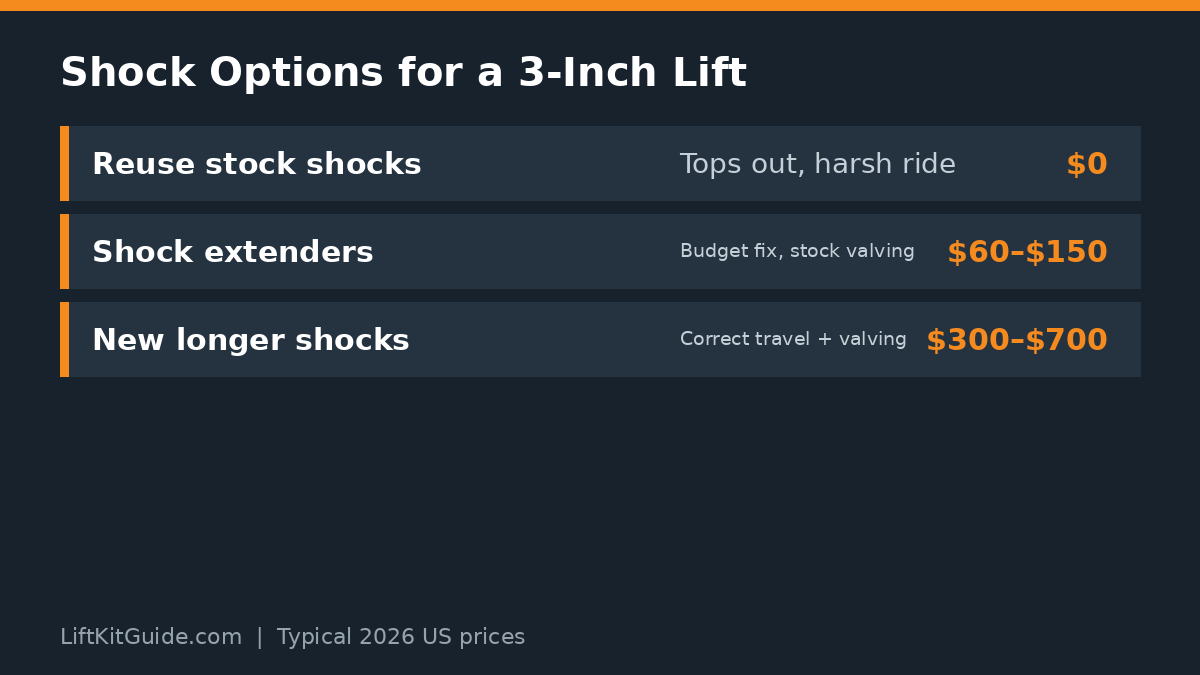
Budget for $300 to $700 for a full set of four quality longer shocks on most half-ton trucks, with installation adding another $200 to $400 at a shop if you do not do the work yourself. That price covers respected mid-range options like Bilstein 5100s or Rancho RS9000XLs, which is why so many owners find that the answer to do you need new shocks with a 3 inch lift kit is worth saying yes to: the cost is modest compared with the price of the lift kit itself. Premium Fox 2.0 or King setups can push the total past $1,000 for the set.
Skipping new shocks is not actually free either. Factory shocks run at the edge of their travel tend to fail early, and replacing a blown set plus the labor to do the job twice often costs more than buying the right shocks once. If your leveling or lift budget is tight, a $60 to $150 set of shock extenders buys time, but plan the real shocks into the project rather than treating the extenders as permanent.
| Option | Typical cost (set of 4) | Ride quality | Best for |
|---|---|---|---|
| Reuse stock shocks | $0 | Poor — topping out, harsh | Nobody long-term |
| Shock extenders | $60–$150 | Acceptable on street | Budget street trucks |
| New longer shocks (mid-range) | $300–$700 | Good — correct travel and valving | Most lifted trucks |
| Premium (Fox 2.0 / King) | $900–$1,600+ | Excellent — tuned, rebuildable | Off-road and towing |
How do you know when your shocks need replacing after a lift?
Start with the bounce test: push down hard on each corner of the truck and let go. A healthy shock settles in one to two oscillations; if the corner keeps bouncing, the shock is worn out. Then inspect each unit for oil weeping around the shaft seal, dented bodies, or torn bushings, and listen for clunking over bumps that signals topping out. Any of these symptoms means replacement time, whether your truck is lifted or not.
Mileage matters too. Factory shocks are generally spent by 50,000 to 70,000 miles even on a stock truck, and a lift shortens that life further if the shocks are operating outside their designed range. If you installed the lift on a truck that already had 40,000-plus miles on the originals, you were effectively due anyway. After any lift, the real question behind do you need new shocks with a 3 inch lift kit becomes how to tell when the units you have are finished.
When you do replace them, size the new units for the lift you have, not the truck you started with, and consider whether a leveling kit versus full lift kit change in the future would alter the lengths you need. One last note: installing a lift does not automatically void your factory warranty, but dealers can deny suspension-related claims on modified components.
Frequently asked questions
Can I drive with stock shocks until I buy new ones for my 3-inch lift?
Short distances at moderate speed are generally fine, but avoid off-roading, towing heavy loads, or high-speed washboard roads until the correct shocks are installed. Every topped-out impact shortens the remaining life of the factory units.
Will a 3-inch lift ruin my stock shocks?
It will shorten their life significantly. Running near full extension accelerates seal and bushing wear, and repeated topping out can kill a marginal shock in a few thousand miles. Shocks that were already halfway through their life may fail within weeks of the lift.
Are shock extenders as good as new longer shocks?
No. Extenders fix the geometry problem by repositioning the stock shock into its travel range, but they do nothing to improve damping. New longer shocks are valved for the lifted ride height and control the suspension far better, especially when towing or off-roading.
Do I need new shocks with a 3-inch body lift?
No. A body lift raises the body on the frame without changing suspension geometry or shock mount distances, so your stock shocks keep working exactly as designed. New shocks are only required when the suspension itself is lifted.
How long do shocks last on a lifted truck?
Properly sized quality shocks typically last 50,000 to 80,000 miles on a lifted daily driver, similar to stock. Undersized or topped-out shocks can fail in under 10,000 miles. Premium rebuildable units from Fox or King can be serviced indefinitely with $150–$300 rebuilds.
The bottom line
Do you need new shocks with a 3 inch lift kit? For nearly every truck, yes — plan on it as part of the project, not an optional add-on. Three inches of lift puts stock shocks outside their designed travel window, and the resulting topping out, harsh ride, and early failure cost more in the long run than a $300–$700 set of properly sized shocks costs up front.
If the budget is genuinely tight, shock extenders are an acceptable stopgap for a street-driven truck, and some spacer kits are engineered to preserve stock shock travel entirely. But longer shocks valved for your lift height remain the correct answer for ride quality, durability, and safety, especially if you tow, haul, or leave the pavement.



Leave a comment