


Last updated: October 2026 Written by the LiftKitGuide Team, truck suspension installers and editors
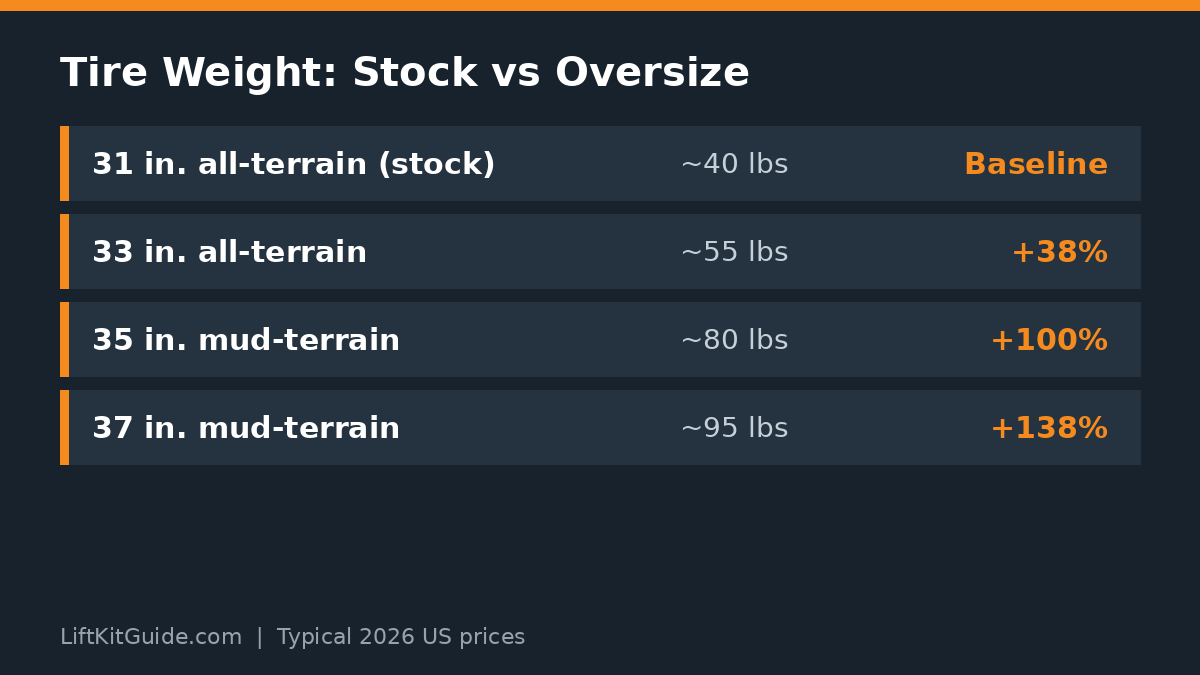
Do bigger tires wear out suspension faster? Yes. Every extra pound of tire and wheel is unsprung weight your suspension was never designed to control, so ball joints, wheel bearings, bushings, and brakes all work harder and wear sooner. A stock 31-inch tire weighs about 40 pounds while a 35-inch mud-terrain can weigh 80 pounds, and that extra mass multiplies the forces on every steering and suspension part. The wear is real but manageable: choose reasonable sizes, keep alignment tight, and inspect wear parts twice as often.
Key takeaways
- A 35-inch mud-terrain can weigh twice as much as a stock 31-inch tire, doubling unsprung weight per corner.
- Wheel bearings, ball joints, and tie rods wear fastest because bigger tires increase leverage on them.
- Negative-offset wheels move the load outward and multiply bearing stress more than tire diameter alone.
- Braking distances grow with heavier tires; one study cites 20 extra feet from 60 to 0 mph.
- Regearing, timely alignment, and lighter wheel choices cut the added wear dramatically.
On this page
Do Bigger Tires Wear Out Suspension Faster? The Short Answer
Do bigger tires wear out suspension faster? The honest answer is yes, and the physics is not debatable. Your truck’s suspension was engineered around a specific tire weight, and every pound you add beyond that becomes unsprung weight the shocks, springs, and joints must manage. Going from a stock 31-inch all-terrain at roughly 40 pounds to a 35-inch mud-terrain at roughly 80 pounds doubles the mass swinging at the end of each control arm. That extra mass hits harder over bumps and resists changes in direction more stubbornly.
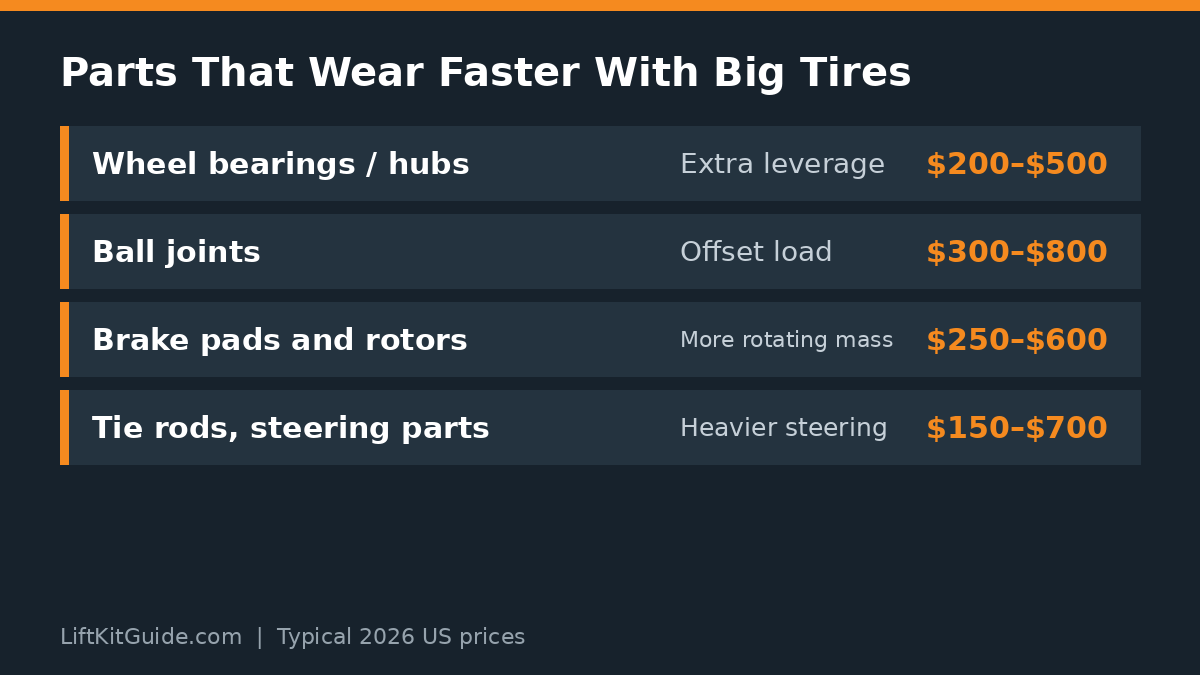
The wear shows up first in parts that carry steering and cornering loads. Wheel bearings and unitized hubs take the beating because the tire acts as a longer lever arm against them, and ball joints see higher forces every time you turn or hit a pothole. Brake components work overtime too, since heavier tires store more energy that the pads and rotors must convert to heat. None of this means big tires will destroy your truck, but it does mean maintenance intervals shrink.
The good news is that the penalty scales with how extreme you go. A one-size step up to 33s on a truck designed for 32s barely changes the wear picture, which is why so many owners run them for years without drama. Jump to 37s with heavy steel wheels (see the biggest tire you can fit without a lift) and deep negative offset, though, and you can realistically expect bearings and ball joints to last half as long. Most of the accelerated wear from asking do bigger tires wear out suspension faster is avoidable with smart choices.
How Does Unsprung Weight Punish Your Suspension?
Unsprung weight is everything the springs do not support: tires, wheels, brakes, and part of the suspension itself, all factors in MPG loss with bigger tires. When this mass grows, the shock absorbers must work much harder to keep the tire planted, because a heavier wheel-tire assembly carries more momentum over every bump. Engineers describe it as the suspension losing authority over the wheel. The result is a harsher ride, faster shock fade, and more impact force transmitted into bushings and mounts.
The numbers make the problem concrete. Tire industry sources note that moving from a 16-inch wheel to a 22-inch wheel can add 40 pounds or more per corner, and off-road combinations are worse: a 35-inch mud-terrain on a steel wheel can approach 100 pounds per corner versus 60-65 for a stock setup. Since force rises with mass, doubling tire weight roughly doubles the loads cycling through ball joints and bearings on every bump, which is exactly why do bigger tires wear out suspension faster has such a clear answer. These leverage effects are documented in a Counterman guide on off-road tires and bearing wear.
Lighter wheels are the cheapest way to fight back. A forged aluminum wheel can save 10-15 pounds per corner over a cheap steel or cast wheel in the same size, and that saving counts double because it is both unsprung and rotating mass. If you want big tires without the full wear penalty, spend the wheel budget on light forged aluminum rather than heavy show wheels. Your bearings, brakes, and fuel economy will all thank you.
| Setup | Approx. weight per corner | Wear impact |
|---|---|---|
| Stock 31 in. all-terrain | ~60-65 lbs | Baseline |
| 33 in. all-terrain, alloy | ~70-75 lbs | Minimal increase |
| 35 in. mud-terrain, alloy | ~85-90 lbs | Noticeably faster wear |
| 37 in. mud-terrain, steel | ~95-110 lbs | Bearings may last half as long |
Why Does Wheel Offset Matter More Than Tire Diameter?
Here is the secret most tire shops will not volunteer: wheel offset often matters more than tire diameter for suspension wear. Pushing the wheel outward with negative offset moves the tire’s contact patch away from the bearing centerline, which turns the whole assembly into a longer lever prying on the hub. A 33-inch tire on a deeply negative-offset wheel can stress a wheel bearing more than a 35 on a factory-offset wheel.
The mechanism is simple leverage. Bearings are designed for loads applied near their center; every inch you move the load outward multiplies the bending moment on the bearing and the ball joints. This is why trucks with wide, poked-out fitments chew through unit bearings while trucks running the same tire diameter on tucked-in wheels go years without issues. When people ask do bigger tires wear out suspension faster, the offset they choose is half the answer.
If bearing life matters to you, stay as close to factory offset as your tire clearance allows. A 0 to +18mm offset range works (check whether 35s will rub first) for most leveled trucks on 33s and 35s without pushing the load path far outward. Spacers and deep-dish wheels look aggressive, but they are a direct tax on every steering and suspension joint. Choose the least aggressive offset that clears, and your parts will last far longer.
Which Parts Wear Out First With Bigger Tires?
Wheel bearings and unitized hubs are almost always first. They carry the full multiplied load of the heavier, more leveraged tire, and the first symptom is usually a low humming or growling that changes with speed, followed by play you can feel rocking the tire, distinct from death wobble after a lift kit at 12 and 6 o’clock. On trucks running 35s with negative offset, hub life of 60,000-80,000 miles is common versus 120,000-plus on stock setups.
Ball joints come next, especially uppers on lifted trucks where angles are already steep. Bigger tires add steering effort and bump loads that accelerate socket wear, and a failed ball joint is a safety issue, not just an annoyance. Tie-rod ends, idler and pitman arms on older steering boxes, and control-arm bushings follow in the wear parade. Anyone researching do bigger tires wear out suspension faster should budget for these parts on a shorter cycle.
Do not overlook brakes and steering assist. Heavier tires demand more from pads and rotors, with one widely cited study finding 20 extra feet of 60-to-0 stopping distance with big wheel-tire combos. Power steering pumps and racks also work harder against the wider contact patch, particularly at parking-lot speeds. Upgrading pads to a severe-duty compound and flushing brake fluid on schedule offsets much of this penalty.
| Part | Typical symptom | What helps |
|---|---|---|
| Wheel bearings / hubs | Humming, play at 12/6 | Factory-ish offset, lighter wheels |
| Ball joints | Clunking, loose steering | Quality replacements, greasable joints |
| Tie rods / steering | Wander, uneven wear | Alignment, HD tie rods |
| Brake pads / rotors | Longer stops, fade | Severe-duty pads, fluid flushes |
| Shocks | Bounce, cupped tires | Shocks rated for the weight |
Do Bigger Tires Wear Out Suspension Faster on Daily Drivers?
Do bigger tires wear out suspension faster on a truck that never leaves pavement? Yes, though less dramatically than on a rig that gets jumped. Potholes, expansion joints, and speed bumps deliver the same multiplied impact forces regardless of terrain, and the extra rotating mass still punishes bearings and brakes in stop-and-go traffic. A daily driver on 35s will still replace hubs and ball joints sooner than the same truck on stock tires.
The daily-driver advantage is consistency. Without off-road impacts, wear is gradual and predictable, and good maintenance catches it early. Rotate tires every 5,000 miles, align at least once a year, and inspect front-end parts at every oil change. Many owners daily-drive 35s for 100,000 miles with nothing worse than one set of hubs and a set of ball joints, which is a fair trade for the look and capability.
Heat is the hidden daily-driver killer. Heavier tires make the transmission and brakes run hotter in traffic, and sustained heat shortens fluid and component life across the board. A transmission temperature gauge is cheap insurance on a truck running oversized tires, and it tells you objectively whether your setup is working the drivetrain too hard on your commute.
Can Regearing Reduce Strain on the Rest of the Drivetrain?
Regearing does not change suspension loads, but it absolutely reduces drivetrain strain, which is the other half of the big-tire wear story. Taller tires raise your effective gear ratio, forcing the engine to lug and the transmission to slip the torque converter more to get moving. That extra slip becomes heat, and heat kills transmissions. Restoring the factory effective ratio, as explained in our regearing for 35s with deeper axle gears puts shift points, converter lockup, and cruising RPM back where the engineers intended. In other words, while the answer to do bigger tires wear out suspension faster stays yes, regearing at least stops the transmission from wearing faster alongside it.
The rule of thumb is straightforward: 35s generally want 4.56 gears on trucks that came with 3.55-3.73s, and 37s want 4.88s. The job typically costs $1,500-2,500 for both axles including setup, which stings until you compare it to a $3,500-6,000 transmission rebuild. Owners consistently report that proper gears restore around-town pep, stop the constant gear hunting on grades, and drop transmission temperatures 20-30 degrees.
Regearing also corrects the speedometer and shift logic that bigger tires throw off, since the computer once again sees the wheel speed it expects. That matters because late, harsh shifts are themselves a wear mechanism inside the transmission. If you are asking do bigger tires wear out suspension faster, remember the transmission is wearing faster too, and gears are the fix for that half of the equation.
How Much Faster Do Parts Actually Wear?
Realistic numbers help more than fear. As a working estimate, each 10 pounds of added unsprung weight per corner shortens bearing and ball-joint life by roughly 10-15 percent, all else equal. So a 35-inch setup adding 25 pounds per corner over stock might take a 120,000-mile hub down to 80,000-90,000 miles. Aggressive negative offset can double that penalty by adding leverage on top of weight. These are working estimates, but they explain why do bigger tires wear out suspension faster is one of the most asked questions in truck forums.
Driving style multiplies everything. A truck on 35s that tows regularly, hits potholes at speed, and never gets aligned will eat front-end parts at an alarming rate, while the same setup with religious maintenance lasts respectably. Alignment is the force multiplier here: even slight toe-out from worn parts or a sloppy alignment scrubs tires and loads joints sideways, compounding the tire-size penalty fast.
Track your own wear to replace fear with data. Note the mileage when you install the bigger tires, then log every front-end part replacement with its mileage. After one cycle you will know your truck’s personal wear rate instead of guessing from internet anecdotes. Most owners find the penalty real but entirely livable, roughly one extra round of wear parts over 150,000 miles.
What Can You Do to Slow Suspension Wear With Big Tires?
Start with the choices that cost nothing: keep tire pressure correct, rotate every 5,000 miles, and align annually. Correct pressure keeps the contact patch even so loads distribute as designed, and rotation prevents the cupping that hammers shocks and bearings. These three habits alone erase a large share of the big-tire wear penalty for the price of discipline.
Spend money where physics says it matters. Lighter forged wheels cut unsprung weight directly, quality hub assemblies from Timken or SKF outlast cheap white-box parts by wide margins, and greasable ball joints let you flush contaminants before they grind. When parts do wear, upgrading rather than replacing with the cheapest option pays for itself in the longer second life. Do bigger tires wear out suspension faster? Yes, but smart parts choices slow it to a crawl. Check our guide on lift kit warranty implications before arguing a dealer denial.
Finally, right-size the whole package. The least wear comes from the smallest tire that does your job, the lightest wheel that clears your brakes, and the least aggressive offset that avoids rubbing. Every inch of diameter, every pound of wheel, and every millimeter of negative offset you skip is wear you never pay for. Build for your actual use, not the parking lot, and big tires become a manageable choice instead of a maintenance nightmare.
- Rotate every 5,000 miles: prevents cupping that destroys shocks and bearings.
- Align at least yearly: toe wear multiplies every other wear mechanism.
- Check torque: retorque lug nuts and suspension bolts after the first 500 miles on new wheels.
- Grease what you can: greasable ball joints and tie rods last far longer with fresh grease.
- Watch temperatures: a trans temp gauge reveals drivetrain stress early.
Frequently asked questions
Do 33-inch tires wear out suspension faster than stock?
Barely. A 33-inch all-terrain on a reasonable wheel adds modest weight over stock, and most trucks absorb it without a meaningful change in part life. Keep up with rotations and alignments and you will likely never notice the difference.
Do wheel spacers wear out bearings faster?
Yes. Spacers push the wheel outward exactly like negative-offset wheels do, increasing leverage on the hub bearing. Quality hub-centric spacers are safe, but expect shorter bearing life, especially combined with heavy tires.
Will bigger tires void my suspension warranty?
Oversized tires can give a dealer grounds to deny warranty claims on affected parts like bearings and ball joints under the Magnuson-Moss Warranty Act, since the modification plausibly caused the failure. The burden is on them to prove the connection, but expect a fight on wear items.
How often should I inspect suspension with 35s?
Check front-end parts for play at every oil change, roughly every 5,000-7,500 miles, and get a full alignment check yearly. Catching a worn ball joint or hub early prevents it from destroying the tire and neighboring parts.
Do bigger tires affect braking distance?
Yes. Heavier tire-wheel assemblies store more energy, and one study found 60-to-0 stopping distances grew by about 20 feet with large wheel-tire combos. Severe-duty pads, fresh fluid, and larger rotors where they fit help compensate.
The bottom line
Do bigger tires wear out suspension faster? Yes, measurably so. The added unsprung weight and leverage shorten the life of wheel bearings, ball joints, steering parts, and brakes, with 35s and aggressive offsets roughly halving hub life compared to stock. But the penalty is proportional and manageable, not catastrophic.
The owners who get burned are the ones who bolt on the heaviest, widest setup and then skip maintenance. Choose the lightest wheels you can afford, keep offset sane, align yearly, rotate every 5,000 miles, and regear when you go big. Do that, and bigger tires cost you one extra round of wear parts over the life of the truck, which most enthusiasts happily pay.



Leave a comment