


Last updated: October 2026 Written by the LiftKitGuide Team, truck suspension installers and editors
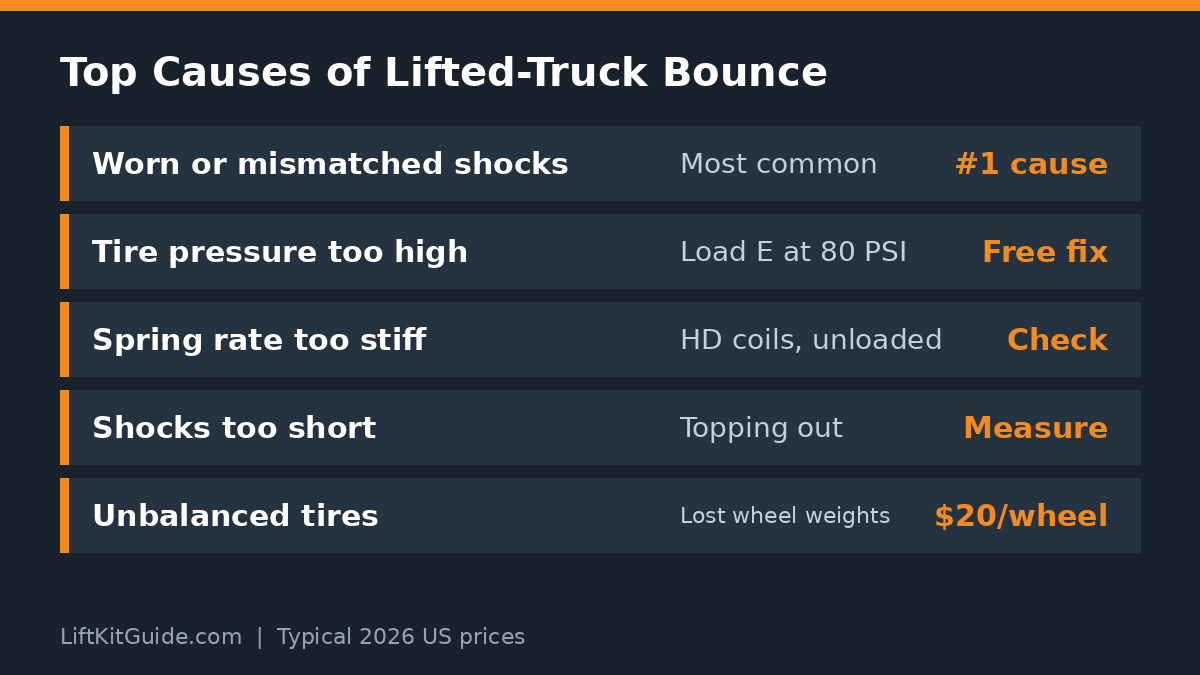
Why does my lifted truck bounce so much? In most cases, worn-out or mismatched shocks can no longer control the springs, tires are inflated far above what the setup needs, or the spring rate suits a heavier truck than yours. A lifted truck bounces when the suspension cannot absorb and settle each bump in one motion, so the axle keeps oscillating. If you are wondering why does my lifted truck bounce so much, start with tire pressure, then test the shocks, then match springs to your weight.
Key takeaways
- Worn or mismatched shocks are the number one reason a lifted truck bounces, because the damper can no longer control spring oscillation.
- Load-range E tires inflated to 70-80 PSI ride like rocks; most lifted trucks ride best at 35-45 PSI when unloaded.
- Springs rated for a winch bumper and armor will bounce an empty truck, so match spring rate to your real curb weight.
- Shocks that are too short for the lift top out over bumps, which feels like harsh bouncing in the rear.
- A full bounce diagnosis costs $0-150 at home and most fixes land between $80 and $600.
On this page
Why Does My Lifted Truck Bounce So Much Right After the Install?
You just paid for a lift, drove out of the shop, and now you are wondering why does my lifted truck bounce so much over every small bump. This is the most common complaint after a fresh install, and it rarely means the kit itself is junk. In the first hundred miles, the usual suspects are tire pressure the shop left at the maximum on the sidewall, shocks that were reused from the stock suspension, and springs that have not settled yet. Each of these makes the truck pogo over bumps instead of absorbing them.
Spacer and block lifts are more likely to bounce than full replacement systems because they keep the factory shocks and springs working outside their designed range. A two-inch front spacer, for example, pushes the stock strut closer to full extension, so it tops out with a jolt on every dip. Full suspension lift kits and leaf-pack systems are engineered for the new ride height, which is why they generally settle bumps in one controlled motion. If your bounce started the day the spacers went on, the design is telling you something.
Start with the free checks before spending money, because that is where most bounce complaints end. Drop tire pressure to a sane level for your load, bounce each corner by hand to feel for dead shocks, and look for oil leaking down the shock bodies. If you are still asking why does my lifted truck bounce so much after those checks, the next step is measuring whether your shocks are actually long enough for the lift. Nine times out of ten, one of these three checks finds it.
| Symptom | Likely cause | First check |
|---|---|---|
| Bounce right after install | Tire pressure at sidewall max | Lower to 35-45 PSI unloaded |
| Rear kicks over bumps | Stock shocks too short | Measure shock travel |
| Floaty then harsh | Worn shocks | Bounce test each corner |
| Bounce only at speed | Tire balance | Rebalance all four |
Are Worn or Mismatched Shocks the Main Cause?
Yes. Shocks exist for one job: controlling the spring. The spring absorbs the bump, and the shock’s job is to stop the spring from bouncing afterward. When shocks wear out, leak, or were never valved for your lift height, the spring keeps oscillating and you feel every wave of it in the seat. This is the textbook answer whenever someone asks why does my lifted truck bounce so much, and it applies whether the shocks have 100,000 miles on them or were simply the wrong length from day one.
Mismatched shocks are the lifted-truck version of this problem. A very common story on owner forums is a truck that got taller springs or an add-a-leaf in the rear while keeping the factory shocks, and then the owner wonders why does my lifted truck bounce so much. The stock damper was valved for a softer, shorter-travel setup, so it cannot control the stiffer, longer spring. The rear end hops over expansion joints and feels nervous on washboard roads.
You can test shocks at home in two minutes. Push down hard on each corner of the truck and let go. A healthy shock settles in one to one-and-a-half bounces. If the corner keeps bouncing two or three times, that damper is done. Also run your finger along the shock body: wet oil or heavy grime means the seal has failed. Replace shocks in pairs at minimum, and on a lifted truck, buy shocks built for your exact lift height, as our Rough Country vs BDS vs Zone comparison explains.
Is Your Tire Pressure Too High for the New Setup?
Tire pressure is the single most overlooked reason a lifted truck bounces, and it costs nothing to fix. Many shops inflate new all-terrain or mud-terrain tires to the maximum printed on the sidewall, often 80 PSI for load-range E tires. At that pressure the tire becomes a rigid hoop that transmits every crack in the pavement straight into the suspension, which is exactly why does my lifted truck bounce so much is so often answered with a tire gauge.
The right pressure depends on your truck’s weight, not the tire’s maximum. Most half-ton trucks on 33s or 35s ride best somewhere between 35 and 45 PSI when unloaded, even on load-range E tires. The classic chalk test still works: draw a thick chalk line across the tread, drive a hundred feet on flat pavement, and check the wear pattern. Even chalk wear means the pressure is right; chalk worn off only in the center means too much air.
Do not forget the spare or the TPMS warning. If you drop pressure well below the factory door-jamb spec, the tire pressure light may come on, which is normal and can be recalibrated. What matters is that the tire’s contact patch is doing the work instead of your spine. Owners who drop from 80 PSI to 40 PSI routinely describe it as the biggest single ride improvement they have ever made, bigger than any shock swap; see why your lifted truck rides rough for the full breakdown.
- Unloaded daily driving: start at 35-40 PSI on 33s or 35s, then fine-tune with the chalk test.
- Towing or hauling: raise the rear tires 10-15 PSI over your unloaded setting to control sway.
- Load-range E tires: ignore the 80 PSI sidewall maximum unless you are at full rated load.
- Check monthly: tires lose 1-2 PSI per month, and a slow leak mimics bad shocks.
Could Too Much Spring Rate Be the Problem?
Spring rate is how stiff the spring is, and getting it wrong guarantees a bouncy ride. Lift springs are sold in different rates for different uses: soft rates for an empty daily driver, heavy rates for trucks carrying winch bumpers, armor, and rooftop tents. If your truck wears heavy-duty coils but carries no extra weight, every bump gets launched back at you because the spring barely compresses. The result feels like bouncing even with perfect shocks.
This mistake is easy to make because heavy springs sound tougher. A 700-pound coil sounds more capable than a 600-pound coil, so buyers pick the bigger number. On an empty truck, though, that extra rate just means the suspension never gets into its comfortable working range. If you are asking why does my lifted truck bounce so much and your springs were chosen for a build you have not finished yet, the springs are fighting the truck instead of working with it. Owners discussing this exact issue in a TacomaWorld thread on rough ride after a new lift reached the same conclusion.
Match the spring to the weight the truck actually carries every day. Most quality coilover makers publish spring-rate charts by vehicle weight and intended use; use them. If you already bought too stiff, options include swapping to a lighter rate, which many shops will do for the cost of labor, or adding the weight the springs were designed for. Never try to soften stiff springs by cranking preload down excessively, because that just costs you ride height without fixing the rate.
| Truck setup | Typical front coil rate | Ride character |
|---|---|---|
| Stock daily driver | 550-600 lb/in | Soft, comfortable |
| Leveled, no extra weight | 600-650 lb/in | Firm but controlled |
| Winch bumper + skids | 650-700 lb/in | Controlled with weight |
| Full armor + tent | 700 lb/in and up | Harsh when unloaded |
Does Your Lift Kit Need Longer Shocks?
A shock that is too short for the lift will top out, meaning it hits full extension with a metal-on-metal jolt every time the axle drops into a dip. That jolt feels exactly like bouncing, and it is brutal on the shock’s internal stops. This is extremely common on budget spacer lifts and on rear lifts where blocks were added but the stock shocks were kept. If you wonder why does my lifted truck bounce so much specifically over dips and driveway entrances, topping out is a prime suspect.
Measuring is simple and settles the question. With the truck on level ground, measure the exposed shock shaft at ride height, then jack up that corner until the tire just leaves the ground and measure again. The difference is your available droop travel, and a shortage here is a classic reason why does my lifted truck bounce so much over dips. If you have less than about two inches of shaft showing at ride height on a lifted truck, the shock is too short and you are riding on the extension stops.
The fix is shocks built for your lift height or shock relocation brackets that reposition the mounts. Quality lift manufacturers list the exact extended and collapsed lengths their kits need, so buy by measurement rather than by guess. As a rule of thumb, a three-inch lift needs shocks roughly three inches longer than stock. Spending $400-600 on correctly sized shocks (budget it with our lift kit installation costs) transforms a bucking truck into a composed one.
Can Unbalanced or Out-of-Round Tires Cause Bouncing?
Yes, and this one is sneaky because it feels like a suspension problem. A tire that lost a wheel weight on your biggest tire you can fit without a lift setup, or a mud-terrain with an out-of-round carcass, sends a rhythmic thump through the whole truck that owners describe as bouncing. The clue is speed: tire-related bounce usually appears in a specific speed band, often 45-65 mph, and changes or disappears above and below it, while shock problems bounce at any speed over bumps.
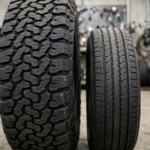
Big mud-terrains are the usual offenders. Their heavy tread blocks are harder to balance perfectly, and some develop flat spots from sitting or slight out-of-roundness from the mold. Standard spin balancing sometimes cannot fix them, which is why many shops recommend road-force balancing for 35s and larger. A road-force balancer presses a roller against the tire to simulate road pressure and finds the stiff spots a regular balancer misses.
If you recently mounted new tires and immediately started asking why does my lifted truck bounce so much, go back to the tire shop before touching the suspension. Ask for a rebalance, and specifically request road-force balancing if they offer it, usually $25-35 per wheel versus $15-20 for a standard balance. Also inspect for mud or snow packed inside the wheels after off-roading, because even a pound of packed mud throws a big tire badly out of balance.
How Do You Test Whether Your Shocks Are Worn Out?
The bumper bounce test is the classic for a reason: it works. Stand at each corner, push down hard with your body weight, and release. Count the bounces. One controlled rebound means the shock is healthy. Two or more full bounces means the damper is worn and the spring is doing whatever it wants. Do all four corners, because a truck can have one dead shock making the whole vehicle feel unstable.
Next, inspect with your eyes and hands. Look for oil misting or wet streaks on the shock body, dented tubes, torn bushings, and loose mounting bolts. Grab the shock and try to move it laterally; clunking means the bushings are gone. Mileage is a rough guide: twin-tube shocks often fade by 50,000 miles of hard use, while quality monotubes like Bilstein 5100s commonly last 80,000-100,000 miles. If you cannot remember when yours were replaced, that is your answer.
For a definitive test, remove one shock and cycle it by hand. A good shock resists firmly and smoothly in both directions with no dead spots or gurgling. A worn shock moves easily, sticks, or makes noise. This test takes twenty minutes per corner with basic hand tools and removes all doubt. When you confirm the diagnosis, replace in axle pairs and consider it routine maintenance, not a failure of your lift kit.
Why Does My Lifted Truck Bounce So Much Even After New Shocks?
So you replaced the shocks and you are still asking why does my lifted truck bounce so much. Do not despair; this just means the shocks were only part of the story. The remaining suspects are tire pressure that is still too high, springs with the wrong rate for your weight, worn control-arm or leaf-spring bushings letting the axle move around, and alignment numbers, especially caster, that went out of range with the lift. Each of these can mimic bad shocks.
Worn bushings deserve special attention on trucks with 80,000-plus miles. Rubber bushings harden and crack with age, and a lift changes the angles they work at, which is why upper control arms for a 3-inch lift matters, which finishes them off. Sloppy bushings let the axle steer itself over bumps, producing a loose, bouncy feeling no shock can fix. A full bushing inspection on a lift install is cheap insurance and often reveals the real culprit behind a persistent bounce.
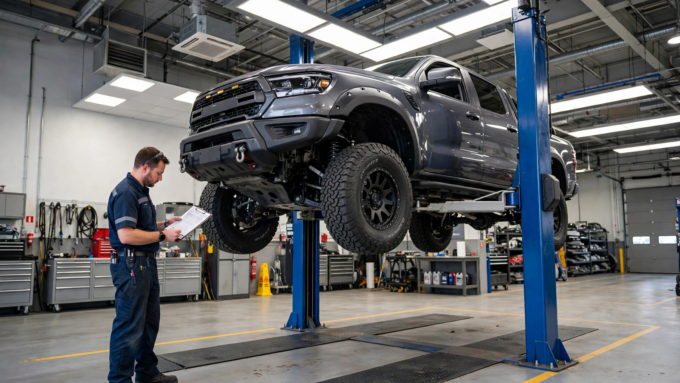
If you have worked through pressure, shocks, springs, bushings, and balance and the bounce persists, get a professional diagnosis with an alignment check. Ask the shop for before-and-after alignment numbers and have them check for bent components or a tweaked frame from a previous impact. At that point you are paying for expertise, usually $150-250, which beats throwing another set of parts at the problem.
Frequently asked questions
Why does my lifted truck bounce so much on the highway?
Highway bounce is usually tire-related: pressure too high, a lost wheel weight, or an out-of-round mud-terrain. It shows up in a specific speed band, often 45-65 mph. Drop pressure to 35-45 PSI unloaded, get a road-force rebalance, and recheck. If the bounce happens over bumps at any speed instead, suspect shocks.
Will new shocks fix a bouncy lifted truck?
New shocks fix the bounce when worn or mismatched dampers are the cause, which covers most cases. Buy shocks valved and sized for your exact lift height, not generic replacements. If the bounce comes from 80 PSI tires or springs rated for armor you do not carry, new shocks alone will disappoint, so check pressure and spring rate first.
What tire pressure should I run on my lifted truck?
Most half-ton trucks on 33s or 35s ride best at 35-45 PSI when unloaded, even on load-range E tires rated to 80 PSI. Use the chalk test to dial it in: even chalk wear across the tread means the pressure is right. Add 10-15 PSI in the rear when towing or hauling heavy.
Can a leveling kit cause bouncing?
Yes. Leveling spacers push stock struts toward full extension, so they top out harshly over dips, and they preload the factory springs into a stiffer part of their travel. If the bounce started with the leveling kit, longer shocks or a proper coilover setup usually cures it.
How much does it cost to fix a bouncing lifted truck?
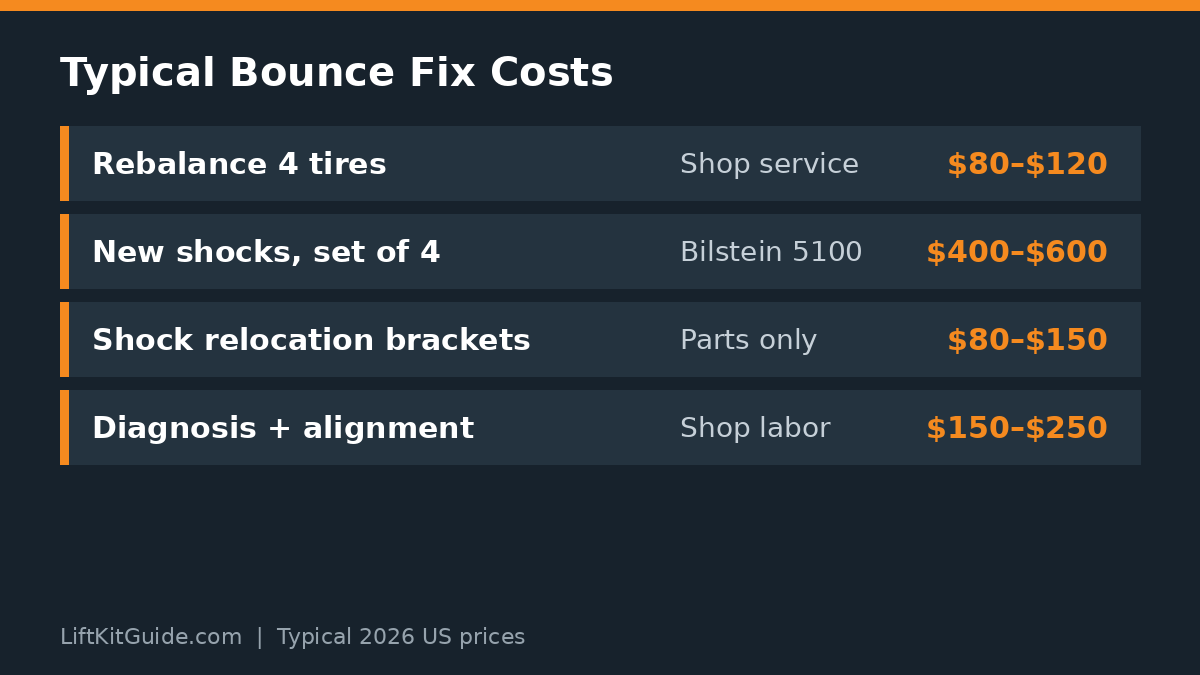
A tire rebalance runs $80-120, a set of four quality shocks $400-600, and shock relocation brackets $80-150. A professional diagnosis with alignment check is $150-250. Most owners solve bounce for under $600 total when they diagnose before buying parts.
The bottom line
When you ask why does my lifted truck bounce so much, the answer is almost always one of four things: shocks that are worn or wrong for the lift, tires inflated to the sidewall maximum, springs rated for weight you do not carry, or shocks too short for the new ride height. Work through them in that order, starting with the free tire-pressure check, and you will find the culprit without guessing.
Resist the urge to throw parts at the problem. A $0 pressure adjustment and a two-minute bounce test solve more bounce complaints than any upgrade. Spend money only on the confirmed weak link, buy components sized for your actual lift height and curb weight, and your lifted truck will ride the way the brochure promised.



Leave a comment