


Last updated: October 2026 Written by the LiftKitGuide Team, truck suspension installers and editors
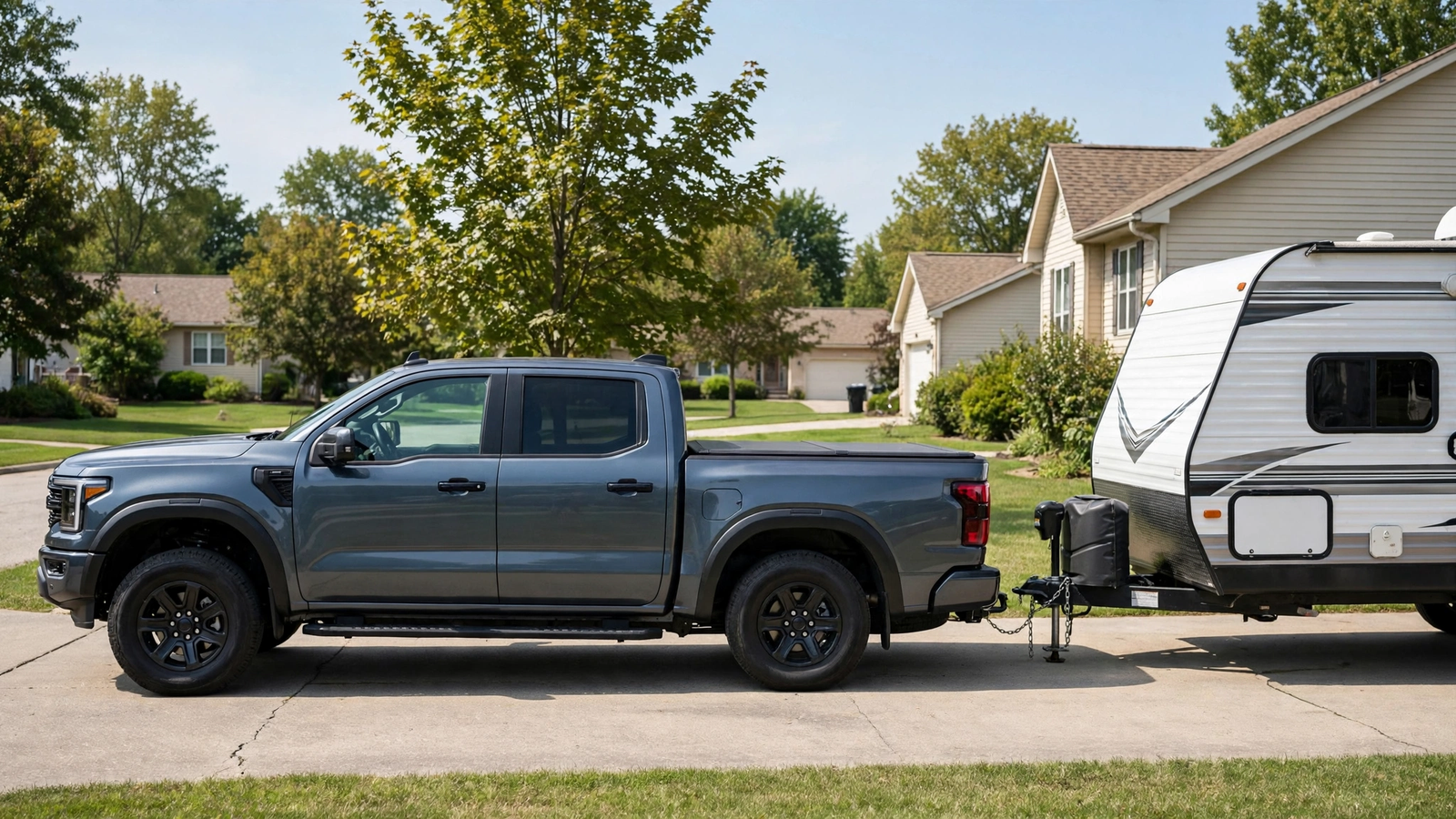
Why does my truck sag in the rear after a leveling kit? Because the kit raised the front to match the rear, erasing the factory rake your truck needs to sit level under load. Trucks leave the factory with the rear 1-2 inches higher so cargo or a trailer brings them to level; once leveled, even a moderate load drops the rear below the front. The fix depends on use: air helper bags, an add-a-leaf, or a small rear block restore the working stance.
Key takeaways
- Leveling kits raise the front about 2 inches, erasing the factory rake trucks need for loaded driving.
- A leveled truck squats 2-4 inches under tongue weight that a stock truck would absorb gracefully.
- Worn rear leaf springs with flattened arch sag sooner and make a leveled truck look worse.
- Air helper bags ($300-600) are the best fix for towers; add-a-leaf ($150-300) suits constant loads.
- Measure fender heights loaded and unloaded before buying any fix so you size it correctly.
On this page
Why Does My Truck Sag in the Rear After a Leveling Kit?
Why does my truck sag in the rear after a leveling kit? The short answer is that nothing is broken: the kit did exactly what it was designed to do, and the sag is the price. A leveling kit basics lifts the front of the truck roughly two inches to eliminate the nose-down factory stance. That looks great in the driveway, but it also deletes the rake the engineers built in so the truck would sit level with a load in the bed or on the hitch.
With the rake gone, physics takes over the moment you load up. A trailer tongue dropping 500-800 pounds on the hitch compresses the rear springs two to four inches, and now there is no extra rear height to absorb it. The result is a truck that sits nose-high, points its headlights at the sky, and steers lighter than it should. Owners describe it as the truck suddenly looking broken every time they tow.
This surprises people because the truck looked perfect when empty. An empty leveled truck sits dead level, which photographs beautifully and feels like an upgrade. But trucks are tools first, and the factory rake exists because engineers expect you to use the bed and the hitch. If you are asking why does my truck sag in the rear after a leveling kit, the honest answer is that you traded loaded capability for empty looks.
What Is Factory Rake and Why Do Trucks Have It?
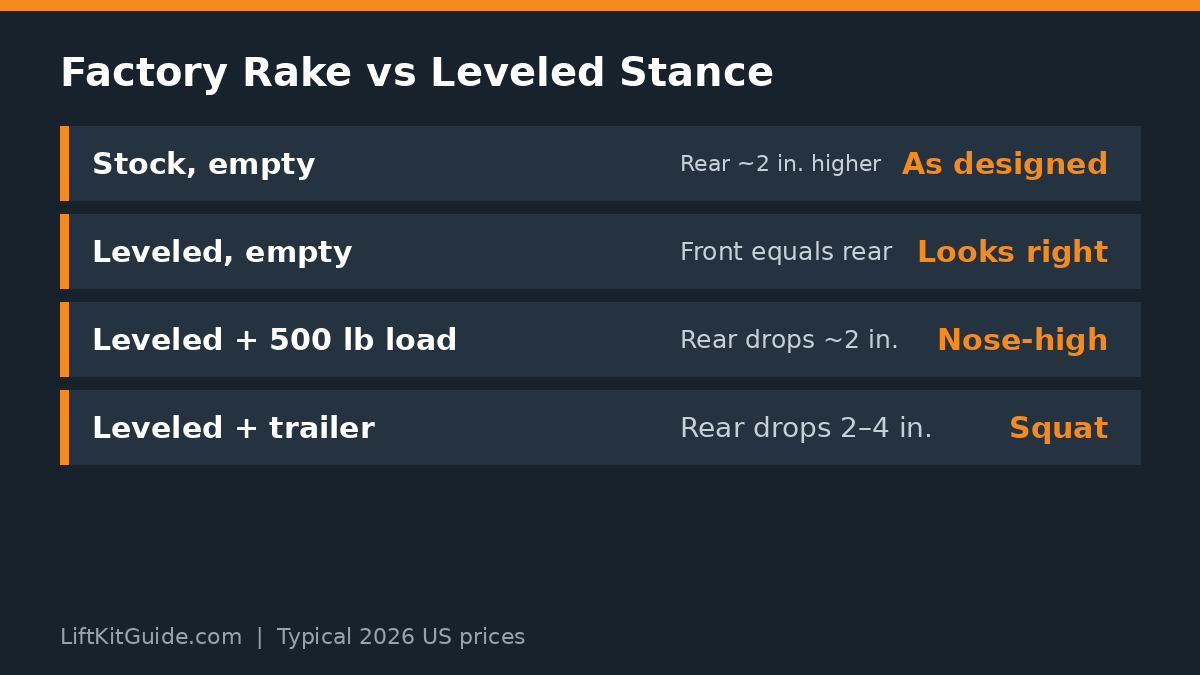
Factory rake is the nose-down stance trucks get instead of a full leveling kit vs lift kit trucks leave the assembly line with: the rear fender sits roughly one to two inches higher than the front. It is not a styling mistake. Engineers design it so that when you load the bed to the payload rating or drop a trailer on the hitch, the rear settles down to approximately level instead of sagging below the front. Rake is load capacity made visible.
The springs tell the same story. Modern trucks use variable-rate rear springs that start soft for ride comfort and firm up as they compress, like a built-in overload spring. Even moderate loads use up an inch or two of that soft initial travel, which is exactly the amount of rake the factory provided. Remove the rake with a leveling kit and that first inch of load travel now shows up as visible sag. In fact, why does my truck sag in the rear after a leveling kit is really a question about what rake was doing for you all along.
Rake also keeps headlights aimed correctly and weight distributed properly when loaded. A truck that squats nose-high under a trailer lifts weight off the front axle, which lightens steering feel and lengthens stopping distances. The factory stance is a compromise, but it is a carefully engineered one, and understanding it explains most of what owners notice after leveling.
| Truck | Typical factory rake | What it absorbs |
|---|---|---|
| Half-ton (F-150, Silverado) | 1.5-2 in. | 500-1,000 lb bed load |
| Heavy-duty 2500/3500 | 2-3 in. | 1,500+ lb and gooseneck |
| Midsize (Tacoma, Colorado) | 1-1.5 in. | 400-800 lb bed load |
| Leveled (any truck) | 0 in. | Nothing; sag shows immediately |
Is the Sag Real or Just an Optical Illusion?
Sometimes the sag is partly in your eyes. After staring at a nose-down truck for years, a dead-level truck can look rear-low simply because your brain expects the old stance. Shadows, sloped driveways, and camera angles exaggerate it further. Before spending money, verify with a tape measure rather than a glance, because a surprising number of sag complaints evaporate at the measuring tape.
Measuring is easy and settles it. Park on flat concrete, then measure from the ground to the bottom edge of each fender arch, front and rear, and write the numbers down. Do it empty, then again with your typical load or trailer hooked up. If the rear measurement drops more than an inch below the front under load, the sag is real and worth fixing. If the numbers are within half an inch, you are chasing an illusion. If you are still unsure why does my truck sag in the rear after a leveling kit, these numbers give you the objective answer.
Also check whether the truck sat level before the leveling kit. Many trucks develop a slight rear sag over the years as leaf springs flatten with age and miles, and the leveling kit just made the pre-existing sag visible by raising the front to match. In that case the leveling kit exposed worn springs rather than causing the problem, and the rear suspension was due for attention anyway.
How Much Does a Truck Normally Squat Under Load?
A healthy stock truck squats a predictable amount: roughly one inch per 400-500 pounds of well-distributed bed load on a half-ton, and two to four inches under typical travel-trailer tongue weights of 500-1,000 pounds. Heavy-duty trucks squat less thanks to stiffer springs, often just an inch under a loaded gooseneck. These numbers assume stock rake; the truck settles toward level, which is the design working as intended. This baseline matters because why does my truck sag in the rear after a leveling kit only makes sense compared to how a stock truck behaves.
The trouble starts when squat exceeds the available rake. A leveled truck has zero rake in reserve, so that same two-inch trailer squat puts the rear two inches below the front instead of bringing it down to level. Headlights aim high, the front end gets light, and the rig looks and feels wrong. This is the core mechanical reason a leveled truck seems to sag so much worse than stock under identical loads.
Tongue weight percentage matters enormously. Travel trailers should carry 10-15 percent of their weight on the tongue; too little causes sway, too much causes extreme squat. Weigh your setup at a CAT scale if you tow regularly: knowing your actual tongue weight turns the sag question from a feeling into a number you can fix with the right spring rate or air pressure.
- Park on flat concrete: even a slight slope corrupts fender measurements.
- Measure all four fenders: ground to fender-arch lip, recorded to the nearest eighth inch.
- Measure empty first: this is your baseline; fuel tank should be similarly full each time.
- Measure loaded: same spots, with your real cargo or trailer attached.
- Compare front to rear: more than 1 inch of rear-low under load means real sag.
Why Does My Truck Sag in the Rear After a Leveling Kit When Towing?
Towing is where the missing rake hurts most, which is why does my truck sag in the rear after a leveling kit when towing is one of the most common follow-up questions. A weight-carrying hitch dumps the full tongue weight directly onto the rear axle with no leverage advantage, so a 700-pound tongue compresses the rear two to three inches. On a stock truck that compression just erases the rake; on a leveled truck it creates a visible, handling-affecting squat. Owners debating this in a RamForum discussion on leveling kits and towing reached the same conclusion.
The handling consequences are real, not cosmetic. A nose-high rig unloads the front axle, which makes steering vague and lets the front tires tramline along road grooves. Braking distances grow because the rear-heavy bias overwhelms the rear brakes while the fronts do less work. At night, leveled headlights blind oncoming traffic when the rear squats. None of this happens on a stock-rake truck under the same trailer.
The right answer for towers is load support, not more lift. Air helper bags inside the rear coils or alongside the leaf springs let you add 5-100 PSI to restore ride height only when towing, then air down for the daily commute. A weight-distributing hitch is the other half (see our guide to towing with a lifted truck) of the solution: it levers several hundred pounds of tongue weight back onto the front axle, restoring steering feel and headlight aim.
Can Worn Rear Leaf Springs Make the Sag Worse?
Absolutely, and this is the most commonly missed contributor. Leaf springs lose arch over years of cycles and heavy loads; a spring pack that started with a healthy upward smile gradually goes flat and then starts to frown. Flat springs have less travel before they hit the overload stage and less rate to resist load, so they sag sooner and deeper. A ten-year-old truck can easily have lost an inch of rear ride height to spring fatigue alone. That is a different fix than most people expect when they ask why does my truck sag in the rear after a leveling kit.
Diagnosing it is visual. Crawl under the rear and look at the leaf pack from the side: healthy springs arc upward in the middle, tired ones sit flat, and truly worn ones curve downward. Check for cracked leaves, shifted center bolts, and flattened overload leaves. If you are wondering why does my truck sag in the rear after a leveling kit and your springs look flat empty, the kit is innocent and the springs are guilty.
Worn springs also ride worse, with more axle wrap and a harsher bottoming over bumps. Replacement options range from an add-a-leaf at $150-300 that restores an inch or so, to a full aftermarket leaf pack at $500-1,000 that lets you choose spring rate and height together. If your truck has over 100,000 miles or a history of heavy hauling, budget for rear springs as part of any leveling project.
What Are the Fixes: Air Bags, Add-a-Leaf, or Blocks?
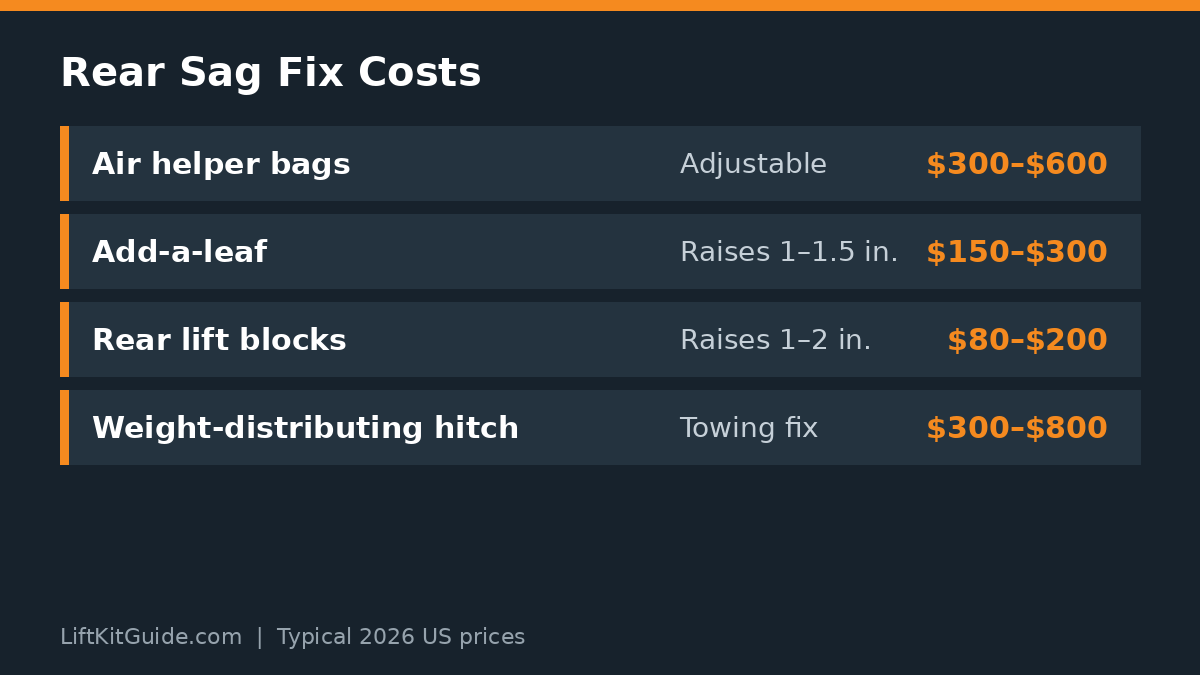
Air helper bags are the most versatile fix, especially if you tow. Kits from Air Lift and Firestone (budget them with our leveling kit costs) slide inside the rear coil springs or mount beside leaf packs and inflate from 5 to 100 PSI, letting you dial in exactly the support each load needs. Unloaded, you run minimum pressure and keep the stock ride; hitched up, you add air until the truck sits level. Installed cost typically runs $300-600 plus an hour or two of driveway labor.
An add-a-leaf is the budget permanent fix for trucks that always carry weight. A new leaf inserted into the pack adds roughly one to one-and-a-half inches of rear height and meaningful spring rate for $150-300. The tradeoff is a firmer unloaded ride, since the extra rate never goes away. For work trucks with constant bed loads or shells, that tradeoff is usually welcome. For drivers asking why does my truck sag in the rear after a leveling kit with a loaded work bed, this is often the best dollar-for-dollar fix.
Rear lift blocks are the simplest way to restore rake: a one or two-inch block between the axle and spring pack raises the rear to match the leveled front. At $80-200 they are cheap and easy, but they add no spring rate, so a heavy load still compresses the same springs just as far. Blocks fix the empty stance beautifully and do nothing for loaded squat, so pair them with bags if you tow.
| Fix | Cost | Best for | Downside |
|---|---|---|---|
| Air helper bags | $300-600 | Towing, variable loads | Requires air management |
| Add-a-leaf | $150-300 | Constant bed weight | Firmer empty ride |
| Rear lift blocks | $80-200 | Empty stance | No extra load support |
| Weight-distributing hitch | $300-800 | Travel trailers | Setup per trailer |
Should You Skip the Leveling Kit If You Tow?
If towing is your truck’s main job, think hard before leveling; it is one of the common lift kit mistakes. Every inch of front lift is an inch of rake you will miss the first time you hook up the trailer, and no bolt-on fix fully restores what the factory gave you for free. Many experienced towers run stock height or a mild lift with the rear raised equally, keeping one to two inches of rake for loaded work. Looks are nice, but a rig that tows level is safer.
That said, you can have both with the right supporting mods. A leveling kit plus air bags is a proven combination: leveled looks when empty, level towing when aired up. The key is budgeting the bags as part of the leveling project rather than discovering the need afterward. Installed together, the whole package typically runs under $1,000 on top of the cost to lift a truck and the truck works as a truck again.
Whatever you choose, measure first and decide with numbers. Record your fender heights empty and loaded before the leveling kit goes on, so you know exactly what the kit changed and what your real loaded stance needs. Owners who skip this step end up asking why does my truck sag in the rear after a leveling kit on forums; owners who measure just order the right fix the first time. And they never have to ask why does my truck sag in the rear after a leveling kit twice.
Frequently asked questions
Will a leveling kit make my truck squat when towing?
Yes, it makes visible squat more likely. Leveling removes the factory rake that absorbs tongue weight, so the same trailer that settled a stock truck to level will push a leveled truck nose-high. Air helper bags or a weight-distributing hitch restore loaded stance.
How do I fix rear sag after a leveling kit?
For towing, air helper bags ($300-600) are best because they adjust to each load. For constant bed weight, an add-a-leaf ($150-300) adds permanent height and rate. For looks alone, a 1-2 inch rear block ($80-200) restores rake but adds no load support.
Do I need an alignment after a leveling kit?
Yes. Raising the front changes camber and toe, which wears tires fast if left uncorrected. Get a full alignment immediately after any leveling kit install, typically $100-150, and recheck it yearly.
Can worn leaf springs cause rear sag without a leveling kit?
Yes. Leaf springs flatten with age and heavy use, losing an inch or more of rear ride height over 100,000 miles. If your stock truck sags, inspect the spring arch before blaming anything else; flat or frowning springs need replacement.
Are air bags better than add-a-leaf for rear sag?
For variable loads like towing, yes: air bags adjust from 5-100 PSI to match each load and ride stock when empty. Add-a-leaf is better for constant weight since it is always working and costs half as much. Many towers run both.
The bottom line
Why does my truck sag in the rear after a leveling kit? Because leveling deletes the factory rake your truck relied on to sit level under load. The kit did not break anything; it simply spent the two inches of rear height the engineers had reserved for cargo and tongue weight. Every load now shows up as visible squat instead of being absorbed gracefully.
The fix is straightforward once you measure. Towers want air helper bags, work trucks with constant loads want an add-a-leaf, and stance-only owners can use a small rear block. Measure your fender heights empty and loaded, pick the fix that matches your actual use, and your leveled truck will work as good as it looks.



Leave a comment