


Last updated: October 2026 Written by the LiftKitGuide Team, truck suspension installers and editors
Can a lift kit cause transmission problems? Rarely directly, but the bigger tires that come with most lifts absolutely can. Taller tires raise your effective gearing, forcing the transmission to work harder for the same acceleration, which increases torque-converter slip and fluid heat. Sustained heat breaks down transmission fluid and wears clutches, leading to erratic shifts and early failure. The protection is simple: regear the axles to match the tires, add a transmission cooler if you tow, and watch fluid temperatures.
Key takeaways
- The lift kit itself rarely harms the transmission; the bigger tires are what create the strain.
- Taller tires raise effective gearing, increasing converter slip and transmission fluid heat.
- Sustained fluid temperatures above 225F rapidly shorten transmission life.
- Regearing to 4.56 or 4.88 for 35s-37s restores shift points and drops temperatures 20-30 degrees.
- A $150-400 auxiliary transmission cooler is cheap insurance for lifted trucks that tow.
On this page
Can a Lift Kit Cause Transmission Problems? The Honest Answer
Can a lift kit cause transmission problems? The direct answer surprises most owners: the lift hardware itself, the springs, shocks, and brackets, has almost nothing to do with the transmission. What damages transmissions is the package that usually comes with the lift, namely much taller and heavier tires. Understanding this distinction matters because it tells you exactly where to spend your protection budget, including whether a lift kit voids warranty considerations.
The confusion comes from timing. Owners install a lift and bigger tires together, then blame the first transmission shudder on the lift kit. In reality, the transmission does not know or care how tall the truck sits; it only feels the load at the output shaft. A six-inch lift on stock-size tires stresses the transmission no more than stock, while stock height on 37s can cook a transmission in traffic.
That said, extreme lifts can create indirect transmission issues through driveline angles. When pinion angles go wrong, the resulting vibration travels through the driveshaft into the transmission output bearing and seal, and chronic vibration shortens their life. So while you are asking can a lift kit cause transmission problems, keep the driveline angles correct and the transmission itself is largely insulated from the lift.
How Do Bigger Tires Strain an Automatic Transmission?
It comes down to effective gearing. Your transmission was calibrated for a specific tire diameter; when you bolt on taller tires, each driveshaft revolution moves the truck farther, which is exactly like installing taller axle gears. The engine now lugs at lower RPM for a given speed, so the transmission compensates with more torque-converter slip to get the truck moving, and slip is pure heat dumped into the fluid. The physics are well explained in this Jalopnik on how oversized tires damage transmissions. Put simply, every extra inch of tire diameter asks the transmission to do more work with less leverage, which is the root mechanism behind can a lift kit cause transmission problems.
Heat is the mechanism of damage. Transmission fluid begins breaking down rapidly above roughly 225 degrees Fahrenheit, losing its ability to protect clutches and bands. Under higher constant stress from oversized tires, fluid temperatures climb, friction surfaces glaze and slip more, which generates still more heat in a vicious cycle. This is why transmission failures on big-tire trucks so often trace back to cooked fluid rather than any single broken part.
The strain shows up in everyday driving long before failure. You will notice delayed engagement when shifting into drive, soft or flaring shifts under light throttle, and the converter refusing to lock up on the highway. These are the transmission telling you the load has exceeded its calibration. If you recognize these symptoms after upsizing, and you are still wondering can a lift kit cause transmission problems, the tires are your answer and regearing is your fix; see regearing for 35s.
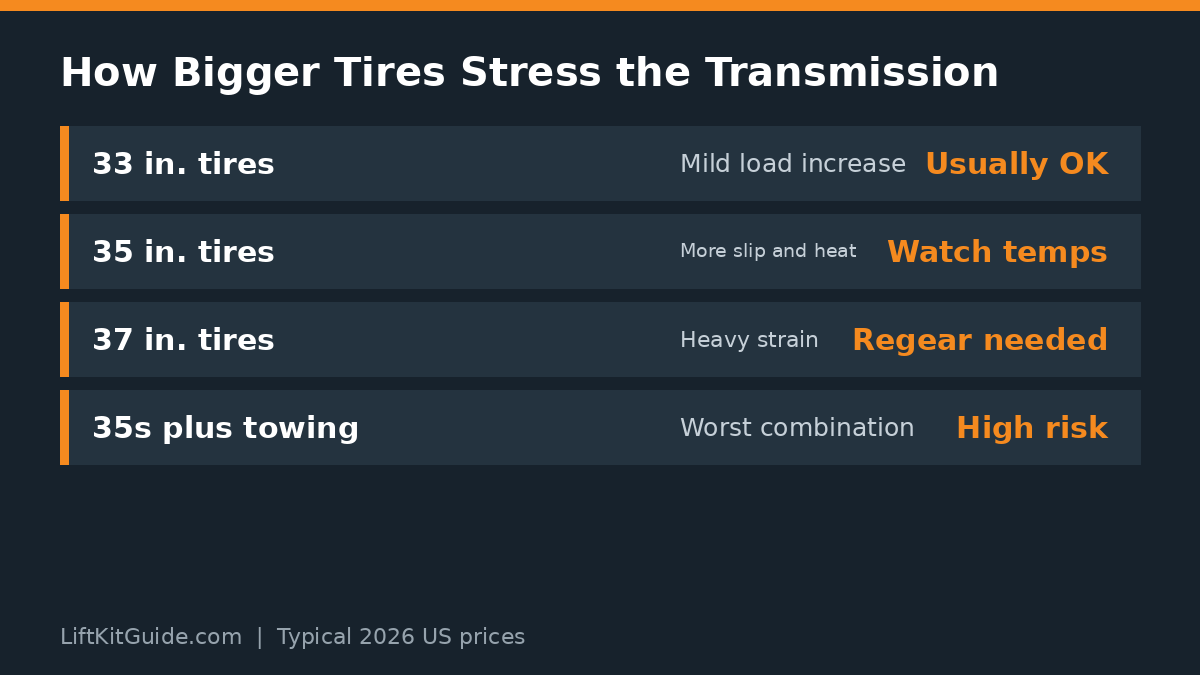
| Tire size | Added trans stress | What to watch |
|---|---|---|
| 33 in. | Mild | Shift quality, usually fine |
| 35 in. | Moderate | Fluid temp, gear hunting |
| 37 in. | Severe | Regear strongly advised |
| 35s + towing | Extreme | Cooler + regear essential |
Why Does the Transmission Hunt for Gears After Bigger Tires?
Gear hunting happens because the transmission’s shift logic no longer matches reality. The computer decides when to shift based on throttle position, speed, and load, all calibrated for the stock tire diameter. With taller tires, the truck needs more throttle to hold speed on any grade, so the transmission downshifts, then upshifts when the grade eases, then downshifts again. That constant cycling is gear hunting. The calibration assumes stock tire height, so any significant increase throws the whole shift strategy off from the first drive.
Each hunt cycle wears the transmission a little. Every shift engages and releases clutch packs, generating heat and wearing friction material, so a transmission that shifts twice as often ages roughly twice as fast. Drivers describe it as the truck never being able to decide on a gear on rolling highways, usually between 55 and 70 mph. It is annoying, and it is measurably destructive over tens of thousands of miles. Fleet data consistently shows that transmissions subjected to constant hunting run hotter and fail earlier, adding real-world weight to the question can a lift kit cause transmission problems.
Regearing is the real cure because it restores the RPM-to-speed relationship the shift logic expects. A handheld tuner (tuning after bigger tires) can also firm up shift points and adjust for tire size, which helps with the computer side of the equation. But tuning cannot replace the mechanical advantage of proper gears; it just makes the wrong gears behave a little better. Fix the gears first, then fine-tune.
Can Driveshaft Angle Vibrations Damage the Transmission?
Yes, indirectly. A lift changes the angles at which the driveshaft meets the transmission output and the differential pinion. When those u-joint angles are unequal or excessive, the driveshaft vibrates, and that vibration hammers the transmission’s output shaft bearing and tailshaft seal with every revolution. Over time the seal weeps, the bearing develops play, and you get a leak or a whine that looks like a transmission problem.
The classic symptom is a vibration that appears at a specific speed range, often 40-60 mph, and changes with throttle: worse on acceleration or deceleration, better when coasting. That throttle sensitivity points to driveline angles rather than tires. If you lift past three inches without addressing pinion angle with shims, a carrier-bearing drop, or an adjustable track bar setup, you are inviting this exact wear pattern.
Diagnosis starts under the truck with an angle finder on the transmission output, driveshaft, and pinion. For a standard two-joint shaft, the working angles at each end should be nearly equal and under about three degrees. Correcting them with tapered shims or a carrier-bearing drop typically costs under $150 in parts. It is the cheapest transmission insurance a lifted truck can buy, and it answers the vibration half of can a lift kit cause transmission problems. Get the angles right and this entire failure mode disappears, which is why driveline setup belongs in every discussion of can a lift kit cause transmission problems.
Does Towing on Big Tires Overheat the Transmission?
Towing on oversized tires is the hardest thing you can ask of an automatic transmission, full stop. You are combining the two biggest heat sources: the mechanical disadvantage of tall tires and the sustained load of a trailer. On long grades, fluid temperatures can climb past 250 degrees, at which point conventional fluid life is measured in hundreds of miles rather than tens of thousands. This is where big-tire trucks actually kill transmissions.
A transmission temperature gauge is non-negotiable if you tow on 35s or larger. Factory warning lights only trigger near catastrophic temperatures, long after damage has begun. An aftermarket gauge with the sender in the hot line out of the transmission shows you real temperatures in real time, letting you back off, drop a gear, or pull over, all covered in our towing with a lifted truck guide before the fluid cooks. It is a $100-200 install that pays for itself the first time it saves a trip.
If you tow regularly on big tires, add an auxiliary cooler with its own fan, sized generously. A quality stacked-plate cooler in series with the factory heat exchanger can drop sustained towing temperatures 30-50 degrees. Combine it with synthetic ATF rated for high heat, and change the fluid twice as often as the factory schedule. These three steps make towing on big tires boringly reliable instead of a gamble. With proper cooling and sensible gears, towing on big tires becomes routine, and can a lift kit cause transmission problems stops being a worry.
Can a Lift Kit Cause Transmission Problems on a Manual Truck?
Manual transmissions are far more forgiving, which is good news for stick-shift owners asking can a lift kit cause transmission problems on a manual truck. There is no torque converter to slip and overheat, no shift logic to confuse, and no clutch packs inside the gearbox wearing from hunting. The gearbox itself barely notices bigger tires beyond slightly taller effective gearing.
The wear moves to the clutch instead. Taller tires demand more slipping of the clutch to launch smoothly, especially on grades or with a trailer, and that extra slip wears the disc faster. Heavy 37s with stock gears can turn a 100,000-mile clutch into a 60,000-mile clutch for drivers who do a lot of city or hill driving. An upgraded clutch with more clamp load restores normal engagement when the time comes.
Regearing helps manuals just as much as automatics, for the same reason: it restores the mechanical advantage the taller tires took away. With proper gears, launches feel stock again and clutch slip returns to normal. So while manuals dodge the heat-death failure mode, the prescription is identical: match the gears to the tires and the whole drivetrain relaxes.
How Does Regearing Protect Your Transmission?
Regearing swaps the ring and pinion gears in your axles for a numerically higher ratio, which raises engine RPM at any given speed back toward stock. For a truck that came with 3.73 gears and now runs 35s, moving to 4.56 gears almost perfectly restores the factory RPM curve. The engine stops lugging, the converter locks up on schedule, and shift points land where the calibration expects them.
The temperature drop is the headline benefit, and it also helps with MPG loss with a lift kit. Owners routinely report 20-30 degree reductions in normal transmission operating temperature after a proper regear, because the converter spends far less time slipping. That single change does more for transmission longevity than any additive or cooler, though coolers still help at the margins. It is the closest thing to undoing the tire-size penalty.
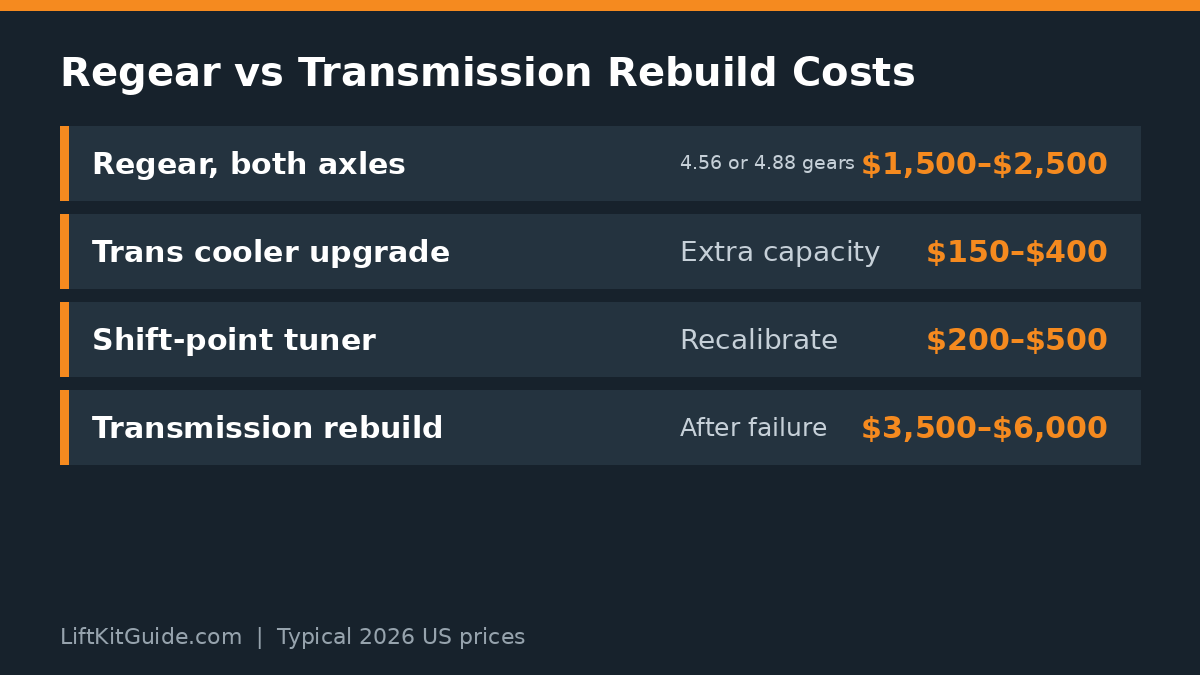
Budget $1,500-2,500 for a professional regear of both axles, including gears, master install kits, and labor. It is real money, but compare it against a $3,500-6,000 transmission rebuild and the math is obvious. Anyone who has stopped asking can a lift kit cause transmission problems because they regeared will tell you it is the best money they spent on the truck. Most owners describe the difference as night and day, with the truck finally feeling like it did before the tires went on.
| Tire size | From 3.55 stock | From 3.73 stock | Target cruise RPM |
|---|---|---|---|
| 33 in. | 4.10 | 4.10 | ~2,000 at 70 mph |
| 35 in. | 4.56 | 4.56 | ~2,100 at 70 mph |
| 37 in. | 4.88 | 4.88 | ~2,200 at 70 mph |
What Transmission Upgrades Help a Lifted Truck?
Start with fluid and cooling, the two cheapest longevity upgrades. Switch to a full-synthetic ATF with a high heat tolerance, add a deep aluminum transmission pan for an extra quart or two of capacity, and install that auxiliary cooler if you tow. Together these run $300-600 and meaningfully extend fluid life under the added stress of big tires. These upgrades directly attack the heat that makes can a lift kit cause transmission problems such a persistent question.
A quality tuner comes next. Devices from Hypertech, Superchips, or DiabloSport recalibrate the speedometer for the new tire diameter, which corrects the shift scheduling the computer derives from wheel speed. Many also offer firmer shift calibrations that reduce clutch slip time. Expect $200-500 depending on the platform, and buy from a reputable brand with support for your specific truck.
For trucks that work hard, consider a shift kit or upgraded valve body and a stronger torque converter. These are deeper investments, typically $800-2,000 installed, but they directly address the slip-and-heat failure mode with higher line pressure and better lockup characteristics. They are overkill for a street truck on 33s, a classic entry in lift kit mistakes and regrets and smart insurance for a tow rig on 37s.
- Regear first: match axle gears to tire size before any other transmission upgrade.
- Add a temp gauge: you cannot manage heat you cannot see; install it before problems start.
- Cooler for towers: a fan-equipped auxiliary cooler is mandatory for towing on 35s+.
- Synthetic fluid: high-heat synthetic ATF plus twice-as-often changes under big tires.
- Tune the computer: recalibrate speedometer and shift points for the new tire diameter.
Frequently asked questions
Will 35s ruin my transmission?
Not automatically. Many trucks run 35s for years on stock gears with no transmission failure, especially with highway driving and no towing. But the transmission works harder and hotter, so fluid changes, temperature monitoring, and eventually regearing are wise. The risk climbs sharply with 37s, towing, or hilly terrain.
What transmission temperature is too high?
175-200F is normal operating range. Sustained 225F and above breaks down conventional fluid quickly, and 250F+ can destroy fluid in a single long tow. If your gauge regularly shows over 220F, add cooling capacity and consider regearing.
Does a lift kit void the transmission warranty?
The lift alone rarely voids powertrain warranty, but oversized tires give dealers grounds to deny transmission claims if they can link the failure to the added stress. Document your maintenance, keep fluid change receipts, and know that the burden of proof is on the dealer under federal warranty law.
Should I regear for 33s?
Usually not necessary. Most trucks handle 33s on stock gears with only minor drivability changes, and the $1,500-2,500 regear cost is hard to justify. Regearing becomes strongly advisable at 35s and essentially mandatory at 37s for transmission health.
Can a tuner fix transmission issues from big tires?
Partially. A tuner corrects speedometer readings and shift scheduling for the new tire size, which stops gear hunting and harsh shifts caused by bad data. But it cannot restore the mechanical advantage lost to taller tires; only regearing does that. Use a tuner as a complement to gears, not a replacement.
The bottom line
Can a lift kit cause transmission problems? The lift itself is nearly innocent; the bigger tires are the real threat, cooking fluid through converter slip and confusing shift logic with wrong speed data. Driveline vibrations from bad pinion angles are the one way the lift hardware itself can reach the transmission, and that is a $150 angle correction, not a rebuild.
Protect the transmission the way the physics demands: regear the axles to match the tires, monitor fluid temperature with a real gauge, add cooling if you tow, and service the fluid twice as often. Do those four things and a lifted truck’s transmission lasts just as long as a stock one’s.



Leave a comment