


Last updated: October 2026 Written by the LiftKitGuide Team, truck suspension installers and editors
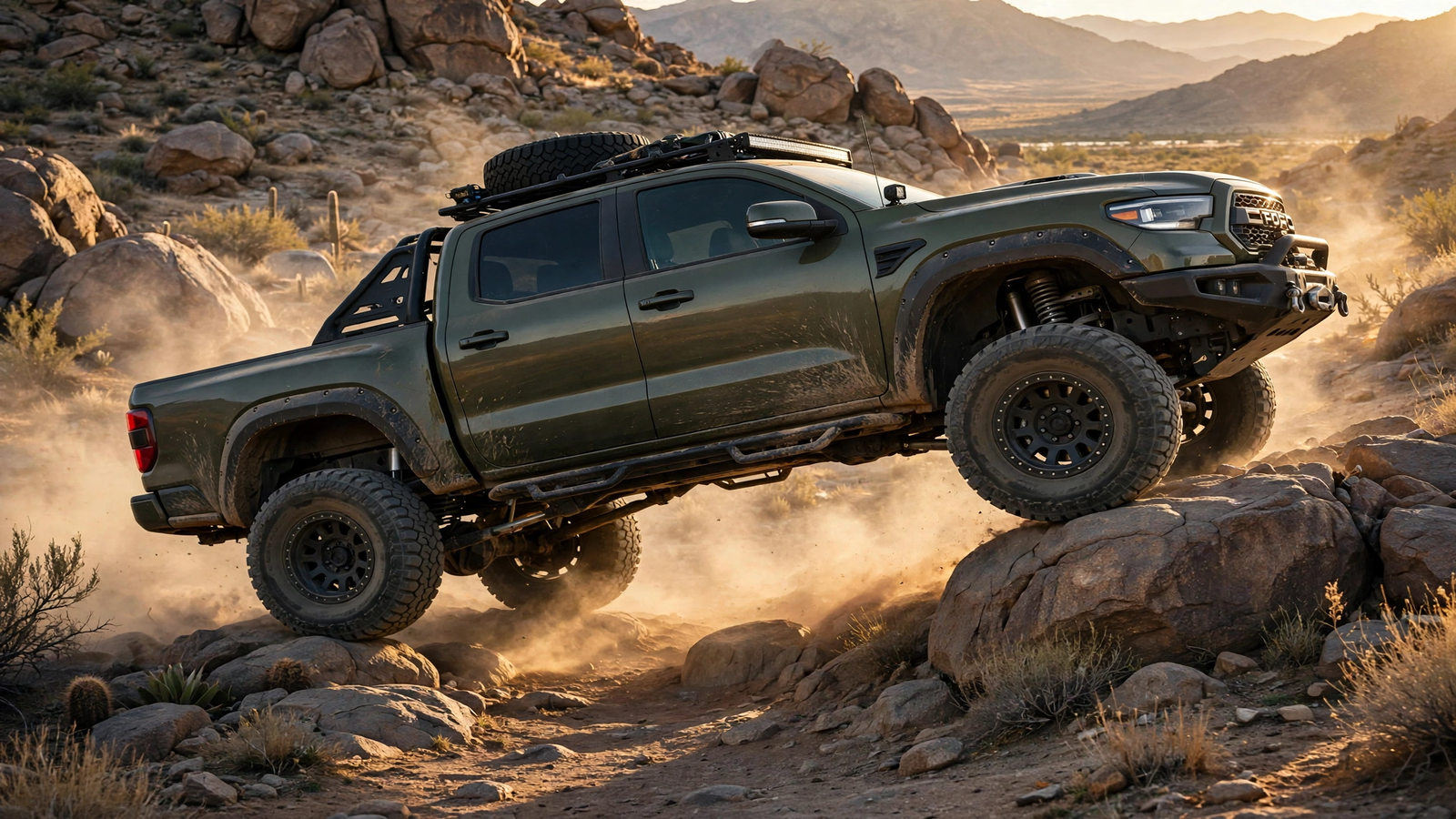
Is a lifted truck good for off-roading? Yes, when it is a real suspension lift set up for the trail. A quality lift adds ground clearance, improves approach, breakover, and departure angles, and makes room for larger tires that add traction. But a lift alone does not make a truck capable: tires, gearing, and driver skill matter more than inches of height. A tall truck on street tires is mostly for looks, while a modest 2 to 4 inch lift on 33 to 35 inch all-terrains is genuinely capable.
Key takeaways
- Yes, a real suspension lift genuinely improves off-road capability: clearance, angles, articulation, and tire room.
- Tires matter more than lift height; aggressive 33 to 35 inch tires are the biggest single capability gain.
- 2 to 4 inches of lift handles most trails; 6 inches and up is for 37s and extreme terrain.
- A lift raises the center of gravity, so side slopes and sudden moves need more caution.
- A tall truck on street tires with stock gears is mostly for looks, not capability.
On this page
Is a lifted truck good for off-roading?
Is a lifted truck good for off-roading? The honest answer is that it depends entirely on what kind of lift and what kind of off-roading. A truck with a quality suspension lift, proper tires, and supporting mods is genuinely more capable on the trail than the same truck stock. It clears bigger rocks, climbs steeper ledges, articulates over uneven ground, and crosses deeper ruts without dragging its belly. That is not marketing; it is geometry.
But there is a second category of lifted truck that is just for looks: tall spacer lifts or body lifts on street tires, often with stock gears and no armor. Those trucks look aggressive in a parking lot but perform barely better than stock on a real trail, and their higher center of gravity can actually make them worse on off-camber sections. That is how you answer is a lifted truck good for off-roading for any specific build: check the parts list, not the stance.
The dividing line is function. If the lift improves suspension travel, corrects geometry, and makes room for tires that actually grip dirt, then the answer to is a lifted truck good for off-roading is a clear yes. If the lift only adds height for appearance, the truck gained style and lost some stability. Everything below breaks down exactly what a lift does and does not do on the trail.
What does a lift actually improve off-road?
A suspension lift improves four measurable things: ground clearance under the frame, approach angle, breakover angle, and departure angle. Ground clearance is the simplest; raising the frame 3 inches means 3 more inches of rock you can straddle. The angles matter just as much. Approach angle determines how steep a ledge you can climb without smashing the front bumper, breakover angle decides whether you high-center on a crest, and departure angle controls whether the rear bumper drags coming off an obstacle.
Suspension travel and articulation are the subtler gains. A well-engineered lift kit increases usable wheel travel, which keeps tires in contact with the ground longer over uneven terrain. More contact means more traction, and traction is what moves the truck forward. This is why suspension lift kits with quality shocks outperform cheap spacer lifts so dramatically off-road: the spacers add height without adding travel, so the truck looks taller but articulates like stock.
There is one thing a lift does not improve: clearance under the differentials. Axle height is set by tire diameter, not suspension height. A 6 inch lift on 33 inch tires has the same diff clearance as a stock truck on 33s. This is the single most misunderstood fact in the lift world, and it is why experienced builders answering is a lifted truck good for off-roading always pair lift height with appropriate tire size.
How much ground clearance does a lift add?
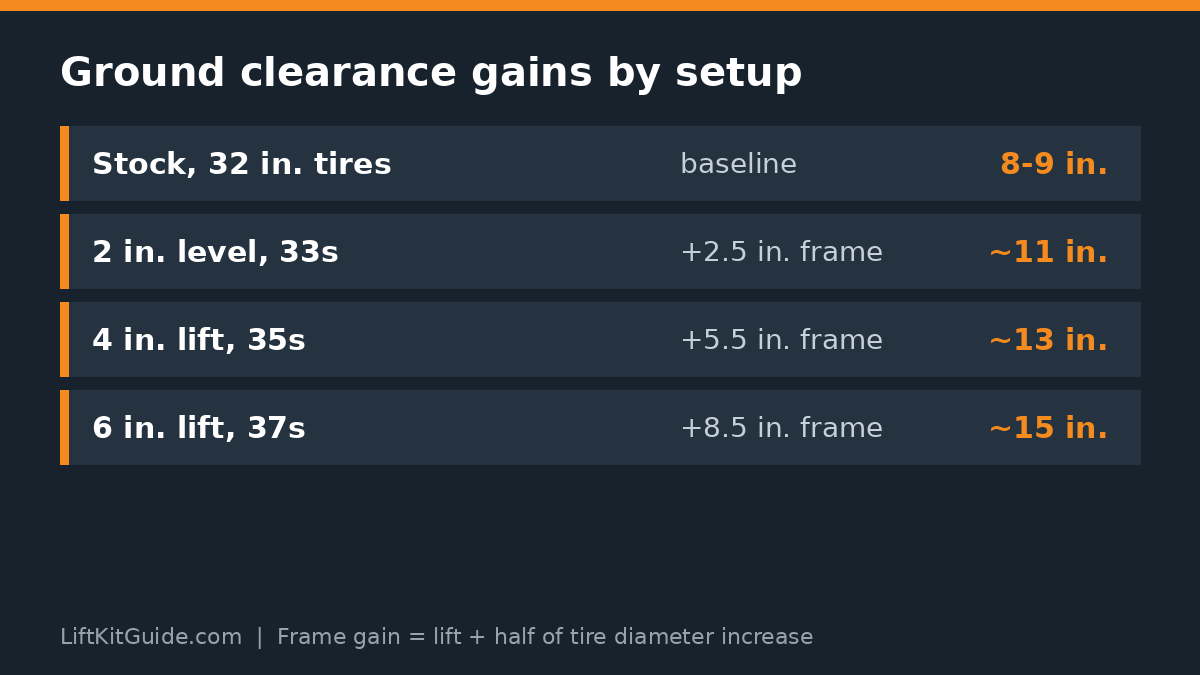
The math is straightforward: a suspension lift adds its rated height to frame and body clearance, while tires add half their diameter increase to everything including the axles. A 3 inch lift plus going from 32 inch stock tires to 35s adds 3 inches at the frame and 1.5 inches at the differentials, for 4.5 inches of total underbody gain. That is the difference between dragging and clearing on many moderate trails. Anyone asking is a lifted truck good for off-roading should do this math first, because clearance numbers beat marketing claims.
Real numbers help set expectations. A stock half-ton typically has 8 to 9 inches of ground clearance. Add a 4 inch lift and 35 inch tires and you are at roughly 13 inches, which handles most forest roads, mud holes, and rock gardens that stop stock trucks. Going to a 6 inch lift with 37s pushes toward 15 inches, but each additional inch costs more in stability, gearing, and driveline stress than the last.
Breakover angle deserves special attention because it is where long-wheelbase trucks suffer most. A crew cab long bed has a much worse breakover angle than a short bed, and lifting helps but does not fully fix the geometry. If your trails have sharp crests, a shorter wheelbase or a smaller lift with bigger tires often outperforms a tall lift on a long truck. Measure your actual breakover angle with an angle finder app before and after the lift so you know what you gained.
| Setup | Frame clearance gain | Diff clearance gain | Typical trail level |
|---|---|---|---|
| Stock, 32 in. tires | Baseline | Baseline | Dirt roads, mild trails |
| 2 in. level, 33s | +2.5 in. | +0.5 in. | Moderate forest roads |
| 4 in. lift, 35s | +5.5 in. | +1.5 in. | Rock gardens, deep ruts |
| 6 in. lift, 37s | +8.5 in. | +2.5 in. | Extreme trails, rock crawling |
Is a lifted truck good for off-roading on rocks, mud, and sand?
On rocks, yes: is a lifted truck good for off-roading is answered most clearly in the rocks. Clearance, angles, and articulation all matter on rock trails, and a lifted truck with lockers and armor walks lines that leave stock trucks winching. The key supporting mods are skid plates and rock sliders, because a lifted truck still has vulnerable oil pans and rocker panels, just higher up.
So is a lifted truck good for off-roading in mud? Partly. In mud, the lift helps less than the tires do. Ground clearance keeps the frame from dragging in deep ruts, but what moves a truck through mud is tire tread and wheel speed. A stock-height truck on aggressive mud-terrains will often outperform a 6 inch lifted truck on all-terrains in serious mud. If mud is your main terrain, spend the tire money first and treat the lift as secondary.
On sand, a lift is nearly irrelevant and can even hurt. Sand driving is about flotation: wide tires aired down to 12 to 15 PSI. A tall, heavy lift with narrow tires digs in worse than a stock truck on wide rubber. The lifted truck’s advantage in sand is only the ability to fit those wider tires. So across the three terrains, the pattern holds: the lift enables capability, but the tires deliver it.
When is a lifted truck just for looks?
A lifted truck is just for looks when the modifications stop at height. The telltale signs are easy to spot: a body lift or spacer lift instead of a full suspension system, street-oriented tires with a mild tread pattern, stock gearing with 35 inch or larger tires, no skid plates or recovery points, and wheels chosen for style over offset and width. That truck will turn heads at the mall and struggle on anything beyond a gravel road.
There is nothing wrong with building for looks; it is a legitimate hobby and a huge part of truck culture. The problem is only when owners expect trail performance from a show build. A 6 inch spacer lift on 24 inch wheels with low-profile tires has less off-road ability than a stock 4×4 on all-terrains, plus worse ride quality and more wear on ball joints. Honesty about the build’s purpose saves money and disappointment.
The benefits of lifted trucks include real ones even for street-driven rigs: better visibility, easier underbody access for maintenance, and the aggressive stance owners want. But capability claims should match the parts list. If someone asks whether your lifted truck is good for off-roading, the answer lives in the tires, gears, and armor, not the number on the lift kit box.
| Build type | Lift | Tires | Real trail ability |
|---|---|---|---|
| Show build | 6 in. spacers/body lift | Street tires, 24 in. wheels | Worse than stock 4×4 |
| Street/trail mix | 2-3 in. suspension | 33 in. all-terrains | Handles most moderate trails |
| Serious trail rig | 4 in. suspension + armor | 35 in. mud-terrains, 4.56 gears | Runs difficult trails confidently |
| Extreme crawler | 6 in.+ long travel | 37s, lockers, full armor | Hardcore rock crawling |
Do bigger tires matter more than the lift?
Is a lifted truck good for off-roading because of the lift or the tires? The tires, and it is not close. Tires are the only part of the truck that touches the ground, so tread pattern, size, and pressure determine traction more than any suspension part. Experienced off-roaders routinely estimate that tires account for the majority of a rig’s capability, with the lift playing a supporting role by making room for those tires and adding frame clearance. A stock truck on 35 inch mud-terrains will out-wheel a 6 inch lifted truck on highway tires on almost any trail.
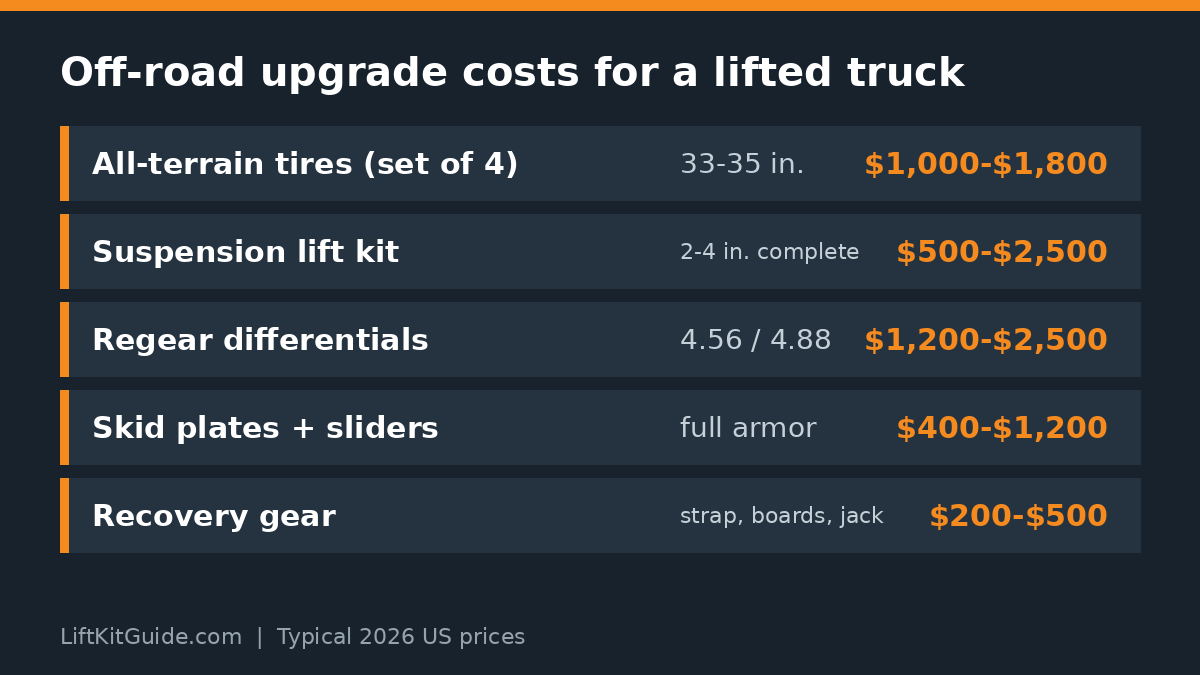
This is why the biggest tire you can fit without a lift matters so much: many trucks clear 33s stock, which transforms them off-road for the price of tires alone. The lift’s job is to unlock the next tire size up. When budgeting a build, the smart order is tires first, then the lift to fit bigger ones, then gears to turn them, then armor to protect the investment.
Tire pressure is the free capability multiplier most beginners miss. Airing down from 35 PSI to 18 PSI can double the contact patch, and on sand or rocks it matters more than an extra inch of lift. Carry a portable compressor, learn your tires’ safe aired-down range, and you will out-perform taller trucks whose owners never touch their tire pressure. Check our will 35s rub guide before sizing up so the new tires actually fit.
What are the off-road downsides of a lifted truck?
The higher center of gravity is the main downside, and it is physics, not opinion. A lifted truck leans more in corners, feels tippier on off-camber trails, and is less forgiving of sudden steering inputs. On side slopes, which are common on mountain trails, the margin between controlled and rolling shrinks. Quality shocks and wider track width help, but they do not repeal gravity. Drive accordingly: slower on side hills, smooth inputs everywhere.
When owners ask is a lifted truck good for off-roading after a budget spacer lift, the answer is usually disappointing, and drivetrain stress increases with height and tire size. Steeper driveshaft and CV angles wear joints faster, bigger tires strain the transmission and brakes, and stock gears make the engine lug. These are manageable with supporting mods, gears, upgraded shafts, and regular maintenance, but they are real costs that belong in the budget. A comparison of lift kit brands shows how kit completeness varies, and incomplete kits cause most of the reliability complaints.
Daily-driving tradeoffs follow the truck home from the trail: worse fuel economy, harder parking, more wind noise, and faster wear on steering components. None of these disqualify a lifted truck, but they are the price of capability. The owners who stay happiest are the ones who use the capability regularly; a trail rig that never sees dirt pays all the costs for none of the benefit.
- Slow down on side slopes: the higher center of gravity tips sooner; keep speed low and weight balanced.
- Air down for traction: 15 to 20 PSI on rocks and trails, 12 to 15 on sand; air back up for pavement.
- Use a spotter: on ledges and crests, a second set of eyes beats guessing your breakover angle.
- Engage 4WD before you need it: shifting on the obstacle is how parts break.
- Carry recovery gear: strap, shackles, traction boards, and a jack rated for your lifted height.
- Inspect after the trail: check for bent links, leaking shocks, and loose bolts before the drive home.
How should you set up a lifted truck for real off-roading?
Start with the foundation: a complete suspension lift kit from a reputable brand, not spacers, in the 2 to 4 inch range for most use. The kit should include geometry correction for your lift height, quality shocks, and everything needed to keep alignment in spec. A leveling kit can work for mild trails, but anything serious deserves a real suspension system with proper travel.
Then add the capability multipliers in order: tires, gears, armor, recovery. Fit the most aggressive tires your driving mix justifies, regear if you went to 35s or larger so the drivetrain is not straining, then protect the underside with skid plates and sliders. Recovery gear comes before the hardest trails, not after the first stuck. This sequence builds a truck where every dollar improves actual trail performance.
Finally, invest in the driver. The most capable lifted truck in inexperienced hands gets stuck where a stock truck with a skilled driver walks through. Take an off-road driving course, practice on easy trails, learn to read lines and use a spotter, and build difficulty gradually. So is a lifted truck good for off-roading? With the right parts and the right driver, it is not just good; it is the whole point of the build.
Frequently asked questions
Is a body lift good for off-roading?
A body lift only raises the body for looks. A suspension lift raises everything, improves articulation, and genuinely improves off-road capability.
What is the best lift height for off-roading?
For most trail riding, a 2 to 4 inch suspension lift with 33 to 35 inch tires is the sweet spot.
Do I need off-road tires if my truck is lifted?
Yes. The lift creates the clearance, but the tires create the traction. Tires are most of the capability equation.
Are lifted trucks more likely to roll over off-road?
A lifted truck's higher center of gravity makes it more tippy on off-camber trails. Drive slower on side hills and avoid sudden steering inputs.
What is the first off-road upgrade I should buy?
Start with quality all-terrain tires, then add a 2 to 3 inch suspension lift, then skid plates.
Can a stock truck go off-roading?
Most stock trucks are limited by small street tires and low ground clearance. Serious obstacles are where lifts earn their keep.
The bottom line
A lifted truck is genuinely good for off-roading when the lift is a quality suspension system paired with appropriate tires, gearing, and armor. The clearance, angles, and articulation gains are real and measurable, and they are the reason serious trail rigs are lifted.
But a lift alone does not make a truck capable. Tires do more for traction than inches of lift do, and a tall truck on street tires with stock gears is mostly for looks. Spend the tire and gearing money before chasing extra lift height.



Leave a comment