


Last updated: October 2026 Written by the LiftKitGuide Team, truck suspension installers and editors
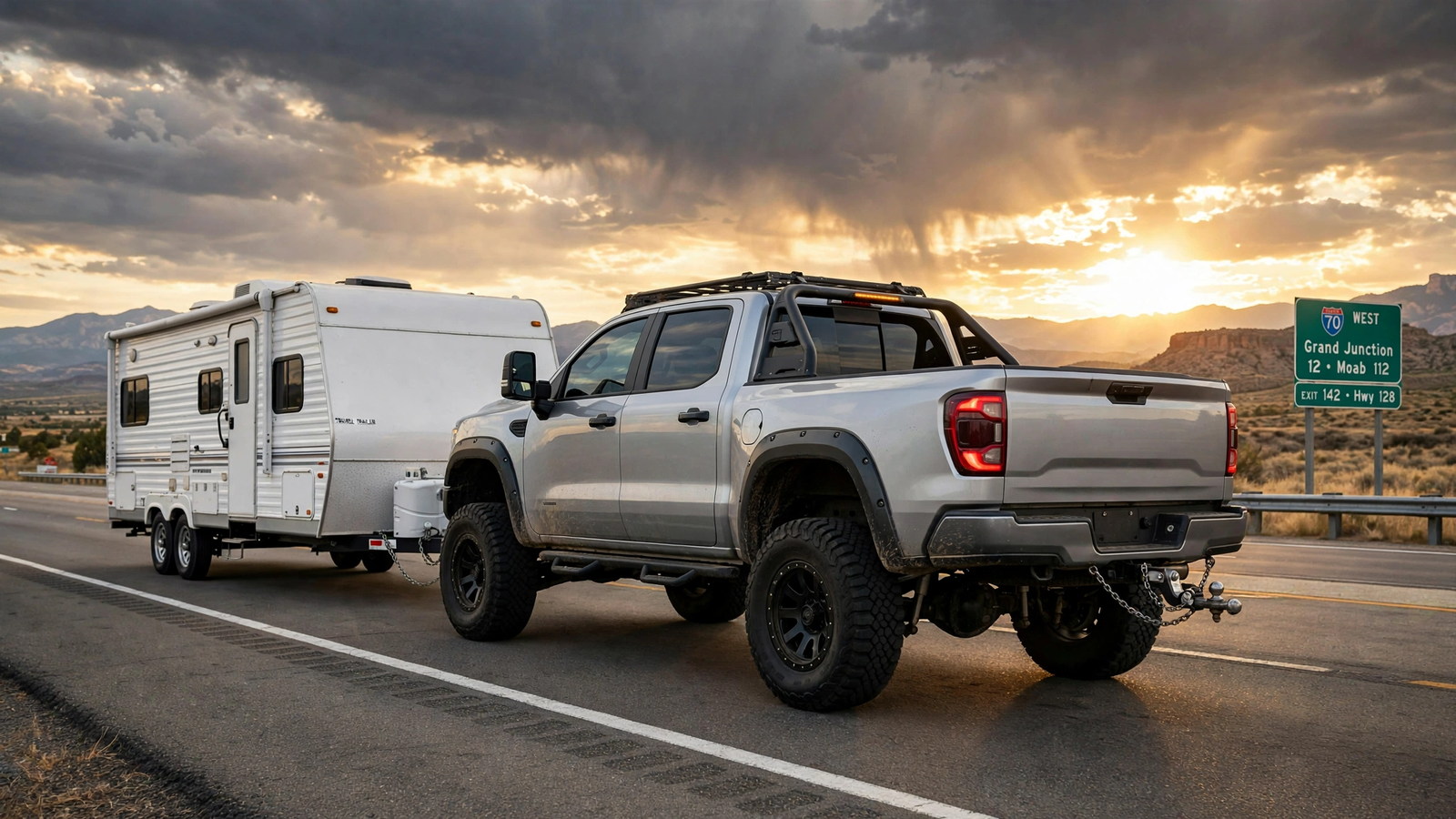
Can you tow a travel trailer with a 6 inch lift? Yes, safely, if you correct the hitch geometry, restore proper tongue weight, and control sway. A 6 inch lift raises the receiver to about 27 inches, so an 8 to 11 inch drop hitch is required to tow the trailer level. Expect 8 to 11 MPG, longer braking distances, and more crosswind sensitivity than a stock truck. A weight distribution hitch with integrated sway control, a trailer brake controller, and 10 to 15 percent tongue weight are the non-negotiables.
Key takeaways
- Yes, with the right setup: an 8 to 11 inch drop hitch, weight distribution, and 10 to 15 percent tongue weight.
- A 6 inch lift puts the receiver around 27 inches off the ground; towing nose-high causes sway and poor braking.
- Lifts above 4 inches measurably reduce towing stability; budget $400 to $1,200 for proper towing hardware.
- A weight distribution hitch with integrated sway control is strongly recommended, not optional, on tall lifts.
- Expect 8 to 11 MPG towing a travel trailer with a lifted half-ton, plus longer stopping distances.
On this page
Can you tow a travel trailer with a 6 inch lift?
Can you tow a travel trailer with a 6 inch lift? Yes, and plenty of owners do it every camping season. The lift itself does not disqualify the truck; what matters is whether the towing geometry is corrected afterward. A stock receiver sits around 20 to 21 inches off the ground, while a 6 inch lift on 35 to 37 inch tires pushes it to 27 inches or more. That seven-inch gap is the entire problem, and it is solvable with the right hardware.
The three things that make or break the setup are hitch height, weight distribution, and sway control. Get those right and a lifted truck tows a travel trailer calmly at highway speed. Get them wrong and the trailer porpoises over bumps, sways when trucks pass, and pushes the truck around under braking. Our broader towing with a lifted truck guide covers the general principles, while this article focuses on the specific demands of a 6 inch lift paired with a travel trailer.
A realistic expectation helps: the honest answer to can you tow a travel trailer with a 6 inch lift is a qualified yes: it can be done safely, but it will never tow as calmly as the same truck at stock height. The center of gravity is higher, the tires are heavier with more sidewall flex, and crosswinds have more leverage on the tall combination. Most experienced owners treat a 6 inch lift as the practical ceiling for regular travel trailer towing and step down to a 4 inch lift if the trailer is the truck’s main job.
How does a 6 inch lift change towing geometry?
A suspension lift changes three towing-relevant measurements at once: receiver height, spring rate, and the truck’s roll center. The receiver height change is the most obvious, but the spring change matters just as much. Many 6 inch kits use softer or taller coil springs tuned for ride quality and articulation, which means the rear squats more under tongue weight than the factory springs did. That squat unloads the front axle, lightening steering exactly when you need it most.
Weight distribution also shifts because the trailer’s tongue now pushes down from a higher pivot point, increasing the leverage on the rear suspension. So can you tow a travel trailer with a 6 inch lift without addressing the rear springs? Only if the kit kept factory-rate springs or you add air helpers. This is why suspension lift kits designed for towing often include stiffer rear springs or recommend air helper springs. Axle wrap under load is another real concern with tall rear blocks, so traction bars are a common companion upgrade on trucks that tow heavy with 6 inch lifts.
Tire choice compounds the geometry changes. The 35 to 37 inch tires that come with a 6 inch lift have taller, more flexible sidewalls than stock tires, and that sidewall flex translates into a vague, wandering feeling when a trailer is pushing from behind. Running the tires at the upper end of their rated pressure range for towing, often 5 to 10 PSI above daily-driving pressure, firms up the sidewalls and noticeably sharpens the rig’s tracking.
What size drop hitch does a 6 inch lifted truck need?
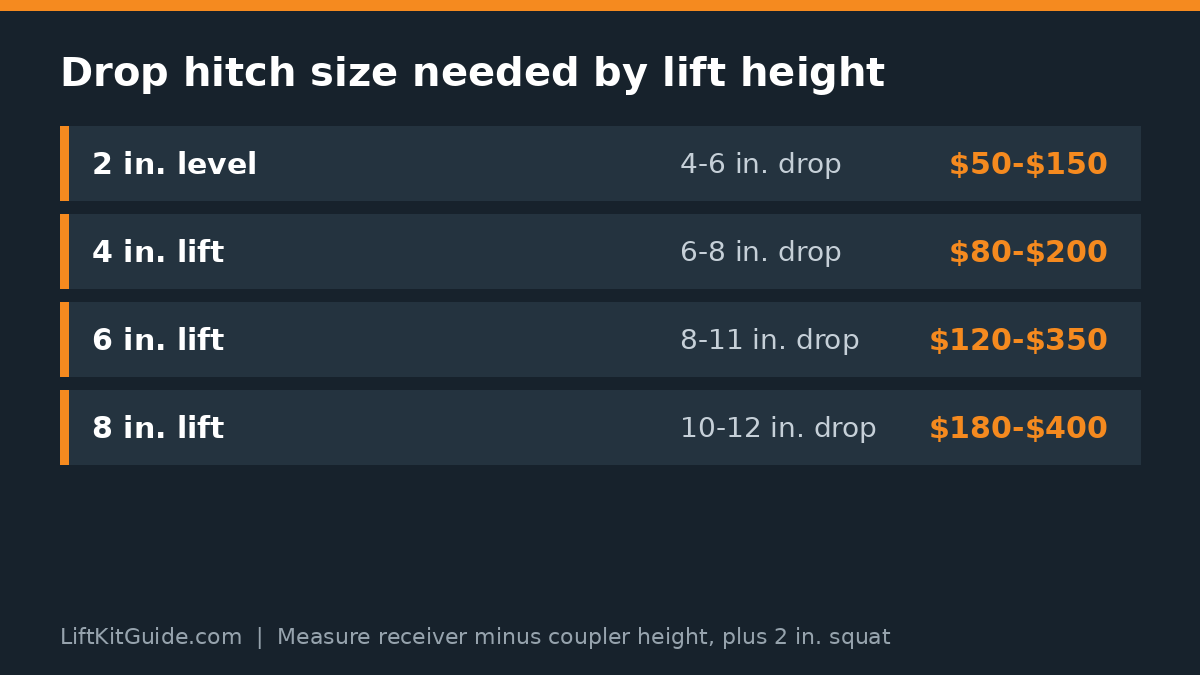
Most 6 inch lifted trucks need a drop hitch between 8 and 11 inches to tow a travel trailer level. The exact number comes from simple math: measure from the ground to the inside top of your receiver, measure from the ground to the trailer coupler with the trailer level, subtract, and add 2 inches to account for rear squat under tongue weight. Guessing this number is how people end up towing nose-high, which is the single biggest cause of trailer sway.
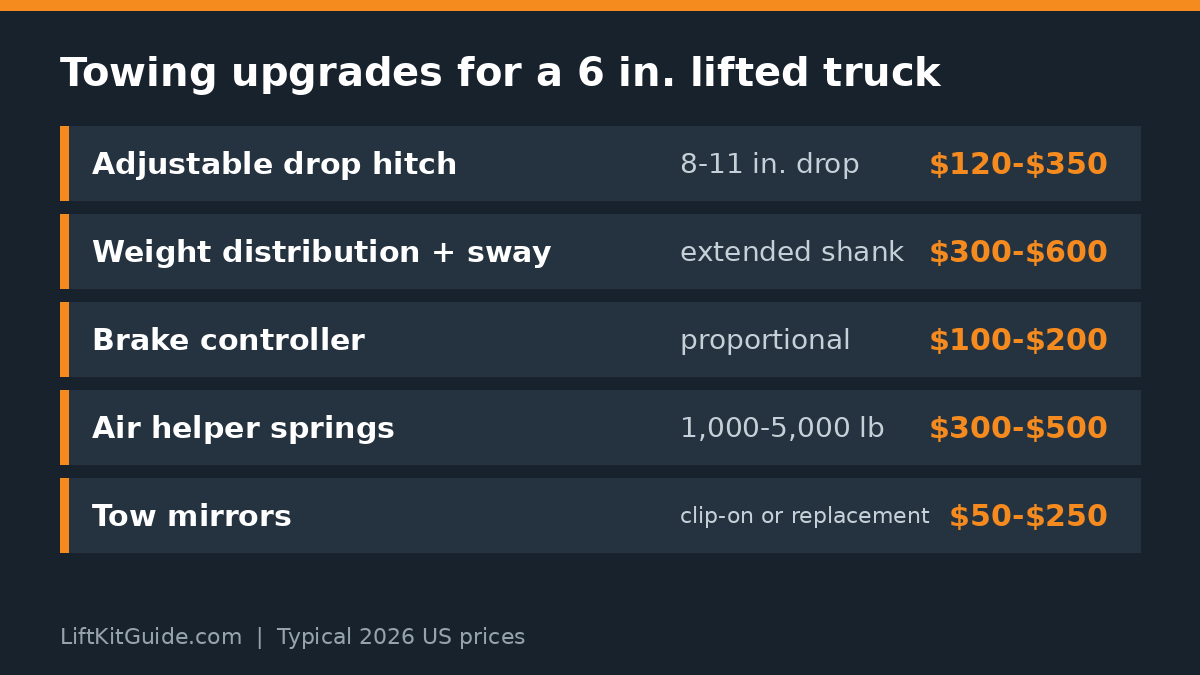
If you are still asking can you tow a travel trailer with a 6 inch lift using a fixed drop mount, the answer is yes when the drop math is right, but an adjustable drop hitch is worth the extra money if you tow more than one trailer or load the truck differently between trips. Fixed drop mounts are cheaper, typically $50 to $120, while quality adjustable aluminum or steel mounts run $150 to $350 and let you dial in the height in 1 inch increments. Whatever you buy, match the ratings: the mount’s gross trailer weight and tongue weight ratings must meet or exceed your loaded trailer, and the ball size must match the coupler exactly.
The drop hitch is also where cheap parts cause expensive problems. A 10 inch drop creates a long lever arm on the receiver, multiplying the stress on the hitch pin and receiver tube. Look for solid or thick-wall shanks, dual hitch pins or anti-rattle designs, and a mount rated well above your actual trailer weight. This is not the place to save $40; a bent or cracked drop mount at highway speed is a nightmare scenario.
| Lift height | Typical receiver height | Drop hitch needed | Typical cost |
|---|---|---|---|
| 2 inch level | 22-23 in. | 4-6 in. drop | $50-$150 |
| 4 inch lift | 24-25 in. | 6-8 in. drop | $80-$200 |
| 6 inch lift | 26-28 in. | 8-11 in. drop | $120-$350 |
| 8 inch lift | 28-30 in. | 10-12 in. drop | $180-$400 |
Can you tow a travel trailer with a 6 inch lift without a weight distribution hitch?
Technically, can you tow a travel trailer with a 6 inch lift without a weight distribution hitch? Yes, but for trailers over about 5,000 pounds it is a bad idea. The WDH does two jobs that matter even more on a lifted truck: it transfers tongue weight forward to restore front-axle load, and with integrated sway control it damps the side-to-side oscillation that tall, soft-sprung trucks are prone to. Skipping it saves $300 to $600 and costs you the two biggest stability improvements available.
The catch is that a standard WDH shank usually does not drop far enough for a 6 inch lift. Most manufacturers sell extended-drop shanks, or you can run the WDH head on an adjustable drop mount, as long as the spring bars end up roughly parallel to the trailer frame at rest. If the bars point steeply uphill or downhill, they cannot transfer weight correctly. Set the system up on level ground, measure front fender height before and after coupling, and adjust until the front returns to within half an inch of its unhitched height.
For lighter trailers under 5,000 pounds with 500 pounds or less of tongue weight, a good sway-control bar paired with a properly sized drop hitch can be enough. But travel trailers are tall, flat-sided sails, and crosswinds affect them far more than low utility trailers. Given that a 6 inch lift already raises the center of gravity, the conservative and correct answer is to run the weight distribution hitch whenever the trailer is a full-size travel trailer rather than a small utility trailer.
Does a lift kit reduce your truck's towing capacity?
On paper, no: the manufacturer’s tow rating does not change because you installed a lift. In practice, yes, and that is the real question behind can you tow a travel trailer with a 6 inch lift: a 6 inch lift reduces the weight you can tow comfortably and safely. The rating on the door jamb assumes stock suspension geometry, stock spring rates, and stock tires. Once those change, the limiting factor becomes stability rather than power, and stability is exactly what a tall lift compromises. Most towing-experienced owners self-limit to 70 to 80 percent of the factory rating on a 6 inch lift.
Payload takes the most visible hit. Aftermarket lift springs are frequently rated lower than factory springs, and the taller ride height means every pound of tongue weight creates more leverage on the rear suspension. Check your 6 inch lift cost and components guide to see whether your kit kept, reduced, or can be optioned with higher-rate rear springs. Air helper springs, which add 1,000 to 5,000 pounds of leveling capacity for $300 to $500, are the most popular fix for lifted trucks that tow regularly.
Braking performance also deserves honest attention as part of the can you tow a travel trailer with a 6 inch lift conversation. Bigger tires increase rotating mass and effective gearing, which lengthens stopping distances, and the trailer’s brakes must pick up the slack. A quality proportional brake controller, properly calibrated so the trailer brakes lead slightly, is mandatory. Before any long trip, do a controlled stop test in an empty lot at 25 MPH and confirm the rig stops straight without the trailer pushing the truck sideways.
| Factor | Stock truck | 6 inch lifted truck | What to do |
|---|---|---|---|
| Receiver height | 20-21 in. | 26-28 in. | 8-11 in. drop hitch |
| Center of gravity | Lower, stable | Higher, more body roll | Sway control + careful loading |
| Rear spring rate | Factory rated | Often softer | Air helper springs ($300-$500) |
| Tire sidewall | Short, stiff | Tall, flexible | Run max tow pressure |
| Comfortable tow limit | 100% of rating | ~70-80% of rating | Stay under payload sticker |
How do you control trailer sway behind a lifted truck?
Can you tow a travel trailer with a 6 inch lift safely in crosswinds? Only with correct tongue weight: trailer sway starts with insufficient tongue weight, and the 10 to 15 percent rule is even more important behind a lifted truck. A 7,000 pound travel trailer needs 700 to 1,050 pounds on the ball, and you should verify it on a scale rather than guessing. Load heavy items forward of the trailer axles, keep water tanks in mind since 40 gallons of water weighs 334 pounds, and never try to fix sway by speeding up.
Integrated sway control in a weight distribution hitch is the best defense because it works constantly and automatically. Friction-style add-on sway bars are a decent budget option at $50 to $100, but they must be removed before backing up and they only dampen sway rather than preventing the weight-transfer problems that cause it. Electronic stability systems that selectively brake the trailer are excellent supplements, but they are a backup, not a substitute for correct loading.
If sway starts, the correct response is to manually apply the trailer brakes with the controller while easing off the truck’s accelerator, never to hit the truck brakes hard or try to steer out of it. Practice finding the manual trailer brake slider without looking before you need it in an emergency. A lifted truck’s taller profile catches more wind, so expect more sway events from passing semis and gusty crosswinds, and plan your following distances and lane position accordingly.
- Verify 10 to 15 percent tongue weight on a scale; a 7,000 lb trailer needs 700 to 1,050 lbs on the ball.
- Run a weight distribution hitch with integrated sway control, set up with an extended-drop shank.
- Keep the trailer level; nose-high trailers sway, nose-low trailers overload the tongue.
- Calibrate the brake controller so trailer brakes engage slightly before the truck brakes.
- Check tire pressures on truck and trailer before every tow, including the spare.
- Know the manual override: trailer brake slider first, ease off the gas, never stab the truck brakes.
What towing upgrades matter most on a 6 inch lift?
If you are asking can you tow a travel trailer with a 6 inch lift on a budget, prioritize upgrades in this order: drop hitch, weight distribution with sway control, brake controller, then load support. The drop hitch and WDH fix geometry and weight transfer, which are safety items. The brake controller is legally required in most states for trailers over 3,000 pounds and is a $100 to $200 install. Air helper springs or upgraded rear springs come next for trucks that squat excessively.
Extended towing mirrors are an underrated upgrade that many owners skip until their first merge. A travel trailer is 8 to 8.5 feet wide, wider than the truck, and factory mirrors leave dangerous blind spots. Clip-on or replacement tow mirrors run $50 to $250 and make lane changes dramatically safer. A rearview camera on the trailer, wired or wireless for $150 to $300, eliminates the guesswork when backing into campsites.
Do not forget the cooling and drivetrain side. Towing heavy with big tires raises transmission temperatures, so an auxiliary transmission cooler ($150 to $300 installed) is cheap insurance, especially in hot climates or mountain grades. Regearing to 4.56 or 4.88 ratios restores the mechanical advantage that 35 to 37 inch tires take away, which helps both towing performance and transmission longevity; Tell your insurance company about the lift and the towing setup, since undeclared modifications can complicate claims.
What should you check before every tow with a 6 inch lift?
Before you ask can you tow a travel trailer with a 6 inch lift across the country, do this walkaround: a pre-tow check takes ten minutes and catches the failures that strand lifted rigs. Check the drop hitch pin and clip, the ball tightness, the coupler latch, safety chains crossed under the tongue, the breakaway cable, and all trailer lights. Then check lug nuts on both truck and trailer, because big aftermarket wheels and trailer wheels both loosen more than people expect in the first 50 miles after any change.
Confirm the numbers, not just the hardware. Re-measure receiver and coupler height with the truck loaded as it will travel, since passenger and cargo weight changes squat. Verify tire pressures cold on all six or ten tires, confirm the weight distribution bars are seated and the sway control engaged, and do a brake controller tug test before leaving the driveway. Knowing your lift installation included proper torque specs matters here, because suspension bolts on a tow rig should be re-torqued after the first 500 miles.
Finally, plan the drive itself differently. A lifted truck towing a travel trailer needs longer following distances, slower speeds in crosswinds, and wider turns to keep the trailer off curbs. Fuel stops come more often at 8 to 11 MPG, so plan them before the gauge gets low, especially out west. The benefits of a lifted truck are real, but towing day is the day to respect the physics: height is the enemy of stability, and preparation is what keeps a tall rig tracking straight.
Frequently asked questions
What size drop hitch do I need for a 6 inch lift?
A 6 inch lift typically needs an 8 to 11 inch drop hitch. Measure from the ground to the inside top of your receiver, subtract the trailer coupler height (usually 17 to 19 inches), and add 2 inches for trailer squat.
Can I use a weight distribution hitch on a lifted truck?
Most weight distribution hitches are rated for 4 to 6 inches of drop through their adjustable shanks, and many manufacturers sell extended-drop shanks for lifted trucks.
Does a 6 inch lift lower my towing capacity?
Lifting does not change the factory tow rating on paper, but it reduces real-world stability. The higher center of gravity and bigger tires make the rig more sensitive to sway.
Is it safe to tow a camper with a lifted truck?
Yes, if it is set up correctly. Keep the trailer level, run 10 to 15 percent tongue weight, and use a weight distribution hitch with sway control.
Will my weight distribution hitch work with a 6 inch lift?
A weight distribution hitch still works on a lifted truck, but it needs an extended-drop shank so the spring bars sit at the right angle.
What MPG should I expect towing a travel trailer with a lifted truck?
Expect 30 to 50 percent worse fuel economy than unloaded highway driving. A stock half-ton getting 18 MPG empty will typically see 8 to 11 MPG towing a travel trailer.
The bottom line
Towing a travel trailer with a 6 inch lift is absolutely doable, but it is a systems problem, not a single part. The drop hitch fixes geometry, the weight distribution hitch restores axle loads, and proper tongue weight plus sway control keep the trailer tracking straight when a semi passes or a crosswind hits.
Budget for the complete towing setup before you buy the lift: $400 to $1,200 for hitch hardware, brake controller, and load support on top of the lift itself. Trucks that tow travel trailers regularly are often happier with a 4 inch lift, which preserves more stability and costs less to set up for safe towing.



Leave a comment