


Last updated: October 2026 Written by the LiftKitGuide Team, truck suspension installers and editors
Air suspension vs coilovers lifted Ram trucks: for a lifted Ram 1500, coilovers usually win. The factory 4-corner air suspension offers auto load-leveling and adjustable ride height, but air springs, compressors, and plastic lines fail with age — especially in cold climates — and a single dealer air strut can cost more than a complete $1,549 coilover conversion kit. Owners who delete consistently report a better ride on coilovers, simpler maintenance, and cheaper long-term ownership, at the cost of losing automatic load leveling.
Key takeaways
- A complete air-to-coilover conversion kit for a 2013-2018 Ram 1500 costs about $1,549 — often less than one OEM air strut from the dealer.
- Factory air suspension auto-levels loads and offers Normal, Aero, and two Off-Road heights, but compressors and air springs are common failure points past 80,000-100,000 miles.
- Cold weather is the enemy of air ride: moisture in lines can freeze, leaving the truck stuck at the wrong height until it thaws.
- Owners who convert overwhelmingly report coilovers ride better than the air system they replaced, with far fewer surprises.
- You can lift a Ram and keep air suspension with link kits or air-specific lift kits, but most big lifts pair better with a coilover conversion.
On this page
What is Ram's factory air suspension and how does it work?
Ram’s available 4-corner air suspension replaces conventional coil springs with air springs at all four corners, managed by an onboard compressor, ride-height sensors, and a control module. From the cab or key fob, the driver can select Normal ride height, an Aero mode that lowers the truck at highway speed for efficiency, and two Off-Road heights that add roughly 1 to 2 inches of clearance for rough terrain. The system’s party trick is automatic load leveling: hook up a trailer and the truck pumps the rear bags to sit level instead of squatting.
That sophistication comes with a web of failure points no coil spring has. Air springs are rubber-and-plastic bladders that crack with age and ozone exposure, the compressor wears out, ride-height sensors corrode, and the plastic air lines that feed the system can chafe, kink, or freeze. On 2013-2018 Ram 1500s — the trucks now hitting the age where these parts die — air suspension problems are one of the most common complaints on owner forums, which is exactly why the air suspension vs coilovers lifted Ram debate never dies.
Model-year coverage matters when shopping: the most common conversion kits target 2013-2018 Ram 1500s, while 2019-and-newer DT-generation trucks use a revised air system with different parts. Verify fitment for your exact year before ordering, because air components do not interchange across generations. This generational split is one more reason the air suspension vs coilovers lifted Ram conversation keeps restarting — the answer depends partly on which truck you own.
Air suspension vs coilovers lifted Ram: which rides better?
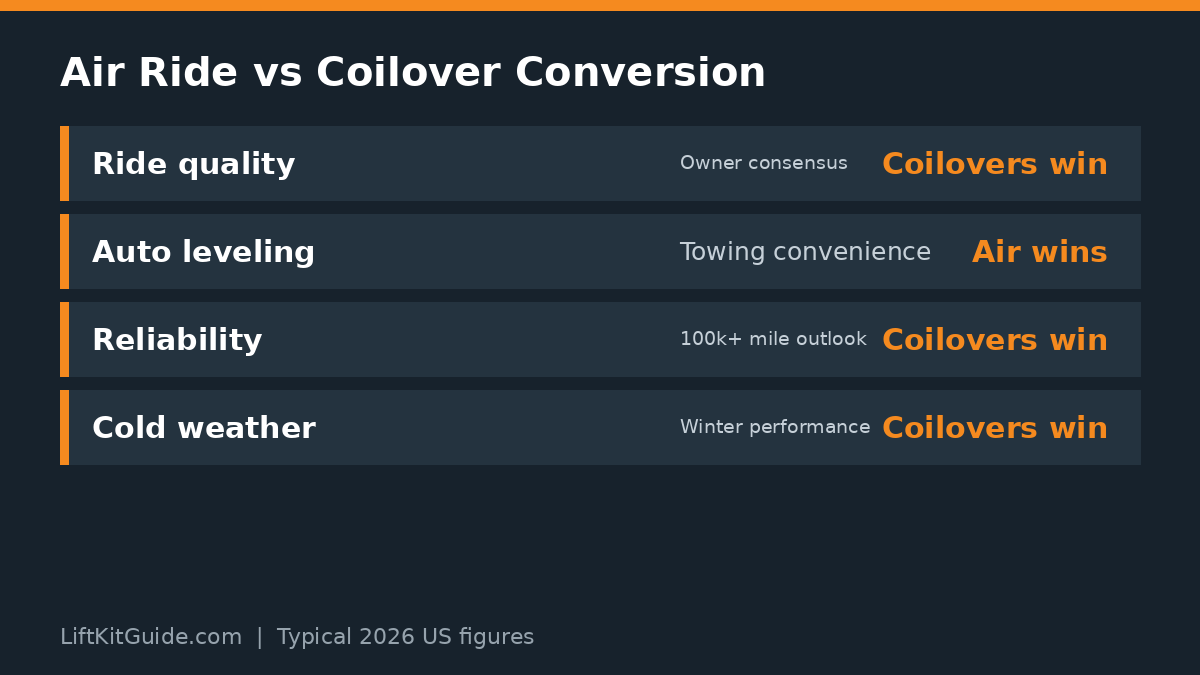
In the air suspension vs coilovers lifted Ram ride debate, the owner consensus is surprisingly one-sided: trucks converted from air to coilovers almost always ride better afterward. That sounds backward until you realize most conversions happen after the air system is already half-dead — leaking bags, a tired compressor, and worn shocks mean the ‘air ride’ being compared was not functioning properly. A fresh set of quality coilovers against a tired air system is no contest, and even against a healthy system, a well-valved coilover with proper springs feels more controlled over big hits.
Where factory air still holds an edge is adaptability. No passive coilover can lower itself for highway aero mode or raise itself for off-road clearance, and none will auto-level a heavy tongue weight without helper springs or air bags added separately. If your Ram tows frequently and you value set-and-forget leveling, working air suspension is genuinely convenient. But once components start failing, the air suspension vs coilovers lifted Ram ride debate shifts hard toward coilovers, because a $1,549 conversion restores — and usually improves — ride quality for less than a single dealer air strut. See our Ram 1500 lift kit guide for which lift kits pair with each setup.
It is also worth noting that ‘better ride’ depends on which coilovers you buy. A $400 set of generic loaded struts will not out-ride a healthy air system, while a $1,200-plus set of Bilstein or Fox coilovers with application-specific valving absolutely will. The air suspension vs coilovers lifted Ram outcome hinges on buying quality dampers, not just deleting air — budget for good shocks and the ride improvement owners rave about becomes your reality too.
Why do Ram owners delete the factory air suspension?
Reliability is the number one reason, and cold climate owners feel it first. Moisture in the air lines can freeze overnight, leaving the truck slammed on its bump stops or stuck at full height until temperatures rise — not a failure you want to discover at 6 a.m. before work. Compressors burn out trying to compensate for slow leaks, and by 100,000 miles many trucks need bags, a compressor, or both. Each dealer visit for air components runs into four figures, which is why the delete conversation starts the moment the first ‘Service Air Suspension’ message appears.
The second reason is lift compatibility. Most mainstream lift kits are engineered around coil-spring Rams, so keeping air suspension narrows your options to air-specific kits or sensor-link tricks that fool the system into riding higher. Those workarounds can confuse the computer and throw the truck into limp modes at the wrong height. Deleting to coilovers opens the entire catalog of suspension lift kits and eliminates the computer from the ride-height equation entirely — a simplicity many owners find worth more than adjustable height.
There is also a DIY angle worth noting. Because conversion kits are bolt-on with no welding or cutting, a competent home mechanic with jack stands and hand tools can do the swap in a weekend, saving the $600 to $1,000 shop bill. The job is essentially a strut and spring replacement plus unplugging the old air hardware. For owners already comfortable wrenching, that makes the air suspension vs coilovers lifted Ram value proposition even stronger.
| Failure point | Typical symptom | Dealer repair cost |
|---|---|---|
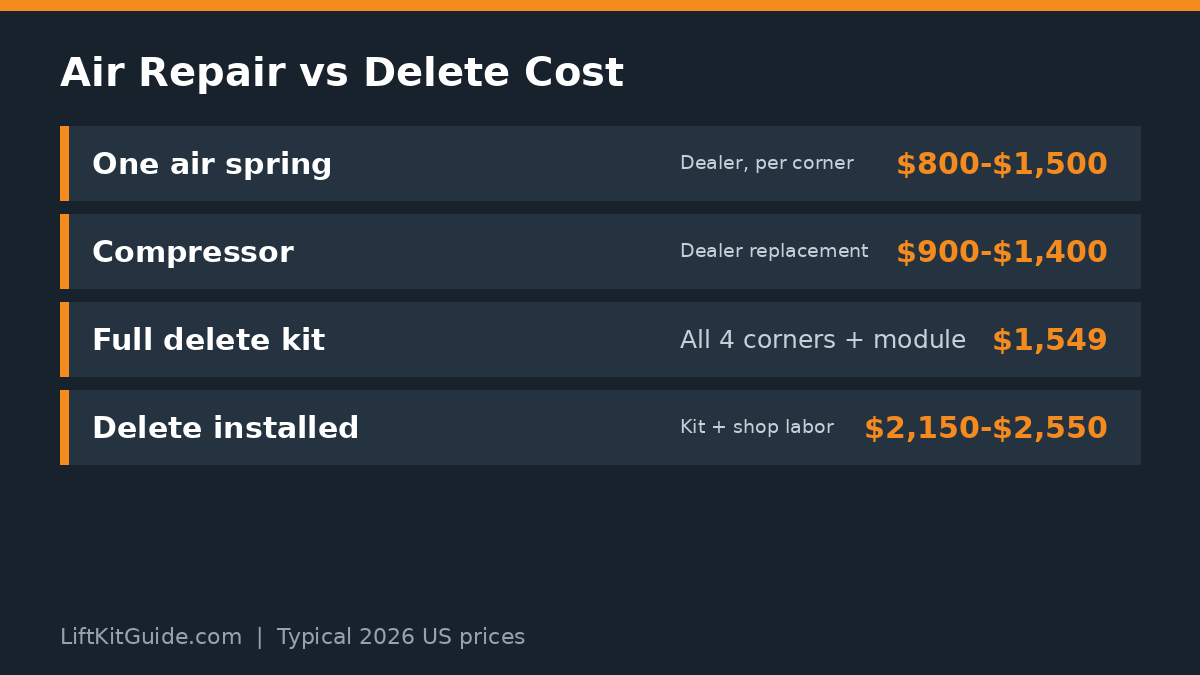
| Air spring leak | Truck sags overnight, compressor runs constantly | $800-$1,500 per corner |
| Compressor failure | ‘Service Air Suspension’ message, no height change | $900-$1,400 |
| Ride-height sensor | Stuck at one height, warning lights | $300-$600 |
| Frozen air lines | Wrong height in cold weather until thaw | $200-$500 (plus tow) |
| Full conversion kit | Replaces all of the above permanently | $1,549 (Strutmasters) |
What does an air suspension delete cost on a Ram 1500?
For the air suspension vs coilovers lifted Ram cost comparison, the benchmark is the Strutmasters conversion kit at $1,549 for 2013-2018 Ram 1500s, which includes two complete front strut assemblies, two rear coil springs, two rear shocks, and a light-fix module to keep the dash happy. That is the entire suspension replaced for less than one OEM air strut at dealer prices. Installation is bolt-on with no welding or cutting, and a shop typically charges $600 to $1,000 for the swap, putting a complete professional conversion around $2,150 to $2,550.
Compare that to nursing the air system along: one air spring and a compressor in the same year can easily exceed $2,500 at a dealer, and you still own an aging system with more failures ahead. The delete math gets even better if you are lifting anyway, since the conversion effectively becomes part of the lift budget. Our cost to lift a truck breakdown shows how the delete fits into total build pricing,.
Air suspension vs coilovers lifted Ram for towing: which wins?
This is the one category where factory air suspension has a genuine, hard-to-replace advantage. Hook up a 7,000-pound travel trailer and the system levels the truck automatically, keeping headlights aimed correctly and weight distribution stable without touching a wrench. Coilover trucks need helper solutions — air helper bags inside the rear coils, Timbren bump stops, or a weight-distribution hitch dialed in for the load — and none of them adjust themselves when you drop the trailer and drive home empty.
That said, plenty of owners tow happily on converted trucks. A quality coilover conversion with properly rated rear springs handles typical half-ton towing fine, and add-on helper bags ($300 to $600) restore most of the leveling convenience for the occasional heavy tow. The air suspension vs coilovers lifted Ram towing verdict comes down to frequency: tow heavy every weekend and working air ride earns its keep; tow a boat twice a summer and coilovers plus helpers are simpler and cheaper. Read towing with a lifted truck for hitch and setup details that apply to either suspension.
Payload ratings deserve a mention too. Factory air suspension does not increase your truck’s GVWR or payload rating — it just levels the load automatically. A coilover conversion with properly rated springs carries the same legal payload, so nothing about the delete reduces what the truck is rated to haul. The air suspension vs coilovers lifted Ram towing debate is about convenience and ride, not capability on paper.
What do you lose when you delete Ram air suspension?
Deleting is not free of trade-offs in the air suspension vs coilovers lifted Ram decision, so go in with eyes open. You lose the adjustable ride heights — no more Aero mode lowering on the highway, no Off-Road 1 and 2 for extra clearance at the touch of a button. You lose automatic load leveling, which means dialing in helper bags or a weight-distribution hitch yourself when towing. And on trucks where the system was healthy, you may notice the loss of that magic-carpet isolation over small chatter that air springs do well.
There are also administrative details: the conversion needs a light-fix module or resistor pack so the dash does not throw permanent suspension warnings, and some owners report minor quirks like trailer-brake display flicker that resolves after a key cycle. None of these are dealbreakers — thousands of converted Rams drive every day without issues — but they are worth knowing before you commit. As with any modification, check whether a lift kit voids warranty implications if your truck is still covered.
Warranty considerations round out the picture. If your Ram is still under factory bumper-to-bumper coverage, any suspension modification — delete or lift — can complicate related warranty claims, though the Magnuson-Moss Act protects unrelated coverage. Most owners doing deletes are well past warranty anyway, which is precisely when air components start failing. Timing the conversion to coincide with the end of warranty coverage is a common and sensible strategy.
- Adjustable height: Normal, Aero, Off-Road 1 and 2 modes disappear — ride height becomes fixed.
- Auto load-leveling: gone; towing setup needs helper bags or a weight-distribution hitch instead.
- Warning lights: require a light-fix module so the dash stays clean after the swap.
- Resale nuance: some buyers specifically want air ride; others see the delete as a reliability upgrade.
- Ride character: slightly firmer and more controlled; most owners call it an improvement.
Can you lift a Ram and keep the factory air suspension?
Yes, with caveats. Several manufacturers offer lift kits designed around the air suspension, typically 4-inch systems from BDS and similar brands that relocate the air components rather than replacing them. There are also adjustable sensor links that trick the computer into riding 1 to 2 inches higher — a cheap leveling method that works until the system decides it disagrees, occasionally stranding owners at the wrong height. These options make sense if your air system is young and healthy and you love the adjustable heights.
The risk is stacking complexity: a lifted truck asks more of every suspension component, and air components were already the weak link. Many owners who lift on air end up deleting later anyway after the first cold-weather failure or compressor death, effectively paying for suspension twice. If your truck already has 80,000-plus miles on the original bags, deleting during the lift is usually the smarter single expense. Our best lift kit brands ranking notes which manufacturers support air-equipped Rams.
One more practical tip: if you plan to sell the truck within a year or two, keep every air component you remove. A future buyer who specifically wants factory air ride may pay more for a truck that can be converted back, and having the original parts in boxes costs nothing to store. It is a small hedge in the air suspension vs coilovers lifted Ram resale discussion that costs only garage space.
| Approach | Cost | Best for |
|---|---|---|
| Keep air + air-specific lift | $2,500-$4,500 kit | Low-mile trucks, owners who love adjustable height |
| Keep air + sensor links | $100-$300 | Mild leveling on healthy systems only |
| Delete to coilovers, then lift | $1,549 + lift kit | High-mile trucks, cold climates, maximum reliability |
| Delete only (no lift) | ~$2,150-$2,550 installed | Fixing dead air ride on a stock-height truck |
Should you delete air suspension before or after lifting your Ram?
If the air system is already failing, delete first and lift second — or do both at once. Combining the jobs saves duplicate labor, since the front struts come out either way, and it lets you choose any lift kit on the market instead of the short list of air-compatible ones. Shops familiar with Rams do this pairing routinely, and bundling the work typically saves $300 to $500 in overlapping labor compared to two separate visits.
If the air system is healthy and you are lifting for looks with a mild kit, keeping it is defensible — enjoy the adjustable heights while they last. Just budget mentally for the eventual conversion, because the air suspension vs coilovers lifted Ram question rarely stays theoretical past 100,000 miles. Either way, decide before buying the lift kit, since air and coilover trucks take different parts. A planned delete is a $1,549 upgrade; a panicked delete after a failure is the same money plus a tow bill.
Frequently asked questions
How much does it cost to delete Ram 1500 air suspension?
A complete conversion kit runs about $1,549 for 2013-2018 Ram 1500s, including front strut assemblies, rear coils, rear shocks, and a light-fix module. Professional installation adds roughly $600 to $1,000, for a total around $2,150 to $2,550 — typically less than one dealer air strut replacement.
Does deleting air suspension affect towing?
You lose automatic load leveling, so towing setup needs more attention — helper air bags ($300-$600) or a properly adjusted weight-distribution hitch. With those in place, converted Rams tow just as well as stock; without them, expect more squat under heavy tongue weight.
Will the dashboard show warnings after an air suspension delete?
Not if the kit includes a light-fix module, which fools the computer into thinking the air components are still present. Quality conversion kits include this module; skipping it leaves permanent 'Service Air Suspension' warnings on the dash.
Is factory air suspension bad in winter?
It can be. Moisture in the air lines can freeze, leaving the truck at the wrong ride height until it thaws, and compressors work harder in cold weather. Owners in northern states report the most air suspension failures, which is a major driver of delete conversions.
Can you lift a Ram 1500 and keep air suspension?
Yes — air-specific lift kits from brands like BDS relocate the air components, and sensor links can add 1-2 inches cheaply. But the air system remains the weak link, and many owners end up deleting later anyway. On high-mileage trucks, deleting during the lift is usually cheaper long-term.
Do coilovers ride better than Ram air suspension?
According to overwhelming owner feedback, yes — converted trucks almost always ride better than they did on aging air suspension. Against a brand-new air system the comparison is closer, but a quality coilover setup is more controlled over large bumps and never sags overnight.
The bottom line
For a lifted Ram 1500, the air suspension vs coilovers debate resolves into a simple rule: healthy low-mile air ride is worth keeping and lifting around, but aging or failing air suspension should be deleted, not repaired. A $1,549 conversion buys permanent simplicity, usually better ride quality, and access to the full lift-kit catalog.
The only owners who should fight to keep air are frequent towers who use auto-leveling weekly and live where winters are mild. Everyone else — especially cold-climate and high-mileage owners — will spend less and worry less on coilovers.




Leave a comment