


Last updated: October 2026 Written by the LiftKitGuide Team, truck suspension installers and editors
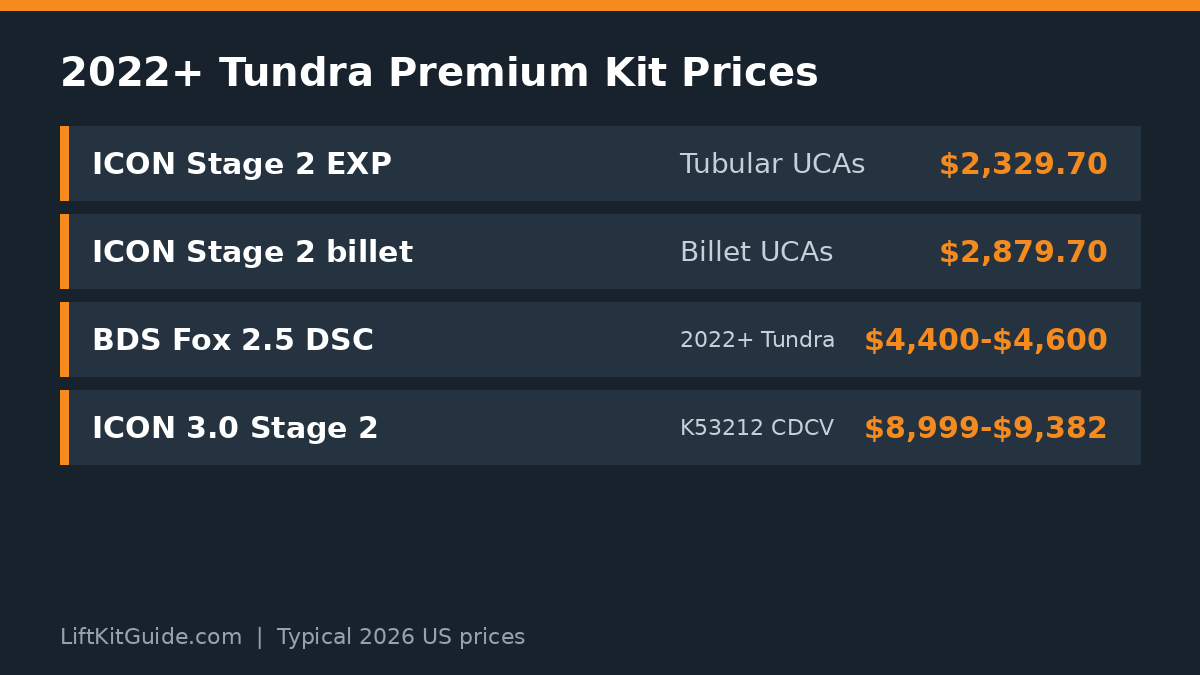
In the bds vs icon stage 2 tundra showdown, ICON’s Stage 2 EXP system for the 2022+ Tundra costs $2,329.70 with tubular upper control arms ($2,879.70 with billet UCAs), while BDS’s premium 2022+ Tundra play — its Fox 2.5 DSC coilover system — runs roughly $4,400 to $4,600. ICON wins on value and tunability per dollar; BDS with Fox 2.5 DSC coilovers wins on out-of-the-box damping sophistication. For most owners, the ICON Stage 2 EXP is the smarter buy; for no-compromise performance, the BDS Fox DSC system justifies its premium.
Key takeaways
- ICON’s Stage 2 EXP system for the 2022+ Tundra lists at $2,329.70 with tubular UCAs and $2,879.70 with billet UCAs, including 2.5 EXP coilovers and rear 2.0 IR shocks.
- BDS’s premium 2022+ Tundra offering is its Fox 2.5 DSC coilover system at roughly $4,400 to $4,600 — nearly double the ICON Stage 2 EXP.
- ICON’s Stage 2 delivers 2 to 3 inches of lift with tubular or billet UCAs featuring the Delta Joint Pro (90 degrees of articulation).
- BDS counters with Fox 2.5 Factory Series remote reservoir coilovers featuring DSC dual-speed compression adjusters for on-the-fly tuning.
- Both brands carry limited lifetime warranties on hard parts; ICON coilovers and Fox coilovers both need rebuilds every 30,000 to 50,000 miles of hard use.
On this page
What is the ICON Stage 2 system for the 2022+ Tundra?
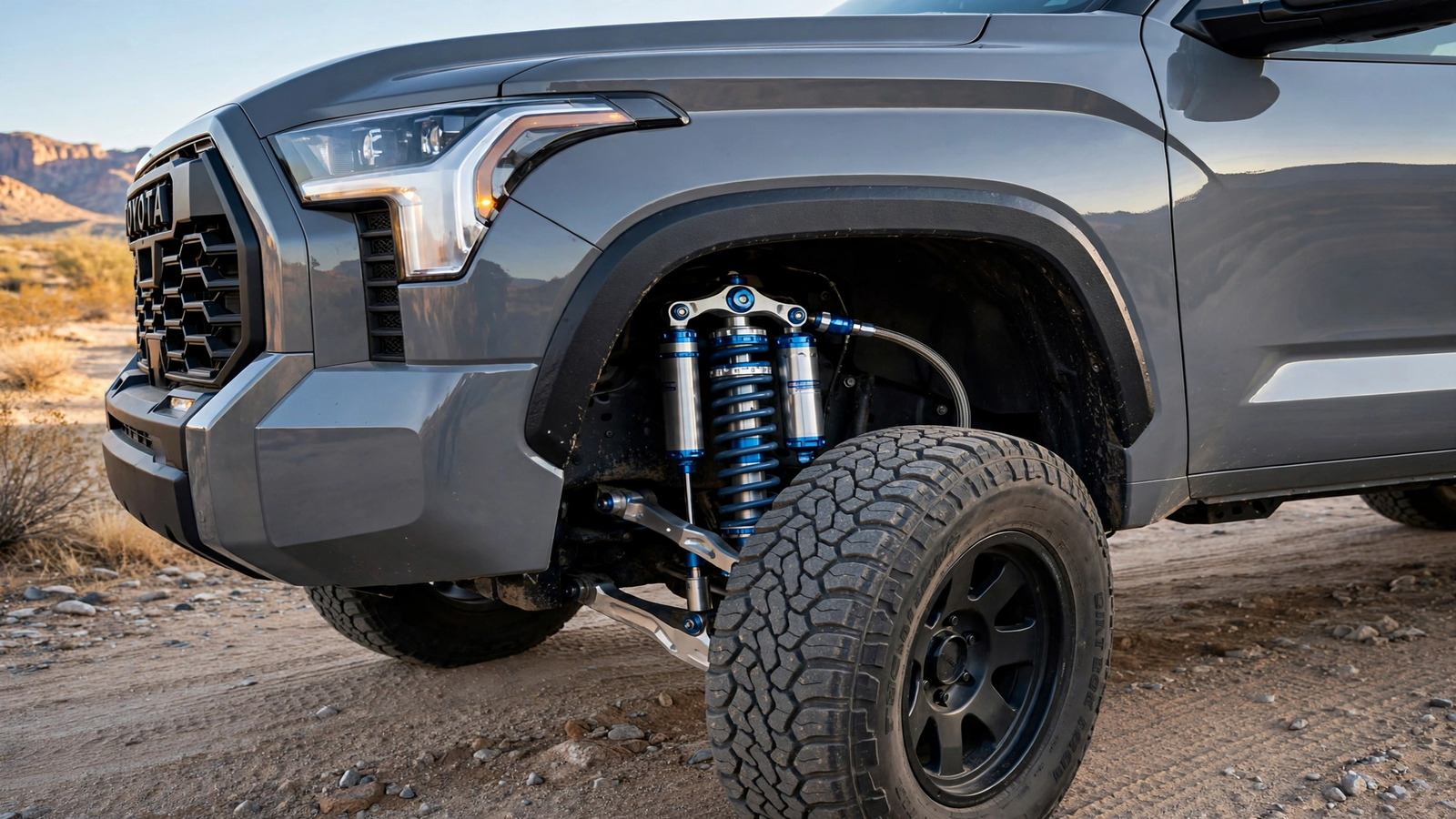
ICON Vehicle Dynamics structures its 2022+ Tundra lineup in stages, and Stage 2 is the sweet spot for most owners. The Stage 2 EXP system bundles ICON’s 2.5 EXP Series front coilovers, a tubular (or billet, your choice) upper control arm kit with the Delta Joint Pro, a sway bar drop kit, and 2.0 VS Series internal-reservoir rear shocks. It delivers 2 to 3 inches of front lift with the coilovers’ threaded preload adjustment, retains the factory rear coils with shock upgrades, and is engineered specifically for the 2022+ Tundra’s new suspension geometry. Understanding how suspension lift kits work helps contextualize why coilover systems cost multiples of spacer kits. The complete component list and current price are published on this ICON Stage 2 EXP Tundra system listing, which breaks down every part number in the kit.
The Delta Joint Pro deserves its own mention because it is ICON’s answer to the eternal ball-joint-versus-uniball debate. It is a patented hybrid joint offering 90 degrees of total articulation with the durability of a sealed unit and the serviceability of a rebuildable one. Paired with corrected UCA geometry, it restores alignment range and droop travel that the factory arms lose at 2-3 inches of lift. For shoppers comparing the best lift kit brands in the premium Toyota space, ICON’s joint technology is a genuine differentiator.
Above the EXP system sits the 3.0 Stage 2 (K53212) at $8,999 to $9,382 — 3.0 Series remote-reservoir coilovers with CDCV (compression damping control valves), up to 40 percent more front travel, and 20 percent more rear travel. That is a different budget universe, and this comparison focuses on the EXP system where most buyers actually shop. The bds vs icon stage 2 tundra debate lives at the $2,300 to $4,600 level, not the $9,000 one. That positioning is exactly why the bds vs icon stage 2 tundra debate lives at the $2,300 to $4,600 level, where real buyers make real trade-offs.
| System | Front coilovers | UCAs | Rear shocks | Parts price |
|---|---|---|---|---|
| ICON Stage 2 EXP (tubular) | 2.5 EXP coilovers | Tubular + Delta Joint Pro | 2.0 VS IR | $2,329.70 |
| ICON Stage 2 EXP (billet) | 2.5 EXP coilovers | Billet + Delta Joint Pro | 2.0 VS IR | $2,879.70 |
| ICON 3.0 Stage 2 | 3.0 remote reservoir + CDCV | Billet + Delta Joint Pro | 3.0 VS RR + CDCV | $8,999-$9,382 |
| BDS Fox 2.5 DSC (2022+) | Fox 2.5 DSC remote reservoir | BDS performance UCAs | Fox 2.0 | $4,400-$4,600 |
What does BDS offer against it in the bds vs icon stage 2 tundra matchup?
BDS does not sell a part-for-part clone of ICON’s Stage 2, so the bds vs icon stage 2 tundra matchup needs honest framing. For the 2022+ Tundra, BDS’s premium answer is its Fox 2.5 DSC coilover system: Fox 2.5 Factory Series remote-reservoir coilovers with DSC (dual-speed compression) adjusters up front, BDS performance upper control arms, and Fox 2.0 rear shocks. It is a coilover-system philosophy just like ICON’s Stage 2, but built around Fox’s flagship DSC dampers rather than ICON’s EXP units.
The Fox 2.5 DSC coilover is the star of the BDS system. The DSC adjusters let you independently tune high-speed and low-speed compression — effectively giving you a street mode and an off-road mode at the twist of two knobs. That adjustability is a step beyond ICON’s EXP coilovers, which are valved for a fixed performance window. BDS pairs the Fox units with its own geometry correction, skid plates on some versions, and the company’s Factory Protection Plus warranty backing.
Price is where the framing gets uncomfortable for BDS: roughly $4,400 to $4,600 puts it nearly double the ICON Stage 2 EXP’s $2,329.70. Some of that is the Fox 2.5 DSC hardware, which is genuinely more expensive to build than ICON’s EXP coilovers. The question the rest of this comparison answers is whether the damping sophistication is worth double the money — and for whom. The Tundra lift kit guide has more on how these systems fit into the broader Tundra lift landscape. Shoppers framing the bds vs icon stage 2 tundra choice should test-drive both damper philosophies back to back if a local shop has demo trucks.
How does the bds vs icon stage 2 tundra pricing compare?
The bds vs icon stage 2 tundra price comparison is stark. ICON Stage 2 EXP with tubular UCAs: $2,329.70. With billet UCAs: $2,879.70 — a $550 upgrade for the billet arms’ extra strength and looks. BDS’s Fox 2.5 DSC system: roughly $4,400 to $4,600 depending on retailer. The BDS system costs 55 to 100 percent more than the ICON system depending on which ICON UCA tier you choose.
Installation is comparable: both are coilover-swap systems booking at 6 to 8 hours ($750 to $1,200 labor) plus $100 to $150 for alignment. Neither requires cutting or welding on the 2022+ Tundra. Installed totals run roughly $3,200 to $3,700 for the ICON Stage 2 EXP and $5,300 to $5,900 for the BDS Fox DSC system. That $2,000 installed gap is the decision in a nutshell. The bds vs icon stage 2 tundra installed gap of roughly $2,000 is the decision in a nutshell: adjustability has a price.
Long-term costs favor neither brand decisively. Both Fox 2.5 and ICON 2.5 coilovers want rebuilds every 30,000 to 50,000 miles of hard use at $200 to $400 per corner, and both brands’ UCAs have serviceable joints. The ICON system’s lower buy-in leaves budget for the first rebuild cycle with money to spare. For the complete ownership math, see the full cost of lifting a truck — premium coilover systems have premium maintenance.
| Cost item | ICON Stage 2 EXP | BDS Fox 2.5 DSC |
|---|---|---|
| Parts | $2,329.70 | $4,400 – $4,600 |
| Labor (6-8 hr) | $750 – $1,200 | $750 – $1,200 |
| Alignment | $100 – $150 | $100 – $150 |
| Installed total | $3,200 – $3,700 | $5,300 – $5,900 |
Which system rides better on road?
On pavement, both systems ride better than stock — that is what $2,300+ coilovers buy you. The ICON Stage 2 EXP’s 2.5 coilovers are valved for controlled compliance: small-bump absorption is excellent, body roll is reduced versus stock, and the truck feels planted without being harsh. Owners describe it as the ride the TRD Pro should have had. The fixed valving means what you feel on day one is what you get — consistent and predictable.
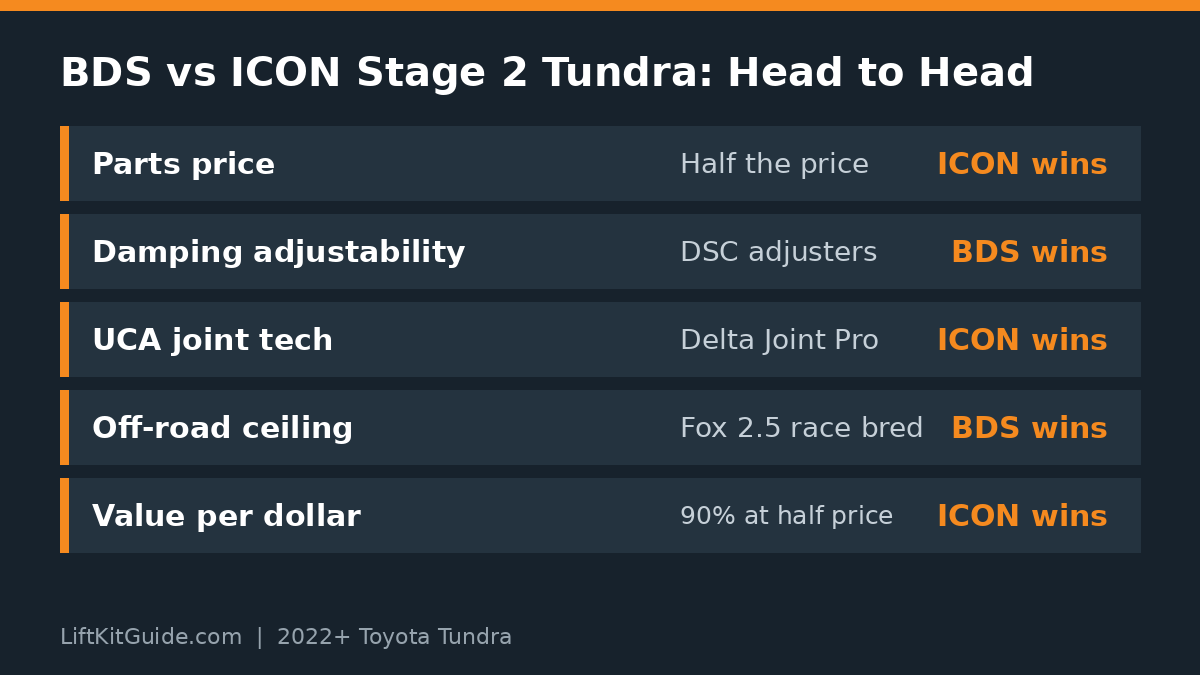
The BDS Fox 2.5 DSC system has a trick the ICON cannot match: the DSC adjusters. Set them soft for the highway commute and the Fox units ride plusher than the ICONs; firm them up for a loaded or towing run and body control sharpens dramatically. That adjustability is the BDS system’s strongest argument — it is two suspensions in one. The catch is that most owners set the adjusters once and never touch them again, in which case the advantage is theoretical. For buyers who will never touch a knob, the bds vs icon stage 2 tundra on-road answer is simple — take the ICON and keep the difference.
The honest on-road verdict: BDS wins on peak capability thanks to DSC adjustability; ICON wins on simplicity and value, delivering 90 percent of the ride quality at half the price. If you will actually use the adjusters — towing on weekends, commuting on weekdays — the BDS premium starts making sense. If not, the ICON’s fixed valving is the smarter money.
Which system performs better off-road?
Off-road is where both systems justify their prices over spacer lifts. The ICON Stage 2 EXP’s 2.5 coilovers with increased travel transform the 2022+ Tundra’s off-road manners: better articulation, controlled high-speed damping over washboard, and UCAs that keep alignment through the travel range. The Delta Joint Pro’s 90 degrees of articulation matters here — it keeps the front end working where ball joints bind. For moderate trails, overlanding, and desert two-track, the ICON system is superb.
The BDS Fox 2.5 DSC system goes further. Fox’s 2.5 Factory Series remote-reservoir coilovers are race-bred hardware with more sophisticated internals than ICON’s EXP units, and the DSC adjusters let you firm up high-speed compression for whoops and soften low-speed for rock crawling. BDS’s geometry correction and available skid plates add protection. For aggressive off-road use — high-speed desert, heavy overland loads — the BDS system has the higher ceiling. Few owners will find the ICON’s limits on anything short of serious desert running, which settles the bds vs icon stage 2 tundra off-road question for most.
The off-road verdict mirrors the on-road one: BDS has the higher performance ceiling, ICON has the better performance-per-dollar. Few owners will find the ICON’s limits on anything short of serious desert running. The bds vs icon stage 2 tundra off-road debate is really about whether your weekends justify double the price — for most, they do not.
How do the UCAs and joints compare?
The upper control arm comparison is closer than the price gap suggests. ICON’s tubular UCAs with the Delta Joint Pro ($2,329.70 system price) offer the patented hybrid joint with 90 degrees of articulation, full serviceability, and corrected geometry. The $550 step to billet UCAs ($2,879.70) buys 6061 billet aluminum arms with the same Delta Joint Pro — stronger, prettier, and more resistant to bending under hard hits. Both are excellent arms.
BDS’s performance UCAs are well-engineered units with quality joints and corrected geometry, but they lack a signature joint technology to match the Delta Joint Pro’s story. They do their job — restoring alignment range and droop travel at 2-3 inches of lift — without fuss. In blind testing, most owners would not feel a difference between the UCAs; the Delta Joint Pro’s advantage shows up in serviceability and extreme articulation rather than daily driving.
One practical note: at 2 to 3 inches of lift on the 2022+ Tundra, aftermarket UCAs are strongly recommended regardless of brand — the factory arms run out of adjustment and droop travel. Both kits include them, which is part of why both cost what they do. Skipping UCAs to save money is a false economy that costs more in tires later. See whether you need upper control arms with a 3-inch lift for the full explanation.
- ICON Stage 2 EXP strengths: $2,329.70 price, Delta Joint Pro with 90-degree articulation, excellent fixed valving, tubular or billet UCA choice, strong value.
- ICON Stage 2 EXP weaknesses: no on-the-fly damping adjustment, EXP coilovers a step below Fox 2.5 DSC internals, rebuilds needed every 30k-50k hard miles.
- BDS Fox 2.5 DSC strengths: DSC dual-speed compression adjusters, race-bred Fox 2.5 remote reservoir coilovers, higher off-road ceiling, Factory Protection Plus warranty.
- BDS Fox 2.5 DSC weaknesses: $4,400-$4,600 price (nearly double), most owners never touch the adjusters, premium rebuild costs.
- Bottom line: value and simplicity — ICON; adjustability and ultimate performance — BDS.
Which kit is easier to live with long-term?
Long-term ownership favors simplicity, which favors ICON. The Stage 2 EXP has fewer adjustments to fiddle with, widely available rebuild services, and a huge installed base meaning any shop that works on Toyotas knows the system. Replacement parts — seals, shafts, Delta Joint rebuild kits — are readily available from ICON and its dealers. The system’s maturity on the 2022+ platform means the bugs are worked out.
The BDS Fox DSC system is also well-supported — Fox’s service network is arguably the best in the business — but the DSC adjusters add complexity and the system’s higher price means higher rebuild bills. Fox 2.5 DSC coilover rebuilds run $250 to $400 per corner at authorized service centers. The Factory Protection Plus warranty is a genuine BDS advantage for the hard parts, though it does not cover wear items like coilover seals. Serviceability is a quiet tiebreaker in the bds vs icon stage 2 tundra long-term math: both brands have excellent rebuild networks.
Resale is a wash: both brands hold value well in the used market, with ICON arguably having slightly stronger name recognition among Toyota owners. Either system, maintained properly, will outlast the truck’s first owner. The Toyota truck lift kits guide covers how these premium philosophies extend across the Toyota lineup.
Verdict: which premium Tundra kit wins?
The ICON Stage 2 EXP wins for most 2022+ Tundra owners. At $2,329.70 with tubular UCAs, it delivers 90 percent of the premium coilover experience — excellent ride, real off-road capability, the Delta Joint Pro, and corrected geometry — for roughly half the price of the BDS Fox DSC system. The value proposition is overwhelming unless you have a specific need for adjustable damping.
The BDS Fox 2.5 DSC system wins for the no-compromise buyer. If you tow heavy on weekends and commute on weekdays, the DSC adjusters genuinely transform the truck between duties. If you run hard off-road, the Fox 2.5 internals have the higher ceiling. At $4,400 to $4,600, it is priced like the flagship it is, and it performs like one.
In the bds vs icon stage 2 tundra decision, the smart money is ICON and the ultimate performance is BDS. Most owners will be happier with the ICON’s value; the few who need the BDS’s adjustability will know exactly who they are.
Frequently asked questions
How much does the ICON Stage 2 cost for a 2022+ Tundra?
The ICON Stage 2 EXP system lists at $2,329.70 with tubular upper control arms and $2,879.70 with billet UCAs. The 3.0 Stage 2 system (K53212) runs $8,999 to $9,382. Installation adds $750 to $1,200 plus alignment.
What does the BDS Fox 2.5 DSC system cost for a 2022+ Tundra?
BDS's Fox 2.5 DSC coilover system for the 2022+ Tundra runs roughly $4,400 to $4,600 in parts depending on retailer. Installed totals land around $5,300 to $5,900 with labor and alignment.
What is the Delta Joint Pro?
The Delta Joint Pro is ICON's patented hybrid joint combining ball-joint durability with uniball-like articulation — 90 degrees total. It is serviceable, rebuildable, and designed for lifted applications needing extra droop travel and alignment range.
Do I need UCAs with a 2-3 inch Tundra lift?
Yes, aftermarket UCAs are strongly recommended at 2 to 3 inches on the 2022+ Tundra. The factory arms run out of alignment adjustment and droop travel. Both the ICON Stage 2 and BDS systems include corrected UCAs.
How often do coilovers need rebuilding?
Premium 2.5 coilovers from ICON or Fox typically need rebuilds every 30,000 to 50,000 miles of hard use (longer for street-only trucks). Rebuilds cost $200 to $400 per corner at authorized service centers.
Is the ICON 3.0 Stage 2 worth it over the EXP?
Only for serious off-road use. The 3.0 Stage 2 ($8,999+) adds remote reservoirs, CDCV adjusters, and up to 40 percent more front travel. For street and moderate trails, the EXP system delivers most of the experience at a quarter of the price.
The bottom line
For most 2022+ Tundra owners, the ICON Stage 2 EXP at $2,329.70 is the winner — premium coilover ride, the Delta Joint Pro, and real off-road capability at half the price of the BDS Fox system.
If you need on-the-fly damping adjustability for towing and hard off-road use, the BDS Fox 2.5 DSC system at $4,400 to $4,600 justifies its premium with race-bred hardware and the highest performance ceiling.



Leave a comment