


Last updated: October 2026 Written by the LiftKitGuide Team, truck suspension installers and editors
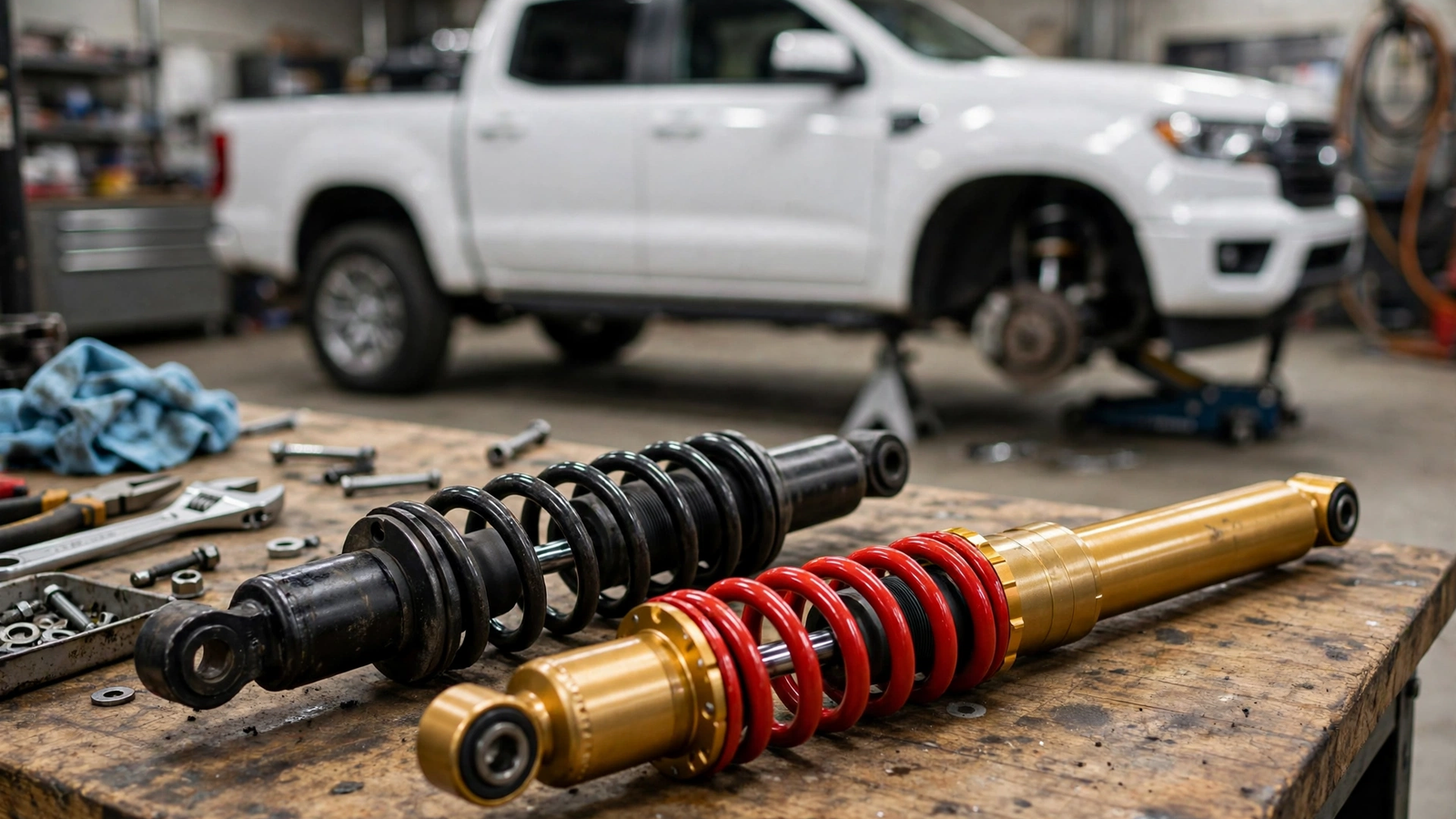
Can you reuse stock shocks with a leveling kit? Yes, you can — a 1.5 to 2.5-inch level stretches stock shocks toward their travel limit but rarely past the point of installation. However, reused shocks will top out over bumps, ride worse than stock, and wear out faster, so most owners end up replacing them within a year or two anyway. If your truck already has 40,000-plus miles on the originals, skip the reuse and install proper leveling shocks from the start.
Key takeaways
- You can reuse stock shocks with a leveling kit, but they will operate near full extension and top out over sharp bumps.
- Fresh shocks on a new truck tolerate a level far better than worn shocks with 50,000-plus miles — age matters more than most owners think.
- Shock extenders ($40–$100) fix the geometry problem but do nothing for damping; they are a stopgap, not a solution.
- A set of Bilstein 5100s ($350–$500) is the standard upgrade and usually costs less long-term than replacing failed stockers twice.
- At 2.5 inches of level or more, or if you tow or off-road, proper longer shocks stop being optional.
On this page
Can you reuse stock shocks with a leveling kit?
Can you reuse stock shocks with a leveling kit? Technically, yes — and thousands of truck owners do exactly that every year without immediate disaster. A typical leveling kit only raises the front end 1.5 to 2.5 inches, which stretches stock shocks toward the edge of their travel but rarely past the point where they physically cannot be installed. For a street-driven truck on a tight budget, reusing the factory shocks is the cheapest way to get the leveled look.
But cheap and correct are different things. The question can you reuse stock shocks with a leveling kit has a second half that matters more: should you? Running stock shocks on a leveled truck means they operate near full extension, which causes topping out over bumps, accelerates seal wear, and generally delivers a worse ride than the truck had stock. Most owners who reuse them end up buying proper shocks within a year or two anyway — after enduring months of clunking they could have avoided.
Owner forums are full of threads asking can you reuse stock shocks with a leveling kit, and the consensus pattern is remarkably consistent: the owners who are happiest long-term are the ones who treated reuse as a temporary phase. The ones who planned to run stock shocks indefinitely usually post a follow-up six months later asking why their truck rides terribly. Set your expectations accordingly and you will not be disappointed.
Why do leveling kits stress stock shocks?
A leveling kit raises the front of the truck by pushing the suspension’s resting position upward — usually with a strut spacer, coil spacer, or adjustable strut. The shock mounts move apart by roughly the amount of the lift, so a 2-inch level leaves the stock shock with about 2 inches less available droop travel than it was designed for. The shock now lives near the top of its stroke, where every pothole and driveway lip can slam it against its extension stop.
This matters because the factory shock is also the front suspension’s down-travel limiter on most trucks. When the shock tops out, it momentarily becomes a rigid link, and the impact loads travel straight into the ball joints, upper control arms, and CV joints. Suspension engineers allow a small margin of extra travel — typically half an inch to three-quarters of an inch — but a 2-inch spacer blows straight past that margin. The result is the harsh topping-out clunk that defines the leveled-on-stock-shocks experience.
It helps to think of the shock as having a fixed budget of travel. Leveling spends a large chunk of that budget just sitting still, leaving little for actual bumps. When owners ask can you reuse stock shocks with a leveling kit, what they are really asking is whether that remaining travel budget is enough — and at 2 inches or more, the honest answer is usually no. A detailed breakdown of the 2-inch leveling shock question reaches the same conclusion: reuse works mechanically, but the ride pays the price.
- Topping-out clunk: a sharp metallic knock from the front end when the wheel drops into a pothole or off a speed bump.
- Floaty highway ride: stock valving cannot control the new geometry, so the truck wallows over dips and bridge joints.
- Premature oil weeping: seals hammered by topping out start leaking far earlier than their normal service life.
- Nose dive under braking: worn or overextended front shocks let the front end plunge when you hit the brakes hard.
- Uneven tire wear: uncontrolled suspension movement scrubs the front tires and shortens their life noticeably.
What are the symptoms of overworked stock shocks?
The first symptom most owners notice is noise: a distinct clunk or bang from the front suspension when the wheel drops quickly, like rolling off a curb or hitting a sharp-edged pothole. That sound is the shock’s piston slamming into its extension stop because there is no travel left. It is annoying on the street and genuinely harmful off-road, where repeated impacts can damage mounts and bushings.
Ride degradation follows. The truck may feel bouncy over rolling dips, harsh over sharp bumps, and vague in corners — sometimes all three at once, which confuses owners into blaming the leveling kit itself. In reality the spacer just changed the geometry; the tired, overextended shock is what fails to manage it. If your leveled truck rode fine for the first few months and then got progressively worse, the stock shocks are telling you they have had enough.
There is a simple diagnostic any owner can do. Find an empty road with a sharp dip, drive over it at moderate speed, and listen. A single controlled thump is normal suspension noise; a harsh metallic bang that you feel through the floor is topping out. If you hear that bang regularly, the debate over can you reuse stock shocks with a leveling kit is settled for your truck — the shocks are done pretending, and it is time for proper replacements. Ignoring the signs only makes the eventual repair bill bigger.
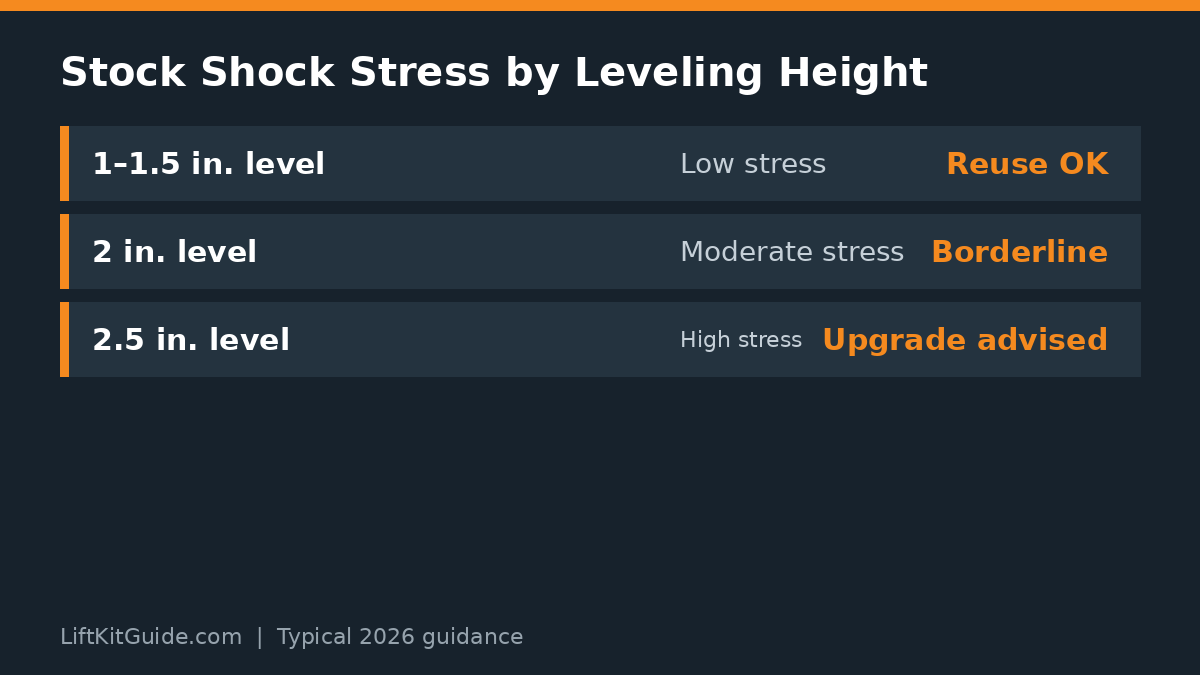
| Leveling kit height | Stock shock stress level | Topping out likely? | Recommendation |
|---|---|---|---|
| 1–1.5 in. | Low — within design margin | Rarely | Stock shocks usually fine |
| 2 in. | Moderate — near travel limit | Sometimes | Consider extenders or new shocks |
| 2.5 in. | High — past design margin | Often | New longer shocks recommended |
| 3 in. (max spacer) | Severe | Almost certain | New longer shocks required |
Can you reuse stock shocks with a leveling kit on a brand-new truck?
This is the one scenario where the answer leans toward yes. Can you reuse stock shocks with a leveling kit when the truck has 5,000 miles on it and the shocks are fresh? Fresh factory shocks have their full damping performance intact, so they tolerate the reduced travel margin far better than worn ones. Many owners level brand-new trucks on stock shocks and report acceptable ride quality for the first year or two.
The key word is acceptable, not ideal. Even fresh stock shocks are valved for stock geometry, and a leveling spacer changes the leverage the suspension has over them. You will still get occasional topping out on sharp impacts, and the shocks will still wear faster than they would at stock height. Think of it as borrowing time: reusing fresh stock shocks buys you a year or two to save for proper leveling-specific shocks, not a permanent solution. Budget for the proper upgrade within the year.
Are shock extenders a better option than reusing stock shocks as-is?
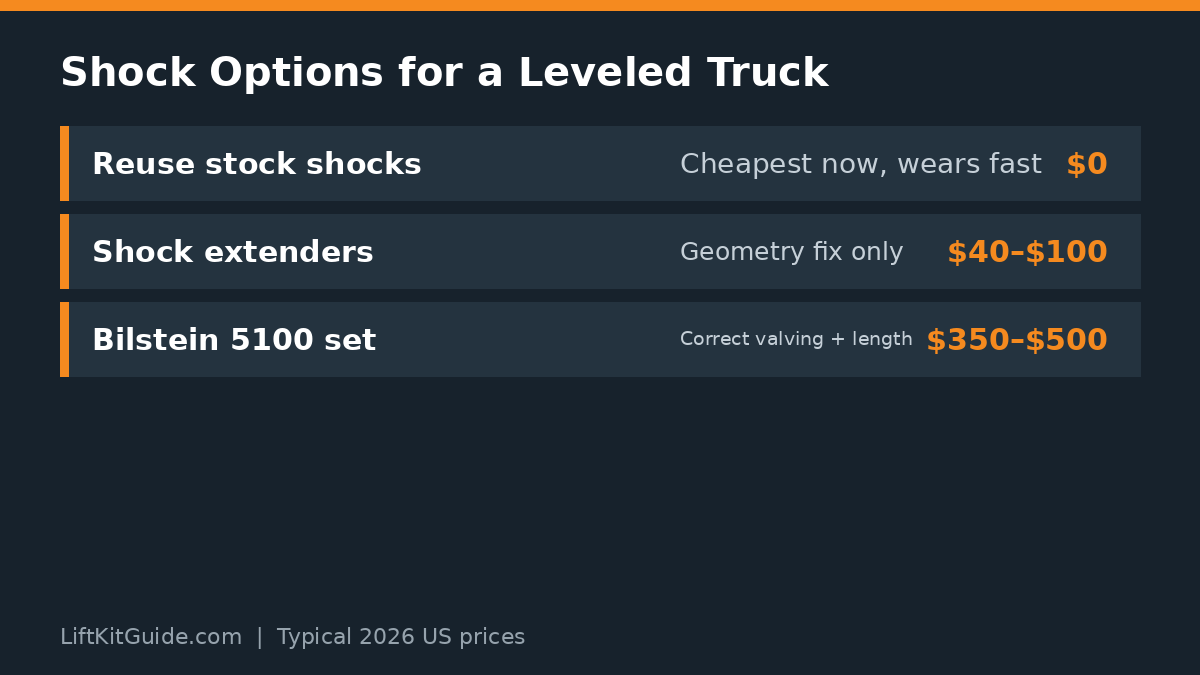
Shock extenders are small steel brackets that bolt to the lower shock mount and reposition the stock shock downward by an inch or two, putting it back in the middle of its travel range. They cost $40 to $100 for a pair and take minutes to install during the leveling job. As a pure geometry fix, they work: the topping-out clunk usually disappears because the shock regains its droop travel.
But extenders are a band-aid, not a cure. They do nothing to change the shock’s damping characteristics, which remain tuned for a stock-height truck. They also add another joint and more hardware to the suspension — another potential failure point, however minor. For the $40 to $100 they cost, extenders are a reasonable stopgap; but a proper set of leveling shocks (Bilstein 5100s at $90 to $130 per corner) solves both the geometry and the damping problems at once, which is why most experienced builders skip straight to them.
One caution about extenders: buy quality steel units from a known brand, not the cheapest no-name brackets. A shock extender is a load-bearing suspension component, and a cracked bracket at highway speed is a genuinely dangerous failure. This is one area where the $30 savings is not worth it — and another reason the owners who ask can you reuse stock shocks with a leveling kit and then add extenders usually wish they had just bought the 5100s in the first place.
When should you upgrade instead of reusing stock shocks?
Upgrade immediately if your truck already has significant miles. Factory shocks are generally worn out by 50,000 to 70,000 miles even without a lift, so leveling a truck with 60,000-mile originals on stock shocks means starting the project with components that are already done. You will feel the difference the first week, and you will be replacing them within months regardless — so do it once, correctly, during the initial installation and save the duplicate labor.
Also upgrade if you tow, haul, or go off-road with any regularity. Towing adds heat and load that overextended stock shocks handle poorly, and off-road use multiplies the topping-out impacts that kill them. The same logic applies if your leveling kit is on the tall side (2.5 inches): the geometry compromise is large enough that proper shocks transform the driving experience. In all of these cases, the $300 to $500 a set of Bilstein 5100s costs is money well spent.
Finally, consider resale and inspection. A truck that clunks over every bump raises questions from buyers and can even draw attention at state safety inspections in strict states. Owners browsing top-rated lift kit brands for their next build consistently report that doing shocks right the first time is one of the highest-satisfaction upgrades in the hobby — which circles back to can you reuse stock shocks with a leveling kit: yes, but the owners who upgrade never wish they had waited.
What do replacement shocks for a leveling kit cost?
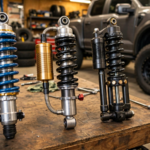
A set of four Bilstein 5100s — the default recommendation for leveled trucks — typically runs $350 to $500, with fronts costing slightly more than rears. Rancho RS5000X twin-tubes are a touch cheaper at $250 to $400 for the set, while Fox 2.0 Performance Series units run $500 to $700. Installation adds $150 to $300 at a shop if you are not doing it yourself, though many owners install shocks during the leveling job for minimal extra labor.
Compare that against the hidden cost of reusing stock shocks: premature failure means buying the shocks anyway in a year or two, plus paying labor twice, plus enduring a worse ride the whole time. When owners ask whether can you reuse stock shocks with a leveling kit to save money, the honest math usually says the savings are temporary. Spending the $350 to $500 once is cheaper than spending $0 now and $600 later — and you get a better truck every day in between. That math is the real answer to can you reuse stock shocks with a leveling kit as a money-saving strategy: the savings are an illusion that evaporates the first time you pay labor twice.
| Option | Upfront cost | Ride quality | Long-term cost |
|---|---|---|---|
| Reuse stock shocks | $0 | Mediocre — topping out likely | High — early replacement + double labor |
| Shock extenders | $40–$100 | Better geometry, stock damping | Medium — shocks still wear faster |
| Bilstein 5100 set | $350–$500 | Good — valved for leveled trucks | Low — correct solution once |
| Fox 2.0 set | $500–$700 | Excellent — aluminum, fade-resistant | Low — premium one-time buy |
How long will stock shocks last with a leveling kit?
It depends entirely on their age when leveled and how you drive. Fresh stock shocks on a street-driven truck might deliver 30,000 to 50,000 acceptable miles after a 2-inch level before topping-out wear catches up with them. The same shocks with 50,000 miles already on them might last 10,000 miles — or fail within weeks if they were marginal before the lift. There is no fixed number, only the direction: a level always shortens shock life, never extends it.
Watch for the warning signs rather than the odometer: new clunking over bumps, oil weeping on the shock body, a floaty or bouncy ride that was not there before, and front tires wearing unevenly. Any of those means the stock units are done regardless of mileage. And if you are still deciding between suspension approaches, our leveling kit versus lift kit comparison covers how shock needs change as lift height grows — the taller you go, the less optional proper shocks become.
As a final rule of thumb, match your shock strategy to your leveling height and your truck’s age together. A new truck with a mild 2-inch level is the best-case scenario for reuse, while an older truck with a tall 2.5-inch level is the worst — and most real trucks fall somewhere in between. When in doubt, price the proper shocks; at $350 to $500 for a quality set, the upgrade is one of the cheapest ways to make a leveled truck ride like it should have from the factory.
Frequently asked questions
Will reusing stock shocks damage my truck?
Not immediately, but topping out hammers the shock's internal stops and transmits impact loads into ball joints and control arm bushings. Over time this accelerates wear on those components too, not just the shocks themselves.
Do I need an alignment after reusing stock shocks with a level?
Yes — any leveling kit changes front suspension geometry, so an alignment is required regardless of which shocks you run. Expect $80–$120 at most shops.
Can I reuse stock shocks with a 2.5-inch leveling kit?
You can, but 2.5 inches is past the comfort zone for most factory shocks and topping out is likely. This is the height where most experienced owners recommend stepping up to proper leveling shocks like Bilstein 5100s.
Are leveling-kit-specific shocks longer than stock?
Yes, typically 0.5 to 1.5 inches longer in extended length, and valved for the leveled ride height. Bilstein 5100s, for example, are built slightly longer than stock with damping tuned for leveled trucks.
Will my warranty cover shocks that fail after a leveling kit?
Probably not for the shocks themselves — dealers routinely deny shock claims on leveled trucks, arguing the altered geometry caused the failure. Check our guide on whether a lift kit voids your warranty before assuming coverage.
Should I replace all four shocks or just the fronts?
A leveling kit only raises the front, so the rears keep working in their stock range — but if the rears are old, replacing all four at once saves duplicate labor later. At minimum, do the fronts with leveling-specific units.
The bottom line
Can you reuse stock shocks with a leveling kit? Yes — it is physically possible, widely done, and acceptable as a short-term move on a fresh, street-driven truck. But it is a compromise with a timer on it: topping out, accelerated wear, and a degraded ride mean most owners buy proper shocks within a year or two regardless.
The smart money depends on your starting point. New truck with fresh shocks and a 2-inch level? Reuse them while you save for Bilstein 5100s. High-mileage truck, 2.5-inch level, towing, or off-road use? Install the right shocks during the leveling job and skip the disappointment. Either way, budget the $350 to $500 eventually — the only question is whether you pay it now or pay more later.



Leave a comment