


Last updated: October 2026 Written by the LiftKitGuide Team, truck suspension installers and editors
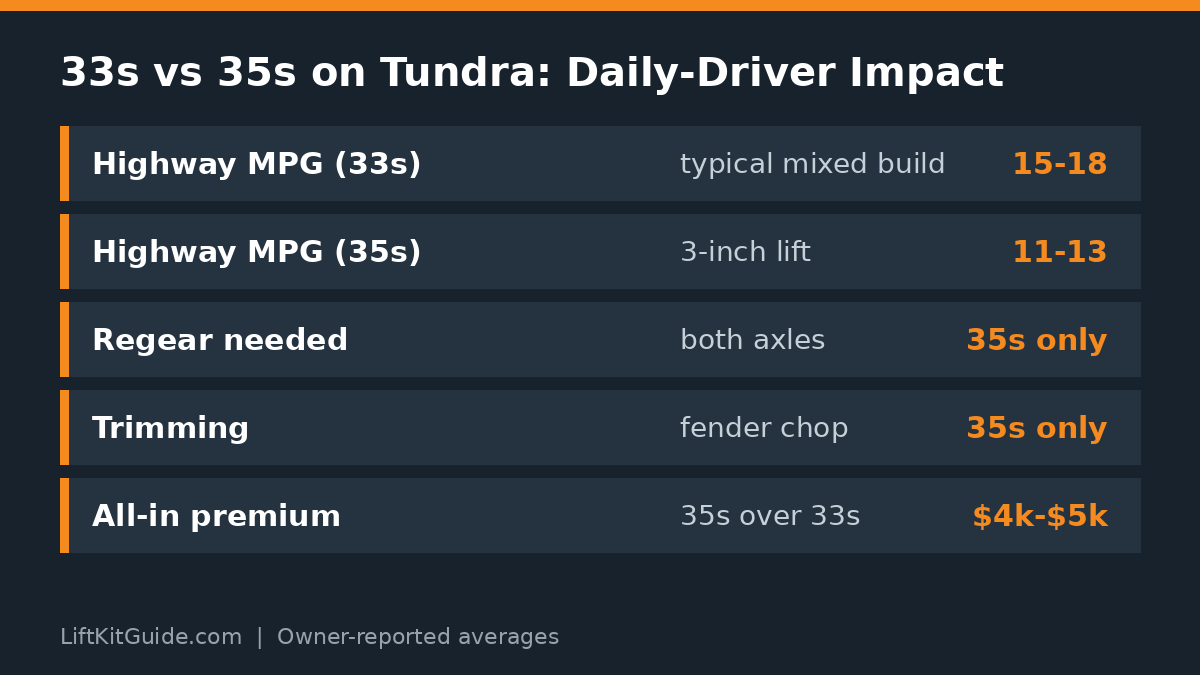
For a daily-driven Toyota Tundra, 33s are the smarter pick in the 33s vs 35s on a Toyota Tundra debate: they need no regear, cost roughly $5,000 less all-in than 35s, and hold 15-18 MPG on the highway versus 11-13 MPG with 35s. Moving to 35s typically demands fender chopping, a regear to 4.88s, and a speedometer correction on top of the tires themselves. Choose 35s only if you off-road often enough to use the extra clearance or simply love the look enough to pay for it.
Key takeaways
- 33s need no regear on a Tundra; 35s usually want 4.88 gears ($1,500-$2,500).
- Expect 15-18 highway MPG on 33s versus 11-13 MPG on 35s with a lift.
- 35s typically require fender chopping and trimming; 33s bolt on with a level.
- The all-in cost gap between 33s and 35s runs about $4,000-$5,000.
- 295/70R18 (34.3 in.) splits the difference for owners who want more than 33s.
On this page
33s vs 35s on a Toyota Tundra: which is better for a daily driver?
When Tundra owners debate 33s vs 35s on a Toyota Tundra for daily driving, the consensus lands on 33s. A 33-inch tire (285/70R17 or 275/65R20) works with stock 4.30 gears, keeps the speedometer honest, and costs little in fuel economy: owners report 15-18 MPG highway and 12-13 MPG city. Nothing else needs to change, which suits a daily driver. Ask five Tundra owners and four will tell you 33s were the right call for a truck that works hard daily.
The 35-inch case is honest but expensive. Owners who run 35s on daily-driven Tundras love the look and the off-road capability, yet most admit the tradeoffs wear on them: constant downshifting on grades, 11-13 MPG, and the nagging feeling the truck is working too hard. One long-time owner summed it up as looking great but not doing it again without a regear. If your Tundra spends 90 percent of its life on pavement, 33s deliver 95 percent of the satisfaction for half the hassle.
Your truck’s generation shifts the math slightly. The 2007-2021 Tundras with the 5.7L V8 tolerate 35s better than the 2022+ twin-turbo V6 trucks, which are more sensitive to gearing changes. But the core verdict holds across generations: 33s are the set-and-forget daily driver tire. Before spending a dollar, read our regear guide for 35s to understand the single biggest hidden cost of going bigger. Either way, test-drive both sizes back to back if a local club or shop can arrange it.
Trim level also plays a role in the 33s vs 35s on a Toyota Tundra decision. TRD Pro and TRD Off-Road trucks come with better stock suspension that handles 33s beautifully, while base SR trucks on smaller wheels may need the level just to look right. Check what your truck already has first: many TRD trims already sit close to level, making 33s a true bolt-on with no extra parts. Ask your dealer parts counter about TRD take-off suspensions for budget upgrades.
How much MPG do you lose with 35s on a Tundra?
The fuel economy penalty is the most documented part of this debate. Tundra owners moving from stock to 33s report losing 1-2 MPG, landing around 15-18 MPG highway in typical mixed builds. Moving to 35s with a lift drops most trucks to 11-13 MPG, a loss of 4 or more MPG versus stock. On a 32-gallon tank, that is the difference between 480 miles of range and barely 380. Track your mileage over three full tanks to get an honest number, not a dashboard estimate.
Tire weight hurts more than tire height, according to owner testing. One Tundra owner switched from heavy 33s to lighter 35s, dropping 5 pounds per tire, and actually gained back 1 MPG despite the taller size. This means a lightweight 35-inch all-terrain can outperform a heavy 33-inch mud-terrain at the pump. When comparing 33s vs 35s on a Toyota Tundra for fuel economy, check the tire’s published weight before its diameter. Always compare the manufacturer’s published weight when shopping between two tire models.
Driving style multiplies everything. A gentle highway cruise at 65 MPH on 35s can still return 14 MPG, while aggressive city driving on the same setup dips into single digits. The 5.7L V8 is particularly thirsty when lugging tall tires around town because it cannot reach its efficient RPM range. Our MPG loss guide breaks down exactly where the fuel goes: rolling resistance, weight, aerodynamics, and gearing. Cruise control at 65 MPH is the great equalizer for honest highway MPG comparisons.
Gearing is not the only drivetrain concern when weighing 33s vs 35s on a Toyota Tundra. The taller tire also changes your crawl ratio off-road and your effective final drive everywhere else, which is why regeared trucks often report better around-town MPG than unregeared ones despite spinning faster. An engine working comfortably at slightly higher RPM burns less fuel than one lugging at low RPM, a counterintuitive truth that surprises many owners. This is why test drives on both setups beat spec-sheet comparisons every time.
| Setup | Highway MPG | City MPG | Notes |
|---|---|---|---|
| Stock 32s | 17-19 | 14-15 | Baseline |
| 33s, level | 15-18 | 12-13 | -1 to -2 MPG |
| 34s (295/70R18) | 14-16 | 11-13 | Middle ground |
| 35s, 3-inch lift | 11-13 | 10-12 | -4+ MPG vs stock |
| 35s + regear 4.88 | 12-14 | 11-12 | Recovers ~1 MPG |
Do you need to regear a Tundra for 35s?
For 33s, no: the stock 4.30 gears handle 33-inch tires without complaint, and owners tow with this combination happily. For 35s, a regear moves from optional to strongly recommended. The taller tire raises your effective gearing by roughly 9 percent, which is like swapping your 4.30s for 3.93s. The truck feels lazier off the line, hunts between gears on the highway, and works harder everywhere, which is exactly what 4.88 gears fix. The tow-haul mode helps, but it cannot replace the mechanical advantage of proper gearing.
The math is straightforward: RPM equals MPH times gear ratio times 336 divided by tire diameter. With 35s and stock 4.30s at 65 MPH, the engine lugs below its happy range; with 4.88s, cruise RPM lands near 1,940, close to stock behavior. The 4.88 to 5.29 jump is only about 150 RPM at highway speed. Serious off-roaders and heavy towers go 5.29 for the extra low-end pull. Online gear calculators let you plug in your exact tire diameter before spending anything.
Regearing both axles on a Tundra costs $1,500-$2,500 at a reputable shop, and it is the single biggest line item in the 35s budget after the tires themselves. Skipping it does not break the truck, but owners who skip it almost universally describe the same symptoms: sluggish launches, gear hunting, and worse real-world MPG than regeared trucks. If 35s are in your future, price the gears before the tires. The Tundra TRD lift kit guide covers suspension pairings that complement either tire size.
What does it really cost to run 35s on a Tundra?
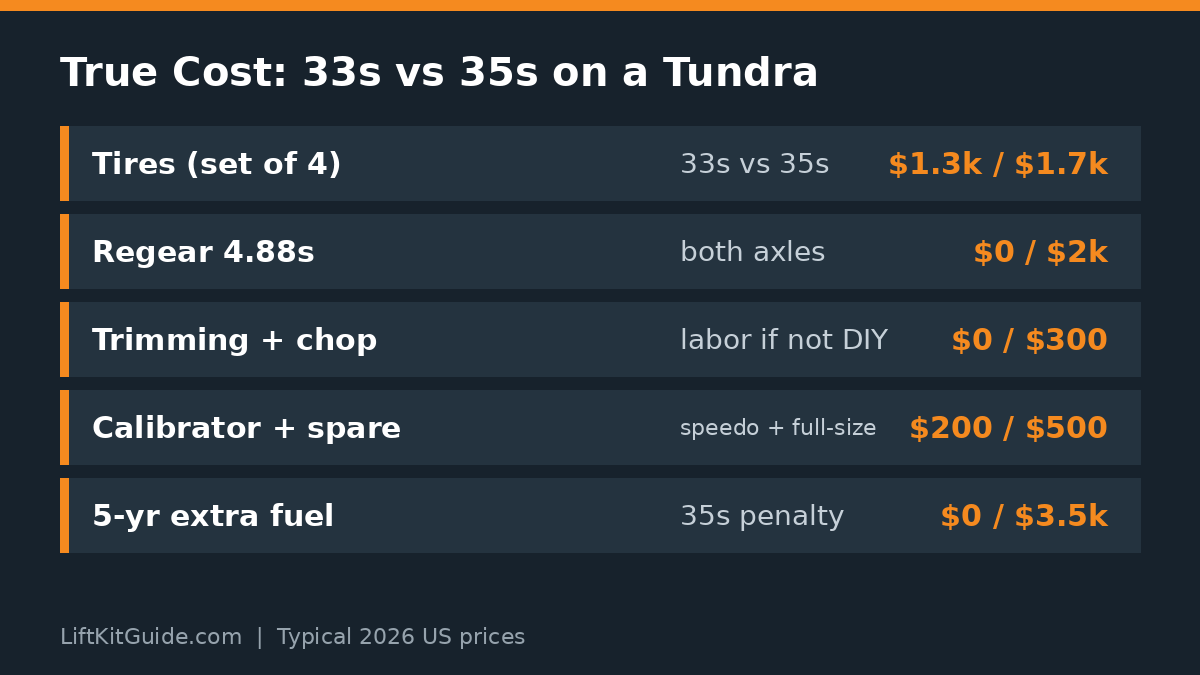
Tires are only the down payment. A set of four 35-inch all-terrains runs $1,400-$2,000 installed, but the supporting mods for 33s vs 35s on a Toyota Tundra tell the real story. Add $1,500-$2,500 for the regear, $200-$400 for fender chopping and trimming labor if you do not DIY, $150-$250 for the speedometer calibrator, and $300-$500 for a full-size spare. The realistic all-in number lands between $3,500 and $5,500 beyond what 33s would cost. Get itemized quotes in writing, since 35s project pricing varies wildly between shops.
Then there is the running cost nobody puts in the spreadsheet. At 4 MPG worse fuel economy and 15,000 miles a year, 35s burn roughly 200 extra gallons annually, which is $600-$800 a year at current prices. Over five years of ownership, fuel alone can exceed the entire initial modification budget. This is why the 33s camp talks about total cost of ownership rather than just purchase price. At $3.50 per gallon, the fuel penalty alone can top $700 every single year.
None of this means 35s are a bad choice, only that they are a committed one. Owners who go in with eyes open, budget the gears and trimming upfront, and actually use the clearance off-road report high satisfaction. The unhappy 35s owners are almost always the ones who bought tires first and discovered the supporting costs later. Price the whole project on paper before spending a dollar, using our cost to lift a truck guide as the budgeting framework.
Do not forget resale math in the 33s vs 35s on a Toyota Tundra calculation. A tastefully built truck on 33s appeals to the widest buyer pool, while 35s with chopping narrow your market to enthusiasts. If you might sell within a few years, the reversible 33s build typically returns more of your investment. Permanent mods only pay when you keep the truck long enough to enjoy them yourself. Talk to three owners who sold modified trucks before deciding how permanent to go.
| Cost item | 33s total | 35s total |
|---|---|---|
| Tires (set of 4) | $1,100-$1,500 | $1,400-$2,000 |
| Regear | $0 | $1,500-$2,500 |
| Trimming/chop labor | $0 | $0-$400 |
| Speedometer calibrator | $0-$150 | $150-$250 |
| Full-size spare | $0-$300 | $300-$500 |
| 5-year extra fuel | $0 | $3,000-$4,000 |
| Realistic total | $1,100-$1,950 | $6,350-$9,650 |
Can you fit 35s on a Tundra without chopping?
On a Tundra, fitting 35s without any chopping is possible but requires careful wheel and tire selection. The cab mount and front fender liner are the usual contact points, and owners who run 35×11.50s on mild-offset wheels with aftermarket upper control arms pushed for extra caster report clearing with only minor plastic trimming. Go to a full 35×12.50 on aggressive wheels and the chop becomes nearly unavoidable. Take photos of your clearances at full lock to document what actually touches and where.
The cab mount chop itself is straightforward for any competent welder: the mount gets cut back, plated, and repainted, typically for $150-$300. It is permanent, which gives some owners pause, but it is also the mod that unlocks every future tire choice. Once chopped, the truck clears 35s in any reasonable wheel combination, and the job is invisible once the liner goes back in. Most off-road shops that do lifts can handle the chop in the same appointment. Get quotes in writing.
If cutting the truck bothers you, that feeling is data. Sticking with 33s or the 295/70R18 middle ground avoids the chop entirely and keeps the truck 100 percent reversible. There is no shame in choosing the size that lets you sleep at night. The right tire is the one that fits your truck, your budget, and your comfort with permanent mods all at once. There is real wisdom in choosing the reversible path when you are unsure. Sleep on it first.
Aftermarket upper control arms change the 33s vs 35s on a Toyota Tundra fitment equation meaningfully. Quality UCAs add caster, which tilts the tire forward and away from the cab mount at full lock. Several owners report that UCAs alone eliminated their 35s rubbing without any chopping. If you are already buying UCAs for alignment reasons, test-fit the 35s after the install before scheduling the chop. A good alignment shop can dial in an extra degree of caster to help clearance further.
Is there a middle ground between 33s and 35s on a Tundra?
Yes, and experienced owners love it: 295/70R18 measures 34.3 inches tall, splitting the 33s vs 35s on a Toyota Tundra debate neatly in half. This size fits with minor trimming, usually needs no regear on the 5.7L, and costs less than true 35s while looking noticeably bigger than 33s. It is the enthusiast’s compromise that somehow satisfies almost everyone who tries it. This size has quietly become the default recommendation on Tundra forums for good reason. Ask for it by name at the tire shop.
The 295/70R18 works because it captures most of what people want from 35s, the stance and the clearance, with most of what they love about 33s, the drivability and cost. Owners report 14-16 MPG highway, no gear hunting, and speedometers only 3-4 percent off. Tire selection in this size has grown every year as its popularity spread through the Tundra community. Check load ratings carefully, since some 295/70R18s come in lighter-duty constructions. This is the size forum veterans recommend to newcomers most often.
Other middle-ground sizes exist for different wheels. On 17s, 285/75R17 (33.9 inches) plays the same role; on 20s, 295/60R20 (33.9 inches) does it with a wider footprint. The pattern is the same: stay under 34.5 inches and the truck stays happy. If you are on the fence, this is the fence to sit on. A quick check of our tune after bigger tires guide will also tell you whether the speedometer correction alone is enough at these in-between sizes.
33s vs 35s on a Toyota Tundra for towing: which wins?
For towing, 33s win the 33s vs 35s on a Toyota Tundra debate without much contest. Towing amplifies every downside of tall tires: the effective gearing loss hurts most under load, transmission temperatures run higher as the truck hunts gears, and the taller sidewall flexes more with tongue weight. Owners who tow travel trailers or boats on 35s overwhelmingly recommend regearing first, which tells you how much the stock gearing struggles. Transmission temperature gauges tell the real story on long grades with tall tires.
That said, 35s can tow acceptably with the right supporting mods. A regear to 4.88s or 5.29s restores the mechanical advantage, load range E tires control sidewall flex, and air bags or Timbren helpers manage the sag. Several owners tow 6,000-plus-pound trailers on 35s happily with this combination. The key insight is that 35s do not ruin towing, they just raise the price of towing well. A weight-distribution hitch with sway control matters even more once tires get taller. Plan accordingly.
If towing is the truck’s primary job, the smart money stays on 33s or the 295/70R18 middle ground. You keep stock-like pulling power, avoid the regear bill, and the truck stays composed on long grades. Save the 35s for the dedicated off-road toy. Your transmission will thank you with a longer life, and your fuel budget will stretch noticeably further on every trip. Your boat ramp manners will thank you for the shorter, more responsive tire. Keep this in mind when budgeting.
Which should you choose for your Tundra?
The decision comes down to honesty about use. A Tundra that commutes, hauls kids, and tows the boat twice a summer is a 33s truck, full stop. The money saved buys a lot of fuel and a lot of peace of mind. A Tundra that hits the trails monthly and turns heads the rest of the time earns its 35s, provided the owner budgets the gears and trimming upfront instead of discovering them later. Be brutally honest here and the rest of the decision makes itself.
Whichever you choose, buy quality rubber in the right load range and get the alignment done properly. Tires are the only part of the truck that touches the ground, so they deserve more thought than any other mod. Browse owner experiences in the Tundras.com 33s vs 35s thread to see both setups in the real world, and check our best lift kit brands ranking when you pair the tires with suspension. Keep your alignment specs in the glovebox.
One final piece of advice for the 33s vs 35s on a Toyota Tundra decision: drive both if you can. Find a local Tundra meet or club run and ask owners for a ride; ten minutes in the passenger seat teaches more than ten hours of forum reading. The right tire size is the one that makes you smile every time you walk up to the truck. Your future self will thank you for the ten minutes spent riding along.
- Choose 33s if: your Tundra is a daily driver, you tow regularly, or you want zero permanent mods and minimal extra cost.
- Choose 35s if: you off-road often, you accept the $4,000-$5,000 premium, and you will regear to 4.88s.
- Choose 295/70R18 if: you want the 35s look with 33s manners and are willing to do minor trimming.
- Regear with 35s if: the truck hunts gears on the highway or feels sluggish launching; 4.88s restore stock feel.
- Skip 35s if: fuel economy matters to you, since the 4+ MPG penalty costs thousands over the truck’s life.
Frequently asked questions
Do I need a lift to run 33s on a Tundra?
No. 33-inch tires fit a stock Tundra with no rubbing in most cases. A 2-inch level improves the stance and adds clearance margin, but it is not required for 33s. This is one of the reasons 33s are the easy button for Tundra owners.
What gear ratio is best for 35s on a Tundra?
4.88 gears are the sweet spot for 35s on a daily-driven Tundra, restoring near-stock cruise RPM and drivability. Go 5.29 if you tow heavy or off-road seriously. The RPM difference between 4.88 and 5.29 at highway speed is only about 150 RPM.
How much does it cost to regear a Tundra?
Regearing both axles on a Toyota Tundra costs $1,500-$2,500 at a reputable shop, including gears, install kits, and labor. 4WD trucks must regear front and rear together to keep the ratios matched. Budget this before buying 35-inch tires.
Will 35s void my Tundra warranty?
Not automatically. Under the Magnuson-Moss Warranty Act, Toyota must prove the modification caused the failure. That said, drivetrain claims on a regeared truck with 35s face real scrutiny, while unrelated claims like infotainment or paint remain covered.
What is the best all-around tire size for a Tundra?
For most owners, 285/70R17 or 275/65R20 (both ~33 inches) hit the sweet spot: no regear, minimal trimming, good MPG, and wide tire selection. If you want more, 295/70R18 (34.3 inches) is the enthusiast favorite middle ground.
Do heavier tires hurt more than taller tires?
Yes, according to owner testing. A 5-pound-per-tire weight drop improved one owner's daily driving feel and recovered 1 MPG even while going taller. When choosing between 33s and 35s, compare published tire weights, not just diameters.
The bottom line
In the 33s vs 35s on a Toyota Tundra debate, 33s are the rational daily-driver choice: cheaper, simpler, and kinder to fuel economy with zero permanent mods. The 295/70R18 middle ground exists for owners who want more stance without the full 35s commitment.
Choose 35s when the look and the off-road clearance justify roughly $5,000 extra and a regear, and go in with the full budget on paper first. Either way, the Tundra is a great truck that rewards thoughtful tire choices.



Leave a comment