


Last updated: October 2026 Written by the LiftKitGuide Team, truck suspension installers and editors
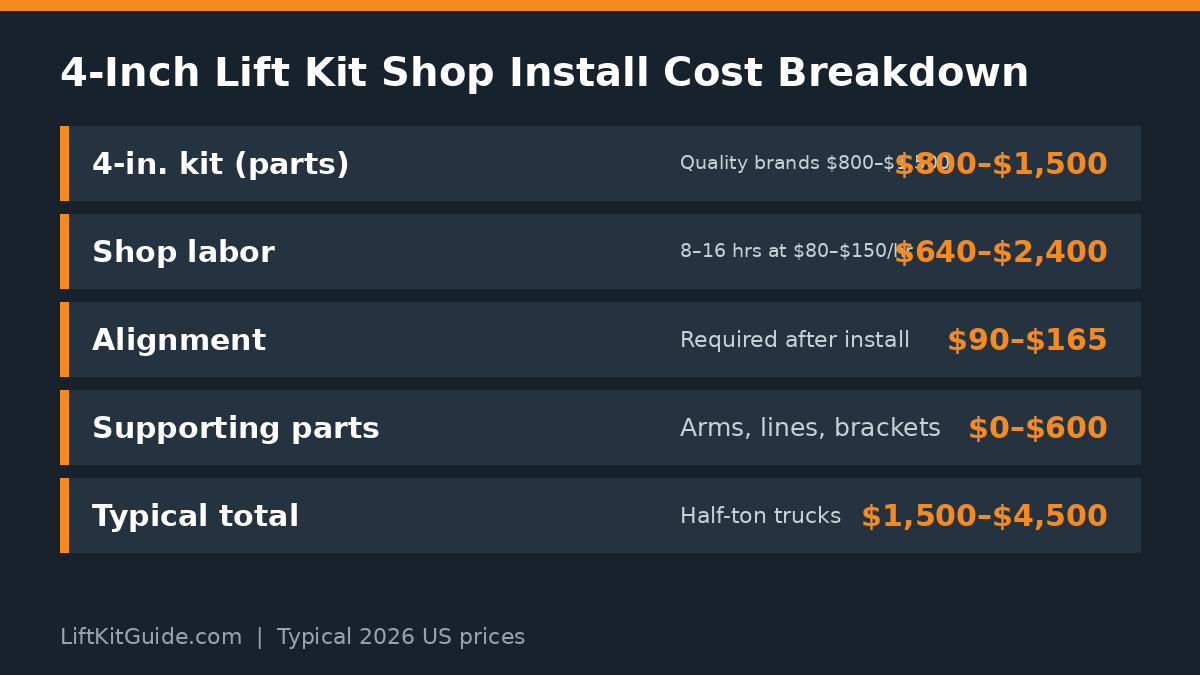
How much does it cost to install a 4 inch lift kit at a shop? In 2026, expect $1,500–$4,500 all-in for a 4-inch lift installed on a half-ton truck. The kit itself runs $800 to $1,500, and shop labor at $80 to $150 per hour over 8 to 16 hours adds $640 to $2,400. A 4-inch lift often needs control arms, brake-line work, and a wheel alignment ($90–$165) after the install. Trucks with rust, seized bolts, or worn suspension parts push the final bill toward the top of that range.
Key takeaways
- A 4-inch lift kit itself costs $800 to $1,500 for quality brands; budget kits exist but often skip geometry-correction parts.
- Shop labor runs $80 to $150 per hour, and a 4-inch lift takes 8 to 16 hours, so labor alone is $640 to $2,400.
- Typical all-in totals: $1,500 to $4,500 on half-ton trucks, higher on heavy-duty trucks and Jeeps.
- A post-install wheel alignment ($90–$165) is mandatory and is often billed separately from the install quote.
- Rust, seized bolts, and worn suspension parts are the top reasons real bills exceed the estimate.
On this page
How Much Does It Cost to Install a 4 Inch Lift Kit at a Shop?
How much does it cost to install a 4 inch lift kit at a shop? The honest 2026 answer for a half-ton truck is $1,500 to $4,500 all-in. That range covers a quality 4-inch kit at $800 to $1,500 in parts plus 8 to 16 hours of professional labor at $80 to $150 per hour. The question how much does it cost to install a 4 inch lift kit comes down to three buckets — parts, labor, and extras: a rust-free truck with a straightforward bracket kit and a rust-belt truck needing control arms and brake lines are two very different jobs.
The parts side of the bill is the easiest to pin down. Name-brand 4-inch suspension kits for popular trucks typically retail between $800 and $1,500, and that usually buys taller front struts or coilovers, rear lift blocks or an add-a-leaf, and basic geometry brackets. Kits under $600 exist, but they frequently skip the control arms, extended brake lines, and differential drop hardware that a true 4-inch lift needs — those parts show up later as separate charges on the shop invoice.
Labor is where quotes diverge. At $80 to $150 per hour, 8 to 16 hours of work puts labor alone between $640 and $2,400. Then add the non-negotiable extras: a wheel alignment at $90 to $165 and any supporting parts the inspection uncovers. Our broader guide to how much it costs to lift a truck puts these numbers in context with taller and shorter lifts, and the lift kit installation cost guide breaks down labor by kit type.
| Cost item | Typical 2026 range | Notes |
|---|---|---|
| 4-inch lift kit (parts) | $800–$1,500 | Quality brands; budget kits often skip correction parts |
| Shop labor (8–16 hrs) | $640–$2,400 | $80–$150/hr; rust and seized bolts add hours |
| Wheel alignment | $90–$165 | Mandatory after install; sometimes billed separately |
| Supporting parts | $0–$600 | Control arms, brake lines, drop brackets, hardware |
| Typical all-in total | $1,500–$4,500 | Half-ton trucks; HD trucks and Jeeps run higher |
What Does Professional Labor Actually Cover?
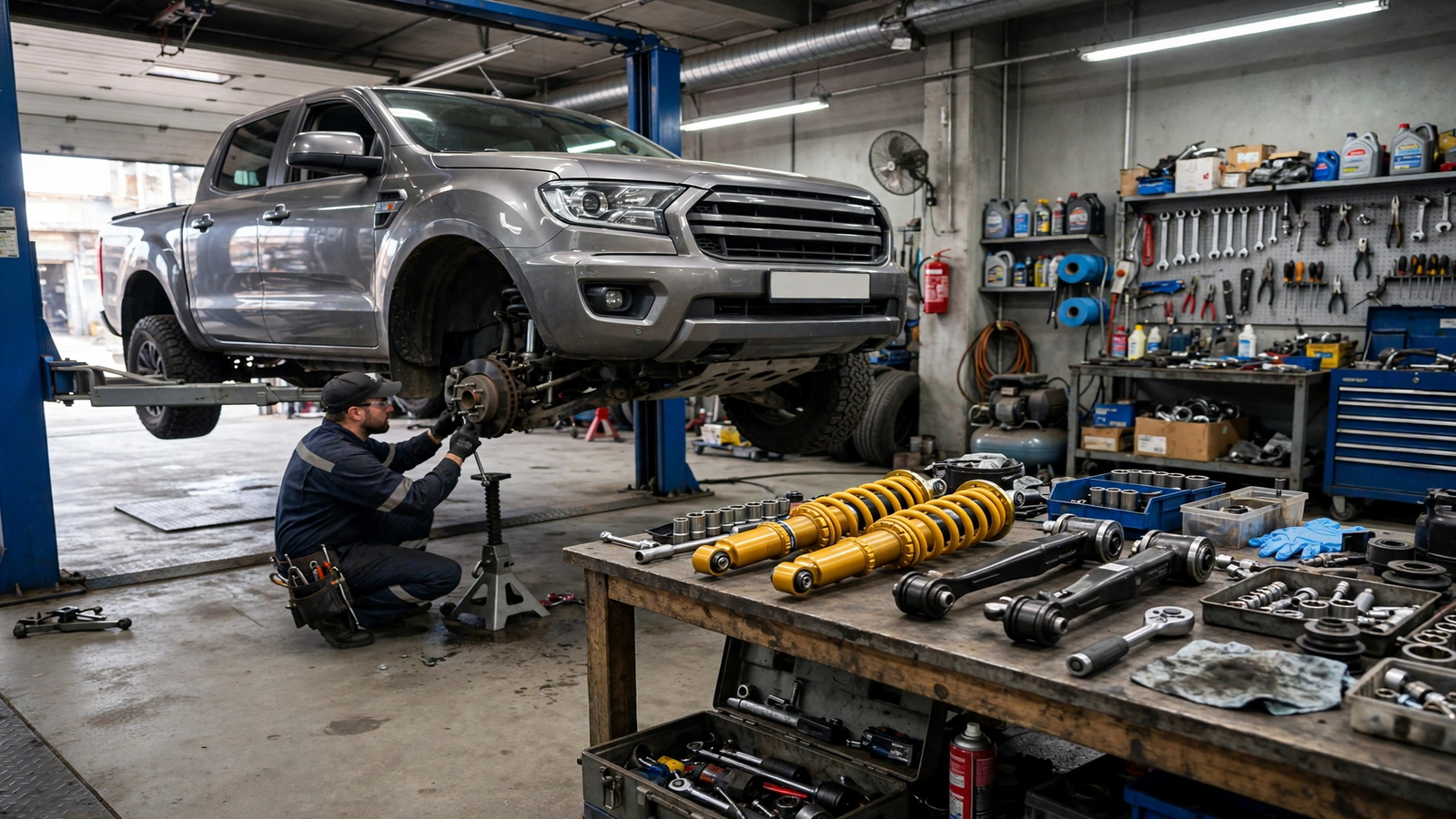
A 4-inch lift install is far more than bolting on taller springs. The technician disassembles the entire front suspension — struts, control arms, steering links, sway-bar connections, and often the front differential mounts — then reassembles everything around the new geometry. Brake lines get rerouted or replaced with extended lines, ABS wiring is checked for slack, and the rear gets blocks or new leaf hardware with fresh U-bolts torqued to spec. Skipped geometry work is the usual reason a quote looks impossibly cheap.
Geometry correction is the skilled part of the job. At 4 inches, the front differential usually needs drop brackets to keep CV axle angles livable, the track bar or steering needs recentering, and caster and camber have to be recoverable through the alignment. A good shop sets all of this deliberately instead of just making the truck sit tall; that precision work is a large share of the labor hours and the main difference between a cheap install and a correct one.
The final steps are the ones owners never see but always pay for: a full torque check on every fastener, a test drive to listen for clunks and check steering return, and the wheel alignment. Shops that do lifts regularly also inspect ball joints, tie-rod ends, and wheel bearings while everything is apart, because installing a $1,200 kit on worn steering parts is asking for a comeback. That inspection time is baked into the labor estimate. Good shops photograph worn parts before asking you to approve replacements.
When owners ask how much does it cost to install a 4 inch lift kit, the labor-coverage answer is what separates a $1,500 job from a $3,000 one. A thorough shop includes the full disassembly, geometry correction, torque verification, road test, and alignment in its quoted labor hours. A cheap quote often covers only the basic component swap and then bills the alignment, brake bleeding, and seized-bolt extraction as extras. Ask for the complete labor scope in writing before you compare any two prices.
| Labor phase | What happens | Why it takes time |
|---|---|---|
| Disassembly | Front and rear suspension, steering links, brake hardware removed | Rusted and seized fasteners slow this phase most |
| Geometry correction | Drop brackets, control arms, track-bar and steering recentering | Precision setup; every angle affects the next |
| Reassembly and torque | New components installed, every fastener torqued to spec | Hundreds of fasteners across two axles |
| Alignment and road test | Wheel alignment, steering check, noise and vibration check | Lifted geometry needs an experienced alignment tech |
How Many Shop Hours Does a 4-Inch Lift Take?
For a 4-inch suspension lift, professional shops typically book 8 to 16 hours of labor. A straightforward install on a newer half-ton truck with a well-engineered kit lands near 8 to 10 hours. Older trucks, heavy-duty models, and kits with extensive bracket work push toward 14 to 16 hours, and anything with significant rust can blow past the estimate entirely — seized hardware does not care about the book rate. That distinction decides who pays when rust stretches the job past book time.
Kit design drives the hour count more than most owners expect, and for anyone asking how much does it cost to install a 4 inch lift kit, hours are the biggest swing factor in the quote. A simple coilover-and-block 4-inch kit on a 2WD truck is near the low end, while a full bracket kit with differential drops, replacement knuckles, and rear lift springs is near the high end. Diesels add complexity, and 4x4s add front-drivetrain work. When a shop quotes hours, ask which kit they based it on.
Book time is also why phone quotes are unreliable. Two shops can quote the same truck hours apart because one assumes a clean install and the other budgets for the rust-belt reality. The suspension lift kit installation cost breakdown shows how hours scale with lift height, and our cost to lift a truck guide explains why labor is the least negotiable part of the bill. Always ask whether the quote is fixed or an estimate that can grow.
- Under 8 hours quoted: likely a leveling-kit-style shortcut or missing geometry work — ask what is excluded.
- 8–12 hours quoted: the normal range for a clean 4-inch install on a half-ton truck.
- Over 14 hours quoted: reasonable for HD trucks, heavy rust, or full bracket kits with driveline work.
- Open-ended hourly: acceptable for rust-belt trucks, but get a cap or check-in point in writing.
How Much Does It Cost to Install a 4 Inch Lift Kit at a Shop on Different Trucks?
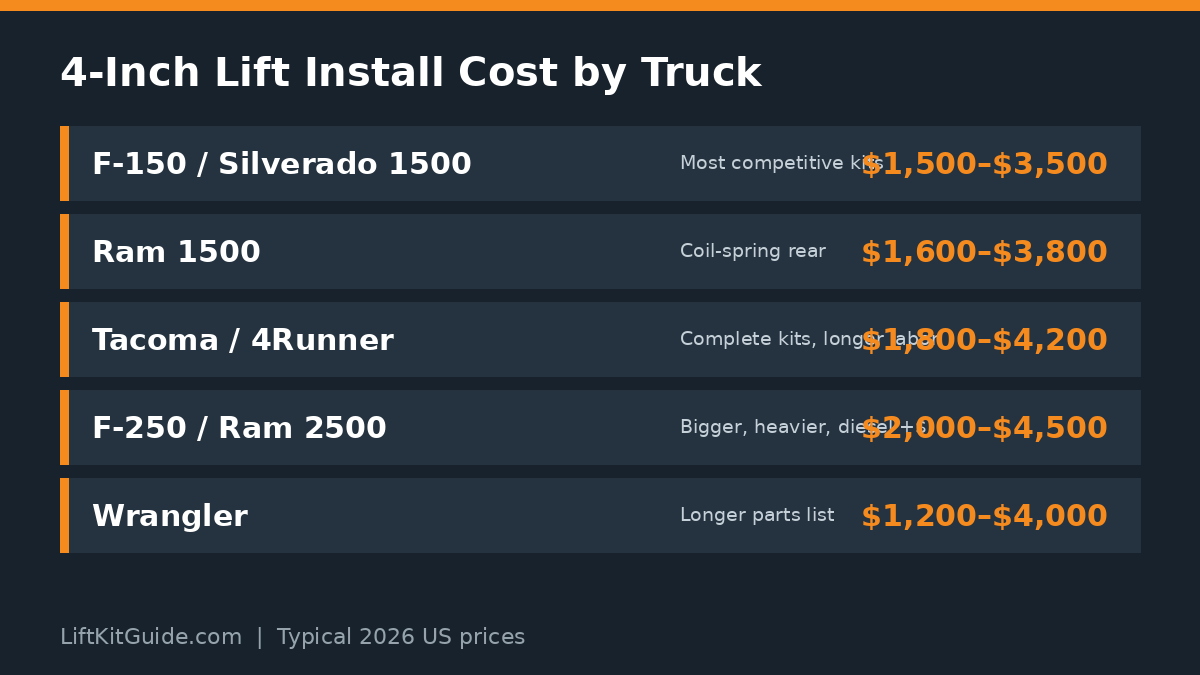
How much does it cost to install a 4 inch lift kit at a shop varies noticeably by truck. Full-size half-tons like the F-150 and Silverado 1500 sit in the sweet spot at $1,500 to $3,500 thanks to fierce kit competition and familiar shop labor — which is also why how much does it cost to install a 4 inch lift kit at a shop trends lowest on the most popular models. Midsize trucks like the Tacoma often run slightly higher at $1,800 to $4,200, since their 4-inch kits lean toward complete systems with control arms.
Heavy-duty trucks change the math. A 4-inch lift on an F-250 or Ram 2500 typically totals $2,000 to $4,500 because everything is bigger, heavier, and more time-consuming — and diesel front ends add both weight and cost. Jeeps are their own category: a 4-inch Wrangler lift often runs $1,200 to $4,000 installed, but the parts list is longer at the same height, with more steering and driveline correction involved than a pickup needs. Heavier components also mean longer, more careful work under the truck.
Drivetrain matters within the same model. A 2WD truck skips the front-differential drop work that a 4×4 requires, which can save two or more labor hours. Cab configuration barely matters, but trim does: trucks with adaptive dampers, air suspension, or advanced driver-assistance cameras need extra calibration steps that base trims skip. Mention your exact trim when getting quotes so the shop prices the truck you actually own, since details like adaptive dampers or air suspension change the labor involved. Exact trim and drivetrain details keep the quote honest right from the start.
| Truck | Typical installed total | Why |
|---|---|---|
| F-150 / Silverado 1500 | $1,500–$3,500 | Huge kit support; shops know them well |
| Ram 1500 | $1,600–$3,800 | Coil-spring rear adds parts; similar labor |
| Tacoma / 4Runner | $1,800–$4,200 | Complete kits with UCAs; longer installs |
| F-250 / Ram 2500 | $2,000–$4,500 | Bigger, heavier; diesel adds cost |
| Wrangler | $1,200–$4,000 | Longer parts list; more driveline work |
What Extra Parts Can Push Your Final Bill Higher?
The kit box is rarely the whole parts story at 4 inches. Upper control arms are the most common add-on: factory arms run out of alignment adjustment and ball-joint angle at this height, and a quality aftermarket pair costs $400 to $1,000 installed. Extended brake lines are next — factory lines can go taut at full droop after a 4-inch lift, and stainless extended lines run $100 to $300 plus the labor to bleed the system. Skipping them now often means paying for a second alignment later.
Driveline parts follow. Trucks with two-piece driveshafts may need a carrier bearing drop kit ($50–$150), and 4x4s sometimes need differential drop brackets if the kit does not include them. If the inspection finds worn ball joints, tie-rod ends, or tired shocks, a responsible shop will flag them, because aligning a lifted truck on worn steering parts is wasted money. These discoveries are the classic source of estimate-to-invoice growth. A small contingency fund keeps these surprises from wrecking your overall budget.
Then there is everything the lift enables. Most owners add larger tires and wheels to fill the new wheel wells — $1,000 to $3,000 for the set — and bigger tires can demand speedometer recalibration ($75–$200) and eventually regearing ($800–$2,000 per axle). None of that is the shop’s install quote, but it is part of the real project cost. The upper control arm guide explains when arms become mandatory, and what a leveling kit is shows the cheaper alternative if the full 4-inch budget stings.
This is also where how much does it cost to install a 4 inch lift kit becomes a moving target. A quote that assumes your ball joints, tie-rod ends, and shocks are healthy can grow by $400 to $1,000 once the truck is on the lift and the technician finds worn parts that should not be reused. Ask the shop to inspect the front end before quoting, or at minimum to call you with a revised number before replacing anything outside the agreed scope of work.
Can You Save Money With a DIY 4-Inch Lift Install?
You can, and many owners do — the $640 to $2,400 in shop labor is real money. But a 4-inch suspension lift is a serious weekend-plus project, not a Saturday bolt-on. Realistic DIY time is one to two full weekends for a first-timer, and you need a heavy-duty floor jack, tall rated jack stands, a quality torque wrench, and usually a spring compressor. Renting or buying that equipment eats into the savings on your first lift. Consumables like brake fluid and thread locker add up on a first DIY job.
The risk side of DIY is what the forums gloss over. Suspension fasteners have specific torque values, and under-torqued control-arm or track-bar bolts can loosen with dangerous results. Brake-line work introduces air that must be fully bled, and steering geometry mistakes create handling problems that feel fine at parking-lot speed and terrifying at highway speed. If any step feels unfamiliar, that is the step to pay a professional for. Highway-speed mistakes have consequences that no online tutorial can undo afterward.
The balanced approach many experienced owners take is hybrid: do the straightforward disassembly and reassembly yourself, then pay a shop for the alignment and a safety inspection of your work. You still need the $90 to $165 alignment regardless — there is no DIY substitute for a calibrated alignment rack. And honestly assess your truck: a rust-free 3-year-old truck is a reasonable DIY candidate, while a 12-year-old rust-belt truck with seized hardware is a shop job. Most owners find that hybrid route the best balance of savings and safety.
The DIY math only works if you value your time modestly and already own the heavy tools. Once you price a spring compressor rental, new jack stands, and the mandatory $90 to $165 alignment, the real DIY saving on how much does it cost to install a 4 inch lift kit shrinks to the labor portion minus your equipment costs. For a straightforward truck that saving is still $500 to $1,500, which is worth it for experienced wrench-turners but questionable for first-timers learning on their daily driver.
- DIY makes sense when: the truck is rust-free, you own or can borrow the right tools, and you have a full weekend plus a backup plan.
- Pay a shop when: fasteners are corroded, the kit needs cutting or welding, or you have never touched suspension before.
- Always pay for: the post-install alignment and a professional torque check if you did the work yourself.
Does a Shop Install Quote Usually Include the Alignment?
Sometimes — but do not assume it. Many shops quote the lift install and the wheel alignment as separate line items, with the alignment adding $90 to $165. A quote that bundles the alignment is usually the better value, since the truck needs it immediately and you avoid a second appointment. Ask the question explicitly before approving any work: “Does this include the alignment?” A vague or evasive answer there is a real red flag about the shop’s actual lift experience.
The alignment is non-negotiable after a 4-inch lift, not an upsell. Raising the suspension 4 inches radically changes toe, camber, and caster, and driving even a few hundred miles on the new geometry with the old alignment will feather expensive tires fast — that premature tire bill is the hidden answer to how much does it cost to install a 4 inch lift kit when the alignment gets skipped. On a truck wearing $1,500 worth of 35s, skipping a $120 alignment is spectacularly false economy.
What the alignment includes matters too. A basic alignment sets toe and gets camber and caster within spec using factory adjustments. A lifted truck sometimes needs more — aftermarket control arms or camber kits to bring angles back into range — and that is extra parts and labor beyond the alignment fee. Ask whether the shop aligns lifted trucks regularly; a tech who only does stock commuter cars may struggle with modified geometry and aftermarket adjustment points. Written coverage prevents the most common billing disputes on modified trucks.
How Should You Compare Quotes From Different Shops?
Compare line items, not bottom lines. Two quotes can differ by $1,000 while describing the same job, because one includes the alignment, control arms, and shop supplies while the other covers kit-plus-labor only. Ask every shop for the same breakdown: parts total, labor hours, hourly rate, alignment cost, and which supporting parts are included. The cheapest total with the thinnest breakdown is usually the most expensive quote in disguise. A simple comparison sheet makes the real differences obvious very fast.
Shop selection matters as much as the numbers. A 4×4 specialty shop that installs lifts weekly will quote accurately and finish faster than a general repair shop doing its third lift this year. Ask how many lifts they install monthly, whether the labor is warrantied, and what happens if they discover worn parts mid-job. A shop that answers confidently is worth $200 more than one that hems and haws. Confidence on those answers is worth more than a small discount elsewhere.
Finally, get the warranty terms in writing. Reputable shops warranty their labor — typically 12 months or 12,000 miles — and will recheck torque and alignment if a vibration or pull appears in the first weeks. That warranty is part of what the labor rate buys. A rock-bottom quote with no labor warranty is not a deal; it is a gamble where you hold all the risk. Without it in writing, a cheap install can become an expensive argument later.
Frequently asked questions
How much does it cost to install a 4 inch lift kit at a shop for an F-150?
On a Ford F-150, plan on $1,500 to $3,500 all-in for most 4-inch kits. The F-150 has huge kit support so parts are competitive, but 4×4 models can add labor time for differential drop brackets and alignment correction.
How long does a 4-inch lift install take at a shop?
A professional shop typically needs 8 to 16 hours for a 4-inch suspension lift, usually one to two full days. Rust, seized hardware, or kits needing drop brackets push toward the long end.
Can I install a 4-inch lift kit myself to save money?
Yes, many owners do, but a 4-inch lift is a full-weekend-plus project needing a floor jack, jack stands, torque wrench, and often a spring compressor. You save labor but still need a professional alignment afterward.
Does the install price include a wheel alignment?
Sometimes, but often the alignment is a separate line item of $90 to $165. Always ask before approving. A quote bundling the alignment is usually the better deal.
Why do 4-inch lift install quotes vary so much?
Quotes vary because shops define the job differently — one may be kit-plus-labor only while another includes control arms, brake lines, and alignment. Truck condition matters too. Compare itemized line items, not totals.
Is a 4-inch lift harder to install than a leveling kit?
Yes, substantially. A leveling kit is a 3- to 4-hour job mostly touching front struts, while a 4-inch lift disassembles the whole suspension and corrects geometry. That is why leveling installs run $400–$800 versus $1,500–$4,500 for 4-inch lifts.
The bottom line
A 4-inch lift is one of the most popular heights because it clears 33- to 35-inch tires and transforms a truck’s stance without going full bracket-lift extreme, but it is also the point where installation stops being simple. Budget $1,500 to $4,500 all-in for a professional shop install on a half-ton truck, and treat any quote far below that as a warning sign that something important has been left out of the estimate.
The smartest money move is an itemized quote that separates parts, labor hours, alignment, and supporting parts, plus a labor warranty from a shop that aligns lifted trucks every week. Get three quotes, ask what happens if rusted bolts snap or factory parts are worn, and you will land within a few hundred dollars of the true price before anyone touches a wrench.



Leave a comment