


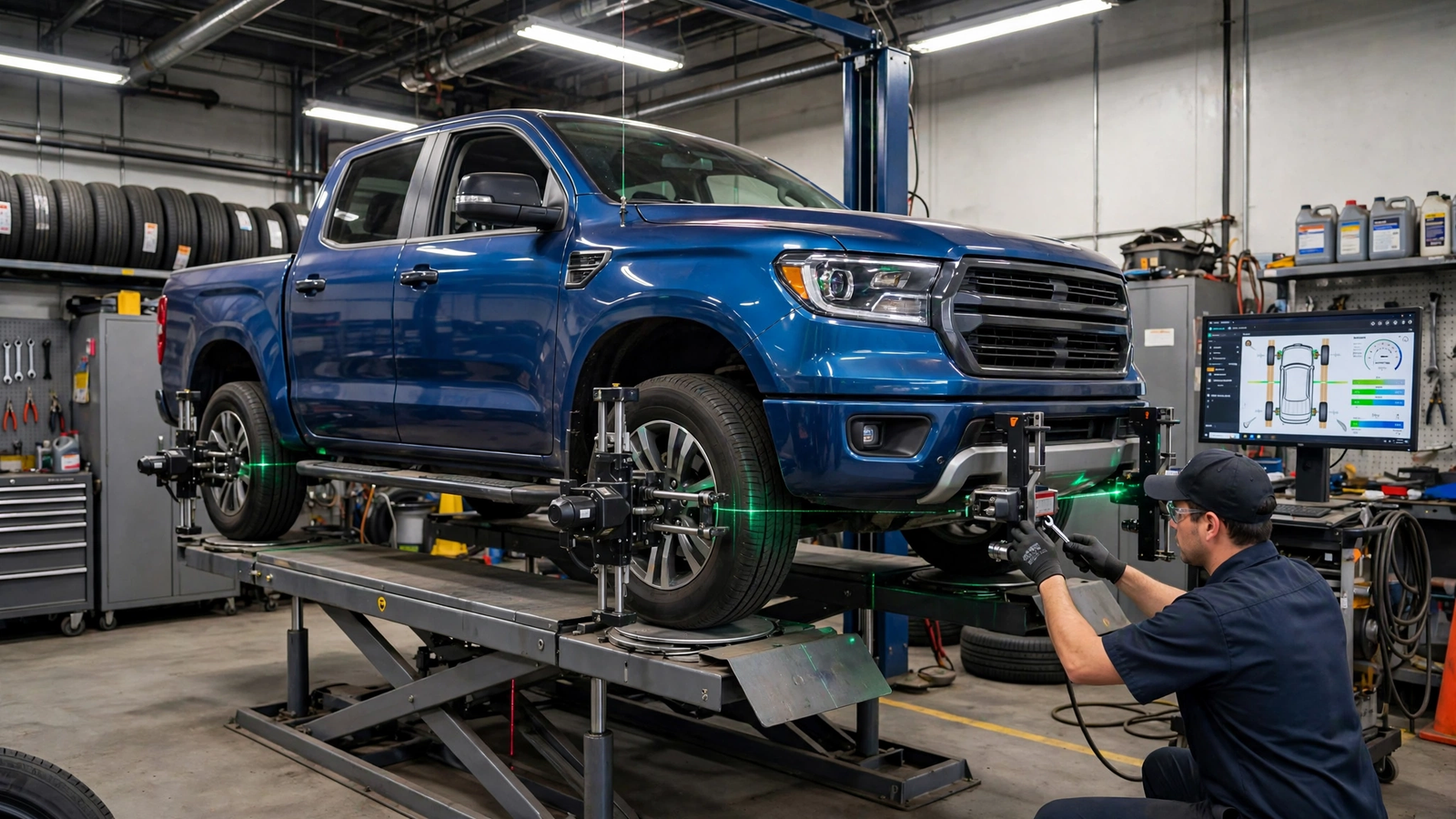
Last updated: October 2026 Written by the LiftKitGuide Team, truck suspension installers and editors
Do I need an alignment after installing a leveling kit? Yes — on any truck with independent front suspension, a wheel alignment is strongly recommended immediately after a leveling kit install. Raising the front 1.5 to 2.5 inches changes toe by nearly a degree per side and shifts camber, which will chew through tires surprisingly fast. The alignment costs $75 to $150, far less than a premature set of tires. The main exception is solid front-axle trucks, which typically only need the steering wheel recentered.
Key takeaways
- Yes — every independent-front-suspension truck needs an alignment immediately after a leveling kit install.
- A level changes toe by nearly 1 degree per side, which destroys tires fast if uncorrected.
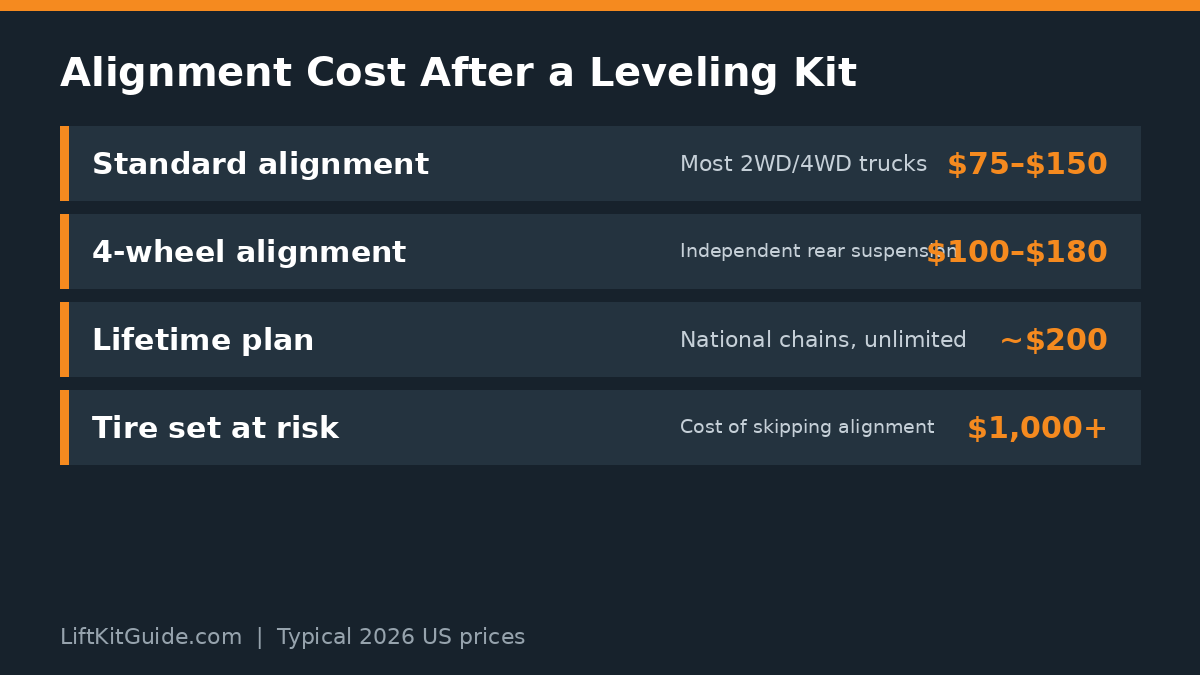
- A standard alignment costs $75 to $150; four-wheel alignments run $100 to $180.
- Solid front-axle trucks are the exception: usually just recenter the steering wheel via the drag link.
- Skipping the alignment risks a $1,000+ premature tire replacement — the alignment is cheap insurance.
On this page
Do I Need an Alignment After Installing a Leveling Kit?
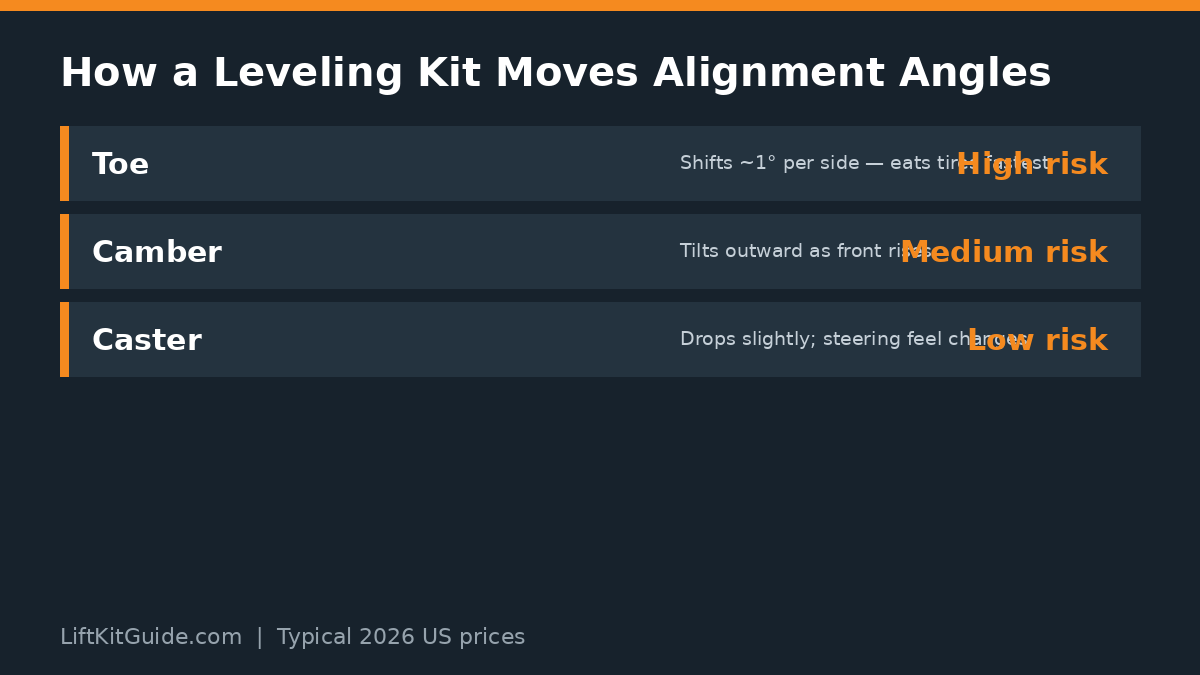
Do I need an alignment after installing a leveling kit? For the overwhelming majority of trucks — every one with independent front suspension — the answer is an unequivocal yes. Raising the front end 1.5 to 2.5 inches rotates the entire steering geometry: toe shifts by nearly a full degree per side, camber tilts outward, and caster drops. None of this is visible to the eye, but your tires feel it immediately, and the wear starts on the very first drive.
The reason is simple physics. Control arms are fixed-length links, so when a leveling kit pushes the wheel downward relative to the body, the wheel has to swing through an arc that changes its angles. Toe is the killer: even half a degree of excess toe-in or toe-out per side scrubs the tread sideways with every revolution. That is why every leveling kit manufacturer prints “alignment required” in the installation instructions — it is not a suggestion. That arc is exactly why do I need an alignment after installing a leveling kit is always answered yes for IFS trucks — the new angles must be measured and reset.
The cost math makes the decision easy. A professional alignment runs $75 to $150, while a set of all-terrain tires for a leveled truck easily tops $1,000. Our leveling kit guide covers what the kit itself does, and the leveling kit cost breakdown shows where the alignment fits in the total project budget. Skipping the alignment to save $120 while risking $1,200 in tires is the worst trade in truck modification. Most shops include a before-and-after printout, so ask to see the numbers rather than taking the technician’s word for it.
| Alignment angle | What a level does to it | Why it matters |
|---|---|---|
| Toe | Shifts ~1° per side | Fastest tire killer; causes feathering and pull |
| Camber | Tilts outward as front rises | Uneven inner/outer edge wear |
| Caster | Drops slightly | Steering feel, straight-line stability, return-to-center |
How Does a Leveling Kit Change Your Alignment?
A leveling kit changes alignment because it changes where the suspension sits in its travel. Your truck’s alignment was set at factory ride height, with the control arms at a specific angle. Push the front up 2 inches and the arms droop, the tie rods pull the wheels into a new toe position, and the fixed-length arms force the camber outward. The truck now sits at a ride height the factory alignment specs never anticipated. Factory specs assume factory height, so any change to ride height invalidates the alignment the truck left the dealership with.
Toe takes the biggest hit and does the most damage. Technicians and forum veterans consistently report toe moving close to a full degree per side after a typical 2-inch level — and toe wear is ruthless because the tire is dragged sideways slightly on every single rotation. A truck can look perfectly fine and drive acceptably while its front tires are being feathered into an early grave. Owners who skip the alignment over do I need an alignment after installing a leveling kit doubts usually discover the feathering only when the tires start humming on the highway.
Camber and caster move less dramatically but still matter. Added positive camber wears the outer tread edge, while reduced caster makes the steering feel lighter and less willing to track straight or return to center after a turn. This is exactly why the question do I need an alignment after installing a leveling kit is really a question about all three angles, not just the one you can feel in the steering wheel. Even small caster changes are noticeable to sensitive drivers, especially in crosswinds or on grooved concrete highways.
Do I Need an Alignment After Installing a Leveling Kit on a Solid-Axle Truck?
Do I need an alignment after installing a leveling kit on a solid front axle? Usually not a full alignment — and this is the one genuine exception to the rule. On a solid-axle truck like a Ford Super Duty or Ram 2500/3500, the axle is a rigid beam: raising it with a leveling spacer does not change camber or toe the way it does on independent suspension, because there are no control arms swinging through arcs. The beam simply moves up as a unit, which is why the alignment angles survive the change intact.
What does change is the steering wheel position. The drag link geometry shifts slightly with ride height, so the wheel may sit a few degrees off-center when driving straight. The fix is a simple drag-link adjustment that any shop — or a competent DIY owner — can do in minutes. Some solid-axle trucks also benefit from a caster check, since leveling can reduce caster enough to affect highway manners, and many leveling kits include caster correction shims for exactly this reason.
Even so, a quick alignment check is cheap peace of mind. If your solid-axle truck drives straight with a centered wheel and even tire wear after a few hundred miles, you are fine. But if anything feels off — wandering, a crooked wheel, uneven wear — get it on the rack. The leveling kit vs lift kit comparison explains which suspension designs each kit type suits best. A $50 alignment check beats a $1,000 tire surprise every single time.
| Suspension type | Alignment needed after level? | What to do |
|---|---|---|
| Independent front (most 1500s, Tacoma, etc.) | Yes — full alignment | Align immediately; check toe, camber, caster |
| Solid front axle (Super Duty, Ram HD) | Usually not full alignment | Recenter steering wheel via drag link; check caster |
| Independent rear suspension | Yes — 4-wheel alignment | Rear geometry moves too; needs rear adjustment |
What Happens If You Skip the Alignment?
Skip the alignment and the first thing you lose is tire life. Excess toe from an unaligned level feathers the tread — you can feel the sawtooth edges by running your hand across the tire — and a set of front tires can go from new to noisy and half-worn in as little as 10,000 to 15,000 miles. On 33s or 35s that wear pattern also gets loud, adding a drone that no rotation will fix once the feathering sets in.
Handling degrades in ways that feel normal until you drive a properly aligned truck. The steering may pull slightly, the wheel sits off-center, and the truck needs constant small corrections on the highway. In an emergency maneuver, a misaligned truck can respond unpredictably right when you need precision most. None of this announces itself dramatically — it just slowly makes the truck worse to drive. The vagueness creeps in gradually, which is why many owners do not connect it to the leveling kit they installed months earlier.
Then there is the money. Do I need an alignment after installing a leveling kit is ultimately a $120 question versus a $1,200 question: the alignment costs $75 to $150 once, while premature tire replacement, extra fuel from rolling resistance, and accelerated ball-joint and tie-rod wear cost far more over time. Every mile driven unaligned is a mile of uneven wear you cannot undo. Catch it early and the fix is a $120 alignment; catch it late and the fix is $120 plus two new front tires.
| If you skip it | What it costs you | Timeline |
|---|---|---|
| Feathered front tires | $500–$1,200 early replacement | 10,000–15,000 miles |
| Constant steering correction | Driver fatigue, unpredictable handling | Immediate |
| Extra rolling resistance | 2–5% worse fuel economy | Ongoing |
| Worn steering components | $300–$800 in parts | 20,000–40,000 miles |
How Soon After the Install Should You Get Aligned?
Immediately — as in, drive straight from the install to the alignment rack. Every mile on fresh leveling geometry with the old alignment is a mile of uneven tire wear, and toe wear in particular starts instantly. If you installed the kit yourself on a Saturday, book the alignment for Monday morning and keep the weekend driving to an absolute minimum. The cheapest answer to do I need an alignment after installing a leveling kit is to book the rack before the tires tell you that you waited too long.
The drive to the shop deserves some care. Avoid potholes, hard cornering, and highway speeds if you can; the goal is to get the truck aligned before the tires develop any wear pattern at all. Make sure every suspension fastener is torqued to spec before that drive, because a loose control-arm bolt will move during the trip and invalidate the alignment you are about to pay for. Keep weekend driving minimal and avoid loading the bed heavily, since extra weight changes the loaded alignment slightly.
One more timing tip: do the alignment after the leveling kit but before any long road trip or new tire purchase. Aligning on worn tires gives slightly less accurate results, so the ideal sequence is level, align, then mount fresh rubber. If new tires are part of the project, the lift kit installation cost guide helps you sequence the whole job without paying twice. Skipping this sequence is how owners end up paying for an alignment twice — or for tires once, which costs far more.
What Does the Alignment Shop Actually Adjust?
On an independent-front-suspension truck, the technician adjusts three angles: toe via the tie rods, camber via factory eccentrics or aftermarket cam kits, and caster the same way. Toe is set first because it has the biggest effect on tire wear, then camber and caster are brought into spec. The whole job typically takes 45 to 90 minutes on a modern alignment rack. If you are still wondering do I need an alignment after installing a leveling kit at this point, the before-and-after printout settles it — numbers do not bluff.
Do I need an alignment after installing a leveling kit even if the shop says the readings look close? Yes — “close” on a printout still means measurable toe error, and toe error is what eats tires. Ask for the before-and-after printout and check that toe is at or near zero total, camber is within the factory range, and caster is even side to side. A good tech will walk you through the numbers without being asked. Ten minutes of attention here prevents months of arguing with a shop about whether the alignment was done right.
Sometimes the factory adjustments run out. If camber or caster cannot be brought into spec with stock hardware after a 2.5-inch level, the shop may recommend aftermarket cam bolts or adjustable control arms. That is normal on taller levels, not a sign of a problem — it just means the geometry moved further than the factory slots allow. Budget $50 to $150 extra if correction hardware is needed. Some trucks need aftermarket cam bolts at this stage, which is a normal consequence of taller levels rather than a shop upsell.
| Adjustment | How it is set | Typical time |
|---|---|---|
| Toe | Tie-rod ends | 15–20 minutes |
| Camber | Factory eccentrics or cam bolts | 15–25 minutes |
| Caster | Eccentrics or control-arm shims | 15–25 minutes |
| Steering wheel center | Drag link or tie-rod trim | 5–10 minutes |
Can You Check Alignment at Home After a Level?
You cannot perform a real alignment at home — that takes a calibrated rack — but you can absolutely spot the warning signs. The hand-across-the-tread test is the classic: smooth in both directions means the toe is reasonable, while a sawtooth texture you can feel catching your palm in one direction means the tires are being scrubbed. Check this weekly for the first month after any suspension change. A bright flashlight and five minutes in the driveway can reveal feathering long before it becomes audible.
The steering wheel tells its own story. If it sits off-center when the truck tracks straight, the geometry moved during the install. If the truck pulls to one side on a flat road, something is out — though first rule out tire pressure and road crown, which fool a lot of owners into suspecting alignment. Do I need an alignment after installing a leveling kit is easy to answer yourself when two or more of these symptoms show up together.
The honest home verdict: these checks tell you whether you have a problem, never whether you do not. A truck can be measurably out of spec while driving acceptably, quietly wearing its tires the whole time. Home checks are a supplement to the professional alignment, never a substitute — especially in the first weeks after the install when the geometry is newest. Set a weekly phone reminder for the first month, because early detection is the whole point of these checks.
- Feathered tread edges: run your hand across the tread — sawtooth texture means toe is off.
- Crooked steering wheel: driving straight but the wheel sits off-center means geometry moved.
- Pulling or drifting: the truck needs constant correction to hold a lane.
- Uneven wear: one edge of the tire wearing faster than the other points to camber.
- Vague steering: wandering or no return-to-center suggests caster dropped too far.
Do You Need Another Alignment After Bigger Tires?
New tires alone do not change alignment angles, so mounting bigger rubber after your level does not automatically demand another alignment. If the truck was aligned right after the leveling kit and nothing in the suspension has been touched since, the angles are still where the technician set them. The tires are just along for the ride. That is also why do I need an alignment after installing a leveling kit gets asked again with every new tire purchase — owners want to protect the investment.
That said, there are two good reasons to recheck. First, larger and heavier tires amplify the effects of small alignment errors — a quarter-degree of toe that was harmless on stock tires wears 35s noticeably faster. Second, most owners install bigger tires weeks or months after the level, and potholes, curb hits, and off-road miles in between can knock things out. A quick alignment check with new tires is cheap insurance on a $1,200 rubber investment. Pothole season alone justifies the recheck habit for anyone running expensive all-terrains.
The smart sequence for a full leveled-truck build is: install the leveling kit, align immediately, then mount the bigger tires and get a free alignment recheck if your shop offers one — many lifetime plans include it. Our warranty guide covers whether the level itself affects your factory coverage, and suspension lift kits explained walks through the next step up if a level stops being enough. Think of the alignment as part of the tire purchase, not an optional add-on to it.
Frequently asked questions
Do I need an alignment after installing a leveling kit myself?
Yes. The answer is the same whether you installed it yourself or paid a shop: any change to front ride height moves the alignment angles. Drive gently to an alignment shop as soon as the install is done.
How much does an alignment cost after a leveling kit?
Usually $75 to $150 for a standard front-end alignment. Four-wheel alignments run $100 to $180. Specialty off-road shops may charge $150 to $250 for modified geometry.
Can I skip the alignment on a solid-axle truck?
It can, but the truck still benefits from a check. On a solid front axle the main adjustment is recentering the steering wheel via the drag link; some trucks need a caster correction too.
What are the signs my truck needs an alignment after a level?
Uneven or feathered tire wear is the first sign, followed by pulling to one side or a crooked steering wheel. Vague highway handling also points to moved alignment angles.
Does a leveling kit require tire balancing instead of an alignment?
No. Leveling changes alignment angles, not tire balance. Alignment addresses wheel angles; balancing addresses vibration from the wheel-tire assembly. You need an alignment after a level.
Is a lifetime alignment plan worth it?
Yes, it is one of the best values in truck maintenance. A lifetime plan from a national chain costs around $200 and covers free realignments as long as you own the truck.
The bottom line
A leveling kit is one of the cheapest, most satisfying truck mods, but skipping the $75 to $150 alignment afterward is the classic way to turn a $300 project into a $1,300 tire bill. On independent-front-suspension trucks the answer is always yes: align it immediately, and tell the shop about the leveling kit so they check camber and caster against the new ride height.
Solid-axle truck owners get the easy version — recenter the steering wheel, verify caster, and drive on. For everyone else, the alignment is not an upsell; it is the final step of the installation. Budget it into the project from the start and your leveled truck will drive straight and wear its tires evenly for years.



Leave a comment